Treatment Options for Dental Implant Infection in McKees Rocks PA
If you have invested time, money, and hope into dental implants, the last thing you want to hear is that one of them might be infected. But here is the honest truth: dental implant infections are more common than many people realize. The good news? They are also highly treatable, especially when caught early.
Living in McKees Rocks PA, you have access to solid dental care options. However, knowing what to expect before you even call a dentist can make all the difference. This guide walks you through every realistic treatment option for a dental implant infection, from simple office visits to more advanced procedures. No fear tactics. No unrealistic promises. Just clear, helpful information you can actually use.
Let us start with the most important question.
What Exactly Is a Dental Implant Infection?
A dental implant infection is medically known as peri-implantitis. Think of it as a more advanced version of gum disease, but one that affects the tissue and bone around a dental implant instead of a natural tooth.
In a healthy mouth, your gum tissue fits snugly around the implant, just like it would around a natural tooth. When bacteria build up, they cause inflammation. If that inflammation is not addressed, it spreads deeper, eventually affecting the bone that holds the implant in place.
Note to readers: Peri-implantitis does not happen overnight. It usually develops over months or even years. That is why regular checkups in McKees Rocks PA are so valuable.
Early Stage: Peri-Implant Mucositis
Before we talk about full-blown infections, it helps to understand the early warning stage. Peri-implant mucositis is the reversible form of the disease. The gums appear red, swollen, and may bleed when you brush or floss. However, the bone around the implant remains unaffected.
At this point, treatment is straightforward and highly successful.
Late Stage: Peri-Implantitis
Once bone loss begins, you have moved into peri-implantitis. This stage is not reversible in the sense that lost bone does not grow back on its own. But with proper treatment, we can stop the infection from progressing and preserve the remaining bone.
Common signs include:
- Bleeding when probing around the implant
- Deep pockets around the implant (measured by your dentist)
- Pus or discharge from the gum line
- Bad taste in your mouth or persistent bad breath
- Loosening of the implant (in advanced cases)
Why Do Dental Implant Infections Happen?
Understanding the cause helps you choose the right treatment and prevent future problems. In McKees Rocks PA, the most common causes include:
Poor Oral Hygiene
Dental implants do not decay like natural teeth, but the gums and bone around them are still vulnerable. If you skip brushing, flossing, or regular cleanings, bacteria accumulate.
Smoking or Tobacco Use
Tobacco significantly reduces blood flow to the gums. Lower blood flow means slower healing and a much higher risk of infection.
Untreated Gum Disease Elsewhere in the Mouth
If other teeth still have active gum disease, that bacteria spreads easily to your implant.
History of Periodontal Disease
Even if your gum disease was treated before your implant placement, your risk remains higher than someone who never had gum disease.
Poor Implant Placement or Restoration Fit
Sometimes the cause is mechanical. If the crown does not fit properly, or if the implant was placed at an awkward angle, cleaning becomes difficult, and bacteria thrive in hard-to-reach areas.
Underlying Health Conditions
Diabetes, autoimmune disorders, and certain medications can lower your body’s ability to fight infection.
First Steps: What to Do If You Suspect an Infection
You notice bleeding, swelling, or a strange taste. Now what? Here is a simple action plan.
Step one: Do not panic. Most implant infections can be treated successfully, especially if you act quickly.
Step two: Schedule an appointment with a dentist in McKees Rocks PA who has experience treating peri-implantitis. Not every general dentist feels comfortable managing advanced cases, so do not hesitate to ask about their experience upfront.
Step three: While waiting for your appointment, step up your home care. Gently brush around the implant. Use a soft-bristled brush. Rinse with warm salt water (one teaspoon of salt in a cup of warm water) twice daily. This will not cure the infection, but it can reduce surface bacteria and ease some discomfort.
Step four: Stop any tobacco use. Even temporarily, reducing tobacco improves blood flow and gives your immune system a fighting chance.
The Importance of a Proper Diagnosis
Before any treatment begins, your dentist needs to know exactly what they are dealing with. In McKees Rocks PA, a thorough diagnosis typically includes:
- Visual examination: Looking for redness, swelling, and bleeding
- Probing: Measuring pocket depths around the implant (healthy is 3mm or less)
- X-rays: Checking for bone loss around the implant threads
- Checking for mobility: Gently testing if the implant has loosened
Important note: Not every red or bleeding gum around an implant means failure. Sometimes simple mucositis responds beautifully to a professional cleaning. But guessing is never a good strategy. A proper diagnosis protects your implant and your wallet.
Non-Surgical Treatment Options for Dental Implant Infection
If your infection is caught early or if bone loss is minimal, non-surgical treatment may be all you need. These options are performed right in the dental chair, usually with local anesthesia to keep you comfortable.
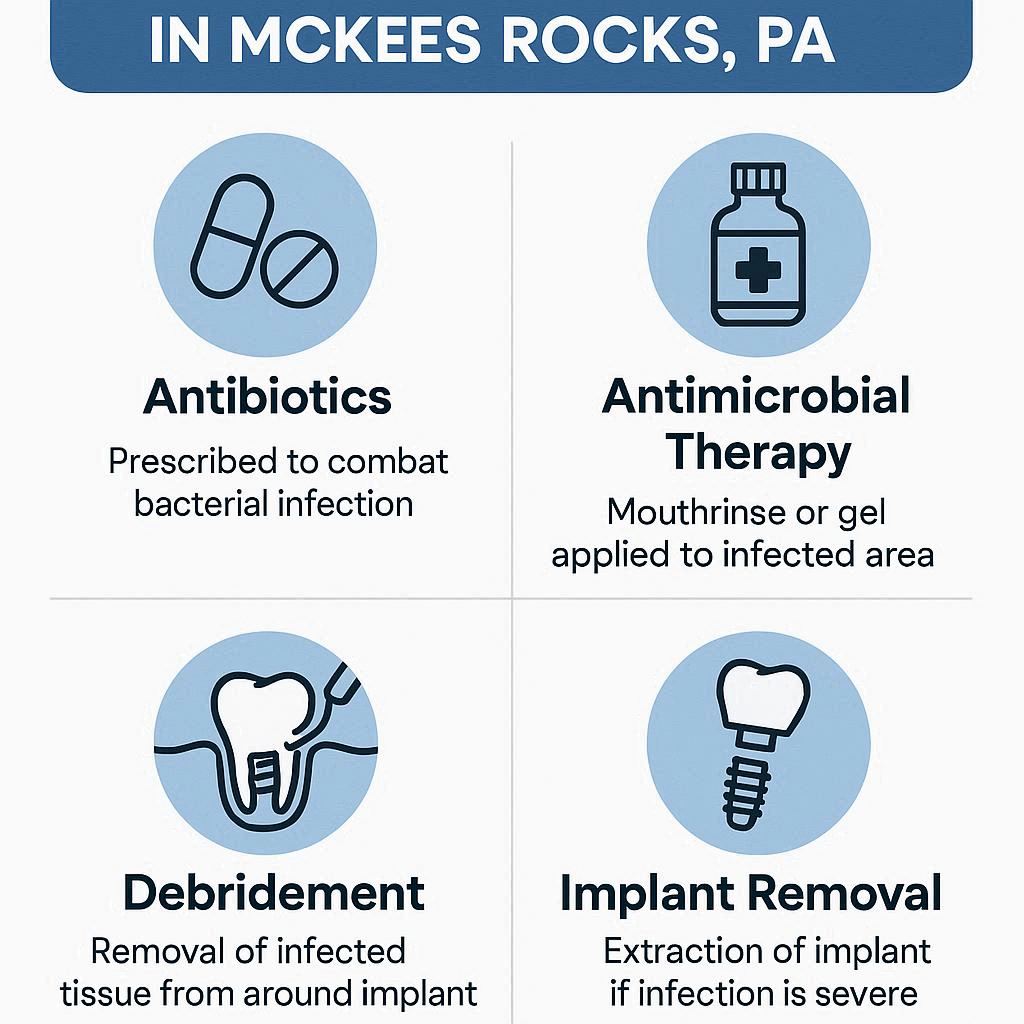
Professional Mechanical Debridement
Think of this as a very deep, very thorough cleaning. Your dentist or hygienist uses specialized instruments designed specifically for implants. Metal scalers can scratch implant surfaces, so they usually use plastic, carbon-fiber, or titanium instruments.
The goal is simple: remove all bacterial plaque and calculus (tartar) from the implant surface and the surrounding pocket.
Ultrasonic Scaling with Implant-Safe Tips
Some offices in McKees Rocks PA use ultrasonic scalers with special plastic-coated tips. These use vibration and water to break up bacterial deposits without damaging the implant itself.
Antimicrobial Irrigation
After cleaning, your dentist may flush the pocket around your implant with an antimicrobial solution. Common choices include chlorhexidine or povidone-iodine. This step helps kill any remaining bacteria and reduces inflammation.
Local Antibiotic Placement
In some cases, your dentist places a topical antibiotic gel or tiny dissolvable chips directly into the infected pocket. This delivers high concentrations of medication exactly where it is needed, without the side effects of oral antibiotics.
A common option is minocycline microspheres (sold under brand names like Arestin). These release antibiotic slowly over several days.
Oral Antibiotics
Oral antibiotics are not always necessary, but they can be helpful in certain situations.
| When Oral Antibiotics May Help | When They Are Less Useful |
|---|---|
| Acute infection with pus or swelling | As a standalone treatment without cleaning |
| Spreading infection (cellulitis) | For long-term management of chronic peri-implantitis |
| Patients with certain medical conditions | When the cause is mechanical (poor crown fit, etc.) |
| Before surgical treatment | As a replacement for removing biofilm |
Common antibiotics include amoxicillin with clavulanic acid, metronidazole, or clindamycin for penicillin-allergic patients. Always complete the full course.
Improved Home Care Training
This sounds simple, but it makes a massive difference. Your dentist or hygienist should show you exactly how to clean around your implant. Many patients are surprised to learn that standard floss often does not work well for implants.
Instead, you may be advised to use:
- Interdental brushes (small, cone-shaped brushes)
- Water flossers (like Waterpik with implant-specific tips)
- Thread floss designed for implants or bridges
- Single-tufted toothbrushes for precision cleaning
Surgical Treatment Options for Moderate to Advanced Infection
When bone loss has already occurred, or when non-surgical treatment fails to resolve the infection, surgery becomes the next logical step. Surgical treatment for dental implant infection in McKees Rocks PA generally falls into two categories: implant-preserving procedures and implant removal.
Open Flap Debridement
This is the most common surgical option for peri-implantitis. Your dentist or periodontist makes a small incision in your gum to lift it back, exposing the implant threads and the bone.
Why do this? Because closed, non-surgical cleaning cannot reach the deepest bacteria hiding in rough implant surfaces or bone defects. With open flap debridement, the dentist can:
- Visually see all contaminated areas
- Thoroughly clean every implant thread
- Remove granulation tissue (infected soft tissue)
- Irrigate with antimicrobial solutions
Resective Surgery
In some cases, the bone around the implant has uneven contours. Resective surgery reshapes the bone to create smoother, easier-to-clean anatomy. This may also involve removing part of the implant’s exposed threads.
Resective surgery works best when the defect is shallow and the implant is still stable. It stops the infection by eliminating the deep pockets where bacteria hide.
Regenerative Surgery (Bone Grafting)
This is the most advanced implant-preserving option. After thoroughly cleaning the infected implant surface, your surgeon places a bone graft material into the bone defect around the implant. A membrane is often placed over the graft to encourage new bone growth.
Important note: Regenerative surgery has the highest success rates when the implant is still fairly stable and the patient commits to excellent home care afterward. It is not a magic fix, but for the right candidate, it can extend the life of an implant by many years.
Results vary. Some patients regrow enough bone to completely cover the exposed threads. Others achieve only partial fill, but that partial fill may still be enough to eliminate deep pockets and stop the infection.
Explantation (Implant Removal)
Sometimes, saving the implant is no longer realistic. Indications for removal include:
- The implant is visibly loose
- More than 50% of the supporting bone is gone
- The infection has failed to respond to multiple treatments
- The patient cannot or will not maintain proper hygiene
Removing an infected implant is usually straightforward. Your dentist or oral surgeon uses a special device called a trephine bur or a reverse torque driver to unscrew the implant. In some cases, a small amount of bone must be removed as well.
After removal, the site is thoroughly debrided to eliminate all infected tissue. Most patients heal well within a few weeks.
What Happens After Implant Removal?
You have several options:
- Do nothing: Leaving the space empty is always an option, though it may affect nearby teeth over time.
- Place a new implant: After adequate healing (usually 3 to 6 months), a new implant can often be placed, sometimes with bone grafting.
- Alternative restoration: A bridge or partial denture can replace the missing tooth without a new implant.
Many patients in McKees Rocks PA successfully receive a second implant after the infection is fully cleared. The key is addressing the original cause of the infection before trying again.
Combined Approaches: When One Treatment Is Not Enough
Modern dental care rarely relies on a single approach. Most successful treatment plans for dental implant infection combine multiple strategies.
Example plan for moderate infection:
- Non-surgical debridement and antibiotic gel placement
- Two-week course of oral antibiotics
- Improved home care with water flosser and interdental brushes
- Re-evaluation at 3 months
- If pockets persist → open flap debridement
Example plan for advanced infection with bone loss:
- Open flap debridement with regenerative bone grafting
- Systemic antibiotics for 7 to 10 days
- Chlorhexidine rinse for 2 weeks post-op
- Strict 3-month recall schedule for professional maintenance
- Patient uses water flosser daily and interdental brushes weekly
There is no shame in needing multiple treatments. Peri-implantitis is a chronic condition, much like high blood pressure or diabetes. It requires ongoing management, not just a one-time fix.
How to Choose the Right Provider in McKees Rocks PA
Not every dentist treats implant infections. Some general dentists feel comfortable managing early mucositis and mild peri-implantitis. For moderate to advanced cases, you may want to see a specialist.
Types of Providers Who Treat Implant Infections
| Provider Type | Best For |
|---|---|
| General dentist | Early mucositis, non-surgical debridement, patient education |
| Periodontist | All stages. Surgical and regenerative procedures. |
| Oral surgeon | Explantation, complex bone grafting, second implant placement |
| Prosthodontist | Restorative aspects, crown modifications if poor fit caused infection |
When calling a dental office in McKees Rocks PA, ask these three questions:
- “How many implant infection cases do you treat each year?”
- “Do you offer open flap debridement and regenerative surgery on site?”
- “What is your protocol for patients who fail non-surgical treatment?”
A confident, experienced provider will answer clearly. A hesitant or vague response is a sign to keep looking.
Preventing a Second Infection After Treatment
You have been through treatment. Your gums look healthy. Your implant feels stable. Now comes the most critical phase: prevention.
Prevention is not complicated, but it does require consistency. Here is what works.
Professional Maintenance Schedule
Never skip your implant maintenance appointments. For healthy implants, every six months is usually fine. For patients with a history of peri-implantitis, every three months is strongly recommended.
During these visits, your hygienist will:
- Probe carefully around each implant
- Remove any calculus buildup
- Check for bleeding or pocket deepening
- Review your home care technique
Daily Home Care for Implants
Standard brushing twice daily is non-negotiable. But implants need more than a toothbrush.
Morning routine:
- Brush for two full minutes
- Use a water flosser on a low setting, directed at the gumline around the implant
Evening routine:
- Brush again
- Use an interdental brush around the implant neck
- Floss with implant-specific floss if spaces allow
Once weekly:
- Use a single-tufted brush to clean the lingual (tongue side) of the implant crown
Risk Factor Modification
If you smoke, ask your dentist about smoking cessation resources in McKees Rocks PA. Even cutting back helps, but quitting offers the biggest benefit.
If you have diabetes, tighter blood sugar control dramatically reduces infection risk. A1C levels below 7% are ideal for implant health.
If you grind or clench your teeth, wear your nightguard. Excessive forces do not cause infection directly, but they accelerate bone loss once inflammation is present.
What Treatment Costs Look Like in McKees Rocks PA
Let us talk honestly about money. Dental implant infection treatment ranges widely in cost depending on severity and provider.
| Treatment | Typical Cost Range (estimate) |
|---|---|
| Non-surgical debridement (per implant) | 200–500 |
| Antimicrobial irrigation and gel | 75–200 |
| Oral antibiotics course | 10–50 (with insurance) |
| Open flap debridement (per quadrant) | 800–1,500 |
| Resective surgery | 900–1,800 |
| Regenerative surgery with bone graft | 1,500–3,500 |
| Explantation (implant removal) | 500–1,000 |
| Three-month maintenance visit | 100–250 |
Note to readers: These figures are estimates. Actual costs in McKees Rocks PA vary by office, insurance coverage, and whether you need X-rays or CT scans. Always request a written treatment plan before agreeing to any procedure.
Many dental offices offer payment plans or third-party financing options like CareCredit. Some dental insurance plans cover part of peri-implantitis treatment, especially if it is billed as periodontal therapy rather than implant-specific.
When to Seek Emergency Care
Most dental implant infections are not emergencies. They develop slowly and can wait a few days for an appointment. However, certain signs require immediate attention.
Seek same-day or next-day care if you experience:
- Rapidly spreading facial swelling
- Difficulty breathing or swallowing
- Fever over 101°F (38.3°C)
- Pus draining from the implant site that suddenly stops (may indicate deeper spread)
- Trauma to the implant area with sudden loosening
These signs suggest a spreading infection that could become serious. Call a dentist in McKees Rocks PA immediately or visit an urgent care center.
Realistic Outcomes: What You Can Expect
Let us be completely honest about success rates, because you deserve realistic hope, not empty promises.
For peri-implant mucositis (no bone loss):
- Success rate with non-surgical treatment: Over 90%
- Most patients return to healthy, stable implants
- Lifelong maintenance required, but no further bone loss expected
For mild to moderate peri-implantitis (less than 25% bone loss):
- Non-surgical success: 60% to 75%
- With open flap debridement: 80% to 90%
- Some bone loss may remain visible on X-rays, but infection stops progressing
For advanced peri-implantitis (25% to 50% bone loss):
- Non-surgical alone rarely succeeds
- Open flap with regenerative surgery: 70% to 85% implant survival at 5 years
- Some implants eventually fail despite best efforts
For very advanced (over 50% bone loss or mobility):
- Implant removal is the most predictable option
- After removal and healing, a new implant succeeds at rates similar to first-time placement (around 95% at 10 years)
These numbers come from peer-reviewed dental literature. They represent real-world outcomes, not idealized clinical trial results.
How Long Does Treatment Take?
Timeframes vary, but here is a general roadmap.
Non-surgical treatment:
- One appointment (60 to 90 minutes)
- Re-evaluation at 4 to 6 weeks
- Total active treatment: 1 to 2 months
Surgical treatment (open flap or regenerative):
- One surgical appointment (60 to 120 minutes)
- Healing period: 2 weeks for soft tissue, 4 to 6 months for bone graft maturation
- Re-evaluation at 3 and 6 months
- Total active treatment: 4 to 8 months
Explantation and new implant:
- Removal appointment (30 to 60 minutes)
- Healing: 3 to 6 months
- New implant placement: one appointment
- Osseointegration: 3 to 6 months
- New crown placement: 2 to 3 appointments over 4 to 6 weeks
- Total timeline: 9 to 15 months
Yes, that is a long time. But remember that the alternative—losing your implant permanently—happens much faster if you do nothing.
Lifestyle Adjustments That Support Healing
Treatment works best when you support it with healthy habits. These are small changes with big impacts.
Nutrition for Gum Healing
Your gums and bone need specific nutrients to heal after treatment.
- Vitamin C: Found in citrus, bell peppers, strawberries. Essential for collagen production in gum tissue.
- Vitamin D: Helps your body fight infection and absorb calcium. Sunlight, fatty fish, or supplements.
- Calcium: Dairy, leafy greens, fortified plant milks. Critical for bone healing.
- Protein: Eggs, meat, beans, lentils. Provides building blocks for new tissue.
What to Avoid During Healing
- Smoking or vaping: At least 2 weeks post-surgery, ideally longer
- Alcohol: Can interfere with antibiotics and slow healing
- Crunchy or sticky foods: Protects the surgical site
- Using a straw: The suction can dislodge blood clots after surgery
Stress Management
High stress raises cortisol levels, which suppresses immune function. This makes it harder for your body to fight off residual bacteria after treatment.
You do not need a full meditation practice. Even 5 minutes of deep breathing, a short walk, or listening to music you enjoy helps lower stress hormones.
Frequently Asked Questions (FAQ)
Can a dental implant infection spread to my jawbone or other parts of my body?
Yes, in rare cases. Untreated peri-implantitis can spread to the surrounding jawbone, and in extremely rare cases, bacteria can enter the bloodstream. This is why early treatment matters. However, most implant infections remain localized to the implant site for a long time.
Will my insurance cover treatment for dental implant infection?
Many dental insurance plans cover peri-implantitis treatment as they would periodontal disease. However, some plans have exclusions for “implant complications.” Call your insurance company or ask your dentist’s office to verify coverage before treatment.
Can I treat a dental implant infection with home remedies alone?
No. Salt water rinses and improved hygiene help reduce bacteria, but they cannot eliminate an established infection deep around an implant. Home remedies are support measures, not cures.
How do I know if my implant infection is gone?
Your dentist will re-evaluate with probing measurements and X-rays. No bleeding on probing, pocket depths under 4mm, and stable or improved bone levels on X-ray indicate successful treatment.
Is it normal to have some discomfort after implant infection treatment?
Yes. Mild soreness, slight bleeding, and some swelling are normal after both non-surgical and surgical treatments. These typically resolve within a few days to a week. Severe or worsening pain is not normal—call your dentist.
Can I get a new implant in the same spot after removal?
Most patients can. After thorough debridement and adequate healing (usually 3 to 6 months), a new implant can often be placed. Sometimes, bone grafting is needed first.
What is the single most important thing I can do to prevent a second infection?
Consistent professional maintenance every 3 to 6 months, combined with daily use of a water flosser and interdental brushes. Most recurrent infections happen when patients stop coming for cleanings.
Additional Resource
For more detailed, evidence-based information on peri-implantitis and dental implant care, the American Academy of Periodontology offers a free patient education library.
This resource includes illustrations of different treatment approaches, patient stories, and a specialist finder tool.
A Final Word of Encouragement
Discovering that your dental implant is infected feels discouraging. You might wonder if you did something wrong, or if the implant was a mistake from the start.
Please hear this: peri-implantitis is a biological complication, not a personal failure. Even patients with perfect hygiene develop it sometimes. What matters now is not how the infection started, but how you respond to it.
The dental community in McKees Rocks PA has the tools and training to help you. Whether you need a simple deep cleaning or a more advanced surgical procedure, effective treatment exists. Your implant can heal. Your smile can remain whole.
Take the first step today. Call a local dentist. Get an honest diagnosis. And then move forward with confidence, knowing you have a clear, realistic path ahead.
Conclusion
Dental implant infections are treatable when caught early, with non-surgical options like deep cleaning and antibiotics often working for mild cases. More advanced infections may require surgery, bone grafting, or implant removal, but most patients retain or replace their implant successfully. Consistent home care and regular professional cleanings in McKees Rocks PA remain the best defense against future infections.
Disclaimer: This article is for informational purposes only and does not constitute medical or dental advice. Always consult a licensed dentist in McKees Rocks PA for a proper diagnosis and treatment plan tailored to your specific situation.