What Dental Schools Will Do Implants?
Dental schools represent an important pathway to affordable implant treatment for patients who cannot afford private practice fees. However, not all dental schools offer implant services, and the services available vary significantly between institutions. Understanding which schools provide implant treatment, what types of care they offer, and how to access their services helps patients find quality care at reduced cost.
Most accredited dental schools in the United States and Canada offer dental implant treatment through their predoctoral clinics, graduate specialty clinics, or both. Predoctoral clinics typically offer straightforward single-tooth implant cases at 40-60% below private practice fees. Graduate specialty clinics in periodontics, prosthodontics, and oral surgery handle complex full-arch cases at 25-40% below specialist private practice rates.
How Dental Schools Structure Implant Education
Understanding the educational framework helps patients navigate dental school implant services effectively.
Predoctoral Implant Training
All accredited dental schools in the United States now include implant dentistry in their predoctoral curriculum. The Commission on Dental Accreditation requires that graduating dentists understand implant treatment planning, restoration, and maintenance.
However, the depth of predoctoral implant training varies considerably. Some schools require students to place and restore implants on live patients. Others provide only didactic instruction and simulated experiences, with actual implant placement reserved for graduate programs.
Predoctoral Implant Services Typically Include:
Single tooth implant planning and restoration. Straightforward implant cases with adequate bone. Implant-supported single crowns. Implant-retained overdentures (at some schools). Patient evaluation and treatment planning for more complex cases.
Predoctoral Students Generally Do Not Perform:
Complex surgical implant placement. Full-arch implant rehabilitation (All-on-4, etc.). Cases requiring extensive bone grafting or sinus lifts. Immediate implant placement into extraction sockets. Treatment of patients with significant medical complexities.
Graduate Specialty Clinics
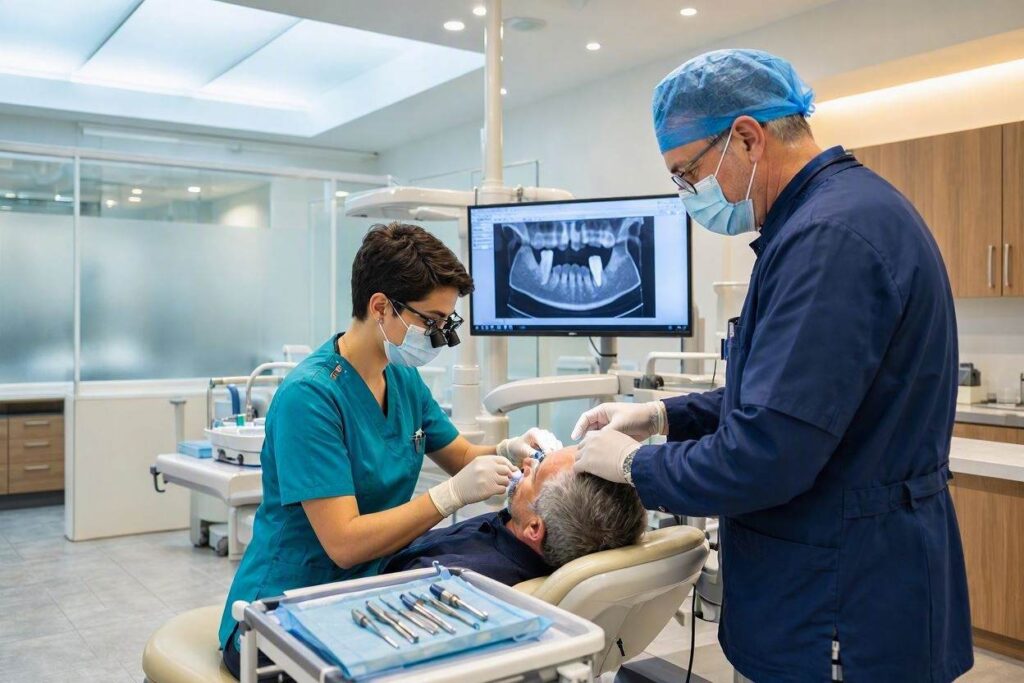
Graduate programs in periodontics, prosthodontics, and oral and maxillofacial surgery provide advanced implant training. Residents in these programs are already licensed dentists pursuing specialty certification. They perform complex implant procedures under faculty supervision.
Graduate Clinic Capabilities:
Complex surgical implant placement. Full-arch implant rehabilitation. Bone grafting and sinus lift procedures. Management of implant complications. Full mouth reconstruction with implants. Treatment of medically complex patients. Implant treatment coordinated with other specialties.
Graduate clinics represent the best option for patients needing complex implant care at reduced cost. The residents bring several years of clinical experience beyond their dental degree, and the supervising faculty are board-certified specialists.
| Clinic Type | Provider Level | Case Complexity | Cost Savings vs. Private Practice |
|---|---|---|---|
| Predoctoral Clinic | Dental students (3rd-4th year) | Simple single implants | 40-60% |
| Graduate Periodontics | Licensed dentists, specialty training | Surgical placement, grafting | 25-40% |
| Graduate Prosthodontics | Licensed dentists, specialty training | Complex restoration, full-arch | 25-40% |
| Graduate Oral Surgery | Licensed dentists, surgical residency | Complex surgery, medically complex | 25-40% |
| Faculty Practice | Board-certified faculty dentists | All levels | 10-20% (full fees) |
Major U.S. Dental Schools Offering Implant Services
The following institutions represent major dental schools with established implant programs. This list is representative, not exhaustive. Contact individual schools for current service availability and patient acceptance status.
Northeast Region
Harvard School of Dental Medicine (Boston, MA):
Graduate programs in periodontics and prosthodontics offer comprehensive implant services. Faculty practice provides care from Harvard faculty specialists. Predoctoral implant exposure limited to straightforward cases.
Tufts University School of Dental Medicine (Boston, MA):
Strong predoctoral implant program with students placing and restoring implants. Graduate programs in periodontics, prosthodontics, and oral surgery. Implant center coordinates complex interdisciplinary cases.
Boston University Henry M. Goldman School of Dental Medicine:
Extensive implant curriculum. Graduate programs in all implant-related specialties. Digital dentistry integration for implant planning and restoration.
University of Pennsylvania School of Dental Medicine (Philadelphia, PA):
Renowned graduate prosthodontics and periodontics programs. Predoctoral students exposed to implant restoration. Faculty practice for complex cases.
Columbia University College of Dental Medicine (New York, NY):
Graduate programs offering comprehensive implant care. Predoctoral implant curriculum. Location provides access for New York metropolitan area patients.
New York University College of Dentistry (New York, NY):
Largest dental school in the United States. Extensive implant program with high patient volume. Graduate clinics in all implant specialties. Predoctoral students place and restore implants.
Stony Brook University School of Dental Medicine (Long Island, NY):
Graduate periodontics and prosthodontics programs. Predoctoral implant training. Serving Long Island and greater New York area.
University at Buffalo School of Dental Medicine (Buffalo, NY):
Comprehensive implant training across predoctoral and graduate programs. Lower cost of living area makes treatment particularly affordable.
Southeast Region
University of North Carolina Adams School of Dentistry (Chapel Hill, NC):
Strong graduate programs in periodontics and prosthodontics. Predoctoral implant curriculum. Research-active implant faculty.
University of Florida College of Dentistry (Gainesville, FL):
Graduate implant programs serving Florida patients. Predoctoral implant training. Multiple clinic locations including Jacksonville extension.
Nova Southeastern University College of Dental Medicine (Fort Lauderdale, FL):
Comprehensive implant services through graduate programs. Predoctoral implant exposure. Serving South Florida patient population.
Medical University of South Carolina College of Dental Medicine (Charleston, SC):
Graduate periodontics and prosthodontics programs. Predoctoral implant curriculum.
University of Alabama at Birmingham School of Dentistry:
Strong implant program with graduate specialty clinics. Predoctoral implant training.
Midwest Region
University of Michigan School of Dentistry (Ann Arbor, MI):
Top-ranked dental school with comprehensive implant programs. Graduate clinics in all implant specialties. Research leadership in implant dentistry.
Ohio State University College of Dentistry (Columbus, OH):
Extensive implant services through graduate programs. Predoctoral implant training. Serving central Ohio patient population.
Indiana University School of Dentistry (Indianapolis, IN):
Graduate implant programs. Predoctoral implant curriculum. Lower regional cost structure benefits patients.
University of Illinois at Chicago College of Dentistry:
Comprehensive implant services. Graduate specialty clinics. Serving Chicago metropolitan area.
Marquette University School of Dentistry (Milwaukee, WI):
Graduate programs in periodontics and prosthodontics. Predoctoral implant training. Serving Wisconsin patients.
University of Minnesota School of Dentistry (Minneapolis, MN):
Strong implant curriculum. Graduate specialty clinics. Research contributions to implant dentistry.
Southwest and West Region
University of Texas Health Science Center at San Antonio School of Dentistry:
Pioneering implant research institution. Comprehensive graduate implant programs. Predoctoral implant curriculum. Implant fellowship program.
Texas A&M College of Dentistry (Dallas, TX):
Graduate programs in all implant specialties. Predoctoral implant training. Serving Dallas-Fort Worth metropolitan area.
University of Texas School of Dentistry at Houston:
Comprehensive implant services. Graduate specialty clinics. Texas Medical Center location facilitates interdisciplinary care.
University of California, Los Angeles School of Dentistry:
Strong graduate implant programs. Predoctoral implant exposure. Research leadership. West Los Angeles location.
University of California, San Francisco School of Dentistry:
Comprehensive implant curriculum. Graduate specialty clinics. Serving Bay Area patients.
University of Southern California Herman Ostrow School of Dentistry (Los Angeles, CA):
Extensive implant program. Graduate specialty clinics. Predoctoral implant training. Serving Southern California.
University of the Pacific Arthur A. Dugoni School of Dentistry (San Francisco, CA):
Comprehensive implant training. Graduate programs. Serving Northern California.
Oregon Health and Science University School of Dentistry (Portland, OR):
Graduate implant programs. Predoctoral implant curriculum. Serving Pacific Northwest patients.
University of Washington School of Dentistry (Seattle, WA):
Pioneering implant research. Graduate specialty clinics. Comprehensive implant services.
Canadian Dental Schools
University of Toronto Faculty of Dentistry (Toronto, ON):
Canada’s largest dental school. Graduate programs in all implant specialties. Predoctoral implant training. Serving Greater Toronto Area.
University of British Columbia Faculty of Dentistry (Vancouver, BC):
Comprehensive implant curriculum. Graduate specialty clinics. Research contributions.
McGill University Faculty of Dentistry (Montreal, QC):
Graduate implant programs. Predoctoral implant exposure. Serving Quebec patients.
University of Alberta School of Dentistry (Edmonton, AB):
Graduate periodontics and prosthodontics programs. Predoctoral implant training.
Dalhousie University Faculty of Dentistry (Halifax, NS):
Graduate implant services. Serving Atlantic Canada patients.
How to Access Dental School Implant Services
The process for becoming a dental school implant patient differs from booking a private practice appointment.
Application and Screening Process
Most dental schools maintain patient waiting lists. The screening process evaluates whether your case meets educational requirements.
Steps to Become a Dental School Implant Patient:
Contact the dental school clinic to inquire about implant services and current acceptance status. Complete a screening application describing your dental needs. Attend a screening appointment where faculty evaluate your case for teaching suitability. If accepted, you are assigned to a student provider or graduate resident. Treatment planning proceeds with faculty supervision.
Not all applicants are accepted. Dental schools prioritize cases that provide appropriate educational experiences for their students and residents. Cases that are too simple may not meet teaching requirements. Cases that are too complex may exceed student capabilities and be directed to graduate clinics or referred to private practice.
Time Commitment Required
Dental school implant treatment requires significantly more time than private practice care.
Students work deliberately with frequent faculty checks. Appointments last longer (2-4 hours vs. 1 hour in private practice). More appointments may be required overall. Scheduling is limited to academic calendars (schools close during breaks). Treatment may span multiple academic terms.
Patients who value their time over cost savings may find private practice more suitable. Patients with schedule flexibility and budget constraints benefit most from the dental school pathway.
Cost Structure at Dental Schools
Dental school fees vary by institution but consistently offer savings compared to private practice.
Predoctoral Clinic Fees (Single Implant):
Surgical placement: $500-$1,200. Implant restoration (crown): $400-$1,000. Total complete implant: $900-$2,200.
Graduate Clinic Fees (Single Implant):
Surgical placement: $800-$1,800. Implant restoration: $600-$1,400. Total complete implant: $1,400-$3,200.
Private Practice Comparison:
Complete single implant in private practice: $3,000-$6,000. Dental school savings: 40-60% at predoctoral level, 25-40% at graduate level.
Full-arch implant treatment at dental school graduate clinics may range from $8,000-$18,000 per arch compared to $15,000-$35,000 in private practice.
Insurance and Payment at Dental Schools
Most dental schools accept dental insurance and will submit claims on patients’ behalf. However, school clinic fees may be based on internal fee schedules rather than insurance contracted rates.
Medicaid acceptance varies by state and institution. Some dental schools accept Medicaid for adult dental services including implants when covered. Others do not participate in Medicaid.
Payment plans may be available through the institution. Dental schools typically do not offer third-party financing through companies like CareCredit, though some are beginning to accept healthcare credit cards.
Frequently Asked Questions
Which dental school is best for dental implants?
No single school is “best.” Selection depends on your location, case complexity, and specific needs. Research schools in your region with graduate programs in periodontics, prosthodontics, and oral surgery for complex cases.
Do dental students place implants?
At many schools, yes. Senior dental students place implants on straightforward cases under direct faculty supervision. The degree of predoctoral surgical experience varies between schools.
How much do dental school implants cost?
Predoctoral clinics charge 40-60% less than private practice. Graduate clinics charge 25-40% less. A single complete implant might cost $900-$2,200 at a predoctoral clinic versus $3,000-$6,000 in private practice.
Is dental school implant treatment safe?
Yes. Students and residents work under direct faculty supervision. Cases are carefully selected for appropriateness. The supervision model ensures safety while providing educational experience.
How long is the wait for dental school implants?
Wait times vary from weeks to months depending on the institution, clinic type, and case complexity. Emergency cases receive priority. Non-urgent implant treatment may involve significant waiting periods.
Can dental schools do All-on-4 full-arch implants?
Graduate specialty clinics in prosthodontics and periodontics routinely perform full-arch implant rehabilitation. Predoctoral clinics generally do not handle these complex cases.
Will my dental insurance work at a dental school?
Most schools accept and submit dental insurance claims. Verify acceptance with the specific school before beginning treatment.
What if I need bone grafting or a sinus lift?
Graduate periodontics and oral surgery clinics perform these procedures. Predoctoral clinics may refer grafting cases to graduate clinics or private practice.
Additional Resources
For more information about dental school implant services:
- Commission on Dental Accreditation: List of accredited dental schools (www.ada.org/en/coda)
- American Dental Education Association: www.adea.org
- American Academy of Implant Dentistry: www.aaid.com
- Individual dental school websites for clinic contact information and patient acceptance status