What Is A Dental Implant Annapolis?
If you live in Annapolis, Maryland, or the surrounding Anne Arundel County area, you have probably seen advertisements for dental implants. Perhaps you are missing a tooth, struggling with a loose denture, or simply tired of hiding your smile. You know you want a permanent solution, but you are not quite sure what a dental implant actually is, or why it is so highly recommended by dentists in the Annapolis area.
You might have searched online for “Dental Implant Annapolis” and been overwhelmed by the results. You see photos of titanium screws and beautiful smiles, but you need a clear, jargon-free explanation of what the procedure involves and what makes it different from other options available in Maryland.
This guide will explain exactly what a dental implant is, why the Annapolis dental community considers it the gold standard for tooth replacement, and what you can expect if you decide to pursue this treatment locally. We will also touch on the specific factors of seeking care in a historic, waterfront city like Annapolis.
The Basic Definition: The “Root” of the Problem
To understand what a dental implant is, you must first understand why losing a tooth is so problematic. A natural tooth has two main parts: the crown (the white part you see above the gum) and the root (the part hidden below the gum, anchored in your jawbone).
When you lose a tooth, most people only notice the missing crown—the gap in their smile. But the real problem is the missing root. The root stimulates the jawbone every time you chew. Without that stimulation, the bone begins to shrink away (a process called resorption). This is why people who have been missing teeth for years often have a sunken-in look to their face.
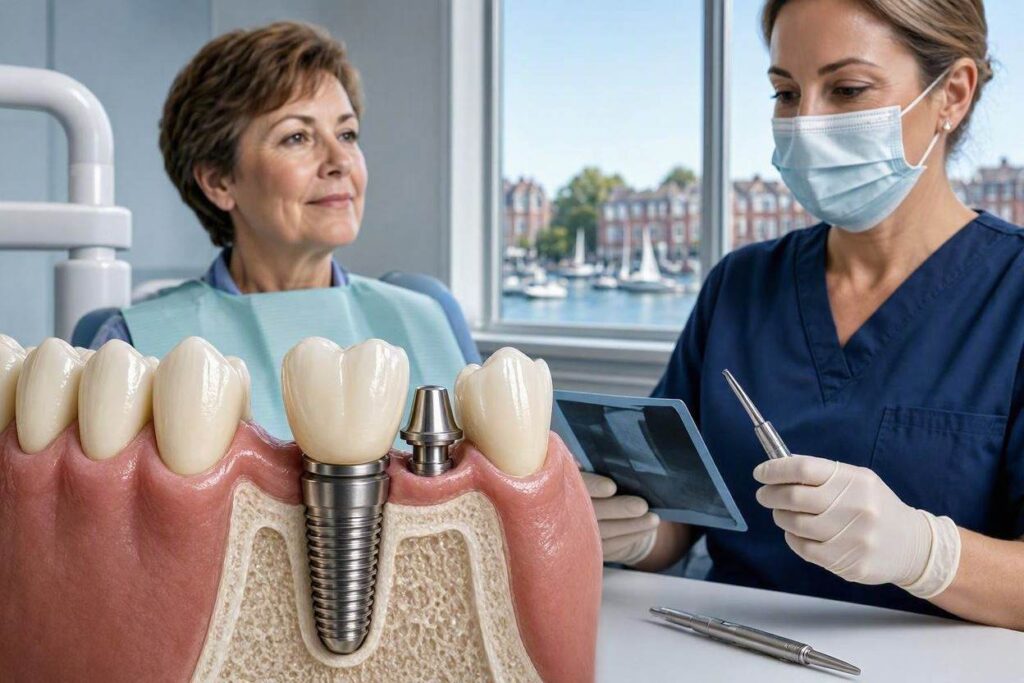
A dental implant is, in essence, an artificial tooth root. It is a small, biocompatible post (usually made of titanium) that is surgically placed into the jawbone to replace the missing root. Once it is placed, a replacement tooth (the crown) is attached to the top.
The Three Parts of an Annapolis Dental Implant
When a dentist in Annapolis talks about a “dental implant,” they are usually referring to a three-part system. Understanding these parts helps you understand the cost and the timeline.
- The Implant Fixture (The Post): This is the titanium screw that is placed into the bone. It is the “root.” In Annapolis, many local periodontists and oral surgeons place this part.
- The Abutment (The Connector): This is a small piece that screws onto the top of the implant fixture. It serves as the base for the new tooth. It sticks out slightly above the gum line.
- The Crown (The Tooth): This is the custom-made, tooth-colored cap that is cemented or screwed onto the abutment. This is the part you see and use to chew.
Why Annapolis Dentists Prefer Implants Over Bridges
In Annapolis, you have choices for replacing a missing tooth. The two most common options are a dental bridge or a dental implant. While a bridge is often cheaper upfront, many top Annapolis dentists steer patients toward implants for several compelling reasons.
1. Preservation of Healthy Teeth
A traditional dental bridge requires the dentist to grind down the two perfectly healthy teeth adjacent to the gap. These teeth are then capped with crowns to support the fake tooth in the middle. This permanently damages healthy structure.
A dental implant, on the other hand, stands alone. It fills the gap without touching the neighboring teeth. This is the biggest biological advantage of the implant.
2. Bone Preservation
As mentioned earlier, the jawbone needs stimulation. An implant replaces the root, which means the bone continues to receive the pressure it needs to stay dense and healthy. A bridge only covers the gap at the gum line; it does not replace the root, so the bone beneath the bridge will slowly melt away over time.
3. Longevity
A bridge lasts, on average, 7 to 15 years. It can fail due to decay on the supporting teeth or fracture. An implant, with proper care, can last a lifetime. The titanium post never decays. While the crown might need replacement eventually, the implant itself is permanent.
4. The “Annapolis Lifestyle” Factor
Annapolis is a city of food and culture. From crab feasts on the waterfront to steak dinners on West Street, chewing is part of the lifestyle. A bridge can limit your bite force, and you have to be careful with sticky or hard foods. An implant restores nearly 100% of your natural chewing power. You can bite into that apple or enjoy a steak without a second thought.
The Implant Process in Annapolis: What to Expect
If you decide to get an implant in the Annapolis area, here is a typical roadmap of the journey.
Step 1: The Consultation and 3D Scan
Your journey usually starts with a visit to a local Annapolis implant dentist, periodontist, or oral surgeon. They will perform a comprehensive exam and take a 3D CBCT scan. This advanced imaging allows the doctor to see your bone density, locate nerves, and plan the exact placement of the implant digitally before any surgery happens. Many high-tech offices in the Annapolis/Parole area use this technology.
Step 2: The Surgical Placement
The implant post is placed into the jawbone. This is a minor surgical procedure. In Annapolis, this might be done in the office under local anesthesia, or with IV sedation for anxious patients. The surgeon makes a small incision in the gum, drills a precise hole, and screws the titanium post in. The gum is stitched closed over the post.
Step 3: The Healing Phase (Osseointegration)
This is the waiting game. Over the next 3 to 6 months, the bone in your jaw grows and fuses to the titanium post. This is called osseointegration. It is what makes the implant so strong. You will be on a soft food diet for a period of time to protect the implant.
Step 4: The Restoration (The Crown)
Once the implant is fused, you return to the dentist. The abutment is attached, and impressions are taken. A local dental lab (often in the Baltimore-Washington metro area) fabricates your custom crown. A few weeks later, the crown is fitted and secured.
The Cost of Implants in the Annapolis Market
Annapolis is an affluent area, and dental fees reflect that. The cost of a single implant in Annapolis (including the post, abutment, and crown) typically ranges from $3,500 to $6,500.
- General Dentist vs. Specialist: An oral surgeon in Annapolis will charge more for the surgical phase than a general dentist who does implants in-house.
- Location: Dental offices in downtown Annapolis or near the mall might have higher overhead (and thus higher fees) than those in Edgewater or Severna Park.
- Insurance: Dental insurance in Maryland often covers implants at 50%, but subject to a strict annual maximum (usually $1,500 to $2,000).
How to Choose an Annapolis Implant Provider
Finding the right dentist in the Annapolis area is crucial. Here are a few tips specific to this region:
- Look for Credentials: Search for providers who are members of the Anne Arundel County Dental Society or who have advanced credentials from organizations like the International Congress of Oral Implantologists (ICOI).
- Read Local Reviews: Check Google reviews and local Annapolis forums. Look for consistent mentions of patient comfort, clear communication, and successful outcomes.
- Ask About the Technology: A modern Annapolis practice should use 3D scanning (CBCT) for implant planning. This is non-negotiable for safety and precision.
- Consider the “Team” Approach: Many of the best outcomes in Annapolis come from a team approach: an oral surgeon (like those at Chesapeake Oral Surgery) places the implant, and a restorative dentist (like those at Annapolis Dental Care) makes the crown.
The “All-on-4” Concept in Annapolis
If you are missing all of your teeth, you might have heard of “All-on-4” or “Teeth in a Day” being offered in the Annapolis area. This is a specific type of implant treatment where a full arch of teeth (upper or lower) is supported by just 4 to 6 implants.
This is a fantastic option for patients struggling with dentures. It provides a fixed, permanent set of teeth that does not move. The cost is significantly higher (often $20,000 to $30,000 per arch), but the quality of life improvement is immense. Several specialized clinics in the greater Annapolis area offer this procedure.
Conclusion
A dental implant in Annapolis is a state-of-the-art tooth replacement solution consisting of a titanium root, a connector, and a custom crown. Local dentists prefer it over bridges because it protects healthy teeth, prevents bone loss, and restores full chewing power. By choosing a credentialed provider in the Annapolis area who uses 3D technology, you can achieve a permanent, natural-looking smile that fits perfectly with your active Maryland lifestyle.
Frequently Asked Questions (FAQ)
1. Can I get a dental implant at the Naval Academy?
Dental care at the United States Naval Academy is generally reserved for active-duty midshipmen and military personnel. Civilian family members and retirees usually use the TRICARE Dental Program and see civilian dentists in the Annapolis area. If you are active duty, your care on base is free.
2. Is Annapolis water (from the Chesapeake) bad for my dental implants?
No. Dental implants are made of titanium and porcelain. They are completely resistant to corrosion from water, whether it is tap water, well water, or brackish water from the Bay. The water quality in Annapolis does not affect the longevity of the implant.
3. Can I sail or boat right after getting an implant?
You should avoid strenuous activity for a few days after the surgery to prevent bleeding and swelling. However, once you are healed, you can absolutely enjoy the Chesapeake Bay lifestyle. Just be careful with your diet on the boat for the first few weeks!
4. Are there any dental schools near Annapolis for cheaper implants?
The closest major dental school is the University of Maryland School of Dentistry in Baltimore. It is about a 30-40 minute drive from Annapolis. They offer implant services at a reduced cost, though the appointments take longer.
5. What if I am afraid of the surgery?
Annapolis dentists are very experienced in treating anxious patients. Most offer various levels of sedation dentistry, from mild oral sedatives (a pill) to IV sedation (twilight sleep). Discuss your fears during the consultation so they can tailor the experience to your comfort level.