In Canada How Much Does A Dental Implant Cost?
If you are living in Canada and dealing with a missing tooth, you have likely considered a dental implant. You know it is the best solution for restoring your smile, your chewing ability, and your confidence. But you also know that dentistry in Canada comes with a price tag, and implants are often at the top of that range.
Navigating the cost of healthcare can be confusing, especially when you realize that the Canadian healthcare system (Medicare) does not typically cover routine dental work. Dental care is largely privatized, meaning prices vary from clinic to clinic and province to province.
This guide provides a realistic, detailed breakdown of what you can expect to pay for a dental implant in Canada. We will look at the average costs, explain why the price is so high, and explore the financial options available to help you afford this life-changing procedure.
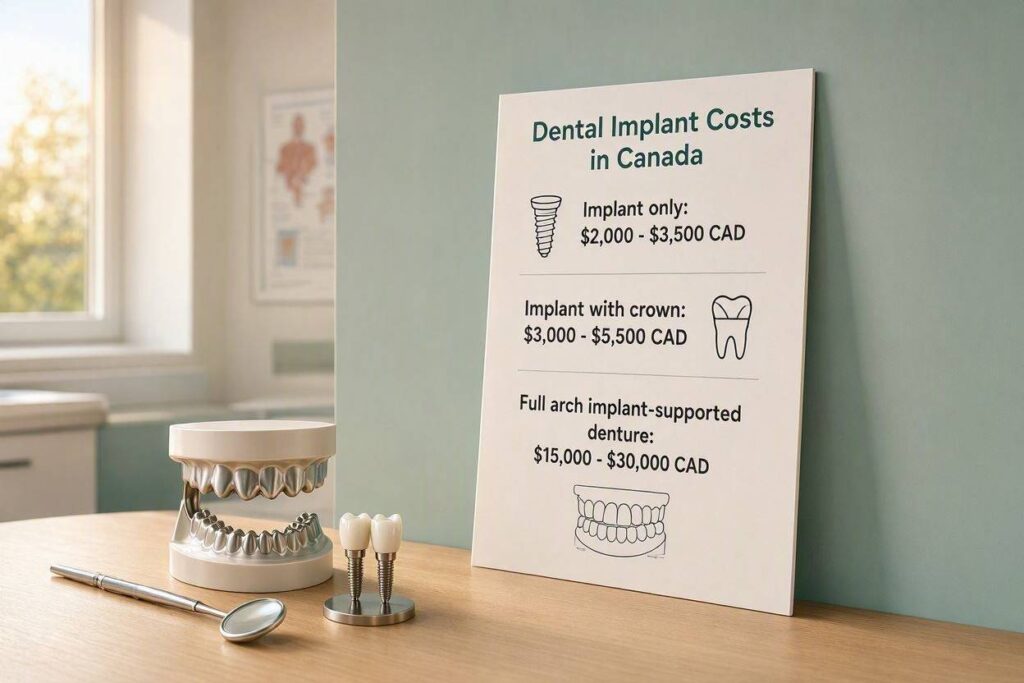
The “All-In” Price: Understanding the Total Cost
When a dentist quotes you a price for a dental implant, it is crucial to understand what is included. A dental implant is not a single item; it is a three-part system (the implant post, the abutment, and the crown). Many clinics advertise a “starting from” price that only covers the surgical placement of the post. This can be misleading.
To get the true cost of the final tooth in your mouth, you need to look at the “all-in” price. In Canada, the total cost for a single dental implant, from start to finish, typically ranges from $3,000 to $6,000 CAD.
Here is how that breaks down:
| Component | Average Cost (CAD) | Notes |
|---|---|---|
| Consultation & 3D X-ray (CBCT) | $150 – $400 | Essential for planning. Often credited toward treatment if you proceed. |
| Implant Fixture (The Post) | $1,200 – $2,000 | The titanium “screw” placed into the bone. |
| The Surgery Fee | $500 – $1,000 | The dentist or surgeon’s time to place the post. |
| The Abutment | $500 – $800 | The connector that attaches to the post. |
| The Crown (The Tooth) | $1,000 – $2,000 | The visible porcelain or zirconia tooth. |
| Total Average | $3,350 – $6,200 |
Note: These are national averages. Prices in major cities like Toronto and Vancouver tend to be higher, while prices in rural areas or smaller provinces may be lower.
The “Hidden” Extras: Bone Grafts and Extractions
The price above assumes you have a healthy jawbone and the tooth is already missing. If you need additional procedures, the cost increases significantly.
1. Tooth Extraction
If the failing tooth is still in your mouth, it needs to be pulled first. A simple extraction costs between $150 and $350, while a surgical extraction of a broken tooth can cost $300 to $600.
2. Bone Grafting
When a tooth is lost, the jawbone begins to shrink (resorb). If you have been missing a tooth for a while, you often lack the bone density needed to hold an implant. A bone graft rebuilds this foundation.
- Minor Graft: $400 – $800
- Major Graft (Block Graft): $1,000 – $2,500
3. Sinus Lift
If you are replacing upper back teeth, the sinus cavity often sits too low. A sinus lift surgery raises the sinus floor. This is a complex procedure costing $1,500 to $3,000.
If you need a sinus lift and a bone graft, your total bill for the implant journey could easily exceed $8,000 CAD.
Why is the Cost So High in Canada?
Canadians often wonder why dental care is so expensive when their medical care is free. The answer lies in the structure of the system.
1. It is Private Healthcare
Unlike hospitals and doctors, which are funded by the government, the vast majority of dental clinics are private small businesses. They receive no government funding. They must cover their own overhead: rent, staff salaries, equipment, and materials.
2. The High Cost of Technology
Modern implant dentistry relies on expensive technology. The 3D CBCT scanners used to plan the surgery cost over $100,000. The specialized surgical kits and drills are also costly. The materials (medical-grade titanium and high-quality porcelain) are imported and subject to currency fluctuations.
3. The Lab Fees
The crown that goes on top of the implant is custom-made by a dental laboratory. The lab charges the dentist a fee (often $300 to $500). The dentist marks this up to cover the time spent taking impressions, fitting the crown, and managing the case.
4. The Specialist Fee
Many general dentists refer the surgical part to an oral surgeon or periodontist. Specialists charge higher fees for their advanced training and expertise. You are paying for the peace of mind that comes with a surgeon who does this every day.
The Role of the Canadian Dental Care Plan (CDCP)
Historically, there was no government assistance for dental implants in Canada. However, the landscape is changing with the introduction of the Canadian Dental Care Plan (CDCP) .
The CDCP is a federal program designed to help Canadian residents with a household income below $90,000 who do not have access to private dental insurance.
Does the CDCP cover implants?
This is the critical question. The CDCP covers a wide range of essential services, including cleanings, fillings, and dentures. However, dental implants are generally NOT covered by the CDCP in its initial phases.
The program focuses on “medically necessary” care to restore basic function. A removable denture is considered the standard of care for a missing tooth under the CDCP. If you want an implant, you will likely have to pay for it out-of-pocket.
Note: There are some exceptions being discussed for complex cases, but as of now, patients should not budget for CDCP funding for a single standard implant.
Private Dental Insurance in Canada
Most Canadians with dental coverage get it through their employer. If you have private insurance (like Sun Life, Manulife, or Blue Cross), your plan might cover a portion of the implant.
What to check in your policy:
- Major Services Coverage: Implants fall under “major” services. Most plans cover 50% of major services.
- Annual Maximum: Your plan has a cap (e.g., $1,500 or $2,500 per year). This cap often limits how much the insurance actually pays for a $4,000 implant.
- Implant Exclusions: Some older plans specifically exclude “dental implants” or only pay the equivalent of a bridge (the “alternate benefit” rule).
- Missing Tooth Clause: If the tooth was lost before you enrolled in the plan, the claim might be denied.
How to Save Money on Implants in Canada
If the price tag is daunting, you have options. Here is how to reduce the financial burden.
1. The Dental School Route
This is perhaps the best-kept secret in affordable dental care. Canada has excellent dental schools (University of Toronto, UBC, McGill, etc.). Their clinics offer implants at a reduced rate—often 40-50% cheaper than private practice. You are treated by a dental student or a resident, closely supervised by an experienced professor. The downside is time. Appointments are long and require more visits.
2. Shop Around (Get Multiple Quotes)
Prices vary significantly between clinics. A high-end cosmetic practice in downtown Toronto will charge more than a general practice in the suburbs. Call several offices and ask for a “ballpark estimate” for a single implant including the crown. Make sure you are comparing “all-in” fees.
3. Travel Within Canada (“Dental Tourism”)
Just as some Canadians travel to Mexico or Costa Rica for cheap dentistry, you can also travel to less expensive provinces. Prices in Alberta and British Columbia are generally higher than in Quebec or the Atlantic provinces. If you have family in another province, it might be worth combining a visit with your dental work.
4. Payment Plans
Most Canadian dental clinics offer in-house financing or work with third-party lenders (like DentalCard or iFinance). You can spread the cost of the implant over 12 to 24 months, making it manageable on a monthly basis.
5. Health Spending Account (HSA)
If you have a Health Spending Account through your employer, you can use it to cover the portion of the implant that your standard insurance doesn’t pay. This is essentially a pool of tax-free money for medical expenses.
The Value Proposition: Is It Worth It?
When you look at a $4,500 quote, it is easy to think, “I could just get a denture for $1,000.” And you could. But the value of an implant goes beyond the initial price.
- Longevity: A denture or bridge lasts 5-10 years. An implant can last a lifetime.
- Bone Health: Implants prevent jawbone loss. Dentures accelerate it.
- Quality of Life: You can eat anything with an implant. Dentures restrict your diet.
- Protection of Other Teeth: A bridge requires grinding down perfectly healthy adjacent teeth. An implant does not.
When you amortize the cost of an implant over 20-30 years, it is often the most economical choice.
Conclusion
In Canada, a single dental implant typically costs between $3,000 and $6,000 CAD all-in, though costs can rise to $8,000 or more if bone grafting or sinus lifts are required. While the government CDCP and some private plans offer limited or no coverage, options like dental schools, payment plans, and Health Spending Accounts can make the procedure more affordable. Despite the upfront cost, the longevity and health benefits of implants often make them the best long-term value.
Frequently Asked Questions (FAQ)
1. Are dental implants cheaper in Quebec than in Ontario?
Generally, yes. The fee guides for dentists in Alberta and Ontario tend to be higher than in Quebec or the Atlantic provinces. This is due to differences in overhead costs and provincial fee schedules. It is always worth comparing, but factor in travel costs.
2. Will OHIP (Ontario Health Insurance Plan) pay for dental implants?
No. OHIP does not cover routine dental care for most adults. It only covers dental surgery performed in a hospital setting if it is medically necessary (e.g., a complex jaw reconstruction due to trauma or a medical condition). A standard tooth replacement is not covered.
3. Are zirconia implants more expensive in Canada than titanium?
Yes. Zirconia (metal-free) implants are a premium product. They can cost 10-20% more than titanium implants due to the higher cost of the material and the specialized training required to place them.
4. Can I claim dental implants on my taxes in Canada?
You can claim dental expenses on your income tax return as a medical expense. You can claim the amount that exceeds 3% of your net income (or a set threshold) using the Medical Expense Tax Credit (METC). This provides a tax credit (not a refund), but it can help offset some of the cost. Keep all your receipts.
5. Why does the crown cost so much on top of the implant?
The crown is not a generic cap. It is a custom-made piece of art. The lab technician layers porcelain to match the color, shape, and translucency of your surrounding teeth. It also takes multiple visits to the dentist to get the fit perfect. You are paying for the materials and the skilled labor required to make a tooth that looks real.
Additional Resource:
For the latest information on the Canadian Dental Care Plan (CDCP) and what dental services are covered, visit the official Government of Canada website at Canada.ca/dental.