What Is A Dental Implant?
If you have ever felt that awkward moment when you smile and try to hide a gap, you are not alone. Millions of adults around the world lose at least one tooth during their lifetime. Some lose a tooth due to an accident. Others face tooth loss because of gum disease or decay. And for many, the solution sits right inside a dentist’s office: the dental implant.
But here is the real question. What is a dental implant, exactly? Is it a fake tooth? Is it a screw? Is it painful? Does it work like a real tooth?
Let me give you the honest answer right away. A dental implant is a small, strong post made of titanium. A dentist places this post into your jawbone. It acts like the root of your natural tooth. After the implant heals, the dentist attaches a crown on top. That crown looks, feels, and works like a normal tooth.
Sounds simple, right? Well, there is more to the story.
This guide walks you through everything you need to know about dental implants. We will talk about the parts, the procedure, the cost, the recovery, and the pros and cons. I will also share some honest warnings and practical tips.
By the end of this article, you will know exactly what a dental implant is and whether it might be the right choice for you.
Understanding the Basics: What Makes an Implant Different?
Before we dive into the details, let us clear up a common confusion. Many people think a dental implant is the whole tooth you see in the mouth. That is not correct.
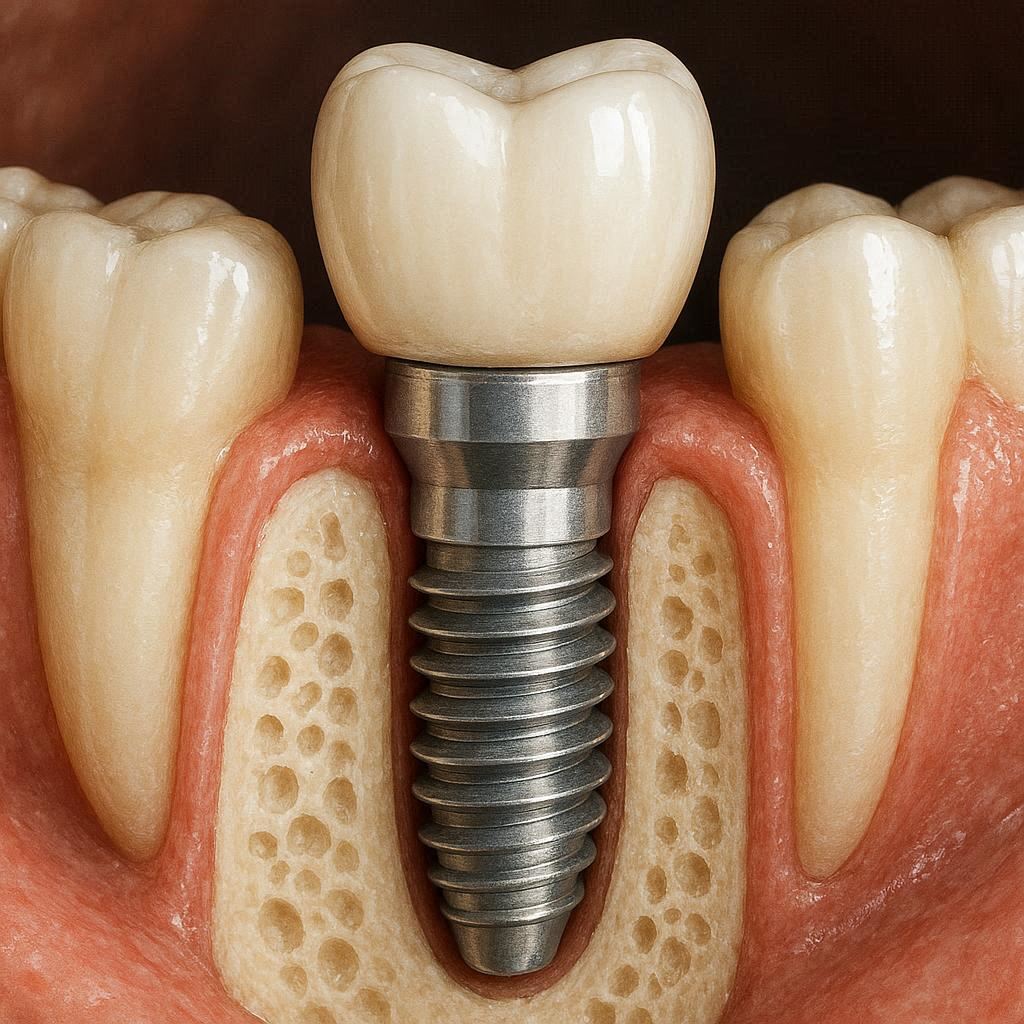
A complete dental implant solution actually has three separate parts.
| Part | What It Is | Where It Goes |
|---|---|---|
| Implant post (fixture) | Small titanium screw | Inside the jawbone |
| Abutment | Connector piece | Above the gumline, on top of the post |
| Dental crown | Artificial tooth | Visible part, attached to abutment |
Think of it like a light fixture. The implant post is the wiring inside the wall. The abutment is the socket. The crown is the lightbulb you see and use every day.
So when someone asks “what is a dental implant,” the most accurate answer is: a surgically placed titanium post that replaces the root of a missing tooth.
But in everyday conversation, most people use “dental implant” to mean the whole package — post, abutment, and crown. And that is fine. We will use the term the same way throughout this guide.
Why Do People Lose Teeth in the First Place?
To understand why implants are so useful, we need to look at the problem they solve. Tooth loss does not happen only to elderly people. It can happen at any age.
Here are the most common reasons.
- Severe tooth decay. When a cavity gets too deep, it destroys the tooth from the inside. Eventually, nothing remains to save.
- Gum disease (periodontitis). This infection damages the soft tissue and bone that hold your teeth in place. Over time, the tooth becomes loose and falls out.
- Trauma or injury. A fall, a car accident, or a sports impact can knock out a tooth completely.
- Failed root canal. Sometimes a root canal treatment does not work. The tooth becomes infected again and needs removal.
- Genetics or medical conditions. Some people naturally have weaker enamel or conditions that affect their teeth.
When you lose a tooth, you have three main options. You can do nothing. You can get a bridge. Or you can get a dental implant.
Doing nothing sounds free and easy. But it causes problems. Nearby teeth shift into the empty space. Your jawbone shrinks over time. Chewing becomes harder. Your smile changes shape.
A bridge uses two neighboring teeth as supports. The dentist shaves down those healthy teeth and connects a fake tooth between them. It works, but it damages healthy teeth.
An implant stands alone. It does not touch or harm your other teeth. That is one of its biggest advantages.
Note for readers: If you have a missing tooth, do not wait too long. The longer you wait, the more bone loss you experience. Less bone makes an implant harder to place.
The Different Types of Dental Implants
Not all implants are the same. Dentists choose different types based on your bone health, your budget, and how many teeth you are missing.
Let me walk you through the most common ones.
Endosteal Implants (The Most Common)
This is the standard type you will see in most dental offices. The word “endosteal” means “inside the bone.” The dentist drills a hole into your jawbone and places the titanium post directly inside.
After a few months of healing, the bone grows around the implant. This process is called osseointegration (more on that later). Once the implant is stable, the dentist adds the abutment and crown.
Endosteal implants work for most healthy adults who have enough bone density.
Subperiosteal Implants
Some people do not have enough healthy jawbone for a standard implant. Maybe they waited too long to replace a missing tooth. Maybe they had bone loss from gum disease.
In the past, those patients needed a bone graft first. Today, some dentists offer subperiosteal implants. Instead of going into the bone, this implant sits on top of the bone but under the gum. A metal frame rests against your jawbone. The gum heals over it, and the artificial teeth attach to posts that stick through the gum.
Subperiosteal implants are less common today. Many dentists prefer bone grafting instead because the long-term results are more predictable.
Zygomatic Implants
These are rare and used for extreme cases. If you have almost no bone in your upper jaw, a zygomatic implant anchors into your cheekbone (the zygomatic bone) instead of your jawbone.
Only a few specially trained oral surgeons perform this procedure. It is usually a last resort.
Mini Implants (MDIs)
Mini implants are smaller and narrower than standard implants. Dentists sometimes use them to stabilize a lower denture. They are less invasive and cost less. But they are not as strong as regular implants. For a single missing tooth, most dentists recommend a standard implant over a mini implant.
Quick comparison table:
| Type | Best for | Strength | Cost |
|---|---|---|---|
| Endosteal | Most patients | Very strong | $$ |
| Subperiosteal | Low bone density | Moderate | $$$ |
| Zygomatic | Extreme bone loss | Very strong | $$$$$ |
| Mini | Denture stabilization | Less strong | $ |
Important note: Do not choose an implant type based only on price. A weaker or less predictable implant may fail sooner. That means you pay twice — once for the implant and again to fix it or remove it.
The Anatomy of a Dental Implant: A Closer Look
Let me break down each part of a dental implant so you understand exactly what goes into your mouth.
The Implant Post (The Root)
This is the part that does the heavy lifting. The post is usually made of medical-grade titanium. Some newer implants use zirconia (a white ceramic material). Titanium is the gold standard because bone loves it. Your bone cells will actually grow right up to the titanium surface and lock it in place.
The post looks like a small screw. It has threads that help it grip the bone. The top of the post has an internal hex or star-shaped hole. That hole lets the dentist screw the abutment in later.
The Abutment (The Connector)
The abutment is a small metal or ceramic piece that screws into the implant post. It sticks up above the gumline. Think of it as a tiny pillar.
The abutment serves two jobs. First, it connects the crown to the post. Second, it shapes the gum tissue around the future tooth. The gum heals around the abutment and creates a natural-looking collar.
Some implants come with a built-in abutment. Others use a separate piece. Your dentist will choose based on your specific case.
The Dental Crown (The Visible Tooth)
This is the part everyone sees. The crown is custom-made to match the color, shape, and size of your natural teeth. A dental lab technician builds it from ceramic or zirconia.
The crown attaches to the abutment in one of two ways. It can be cemented on (like a bridge) or screwed on (so the dentist can remove it later for repairs). Many dentists prefer screw-retained crowns because they are easier to fix.
When all three parts work together, you get a tooth that looks natural, feels solid, and functions almost exactly like a real tooth.
How Does the Implant Stay in Place? (Osseointegration Explained)
This is the magic behind dental implants. And it is genuinely fascinating.
Your body normally rejects foreign objects. If you put a piece of metal under your skin, your body will attack it. But titanium is different.
When a dentist places a titanium post into your jawbone, your bone cells do not reject it. Instead, they grow right up to the titanium surface and lock onto it. Over time, the bone fuses with the implant. They become one solid structure.
This process has a scientific name: osseointegration (AH-see-oh-in-teh-GRAY-shun). “Osseo” means bone. “Integration” means joining together.
Osseointegration takes time — usually three to six months. During this period, you need to be careful. Do not chew on that side of your mouth. Avoid hard foods. Follow your dentist’s instructions exactly.
Why does it take so long? Because bone grows slowly. You cannot rush biology. But once osseointegration finishes, your implant becomes incredibly strong. In fact, the bond between bone and titanium is often stronger than the bond between a natural tooth root and its bone.
That is why dental implants have a success rate of over 95% in healthy patients. They literally become part of your body.
Note for readers: Some dentists advertise “teeth in a day” or “immediate loading.” That means they place the implant and attach a temporary crown on the same day. This is possible in specific cases, but not for everyone. Most patients still need the standard healing time. Be cautious of any dentist who promises a same-day permanent implant without a thorough exam.
Who Is a Good Candidate for Dental Implants?
Not everyone can get a dental implant right away. You need to meet certain conditions.
Let me give you a realistic checklist.
Good Candidates Usually Have:
- One or more missing teeth
- Enough jawbone density to support the implant
- Healthy gums (no active gum disease)
- Good overall health (certain conditions affect healing)
- Non-smoker or willing to quit during treatment (smoking dramatically increases failure rates)
- Realistic expectations (implants are not magic — they require care)
Who Might Need Extra Preparation?
Some people are not ready for an implant today, but they can become ready with extra treatment.
- Low bone density. You may need a bone graft before the implant.
- Gum disease. You need to treat the infection first.
- Uncontrolled diabetes. High blood sugar slows healing. Get your diabetes under control first.
- Heavy smoker. Smoking reduces blood flow to the gums. Quitting for at least two weeks before and after surgery improves success rates.
- Teeth grinding (bruxism). You may need a night guard to protect the implant.
Who Is Not a Candidate?
In rare cases, a dental implant is not recommended.
- Children or teenagers whose jaws are still growing
- Patients undergoing radiation therapy to the head or neck
- People with untreated autoimmune disorders that affect healing
- Patients with severe uncontrolled osteoporosis (certain medications like bisphosphonates increase risk)
If you fall into the “needs preparation” category, do not lose hope. Many patients get bone grafts or treat their gum disease and then receive implants successfully.
The Step-by-Step Dental Implant Procedure
Let me walk you through what actually happens during a dental implant procedure. I will be honest about the time, the discomfort, and what to expect at each stage.
Keep in mind: every case is different. Your timeline may vary.
Step 1: Initial Consultation (1 hour)
Your dentist will:
- Examine your mouth and remaining teeth
- Take X-rays or a 3D CT scan of your jaw
- Review your medical history
- Discuss your goals and budget
- Determine if you need bone grafting or other prep work
This is your chance to ask questions. Write them down before you go.
Step 2: Preparatory Work (If Needed)
Some patients need extra procedures before the implant. The most common is a bone graft. The dentist takes bone from another part of your body or uses donor bone powder. They pack it into the area where your bone is thin.
Bone grafting adds four to twelve months to your timeline. The graft needs time to turn into your own living bone.
Step 3: Implant Placement Surgery (1 to 2 hours)
On surgery day, your dentist will numb the area with local anesthesia. You stay awake but feel no pain. For anxious patients, sedation options are available.
The steps are:
- The dentist makes a small cut in your gum to expose the bone.
- They drill a precise hole into your jawbone.
- They screw the titanium implant post into the hole.
- They place a healing cap or cover screw on top.
- They stitch the gum closed over or around the implant.
That is it. You go home the same day.
Does it hurt? You will not feel pain during the procedure. After the anesthesia wears off, you will feel some soreness. Most patients describe it as less painful than a tooth extraction.
Step 4: Osseointegration Healing (3 to 6 months)
Now the waiting begins. Your bone needs time to fuse with the implant. During this period:
- You eat soft foods on the other side of your mouth
- You avoid chewing on the implant site
- You practice excellent oral hygiene
- You visit your dentist for check-ups
Some dentists place a temporary partial denture to fill the gap. This is purely cosmetic and does not put pressure on the implant.
Step 5: Abutment Placement (30 minutes)
Once osseointegration is complete, the dentist needs to uncover the implant. They make a tiny cut in your gum and attach the abutment. This is a minor procedure with local anesthesia.
Your gum then heals around the abutment for two to six weeks. This creates the natural collar shape.
Step 6: Crown Fabrication (2 to 4 weeks)
Your dentist takes impressions of your mouth. A dental lab uses those impressions to build your custom crown. They match the color to your neighboring teeth.
Modern labs use CAD/CAM technology to mill crowns from a single block of ceramic. This makes them very strong and natural-looking.
Step 7: Crown Attachment (1 hour)
The final step. Your dentist checks the fit and color of the crown. Then they attach it to the abutment either with cement or a small screw.
Congratulations. You now have a new tooth.
Total timeline: Most patients finish in 6 to 9 months from start to finish. Cases with bone grafting can take a year or more.
Note for readers: Do not rush the healing time. Every patient who has an implant fail early tries to do too much too soon. Trust the process.
Dental Implant Recovery: What to Expect Week by Week
Recovery is different for everyone. But here is a general roadmap based on what most patients experience.
Days 1 to 3 (The Swelling Phase)
- Your gum will be swollen and tender.
- You may have minor bleeding.
- You take pain medication as prescribed (usually ibuprofen or acetaminophen).
- You eat only cold soft foods: yogurt, smoothies, applesauce, pudding.
- You apply ice packs to your face for 15 minutes at a time.
- You sleep with your head elevated.
What to avoid: Spitting, using a straw, smoking, hot foods, heavy exercise.
Days 4 to 7 (The Bruising Phase)
- Swelling starts to go down.
- Bruising may appear on your cheek or neck. This is normal.
- You can switch to warm soft foods: mashed potatoes, oatmeal, scrambled eggs, soup.
- You can gently rinse with warm salt water.
- You return to light activity (walking is fine).
Weeks 2 to 4 (The Healing Phase)
- Most soreness disappears.
- You resume most normal activities.
- You can eat soft solid foods like pasta, fish, and cooked vegetables.
- You avoid hard, crunchy, or sticky foods.
- You continue salt water rinses twice daily.
Months 1 to 6 (The Osseointegration Phase)
- You feel completely normal.
- The implant is silent under your gum.
- You must still avoid chewing directly on the implant site with force.
- You maintain excellent brushing and flossing (avoid the implant area with floss).
After Crown Placement
- You may feel mild sensitivity for a few days.
- Your bite may feel slightly different. This is normal and will adjust.
- You can eat normally, including steak, apples, and nuts.
- You clean around the crown like a natural tooth.
The Cost of Dental Implants: An Honest Breakdown
Let us talk about money. Dental implants are not cheap. But they are also not as expensive as many people fear.
I will give you realistic numbers based on the United States market. Prices in other countries vary significantly.
| Item | Typical Cost Range (USD) |
|---|---|
| Initial consultation and X-rays/CT scan | 150−500 |
| Bone graft (if needed) | 300−3,000 |
| Implant post placement surgery | 1,500−3,000 |
| Abutment | 300−600 |
| Custom crown | 1,000−2,500 |
| Total for one implant (no graft) | 3,000−3,000−6,000 |
| Total for one implant (with graft) | 3,500−3,500−9,000 |
These numbers are for the implant itself. If you need multiple implants, the per-tooth cost often goes down.
Does Insurance Cover Implants?
Traditional dental insurance plans often do not cover implants. They call them “cosmetic” or “elective.” However, more plans now offer partial coverage.
- Some plans cover the crown portion (because a crown is “restorative”).
- Some plans cover the extraction of the old tooth but not the implant.
- Some plans have a waiting period before implant coverage begins.
Call your insurance company and ask these exact questions:
- “Does my plan cover dental implant posts?”
- “Does it cover the abutment and crown?”
- “Is there a waiting period?”
- “Do I have an annual maximum that applies?”
Payment Options
Many dental offices offer financing through third-party companies like CareCredit. You can pay over 6, 12, or 24 months with little or no interest.
Some patients travel to other countries for cheaper implants. Mexico, Costa Rica, Colombia, and Thailand offer implants for 800to2,000. But be careful. If something goes wrong, your local dentist may not want to fix another dentist’s work.
Note for readers: Cheap implants are rarely good. Good implants are rarely cheap. If a price sounds too good to be true, ask why. The material quality, the dentist’s training, and the sterilization standards all matter.
Pros and Cons of Dental Implants
Let me give you a balanced, realistic look at the advantages and disadvantages. No marketing hype. No fear-mongering.
The Pros (Why Patients Love Implants)
1. They look and feel like natural teeth.
Once the crown is on, most people cannot tell which tooth is the implant. Even you will forget it is there.
2. They preserve your jawbone.
When you lose a tooth, your jawbone starts to shrink. An implant stops that process. The bone stays healthy because it has a root to support.
3. They do not harm neighboring teeth.
A bridge requires shaving down healthy teeth. An implant stands alone. Your natural teeth remain untouched.
4. They are permanent.
With good care, a dental implant can last 25 years, 30 years, or even a lifetime. The crown may need replacement after 10 to 15 years due to normal wear. But the post stays forever.
5. They restore chewing power.
Dentures give you about 20% of natural chewing strength. Bridges give you about 60%. Implants give you 90% or more. You can eat steak, corn on the cob, and apples again.
6. They improve speech.
Ill-fitting dentures slip and cause slurring. Implants stay put. You speak normally.
The Cons (The Honest Downsides)
1. They are expensive upfront.
3,000to6,000 per tooth is real money. While implants save money long-term compared to replacing bridges every 7 to 10 years, the upfront cost is high.
2. The process takes a long time.
Six to nine months is a commitment. Some people do not want to wait that long.
3. Surgery carries risks.
Any surgery has potential complications: infection, nerve damage (rare), sinus problems (for upper implants), or implant failure.
4. Not everyone is a candidate.
If you have advanced bone loss or uncontrolled medical conditions, you may need extensive preparation or may not qualify at all.
5. Implants require daily care.
You cannot neglect them. Poor oral hygiene leads to peri-implantitis, an infection around the implant that can cause bone loss.
6. Smoking dramatically increases failure risk.
Smokers have failure rates 2 to 3 times higher than non-smokers. If you smoke and want an implant, you need to quit, at least during healing.
Dental Implants vs. Alternatives
Sometimes an implant is not the best choice for your specific situation. Let me compare your options honestly.
| Feature | Dental Implant | Fixed Bridge | Removable Denture | Do Nothing |
|---|---|---|---|---|
| Looks natural | Excellent | Good | Poor to fair | N/A |
| Chewing power | 90%+ | 60-70% | 20-30% | 0% (tooth missing) |
| Affects healthy teeth | No | Yes (shaves down 2 teeth) | No | No |
| Stops bone loss | Yes | No | No | No |
| Lifespan | 25+ years (post), 10-15 years (crown) | 7-15 years | 5-10 years | N/A |
| Upfront cost | High (3k−6k) | Medium (2k−4k) | Low (500−2k) | Free |
| Long-term cost | Low | Medium (replacements) | Medium (replacements, adhesives) | High (bone loss, other teeth shift) |
| Procedure time | 6-9 months | 2-4 weeks | 2-4 weeks | None |
When to Choose an Implant
- You are missing a single tooth (especially visible front tooth)
- You have good bone density
- You want a permanent solution
- You can afford the upfront investment
When to Choose a Bridge
- You are missing multiple teeth in a row
- You have low bone density and do not want a bone graft
- You want a faster solution
- Your budget is limited
When to Choose a Denture
- You are missing most or all of your teeth
- You have significant medical problems that make surgery risky
- You cannot afford implants
Note for readers: If you choose a bridge or denture now, you can still get an implant later. However, bone loss occurs over time. The longer you wait, the more likely you will need a bone graft.
How Long Do Dental Implants Last?
This is one of the most common questions. And the answer surprises many people.
The implant post (the titanium screw inside your bone) can last a lifetime. The longest studies follow patients for over 40 years. Those implants are still going strong.
The abutment also lasts indefinitely in most cases.
The crown (the visible tooth) wears down over time. Crowns typically last 10 to 15 years before they need replacement. You will not need surgery to replace the crown. The dentist simply unscrews or removes the old crown and attaches a new one.
What Affects Longevity?
| Positive factors | Negative factors |
|---|---|
| Good oral hygiene (brushing, flossing) | Poor oral hygiene |
| Regular dental check-ups | Smoking |
| Non-smoker | Teeth grinding (bruxism) |
| Healthy diet (low sugar) | Untreated gum disease elsewhere in the mouth |
| No teeth grinding | Medical conditions that affect healing (uncontrolled diabetes) |
| Using a night guard if needed | High sugar diet (increases decay risk on natural teeth) |
The most common reason implants fail long-term is peri-implantitis. This is an infection around the implant that destroys the bone holding it in place. It is similar to gum disease around natural teeth. The best prevention is excellent daily cleaning and professional cleanings every 6 months.
Risks and Complications: What Can Go Wrong?
I promised you an honest guide. So let me talk about the risks. They are rare, but they exist.
Short-Term Complications (During or Soon After Surgery)
- Pain and swelling. Normal, but manageable.
- Bleeding. Usually minor and stops within a day.
- Infection. Occurs in less than 2% of cases. Antibiotics treat it.
- Nerve injury. Rare (less than 1%). Can cause numbness in your lip, chin, or tongue. Usually temporary but can be permanent.
- Sinus perforation. For upper implants. The implant pokes into your sinus cavity. Usually heals on its own or requires a small repair.
Long-Term Complications (Months or Years Later)
- Implant failure (early). The bone does not fuse with the implant. This happens in about 5% of cases. Smoking and poor bone quality increase the risk.
- Implant failure (late). Bone loss around a previously successful implant. Usually caused by peri-implantitis or overloading (too much pressure).
- Crown fracture. Ceramic crowns can chip or crack. You replace the crown, not the implant.
- Screw loosening. The tiny screw holding the crown can loosen over time. Your dentist tightens it in 5 minutes.
Signs of a Problem (When to Call Your Dentist)
- Fever after surgery (could indicate infection)
- Severe pain that does not respond to medication
- The implant feels loose
- Bleeding or pus around the implant
- The crown changes color or chips
Note for readers: Do not panic. Serious complications are rare. Most implant patients have a smooth, uneventful experience. But knowing the signs helps you catch problems early.
Caring for Your Dental Implant: A Simple Daily Routine
Good news: caring for an implant is not hard. It is very similar to caring for natural teeth. But there are a few specific steps.
Daily Cleaning
- Brush twice a day with a soft toothbrush. Pay attention to the gumline around the implant.
- Floss once a day. Use unwaxed tape or implant-specific floss. Be gentle. Do not snap the floss against the gum.
- Use a water flosser (Waterpik) on a low setting to flush out food and bacteria from around the abutment.
- Avoid metal instruments. Never use metal scrapers or picks on an implant. They scratch the titanium or ceramic surface.
Professional Maintenance
- Visit your dentist every 6 months for cleanings.
- Your hygienist will use special plastic or graphite instruments on your implant.
- Your dentist will check the bite and tighten the screw if needed.
- X-rays every 12 to 24 months to check bone levels.
What to Avoid
- Chewing ice, hard candy, or pens (can crack the crown)
- Using your teeth as tools (opening packages, biting nails)
- Neglecting to wear a night guard if you grind your teeth
- Skipping dental check-ups
If you treat your implant with respect, it will serve you for decades. If you ignore it, you risk losing it.
Frequently Asked Questions (FAQ)
Q: Does getting a dental implant hurt?
A: The procedure itself is painless because of local anesthesia. Afterward, most patients describe soreness similar to a tooth extraction. Over-the-counter pain relievers usually manage it well.
Q: How long does the entire process take?
A: For a standard case without bone grafting, expect 6 to 9 months from first consultation to final crown. Cases with bone grafting take a year or more.
Q: Can I get a dental implant if I have gum disease?
A: Not until the gum disease is treated. Active infection prevents osseointegration. Your dentist will treat the gum disease first, then re-evaluate.
Q: Are dental implants safe for older adults?
A: Yes, age alone is not a problem. Many patients in their 70s and 80s receive implants successfully. Overall health matters more than age.
Q: Can my body reject a dental implant?
A: True allergic rejection is extremely rare (less than 0.1%). However, the bone may fail to fuse with the implant (non-integration). This is failure, not rejection.
Q: What happens if my implant fails?
A: Your dentist can usually remove the implant easily. After the bone heals (another 3 to 6 months), you can try again with a larger implant or a bone graft. Or you can choose a bridge or denture instead.
Q: Can I have an MRI with a dental implant?
A: Yes. Titanium is non-magnetic and safe for MRI. However, the implant may create a small artifact (blurred area) in the image near the implant. Tell the MRI technician you have an implant.
Q: Do implants whistle or make noise when I talk?
A: No. That is a myth. Implants are solid and silent.
Q: Can I whiten my dental implant crown?
A: No. The ceramic crown does not respond to whitening products. If you want to whiten your natural teeth, do it before the crown is made so the lab can match the new shade.
Q: How do I find a good implant dentist?
A: Look for a prosthodontist (specialist in tooth replacement) or an oral surgeon. Ask how many implants they place per year (more than 50 is good). Read patient reviews. Ask to see before-and-after photos.
Additional Resource
For patients who want to dive deeper into implant research, verify dentist credentials, or find financial assistance programs, here is a trusted external resource:
🔗 American Academy of Implant Dentistry (AAID) – Patient Education
Visit: aaid-implant.org/patients
This site offers a “Find an Implant Dentist” tool, a glossary of terms, animated procedure videos, and a cost calculator. It is free, non-commercial, and maintained by dental implant specialists.
Disclaimer
The information in this article is for educational and informational purposes only. It does not constitute medical or dental advice. Every patient is unique. You should always consult with a licensed dentist or oral surgeon before making any decisions about dental implant treatment. The author and publisher are not responsible for any outcomes resulting from the use of this information. Do not delay seeking professional care based on anything you have read here.
Conclusion
Now you know what a dental implant really is: a titanium post that replaces a missing tooth root, topped with a natural-looking crown. Implants preserve your jawbone, restore chewing power, and last for decades without harming neighboring teeth. The process takes time and costs more upfront than alternatives, but the long-term benefits often make it the best investment in your oral health.