What Is a Dental Partial vs Implant?
When you are missing one or more teeth, the decision about how to replace them is one of the most significant choices you will make for your long-term oral health. Two of the most common solutions are the removable partial denture and the fixed dental implant. They represent fundamentally different philosophies of tooth replacement. This guide provides a thorough, side-by-side comparison of these two options. We will explore the mechanics, the biological consequences, the costs, the longevity, and the daily experience of living with each. The goal is to provide you with the clear, honest, and complete information you need to make a confident, informed decision that aligns with your health goals, your lifestyle, and your budget.
The Removable Partial Denture: Design and Function
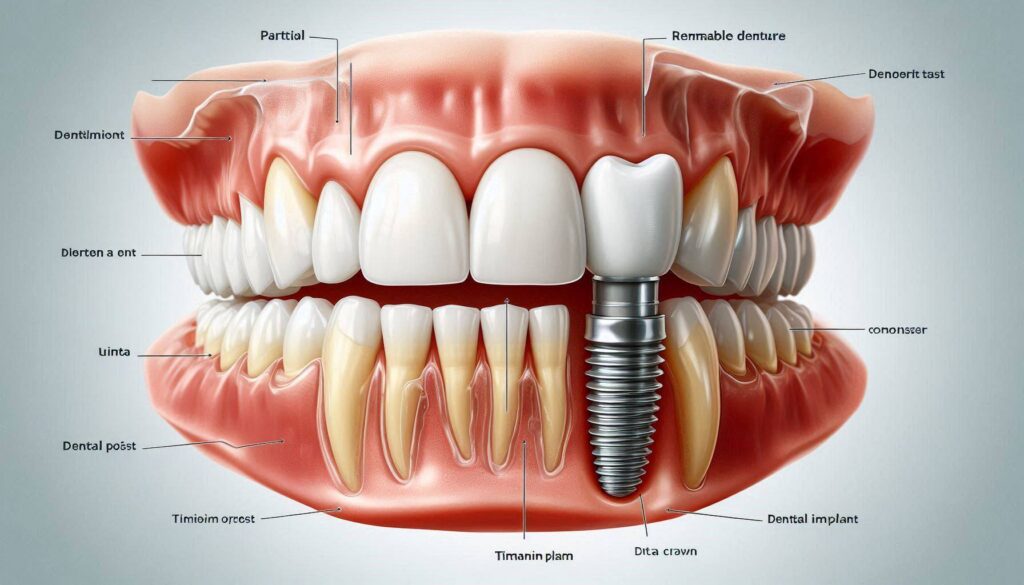
A removable partial denture is a prosthetic device that replaces one or more missing teeth on a dental arch. It is designed to be taken out of the mouth for cleaning and during sleep. The traditional partial denture consists of a metal framework, usually made of a cobalt-chromium alloy, which rests on the gums and the remaining natural teeth. The false teeth, made of acrylic or porcelain, are attached to this framework. The partial is retained in the mouth by metal clasps that wrap around specific natural teeth, called abutment teeth, holding the denture in place. Some modern designs use flexible, tooth-colored nylon materials like Valplast, which are more aesthetic and comfortable than the rigid metal framework.
The partial denture functions by distributing chewing forces between the gums, the underlying bone ridge, and the abutment teeth. The clasps are the source of retention, but they also create a mechanical load on the teeth they grip. The base of the denture rests on the soft tissue, providing some vertical support but no stimulation to the underlying bone. The patient must remove the partial after meals to clean it and to clean the abutment teeth, which are now at a higher risk of decay and gum disease because the clasps create food traps and plaque-retentive ledges. The partial denture is a removable, tissue-supported, and tooth-retained prosthesis. It replaces the crowns of the missing teeth above the gumline. It does nothing to replace the roots.
The Biological Consequences of a Partial Denture
The critical distinction lies beneath the surface. When the natural tooth roots were lost, the bone that supported them began a process of resorption. The partial denture does not halt this process. In fact, the pressure of the denture base on the gum tissue can, over years, accelerate the resorption of the underlying edentulous ridge. The bone continues to melt away, silently and progressively. This is why a partial denture that fits well today may become loose and unstable in five or ten years. The bony foundation is disappearing, and the denture, a rigid device, cannot adapt. The patient then requires relines of the denture base to fill the new void, or eventually, a complete remake.
The clasps on the abutment teeth create specific biological risks. Each clasp encircles a natural tooth, creating a zone of plaque stagnation. The tooth structure under a clasp is highly susceptible to demineralization and decay, particularly if the patient is not meticulous with daily cleaning around and under the clasp arm. The forces transmitted by the clasp during chewing can traumatize the periodontal ligament of the abutment tooth, leading to mobility and bone loss. An abutment tooth that was healthy at the start can become compromised over years of service supporting a partial denture. The partial denture trades the replacement of missing teeth for an increased disease burden on the remaining natural teeth. This is the biological compromise inherent in this design.
The Dental Implant: A Radically Different Philosophy
The dental implant is the antithesis of the removable partial. It does not rest on the gums. It does not clasp onto neighboring teeth. It is an independent, surgically placed replacement for the missing tooth root. The titanium fixture is placed into the jawbone, and over a period of months, the bone fuses to it. This process, osseointegration, creates a prosthetic root that is as solid as a natural one. A custom abutment and a porcelain crown are then attached to the implant. The result is a single, fixed, free-standing tooth that does not touch or burden the adjacent teeth in any way.
The implant crown is a complete restoration of the entire tooth structure, both root and crown. The chewing forces are transmitted through the crown, down the implant body, and directly into the bone. This is the same piezoelectric stimulation that natural teeth provide. The implant halts the bone resorption process at that site. It preserves the jawbone. It maintains the height and width of the alveolar ridge. It supports the gum tissue and the papilla between teeth. The biological consequence of an implant is structural preservation. It is the only tooth replacement option that actively maintains the body’s own architecture. This is not a subtle difference. It is the fundamental reason why the implant is considered the standard of care for a single missing tooth.
The Biomechanical Independence of the Implant
The most beautiful feature of an implant from a tooth-preservation standpoint is its autonomy. A partial denture must cling to the remaining natural teeth to stay in place. This connection comes at a cost. An implant stands alone. It asks nothing of its neighbors. The two healthy teeth adjacent to the missing space are left completely untouched. They are not cut down for a bridge. They are not wrapped in clasps. They remain intact, healthy, and bearing only their own natural functional loads. This is conservative dentistry in its purest form: replace what is lost without sacrificing what remains.
The implant also prevents the cascade of dental migration that a partial denture does nothing to stop. When a tooth is lost and not immediately replaced, the opposing tooth begins to super-erupt, searching for a contact. The adjacent teeth drift and tilt into the space. A partial denture simply fills the empty space. It provides a mechanical blockade against drifting, but it does so at the expense of the abutment teeth. An implant, by recreating the complete tooth, re-establishes normal occlusal contacts and normal interproximal contacts. It integrates seamlessly into the arch and functions as a full member of the dentition. It stabilizes the occlusion and prevents pathological migration through a physiologic, not a mechanical, mechanism.
The Comparative Table: Partial vs. Implant
A side-by-side comparison brings the contrasts into sharp relief. The following table evaluates each option across the key dimensions that matter for your decision. This is a tool for clarity, not an endorsement of one option over the other. The right choice is the one that aligns with your medical status, your financial reality, and your personal priorities.
Partial Denture vs. Dental Implant: A Detailed Comparison
| Feature | Removable Partial Denture | Dental Implant with Crown |
|---|---|---|
| Effect on Adjacent Teeth | Clasps create plaque traps and increase risk of decay and mobility on abutment teeth | No effect; implant is completely independent |
| Jawbone Preservation | No stimulation; bone resorption continues under the denture base | Stimulates bone; halts resorption and preserves ridge volume |
| Stability and Retention | Can move, rock, or dislodge during eating or speaking | Fixed, solid, and completely stable; feels like a natural tooth |
| Daily Maintenance | Must be removed and cleaned separately; abutment teeth require special cleaning aids | Brushed and flossed like a natural tooth; requires water flosser and interdental brushes |
| Longevity | 5 to 8 years on average before needing reline or replacement | Crown may need replacement in 15-25 years; implant fixture can last a lifetime |
| Surgery Required | No surgery; non-invasive impressions and fittings | Yes; minor oral surgery for implant placement, possibly bone grafting |
| Treatment Timeline | Typically 4 to 8 weeks from start to delivery | 4 to 8 months (or longer if grafting is required) to final crown |
| Initial Cost | Lower upfront cost; often partially covered by insurance | Higher upfront investment |
| Long-Term Cost | Requires periodic relines, repairs, and eventual replacement | Lower long-term maintenance costs; no repeat surgeries needed |
| Taste and Comfort | Base can cover parts of the palate, affecting taste and thermal sensation | No palate coverage; feels like a natural part of the body |
| Psychological Impact | Removable device; may cause self-consciousness about slippage or appearance | Fixed, permanent, and indistinguishable from natural teeth; high confidence |
The Practical and Financial Realities
The choice between a partial and an implant is often framed as a financial decision. The partial denture has a significantly lower initial cost. It is typically a fraction of the total cost of a dental implant. Many dental insurance plans provide coverage for partial dentures as a basic or major service, with a coinsurance of 50 percent and a more generous annual maximum than they offer for implants. The partial denture requires no surgery. There is no recovery period. The process is comfortable, non-invasive, and relatively fast. For a patient who is medically compromised, who cannot undergo even minor oral surgery, or who is a heavy smoker unwilling to quit, a partial denture is a rational, appropriate, and functional choice.
The dental implant carries a higher initial investment. However, this cost must be evaluated over the long term. The partial denture is a depreciating asset with a finite service life. It will require relining as the ridge resorbs. The clasps will fatigue and loosen. The acrylic may fracture. The abutment teeth, placed under chronic stress, may develop problems requiring restoration, endodontic therapy, or extraction. A single tooth lost originally can, over a decade, cascade into the loss of two abutment teeth and the need for a much larger, more expensive prosthesis. The implant, by preserving the bone and protecting the adjacent teeth, interrupts this destructive cycle. The implant is a one-time, definitive solution. Over a 20-year horizon, the total cost of ownership of an implant is often less than the cumulative cost of a partial denture and the additional restorative work it necessitates. This is the long-term value equation that must inform the financial decision.
Making the Right Choice for Your Unique Situation
There is no universally correct answer. The decision between a partial denture and an implant is a personal one, made in consultation with your dentist, based on a thorough assessment of your oral and systemic health. If you have adequate bone volume, a healthy medical profile, and a commitment to excellent oral hygiene, an implant is the biologically superior option. It preserves bone, protects neighboring teeth, and provides a permanent, confident solution. If you have significant medical comorbidities, are a heavy smoker, have insufficient bone and are not a candidate for or do not wish to undergo grafting, or if your financial situation makes the upfront implant cost prohibitive, a high-quality removable partial denture is a valid, functional, and perfectly acceptable solution.
The worst decision is to do nothing. The space created by a missing tooth is a progressive disease state. It leads to drifting, super-eruption, bone loss, and occlusal collapse. Whether you choose an implant or a partial, the essential act is to fill the space and restore the integrity of your dental arch. Your dentist should present you with all the options, explain the biological and financial trade-offs honestly, and support you in making the choice that is right for you. Do not let the perfect be the enemy of the good. A well-made partial denture, properly maintained, is a far better outcome than a mouth full of shifting teeth and deteriorating bone.
Conclusion
A removable partial denture is a tissue and tooth-supported device that replaces the visible crowns of missing teeth but does not prevent the progressive bone resorption beneath it and creates a chronic risk of decay and periodontal disease on the clasped abutment teeth. A dental implant is a surgically placed, independent replacement of the entire tooth structure, root and crown, which stimulates the bone, halts resorption, and requires no support from or modification of the adjacent healthy teeth. The choice between them balances the partial denture’s lower initial cost and non-invasive approach against the implant’s superior biological preservation, long-term cost-effectiveness, and the profound psychological benefit of a permanent, fixed, and indistinguishable natural tooth.
Frequently Asked Questions
Can I sleep with my partial denture in?
No. A removable partial denture must be removed at night. The gum tissues need a period of rest and exposure to saliva to remain healthy. Sleeping with a partial denture in place dramatically increases the risk of fungal infections and inflammation of the gums under the denture base.
Is the implant surgery for a single tooth very painful?
The surgery is performed under local anesthesia, so you will feel pressure but no sharp pain. Post-operative discomfort is typically managed well with over-the-counter pain relievers and resolves within a few days. Most patients report the experience was far less painful than they anticipated.
How many implants do I need if I am missing three teeth in a row?
This depends on the specific clinical situation. A common solution is a three-unit implant-supported bridge, where two implants support three artificial teeth. In some cases, three individual implants may be placed. In others, a removable partial denture might be recommended. Your bone volume and anatomy will dictate the possibilities.
Can a partial denture be converted to an implant later?
Yes. This is a common sequence of treatment. A patient may begin with a partial denture and then, years later, choose to transition to an implant-supported restoration. The fact that a partial was worn does not preclude future implant placement, though the bone under the partial base will likely have resorbed and may require grafting.
Which option feels more like having a natural tooth?
A dental implant is, by a significant margin, the option that most closely replicates the feel of a natural tooth. It is fixed, immovable, and transmits force directly to the bone. A partial denture, no matter how well-made, is a removable appliance that sits on the gums and has some degree of inherent movement.
Additional Resource
The American College of Prosthodontists is the authority on the replacement and restoration of teeth. Their patient education resources provide deep, unbiased information on all tooth replacement options, from removable partial dentures to complex implant reconstructions. Visit: https://www.gotoapro.org/