What Is A Zygomatic Dental Implant?
You sit in the consultation room, and your implant surgeon mentions a term you have never heard before. Zygomatic implant. The name sounds complex, even intimidating. You learn that conventional implants may not work for you because you lack sufficient bone in your upper jaw. But these longer implants, anchored in your cheekbone, might provide a solution. You need to understand what they are, how they work, and what the procedure involves.
Zygomatic dental implants represent a specialized solution for patients with severe bone loss in the upper jaw who cannot receive conventional implants without extensive bone grafting. This guide explains everything about these remarkable devices, from anatomy and surgical technique to recovery and long-term outcomes.
The Core Definition
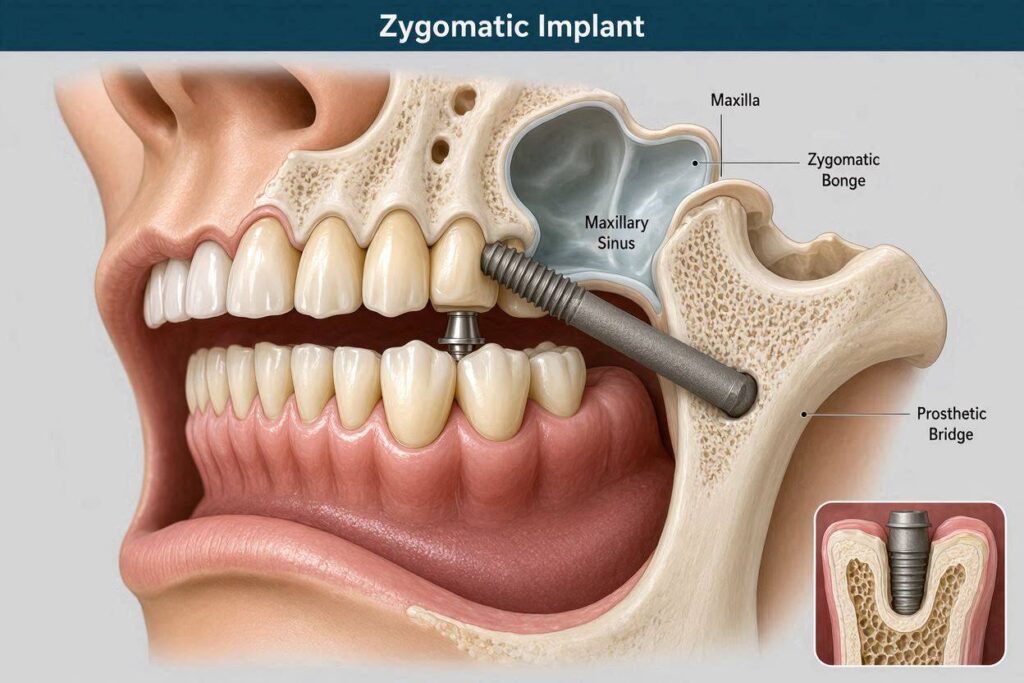
A zygomatic dental implant is a longer-than-standard dental implant that anchors into the zygomatic bone (cheekbone) rather than the maxillary jawbone. It is used when the maxillary bone has resorbed so severely that conventional implants cannot be placed, even with bone grafting. The zygomatic bone, being denser and more resistant to resorption, provides a stable alternative anchorage site.
Zygomatic implants were developed specifically to solve the problem of the severely atrophic maxilla. Without them, patients with extreme upper jaw bone loss faced either extensive bone grafting procedures requiring many months of healing or the prospect of remaining in removable dentures permanently.
The Anatomical Basis
To understand zygomatic implants, you must understand the relevant anatomy.
The Maxilla and Bone Loss
The maxilla is the upper jawbone. After teeth are lost, the maxillary bone begins to resorb. In the posterior region (back of the upper jaw), this resorption is compounded by the presence of the maxillary sinus, an air-filled space that expands as bone is lost. Over years, the floor of the maxillary sinus can descend until only a thin shell of bone remains between the oral cavity and the sinus.
Conventional implants require adequate bone height and width. In the posterior maxilla, bone height is often insufficient due to sinus expansion. Bone grafting procedures, including sinus lifts, can add bone volume but require additional surgery and months of healing.
The Zygomatic Bone
The zygomatic bone is the cheekbone. It is a dense, strong bone that forms the prominence of the cheek and contributes to the orbit (eye socket) floor. The zygomatic bone is:
- Dense cortical bone with excellent load-bearing capacity
- Resistant to resorption regardless of tooth loss
- Located lateral and superior to the maxillary sinus
- Accessible from inside the mouth via a surgical approach
The Anatomical Relationship
A zygomatic implant passes from inside the mouth, through or alongside the maxillary sinus, and anchors into the zygomatic bone. The implant bypasses the deficient maxillary bone entirely, gaining its stability from the dense bone of the zygoma.
How Zygomatic Implants Differ from Conventional Implants
| Feature | Conventional Implant | Zygomatic Implant |
|---|---|---|
| Length | 8–16 mm typical | 30–55 mm typical |
| Anchorage site | Maxillary or mandibular alveolar bone | Zygomatic bone |
| Primary indication | Adequate bone for placement | Severe maxillary atrophy |
| Need for bone grafting | Often required in atrophic cases | Eliminates need for grafting |
| Surgical complexity | Moderate | High; advanced surgical skill required |
| Angle of placement | Relatively vertical | Angled; passes through or near the sinus |
| Number typically placed | Variable | Usually 1–4 per arch; often with conventional implants anteriorly |
| Immediate loading | Sometimes | Typically part of immediate loading protocols |
| Treatment time | 3–6 months typical | Often immediate loading possible |
Indications for Zygomatic Implants
Zygomatic implants are not first-line treatment. They are reserved for specific clinical situations.
Primary Indications
- Severe maxillary atrophy: Insufficient bone for conventional implants in the posterior maxilla
- Failed bone grafting: Previous sinus lift or grafting procedures that did not produce adequate bone
- Contraindications to bone grafting: Medical conditions or patient preference against grafting
- Need for immediate function: When prolonged treatment with grafting and delayed loading is undesirable
- Failed conventional implants: After multiple implant failures in the posterior maxilla
Contraindications
- Active sinus infection or pathology
- Significant zygomatic bone pathology or insufficient zygomatic bone
- Uncontrolled systemic disease
- Heavy smoking (relative contraindication)
- Bleeding disorders
- Previous radiation to the zygomatic area
The Zygomatic Implant Procedure
The placement of zygomatic implants is technically demanding and typically performed by oral and maxillofacial surgeons or periodontists with advanced training.
Pre-Surgical Planning
Extensive planning precedes surgery:
- Cone beam CT (CBCT): Essential for evaluating the zygomatic bone, maxillary sinus, and planned implant trajectory
- Virtual surgical planning: Digital placement of implants to determine optimal position, angle, and length
- Surgical guide fabrication: 3D-printed guides to assist with accurate placement
- Medical evaluation: Assessment of fitness for the surgical procedure
Surgical Technique
The procedure is typically performed under general anesthesia or IV sedation.
Steps:
- Incision: An incision is made along the upper gum, often extending toward the cheek area
- Flap elevation: The gum tissue is reflected to expose the maxilla and provide access to the zygomatic bone
- Sinus window (if needed): A small window may be created in the lateral wall of the maxillary sinus to visualize the implant trajectory
- Implant site preparation: Specialized long drills prepare the path from the maxillary ridge to the zygomatic bone
- Implant placement: The zygomatic implant is inserted along the planned trajectory
- Stability verification: Primary stability is confirmed; typically excellent due to zygomatic bone density
- Multi-unit abutment placement: Abutments that will support the prosthesis are attached
- Closure: The tissue is sutured, often with the abutments protruding through the gum
- Impression: For immediate loading, an impression is taken for prosthesis fabrication
Implant Trajectory Options
| Approach | Description |
|---|---|
| Intrasinus | Implant passes through the maxillary sinus, anchored in zygomatic bone; most common approach |
| Extrasinus | Implant passes outside the lateral wall of the sinus; avoids sinus penetration |
| Zygoma anatomy-guided | Trajectory determined by individual zygomatic bone anatomy |
Immediate Loading Protocol
Zygomatic implants achieve excellent primary stability due to the dense cortical bone of the zygoma. This often allows for immediate loading, where a temporary prosthesis is delivered within 24–72 hours of surgery. The patient leaves with functional teeth the same week as implant placement.
The Zygomatic Implant Prosthesis
The prosthesis attached to zygomatic implants requires careful planning.
Design Considerations
- Zygomatic implants emerge at an angle different from conventional implants
- Multi-unit abutments correct the angulation, providing a prosthetic platform parallel to conventional implants
- The prosthesis typically spans the full arch, splinting zygomatic and conventional implants together
- Cantilevers (extensions beyond the last implant) are minimized
Typical Configurations
| Configuration | Description |
|---|---|
| Zygoma quad | Two zygomatic implants posteriorly plus two or more conventional implants anteriorly |
| Zygoma hybrid | One zygomatic implant on one side plus conventional implants |
| Bilateral zygomatic | Two zygomatic implants, one on each side |
| Quad zygoma | Four zygomatic implants (two per side); used in extreme atrophy |
Advantages of Zygomatic Implants
Elimination of Bone Grafting
This is the primary advantage. Zygomatic implants bypass the need for bone grafting entirely, saving:
- Additional surgical procedures
- Months of graft healing time
- Graft donor site morbidity
- Additional surgical costs
Immediate Function
Most zygomatic implant cases are immediately loaded, meaning the patient receives teeth within days. This eliminates the prolonged period without teeth that accompanies grafting and delayed implant protocols.
Reduced Treatment Time
| Treatment Phase | Conventional with Grafting | Zygomatic Implants |
|---|---|---|
| Grafting surgery | 1 day | Not needed |
| Graft healing | 4–9 months | Not applicable |
| Implant placement | 1 day | 1 day |
| Osseointegration | 3–6 months | Not needed for loading |
| Prosthesis delivery | 3–6 months after placement | 24–72 hours |
| Total time | 7–18 months | Days to weeks |
High Success Rates
Studies report zygomatic implant survival rates of 95–98% over observation periods of 5–12 years, comparable to conventional implants in native bone.
Risks and Complications
Zygomatic implants carry specific risks beyond those of conventional implants.
Surgical Complications
| Complication | Description | Incidence |
|---|---|---|
| Sinusitis | Inflammation or infection of the maxillary sinus | 5–15% |
| Oro-antral fistula | Communication between mouth and sinus | Uncommon |
| Nerve injury | Infraorbital nerve or zygomatic nerve damage | Rare |
| Orbital penetration | Implant entering the orbit | Very rare; catastrophic |
| Bleeding | From maxillary artery branches | Rare |
| Soft tissue dehiscence | Wound opening | 5–10% |
Prosthetic Complications
| Complication | Description |
|---|---|
| Screw loosening | Abutment or prosthetic screw loosening |
| Prosthesis fracture | Fracture of the temporary or final prosthesis |
| Speech difficulties | Due to altered palatal contours |
| Oral hygiene challenges | Difficulty cleaning around the angled abutments |
Late Complications
- Peri-implantitis: Infection around the implant; challenging to treat given the implant location
- Late sinus complications: Chronic sinusitis related to the implant
- Implant failure: Rare but possible; removal is significantly more complex than for conventional implants
Recovery and Aftercare
Post-Operative Period
The immediate post-operative period involves:
- Swelling and bruising, often more extensive than with conventional implants (may involve the cheek and eye area)
- Pain managed with prescribed medication
- Antibiotics to prevent sinus infection
- Nasal precautions (no forceful nose blowing, sneezing with mouth open)
- Soft diet for several weeks
Long-Term Maintenance
Zygomatic implants require the same meticulous care as conventional implants:
- Excellent oral hygiene, which can be challenging around the angled abutments
- Regular professional maintenance
- Monitoring for sinus symptoms
- Periodic radiographic evaluation
Candidacy Evaluation
Who Is a Candidate
The ideal candidate for zygomatic implants:
- Has severe maxillary atrophy precluding conventional implants
- Wishes to avoid bone grafting
- Has adequate zygomatic bone (confirmed by CBCT)
- Is in adequate health for the surgical procedure
- Has realistic expectations
- Is committed to long-term maintenance
The Evaluation Process
| Step | Purpose |
|---|---|
| Clinical examination | Assess oral health, remaining dentition, soft tissues |
| CBCT imaging | Evaluate zygomatic bone, maxillary sinus, anatomical relationships |
| Medical history review | Identify conditions affecting surgery or healing |
| Virtual treatment planning | Determine implant position, trajectory, and prosthetic plan |
| Discussion of risks and alternatives | Informed consent |
Zygomatic Implants vs. Alternatives
Zygomatic Implants vs. Bone Grafting with Conventional Implants
| Factor | Zygomatic Implants | Grafting + Conventional Implants |
|---|---|---|
| Number of surgeries | Typically 1 | 2–3 (graft, possibly second graft, implant placement) |
| Treatment time | Days to weeks | 7–18 months |
| Morbidity | Single surgical episode | Multiple surgical episodes; graft donor site morbidity |
| Immediate teeth | Yes | No; wait months |
| Success rates | 95–98% | 90–95% (varies with graft type) |
| Surgical complexity | High | Moderate to high |
| Surgeon availability | Limited; specialized training required | Widely available |
Zygomatic Implants vs. Removable Dentures
For patients with severe atrophy, the choice is often between zygomatic implants and remaining in removable dentures:
| Factor | Zygomatic Implants | Complete Dentures |
|---|---|---|
| Stability | Fixed | Adhesive-dependent |
| Function | Near-normal | Significantly reduced |
| Quality of life | High | Variable; often poor in atrophic cases |
| Cost | High | Lower |
| Surgical involvement | Significant | None |
Conclusion
A zygomatic dental implant is a specialized, extended-length implant that anchors into the dense zygomatic bone of the cheekbone rather than the deficient maxillary jawbone. Developed for patients with severe upper jaw bone loss, these implants eliminate the need for bone grafting, allow immediate loading with functional teeth placed within days, and demonstrate success rates comparable to conventional implants. The procedure requires advanced surgical expertise and carries specific risks including sinus complications. For appropriate candidates, zygomatic implants offer a transformative alternative to prolonged grafting procedures or a lifetime of inadequate removable dentures.
Frequently Asked Questions
How long are zygomatic implants?
Zygomatic implants typically range from 30 to 55 millimeters in length, compared to 8 to 16 millimeters for conventional implants. The length allows them to reach from the maxillary ridge to the zygomatic bone.
Are zygomatic implants safe?
When placed by properly trained and experienced surgeons, zygomatic implants have demonstrated safety and success rates of 95–98% over long-term follow-up. However, they carry specific risks including sinus complications that must be discussed before treatment.
How painful is zygomatic implant surgery?
The surgery is performed under general anesthesia or IV sedation and is not painful during the procedure. Post-operative discomfort is typically moderate, with swelling and bruising that may extend to the cheek and eye area. Pain is managed with prescribed medication and usually resolves over 1–2 weeks.
Can zygomatic implants be used in the lower jaw?
No. Zygomatic implants are specifically designed for the upper jaw, where the zygomatic bone provides an alternative anchorage site. The lower jaw has different anatomical characteristics, and alternative solutions such as short implants or nerve lateralization address severe lower jaw atrophy.
How much do zygomatic implants cost?
Zygomatic implant treatment is more expensive than conventional implants due to the specialized surgical expertise, hospital or surgical facility fees, general anesthesia costs, and the complexity of the prosthesis. Total costs typically range from $15,000 to $40,000 or more per arch, varying by geographic location and case complexity.
Additional Resources
- American Association of Oral and Maxillofacial Surgeons: www.aaoms.org
- International Congress of Oral Implantologists: www.icoi.org
- Academy of Osseointegration: www.osseo.org