What Is Abutment in Dental Implants and How It Works
The dental implant journey is a sequence of precisely engineered components, each with a distinct and critical role. The implant fixture fuses with the bone, hidden and silent. The crown is the beautiful, functional tooth that you see and use every day. But there is a middle component, an unsung hero, that bridges these two worlds. It is the abutment. The abutment is a small, custom-shaped or stock connector that screws into the implant fixture and protrudes through the gum, providing the platform upon which the final crown or bridge is attached. It is the architectural transition piece that handles the biological environment of the gum on one side and the mechanical demands of the prosthesis on the other. A poorly chosen or poorly fitting abutment can lead to a catastrophic chain of events: a loose crown, bacterial leakage, bone loss, and ultimately, implant failure. This article provides a comprehensive guide to the abutment. You will learn what it is, the types and materials, how it is placed, and why this small component is so critically important to the long-term health and beauty of your implant.
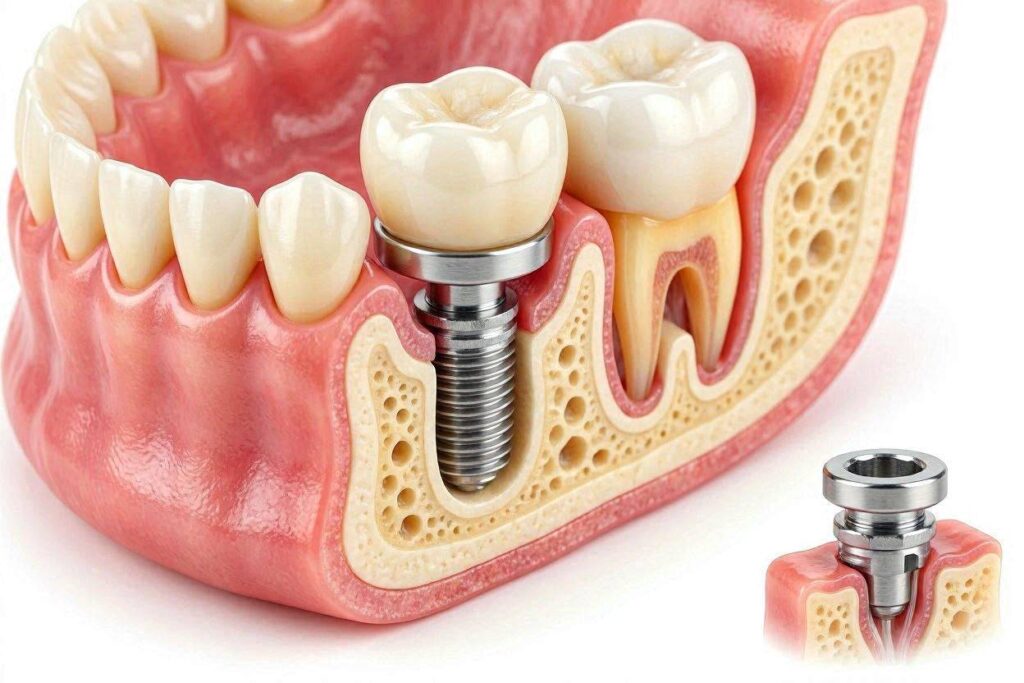
The Abutment Defined: The Connector and the Seal
The abutment is defined in implant dentistry as the intermediate component that is securely fastened to the implant fixture and serves to support and retain the definitive prosthesis. It is the connecting link. One end of the abutment has a precisely machined geometry that engages the internal connection of the implant fixture—be it an internal hex, an octagon, or a Morse taper cone. The other end is shaped to receive the crown, either via a cementable post or a screw-access channel. The abutment must perform a triple function. First, it must create a mechanically stable, leak-proof seal with the implant fixture, eliminating any micro-gap where bacteria could colonize. Second, it must emerge from the gum platform with a contour that supports the peri-implant soft tissue, creating a healthy, aesthetic cuff. Third, it must provide a retentive, stable core for the final prosthesis. It is a structural, biological, and aesthetic component simultaneously.
Abutment vs. Healing Abutment
A common point of confusion is the distinction between a definitive abutment and a healing abutment. A healing abutment, also called a healing cap, is a temporary, wide, dome-shaped or cylindrical piece placed at the second-stage surgery or at the time of implant placement. Its sole purpose is to shape the gum tissue as it heals, creating a round, easily accessible opening to the implant platform. It is not strong enough to support a tooth. The definitive abutment is the custom or stock component that is placed after the tissue has healed, and it is tightened to the precise torque specification (usually 30-35 Ncm) to receive the final crown for a lifetime of function.
Types of Abutments
The choice of abutment type is a complex restorative decision that balances the implant’s 3D position, the required aesthetics, the functional load, and the economics. The two broad categories are stock (prefabricated) and custom (patient-specific) abutments.
1. Stock Abutments
Stock abutments are mass-produced by the implant manufacturer. They come in a range of standard cuff heights, angulations (straight or angled, typically 15° or 25°), and diameters. They are made of titanium, or a titanium base with a white ceramic sleeve. Their main advantages are cost-effectiveness and the fact that they do not require a separate laboratory custom-milling phase. They work very well when the implant has been placed in an ideal, prosthetically-driven position, and the gum tissue is of even thickness. The disadvantage is a lack of ideal customization; the emergence profile might not perfectly support the gum, and in aesthetic zones, a stock titanium abutment can show through thin tissue as a grey shadow.
2. Custom-Milled Abutments (UCLA or CAD/CAM)
A custom abutment is designed and milled specifically for a single patient’s implant site. The process begins with a digital scan or an impression. A dental laboratory technician uses CAD (Computer-Aided Design) software to design an abutment whose emergence profile perfectly matches the gum contours, the angulation of the implant, and the ideal shape of the future crown. The design is then milled from a solid block of titanium, zirconia, or a hybrid material. A custom abutment allows the dentist to compensate for an implant that is placed at a less-than-ideal angle, to create a perfectly shaped gum cuff, and to place the crown’s margin at the precisely correct depth for optimal aesthetics and hygiene. In modern aesthetic implantology, a custom zirconia abutment is the standard of care for anterior teeth.
3. Two-Piece vs. One-Piece Healing Abutments
This refers to a specific workflow. Some systems use a “two-piece” abutment concept where a titanium base (Ti-base) is screwed into the implant, and a custom-milled ceramic crown is bonded onto it. This hybrid approach combines the strength and precise fit of a titanium-to-titanium connection with the aesthetics of a custom-ceramic emergence profile. A “one-piece” approach is typical for a full-zirconia abutment where a single block of zirconia is milled to the final shape, and it engages the implant connection directly. Some clinicians prefer a two-piece approach for a screw-retained crown, as the Ti-base provides a very strong, retrievable connection.
Abutment Materials: A Critical Aesthetic and Biological Choice
The material of the abutment profoundly influences the color of the surrounding gum and the long-term health of the soft tissue seal.
Titanium Abutments
Titanium is the traditional, extremely strong, and well-documented abutment material. A titanium abutment, when engaging a titanium implant connection, creates a metal-to-metal seal that is virtually impervious to bacterial micro-leakage. Titanium is highly biocompatible, and the soft tissue can form a healthy hemidesmosomal attachment to its polished surface, much like it does to a natural tooth root. The major disadvantage is its dark grey metallic color. In a patient with a thin gingival biotype, a titanium abutment can cast a grey shadow through the gum, creating an aesthetic failure.
Zirconia Abutments
Zirconia is a high-strength, tooth-colored ceramic. It is the material of choice for the aesthetic zone. A white zirconia abutment reflects light naturally through the gum, eliminating the metal shadow and producing a vibrant, pink, healthy appearance. Zirconia also has excellent biocompatibility and very low plaque affinity. The concern historically was about the risk of fracture at the connection, but modern, precision-milled zirconia abutments, especially with a metal insert, have a very high clinical success rate. A zirconia abutment is a premium option that directly addresses the grey-gum aesthetic problem.
Titanium-Base with Zirconia or Lithium Disilicate Hybrid
A hybrid abutment uses a stock or custom titanium base with an externally bonded ceramic core. The Ti-base provides the strong, metal-to-metal screw connection. The ceramic, which can be layered with the final crown, provides the white color. This approach marries mechanical reliability with superior optics. It is particularly popular for screw-retained anterior crowns.
How the Abutment Works: Placement and Torque
The abutment is not simply dropped into the implant. Its placement is a precise technical step. After the healing abutment is removed, the gum tissue is inspected. The definitive abutment is tried in. A radiograph is often taken to confirm it is fully seated, with no gap between the abutment and the implant platform. A gap here is a haven for bacteria. Once seating is verified, the abutment screw is tightened using a calibrated manual torque wrench to the exact Newton-centimeter value specified by the manufacturer, typically 30 or 35 Ncm. This precise torque is critical. Under-torquing leads to screw loosening, which is the most common mechanical complication in implant dentistry. Over-torquing can strip the screw threads, deform the connection, or even crack the ceramic. The torque is then documented in the patient’s chart. The abutment is now a fixed, stable core, ready to receive the final crown.
The Biological Role of the Abutment: The Soft Tissue Seal
The portion of the abutment that passes through the gum is the critical seal zone. The soft tissue must attach to this surface to create a barrier against the bacterial onslaught of the oral cavity. The epithelial cells form a hemidesmosomal attachment to the abutment surface, and the underlying connective tissue fibers form a tight cuff. This is the “biological width” around an implant. The surface finish of the abutment in this zone is critical. It should be smooth and highly polished. A rough surface here would act like sandpaper, abrading the cells and also being a niche for tenacious bacterial plaque. A smooth, polished collar is therefore essential for a healthy, long-term seal. The contour of the abutment in this zone should be concave, supporting the gum and providing space for a thick, healthy cuff.
Abutment for a Full-Arch Prosthesis: Multi-Unit Abutments
In a full-arch fixed prosthesis like an All-on-4, a special type of abutment is used: the multi-unit abutment (MUA). These abutments are screwed directly into the implants at a specific torque. They have a conical external connection that allows the full-arch bridge to be screwed onto them. Multi-unit abutments can be straight or angled (17°, 30°, and even 52° angles). The angled MUA is a genius solution. It can correct severely divergent implant angulations, bringing all the prosthetic screw access holes to a position that is practical and aesthetic for the final screw-retained bridge. The MUA thus serves as both an abutment and a prosthetic platform leveler, making a complex full-arch case restoratively manageable.
Important Note: Never ignore a sensation that your implant crown is “clicking,” shifting, or feels even slightly loose. A loose abutment screw is a dental emergency. The micro-motion of a loose abutment will rapidly fracture the screw and can cause irreversible damage to the implant’s internal connection. If caught early, it is a simple matter of removing the crown, retightening the screw to the correct torque, and resealing. Delaying care can lead to a much more expensive and destructive failure.
Conclusion
The abutment is the critical intermediate connector in an implant system, screwing into the fixture and emerging through the gum to provide the core support for the visible crown. It is available as a stock or custom device, in titanium for strength or white zirconia for aesthetics, and its precise fit, correct torque, and polished soft-tissue contour are essential for a bacteria-proof seal, a healthy gum cuff, and a stable, lifelong restoration.
FAQ
1. Is the abutment a separate cost from the implant and crown?
Yes, the abutment is a distinct component with its own code and fee. A custom zirconia abutment is more expensive than a stock titanium one, and this is itemized in your treatment plan.
2. Can the abutment be replaced without removing the implant post?
Yes, absolutely. The abutment screw can be loosened, and the abutment can be removed and replaced with a new one without disturbing the osseointegrated implant fixture in the bone. This is a major advantage of a two-piece implant system, allowing for a restorative upgrade years later.
3. What is a “platform-switched” abutment?
This is a design concept where the abutment is narrower in diameter than the implant platform. This creates a horizontal step, which shifts the inflammatory cell infiltrate and the biological seal inward, away from the bone. It has been clinically shown to better preserve crestal bone levels compared to a conventional, matched-diameter abutment.
Additional Resource
For further reading on prosthetic components and restorative implantology, visit the American College of Prosthodontists: https://www.prosthodontics.org/