What Is Included In A Dental Implant?
You receive a treatment plan from your dentist, and at the bottom is a single number: the total fee for a dental implant. You know that a dental implant replaces a missing tooth, but you do not know exactly what that fee covers. Is it just the metal post in the bone? Does it include the crown? What about the abutment, the X-rays, the follow-up visits? Without a clear breakdown, you cannot compare quotes from different providers or understand what you are paying for.
A dental implant is not a single object. It is a system of components and a series of procedures. This guide explains exactly what is included in a complete dental implant, from the initial diagnostic work through the surgical placement, the restorative components, and the follow-up care. By the end, you will be able to read any treatment plan and understand precisely what each line item means and whether anything is missing.
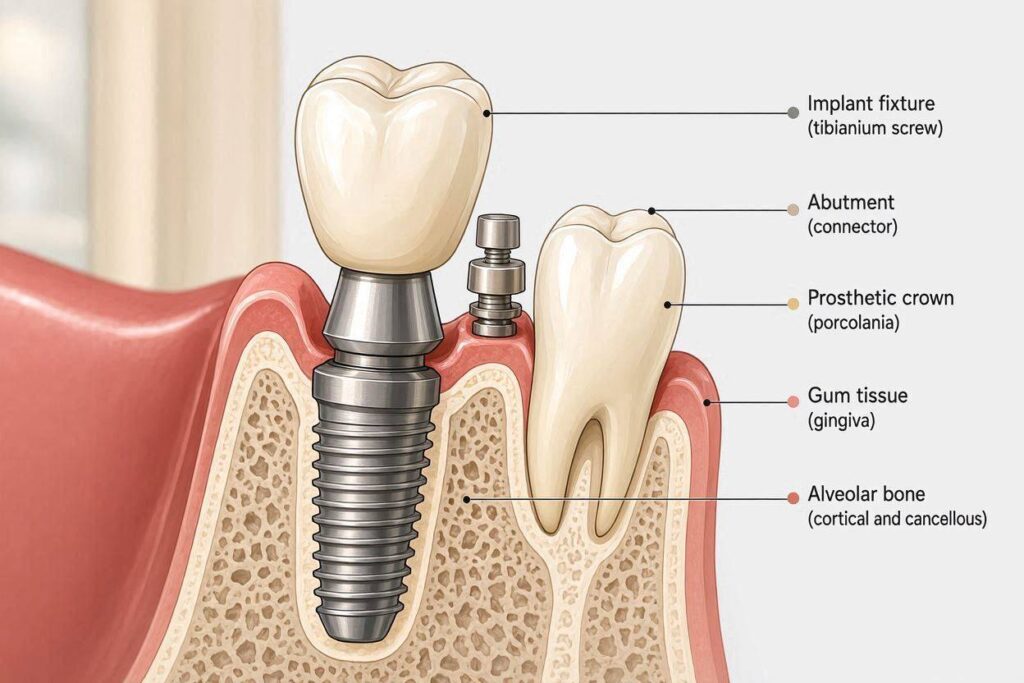
The Core Components of a Dental Implant
A complete single-tooth dental implant consists of three distinct parts. Each serves a specific function, and each is a separate line item on most treatment plans.
The Implant Fixture
The implant fixture, also called the implant body or the implant screw, is the portion surgically placed into the jawbone. It is typically made of titanium or a titanium alloy, materials that are biocompatible and fuse with bone through osseointegration. Some implants are made of zirconia, a ceramic material, for patients with metal allergies or aesthetic concerns.
The implant fixture is threaded on the exterior, like a screw, to engage the bone and provide primary stability at the time of placement. The top of the fixture has an internal connection, a precision-machined socket that receives the abutment. The implant fixture is the permanent foundation of the restoration. It is designed to remain in the bone for the life of the patient.
The cost of the implant fixture includes the manufacturer’s price for the implant itself, which varies by brand and by the specific design features of the implant. Premium implant brands invest heavily in research and development, clinical trials, and quality control, and their products are priced accordingly.
The Abutment
The abutment is the connector that attaches to the implant fixture and protrudes through the gum tissue to support the crown. It is sometimes called the implant post or the transmucosal abutment, because it passes through the mucosa, the gum.
Abutments come in two broad categories. A stock abutment is a prefabricated component manufactured in standard shapes and sizes. It is less expensive and works well when the implant is ideally positioned and the gum contours are favorable. A custom abutment is designed and fabricated specifically for the patient, either milled from a block of titanium or zirconia or cast from a wax pattern. A custom abutment allows the restorative dentist to compensate for implant angulation, to create an ideal emergence profile for the crown, and to achieve optimal aesthetics.
The abutment is secured to the implant fixture with an abutment screw, a small screw that passes through the abutment and threads into the implant’s internal connection. The abutment screw is a separate component, though it is usually included with the abutment rather than billed separately.
The Implant Crown
The crown is the visible tooth that attaches to the abutment. It is the part that you see above the gum line and that functions in chewing. The crown may be a single unit that is cemented or screwed onto the abutment, or it may be a two-piece system where the crown is separate from the abutment.
Implant crowns are fabricated from several materials. Porcelain-fused-to-metal crowns have a metal substructure covered with tooth-colored porcelain. They are strong and have a long track record, but the metal may show through at the gum line over time. Full ceramic crowns, such as those made from lithium disilicate or zirconia, offer superior aesthetics and are metal-free. The choice of material affects both the cost and the appearance of the final restoration.
The crown is custom-fabricated for each patient by a dental laboratory technician. The laboratory fee is a significant component of the crown cost. The technician creates a restoration that matches the adjacent teeth in color, shape, size, and contour.
The Surgical Procedures Included
The placement of the implant fixture is a surgical procedure that includes several components beyond the implant itself.
The Surgical Placement Fee
The surgical fee covers the dentist’s time, skill, and expertise in placing the implant. This fee includes the use of the surgical suite, the surgical instruments, the drill kit specific to the implant system, and the support of the surgical assistant. It also covers the dentist’s professional judgment in selecting the implant size and position and in managing any intraoperative challenges.
The surgical fee varies based on the complexity of the case and the credentials of the provider. A general dentist typically charges less than an oral surgeon or periodontist for implant placement, reflecting differences in training and overhead.
Anesthesia
Local anesthesia is standard for implant surgery and is usually included in the surgical fee. Additional sedation options, if chosen by the patient, are typically billed separately. Nitrous oxide, oral conscious sedation, and intravenous sedation each have their own fees that reflect the medication, the monitoring equipment, and the additional time and training required.
Post-Operative Care
The surgical fee typically includes routine post-operative follow-up. The dentist will see you for one or more post-surgical visits to check healing, remove sutures if necessary, and address any concerns. These visits are part of the global surgical fee and are not billed separately unless a complication requires extended treatment.
The Diagnostic and Planning Components
Before any implant is placed, diagnostic procedures establish the foundation for treatment.
Examination and Consultation
The initial examination includes a review of your medical and dental history, a clinical examination of your mouth, and a discussion of your goals and expectations. The dentist evaluates the gap, the adjacent teeth, the opposing teeth, and the gum tissue. This examination establishes whether you are a candidate for an implant and what additional procedures may be needed.
Imaging
Diagnostic imaging is essential for implant planning. At a minimum, a periapical radiograph, a small X-ray of the specific area, is taken. A panoramic radiograph, which shows the entire jaw, may be used for initial screening. The standard of care for implant planning is cone beam computed tomography, a three-dimensional scan that shows the height, width, and density of the bone, the location of nerves and sinuses, and the relationship of the proposed implant site to adjacent structures.
Imaging fees are typically billed separately from the surgical fee. A CBCT scan costs several hundred dollars and is an investment in safety and accuracy.
Treatment Planning
The dentist uses the diagnostic information to develop a specific treatment plan. This plan identifies the implant system, the size and position of the implant, the need for any preparatory procedures, and the restorative plan. The time spent in treatment planning is included in the professional fees.
Preparatory Procedures
Many patients require procedures to prepare the site before implant placement. These are typically billed separately.
Tooth Extraction
If the tooth to be replaced is still present, it must be extracted. Extraction fees vary based on the complexity. A simple extraction of an erupted tooth costs less than a surgical extraction of a broken or impacted tooth. The extraction may be performed at the time of implant placement or as a separate procedure with a healing period in between.
Bone Grafting
When the jawbone lacks sufficient volume for implant placement, bone grafting is required. A socket preservation graft is placed at the time of extraction to maintain bone volume. A ridge augmentation graft builds up a deficient ridge. A sinus lift adds bone beneath the maxillary sinus. Each type of graft has its own fee, which includes the graft material, the surgical procedure, and the follow-up.
Bone grafting adds significant cost to implant treatment. A patient who needs extensive grafting may pay as much for the graft as for the implant itself.
Soft Tissue Grafting
In areas where the gum tissue is thin or deficient, a soft tissue graft may be performed to increase the thickness and quality of the gum around the implant. This is particularly common in the front of the mouth where aesthetics are critical. Soft tissue grafting is a separate procedure with its own fee.
The Restorative Procedures
After the implant has integrated, the restorative phase creates the visible tooth.
Implant Exposure
If the implant was placed with a two-stage protocol and buried under the gum, a minor surgical procedure exposes the implant and places a healing abutment. This procedure is less involved than the original surgery and carries a smaller fee.
Impression or Digital Scan
The restorative dentist captures the position of the implant and the shape of the surrounding teeth and gum using a traditional impression or a digital intraoral scan. This record is sent to the dental laboratory. The impression fee covers the materials and the dentist’s time.
Crown Fabrication
The dental laboratory fabricates the custom abutment, if one is being used, and the crown. The laboratory fee is included in the crown cost and reflects the skill of the technician and the materials used.
Crown Delivery
The final appointment includes removal of the healing abutment, placement of the final abutment and crown, adjustment of the occlusion, and polishing. This appointment is included in the restorative fee.
Follow-Up and Maintenance
The initial treatment fee typically includes a short-term follow-up period. Long-term maintenance is separate.
Short-Term Follow-Up
The surgical and restorative fees generally include follow-up visits within a defined period, often 90 days to one year. These visits allow the dentist to confirm that the implant is integrating properly and that the crown is functioning without issues.
Long-Term Maintenance
After the initial follow-up period, maintenance becomes the patient’s responsibility. Regular professional cleanings, periodic X-rays to monitor bone levels, and replacement of worn or damaged components are separate from the initial implant fee. These ongoing costs should be factored into the long-term budget for implant care.
What May Not Be Included
Treatment plans vary, and some items that patients assume are included may be billed separately.
Sedation
As noted, sedation beyond local anesthesia is typically an additional charge. Patients who want sedation should confirm the fee during the consultation.
Temporary Restorations
A temporary crown or bridge to wear during the healing period may or may not be included in the implant fee. Some practices include a simple temporary. Others charge separately. A more elaborate temporary, such as a laboratory-fabricated provisional, carries a higher fee.
Complications
If a complication occurs, such as implant failure or infection, the cost of managing the complication may or may not be covered by the original fee. Many practices offer a warranty or guarantee that covers implant replacement within a certain period. Others charge for complication management. Patients should understand the practice’s complication policy before treatment begins.
How to Read an Implant Treatment Plan
A well-prepared treatment plan itemizes each component of the implant. Here is what to look for.
Line Items
The plan should list the diagnostic procedures, including examination and imaging. It should list preparatory procedures such as extraction and bone grafting. It should list the surgical placement of the implant fixture. It should list the abutment and crown, specifying the materials. It should list any sedation and the follow-up schedule.
Fee Totals
Each line item should have a fee. The total should be clearly stated. Some practices offer a bundled fee that covers everything from start to finish. Others bill each component separately. Ask whether the fee is bundled or unbundled so you can compare quotes accurately.
Exclusions
The plan should state what is not included. If a temporary is extra, if sedation is extra, if the crown material you prefer carries an upgrade fee, these should be disclosed in writing.
Conclusion
A complete dental implant includes three core components: the implant fixture surgically placed in the jawbone, the abutment that connects through the gum, and the custom crown that provides the visible chewing surface and aesthetics. The treatment also includes diagnostic examination and imaging, the surgical placement procedure with local anesthesia, preparatory procedures such as extraction and bone grafting if needed, the restorative procedures of impression and crown delivery, and short-term follow-up care. Sedation, temporary restorations, and long-term maintenance are typically additional. A transparent, itemized treatment plan allows patients to understand exactly what they are paying for and to compare quotes from different providers accurately.
Frequently Asked Questions
Does the implant fee include the crown?
It depends on the practice. Some practices quote a bundled fee that covers the implant fixture, abutment, and crown. Others quote the surgical phase and the restorative phase separately. Always ask whether the quoted fee includes the crown.
Is bone grafting included in the implant cost?
Bone grafting is usually a separate procedure with its own fee. If your treatment plan includes grafting, it will be listed as a separate line item.
Are follow-up visits included in the initial fee?
Short-term follow-up visits within a defined period, typically 90 days to one year, are generally included. Long-term maintenance visits and any treatment for complications are separate.
What happens if the implant fails? Is replacement included?
Policies vary by practice. Many dentists offer a warranty period during which they will replace a failed implant at no charge. Others charge a reduced fee. Clarify the complication policy before treatment.
Can I get a treatment plan with everything itemized?
Yes, and you should request one. A reputable practice will provide a written, itemized treatment plan that lists each procedure and its fee. This transparency is a sign of an ethical provider.
Additional Resource:
For more information on implant components and treatment planning, visit the Academy of Osseointegration at https://www.osseo.org.