Do Implant Dentures Come Out?
You are considering implant-supported dentures, and you have a fundamental question: do they come out? The answer depends entirely on which type of implant denture you choose. Some are designed to be removed daily by the patient. Others are fixed permanently in the mouth and can only be removed by a dentist. The distinction between these two types is one of the most important decisions you will make in your tooth replacement journey.
This guide explains the differences between removable and fixed implant dentures, how each type functions, the daily experience of living with each, and the factors that should guide your choice. By the end, you will understand exactly what you are committing to and which option best suits your lifestyle, preferences, and clinical situation.
The Two Fundamental Types of Implant Dentures
Implant dentures fall into two categories that answer the “do they come out” question very differently. Understanding these categories is the starting point for all other considerations.
Removable Implant Overdentures
A removable implant overdenture is a denture that snaps onto implants for retention and stability but is designed to be removed by the patient. You take it out at night for cleaning and for sleeping. You snap it back into place in the morning. The implants hold the denture securely during eating and speaking, but the denture still rests partially on the gum tissue.
This type of restoration is sometimes called a snap-on denture, an implant-retained overdenture, or an implant-stabilized denture. The common feature is that the patient removes it daily. It does not stay in the mouth permanently.
Fixed Implant Prostheses
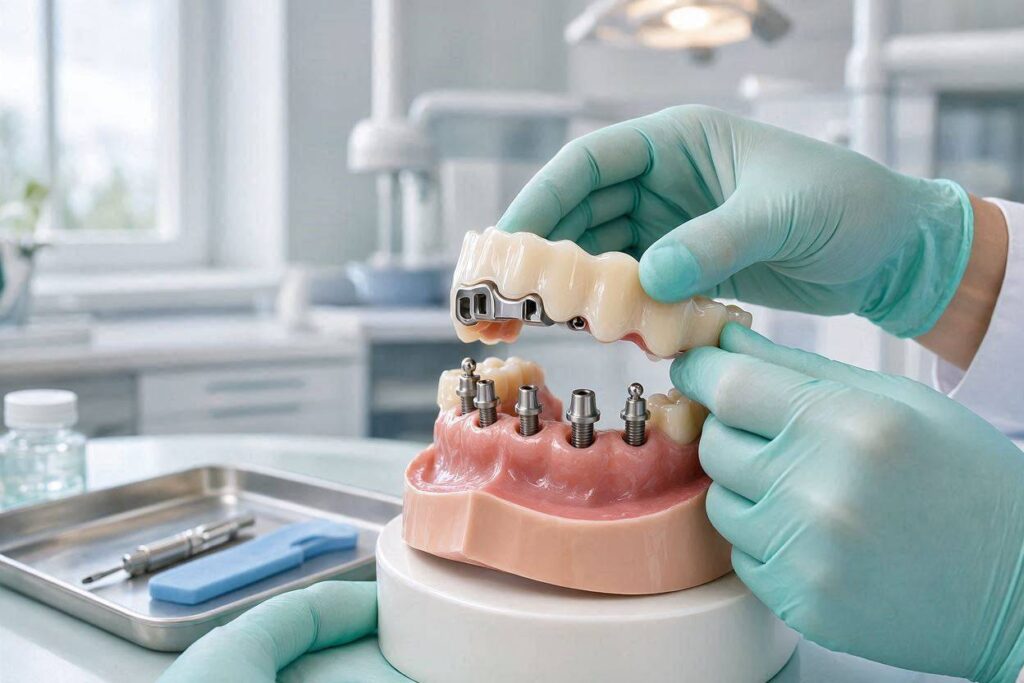
A fixed implant prosthesis is screwed or cemented onto the implants and cannot be removed by the patient. It stays in the mouth 24 hours a day, seven days a week. It is cleaned in the mouth with brushes, floss, and water flossers, just like natural teeth. Only a dentist can remove it, and that removal is typically done only for maintenance or repair.
This type of restoration is sometimes called a fixed hybrid denture, a fixed full-arch prosthesis, an All-on-Four restoration, or an implant-supported fixed bridge. The common feature is that it is fixed. It functions like natural teeth and the patient never takes it out.
The Removable Implant Overdenture in Detail
The removable overdenture is the less expensive and less invasive option, but it requires a daily routine that not everyone embraces.
How It Attaches
Two to four implants are placed in the jaw. Special abutments with attachments are connected to the implants. The denture has corresponding housings that snap onto these attachments. Common attachment systems include Locator abutments, which have a male component on the implant and a female housing in the denture, and bar attachments, where a metal bar connects the implants and the denture clips onto the bar.
The connection is secure enough for normal eating and speaking but can be released by the patient with a deliberate motion. The retention is a significant improvement over a conventional denture that relies on suction and adhesive, but it is not as rigid as a fixed prosthesis.
The Daily Routine
In the morning, you snap the denture into place. It clicks or seats firmly. You go about your day, eating, speaking, and smiling with confidence. The denture does not move during normal function. At night, you remove the denture by pulling gently to release the attachments. You clean the denture with a denture brush and solution. You clean the implants and the gum tissue around them. You place the denture in water or a cleaning solution overnight. You repeat the process the next morning.
This routine is familiar to anyone who has worn a conventional denture, though the implant attachments make the process of seating the denture more precise and the denture far more stable during the day.
Maintenance Requirements
The attachment inserts in the denture wear out over time and must be replaced, typically every six to twelve months. This is a simple office procedure where the dentist or hygienist swaps out the worn insert for a new one. The denture itself will need to be relined periodically to maintain a good fit against the gum tissue, which changes shape over time. The denture base material also wears and may need replacement every five to ten years.
Who Chooses a Removable Overdenture
Patients who choose a removable overdenture often appreciate the ease of cleaning. Removing the denture allows thorough cleaning of the prosthesis, the implants, and the gum tissue. Patients who have worn conventional dentures for years are accustomed to the removal routine and find the implant-retained version to be a dramatic upgrade in stability without a change in habits. Budget considerations also play a role. A removable overdenture costs significantly less than a fixed prosthesis.
Some patients simply prefer the feeling of removing their teeth at night. They find it more hygienic. They do not want something permanently fixed in their mouth. These preferences are valid and personal.
The Fixed Implant Prosthesis in Detail
The fixed prosthesis is the closest possible experience to having your natural teeth back. It is also more expensive and requires a greater commitment to daily hygiene.
How It Attaches
Four to eight implants are placed in the jaw. A prosthesis, which replaces the teeth and a portion of the gum tissue, is fabricated to fit precisely onto these implants. The prosthesis is secured with screws that pass through the prosthesis into the implants. The screw access holes are filled with a tooth-colored material or a small filling. The prosthesis does not move. It feels like natural teeth.
In some cases, the prosthesis is cemented onto the abutments rather than screwed. Cemented prostheses are still not removable by the patient. The dentist must cut them off for removal if necessary.
The Daily Routine
You wake up. Your teeth are in your mouth. You brush them just as you would natural teeth, using a soft toothbrush and non-abrasive toothpaste. You clean between the prosthesis and the gums using a water flosser, interdental brushes, or super floss. You do not remove anything. Your oral hygiene routine is more involved than that of a person with natural teeth, but it is performed with the prosthesis in place.
You eat, speak, and smile without ever thinking about your teeth coming out. They do not move, click, or shift. The experience is as close to having natural teeth as modern dentistry can provide.
Hygiene Challenges
The fixed prosthesis presents cleaning challenges that a removable overdenture avoids. The prosthesis contacts the gum tissue along its base, and there is often a space between the prosthesis and the gum where food and bacteria can accumulate. The patient cannot see this space. Cleaning it requires a water flosser and specialized brushes, and it must be done daily. Neglecting this hygiene leads to inflammation of the gum tissue, bad odor, and eventually peri-implantitis, which can cause implant failure.
Patients who choose a fixed prosthesis must commit to this daily hygiene routine. It is not optional. If you are not willing or able to clean under a fixed prosthesis, you should consider a removable overdenture that can be taken out for thorough cleaning.
Professional Maintenance
A fixed prosthesis requires professional maintenance at regular intervals, typically every six to twelve months. The dentist or hygienist will clean around the implants, check the screws for tightness, assess the health of the gum tissue, and take X-rays to monitor bone levels. The prosthesis itself may need to be removed by the dentist for a thorough cleaning every few years. This removal involves drilling out the screw access fillings, unscrewing the prosthesis, cleaning and examining everything, and replacing the screws and fillings. It is a professional procedure, not something the patient does at home.
Who Chooses a Fixed Prosthesis
Patients who choose a fixed prosthesis want the closest thing to natural teeth. They do not want to remove anything from their mouth. They want the security of knowing their teeth will never move, click, or come loose. They are willing to commit to the daily hygiene regimen and the higher cost. They view the prosthesis as a permanent part of their body, not a removable appliance.
The Hybrid Option: Fixed-Removable Prostheses
Some implant systems offer a hybrid approach that blurs the line between fixed and removable.
The Patient-Removable Fixed Prosthesis
A small number of implant systems allow the patient to remove a fixed prosthesis using a special tool, while the prosthesis functions as a fixed restoration the rest of the time. This design aims to combine the stability of a fixed prosthesis with the cleanability of a removable overdenture. These systems are less common and require specific implant components. If this option appeals to you, discuss it with a prosthodontist who is familiar with the available systems.
Factors That Determine Which Type Is Right for You
The choice between removable and fixed implant dentures is personal, but certain clinical and lifestyle factors influence the decision.
Bone Volume and Quality
A fixed prosthesis requires more implants than a removable overdenture, and those implants must be distributed across the arch. If you have insufficient bone and are not a candidate for or do not want extensive bone grafting, a removable overdenture on fewer implants may be the more feasible option.
Budget
A fixed prosthesis costs two to three times as much as a removable overdenture on the same number of implants, and it typically requires more implants. The cost difference is substantial and is a primary factor for many patients.
Hygiene Capability
If you have limited dexterity due to arthritis, neurological conditions, or age, the daily cleaning of a fixed prosthesis may be difficult. A removable overdenture that can be taken out and cleaned thoroughly outside the mouth may be easier to manage.
Sensory Preferences
Some patients cannot tolerate the feeling of a prosthesis covering their palate or resting on their gums. A fixed prosthesis that is supported entirely by implants and does not cover the palate may feel more natural. Others find the bulk of a fixed prosthesis bothersome and prefer the thinner base of a removable overdenture.
Sleep Preferences
Some patients are uncomfortable sleeping with teeth in their mouth. A fixed prosthesis is in place 24 hours a day. A removable overdenture can be taken out at night, which some patients prefer for comfort.
The Transition from Removable to Fixed
Some patients begin with a removable overdenture and later upgrade to a fixed prosthesis. This is possible if the implants are positioned appropriately and remain healthy. The transition requires fabrication of a new prosthesis and possibly the addition of more implants. If you are considering an eventual upgrade, discuss this with your implant dentist at the outset so that the initial implant positions are planned with future conversion in mind.
Conclusion
Whether implant dentures come out depends on the type of restoration. A removable implant overdenture is designed to be taken out daily by the patient for cleaning and sleeping, snapping securely onto implants during the day. A fixed implant prosthesis is screwed or cemented permanently onto the implants and can only be removed by a dentist. The choice between removable and fixed involves tradeoffs in cost, hygiene requirements, sensory experience, and lifestyle preferences, and should be made in consultation with an experienced implant dentist who can evaluate your specific clinical and personal needs.
Frequently Asked Questions
Can I sleep with my removable implant denture in?
It is not recommended. Removing the denture at night allows the gum tissue to rest and reduces the risk of fungal infections under the denture. The attachments also last longer when the denture is not subjected to nighttime grinding forces.
How often does a fixed implant prosthesis need to be removed by the dentist?
Typically every one to three years for a thorough professional cleaning and examination of the implants and the prosthesis. Some dentists recommend annual removal. Others extend the interval if hygiene is excellent.
Will my implant denture ever accidentally come out?
A properly fabricated and maintained removable overdenture will not come out accidentally during eating or speaking. The attachments provide positive retention. A fixed prosthesis will never come out accidentally because it is screwed or cemented in place.
Can I upgrade from a removable to a fixed implant denture later?
In many cases, yes. The implants must be sufficient in number and distribution to support a fixed prosthesis, and they must be positioned appropriately. Discuss this possibility with your dentist during the initial treatment planning.
Which type of implant denture feels more natural?
Most patients report that a fixed prosthesis feels more like natural teeth because it does not move and is not removed. However, a well-made removable overdenture feels far more natural than a conventional denture. Perceptions vary by individual.
Additional Resource:
For more information on implant denture options and to find a qualified provider, visit the American College of Prosthodontists at https://www.gotoapro.org.