What Is The Cost Of A Minimum Dental Implant?
The search for the most affordable path to a dental implant often begins with a specific, pragmatic question: “What is the cost of a minimum dental implant?” This is the patient asking, in plain language, for the absolute baseline price. They are not inquiring about premium brands, luxury clinics, or complex full-arch reconstructions. They want to know the lowest possible financial threshold at which a clinically acceptable, surgically sound, single titanium post and a functional crown can be obtained. This question is born of real financial constraint, and it deserves an honest, transparent, and medically responsible answer that does not simply bait the patient with a misleading low number.
The concept of a “minimum” dental implant is a razor’s edge. It represents the intersection of a basic, no-frills treatment plan, a value-engineered implant brand, a general dentist’s surgical fee, and an assumption of an ideal, uncomplicated clinical scenario. The rock-bottom, all-inclusive cost for a single dental implant with a crown in the United States, placed in a legitimate, licensed dental practice using a FDA-cleared implant and a basic ceramic crown, is approximately $2,500. This is the floor. Any advertised price below this threshold should be met with extreme skepticism and an exhaustive investigation of the fine print, the hidden exclusions, and the quality of the materials and the provider. This comprehensive guide will dissect the anatomy of a minimum-cost implant, explain how a practice can reach a $2,500 price point, identify the components that are compromised or omitted, and provide you with a list of critical questions to separate a genuine, ethical, affordable option from a dangerous, high-volume corporate loss leader that will cost you far more in the long run.
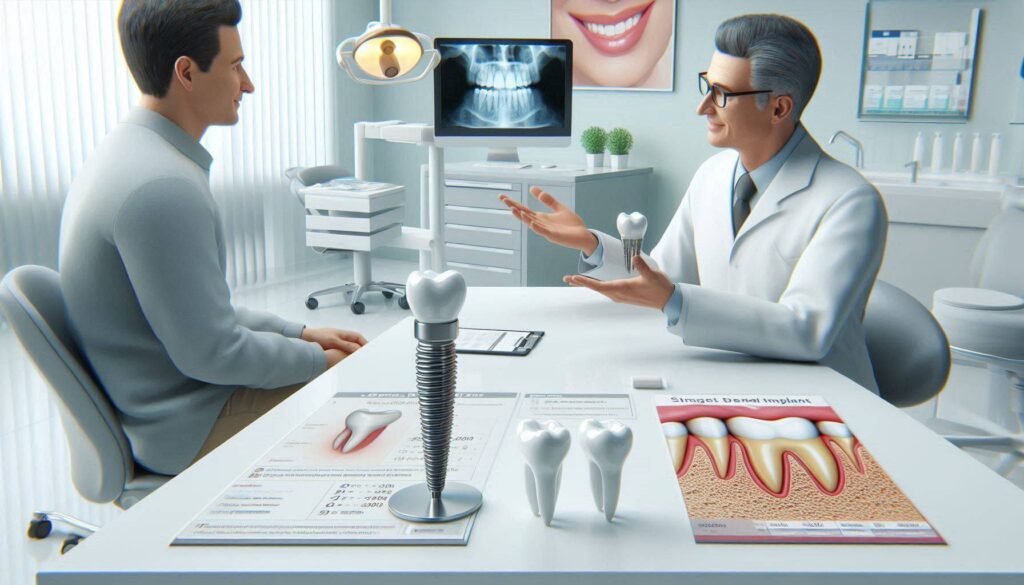
The Anatomy of a $2,500 Minimum Implant
How can a dental practice offer an implant for $2,500 when the national average is between $4,000 and $5,000? The answer lies in a combination of specific, deliberate cost-cutting measures across every component of the treatment. Understanding these measures is essential to evaluating the value.
The Implant Fixture: The Value Brand
The implant itself is the titanium post placed in the bone. A premium brand like Nobel Biocare or Straumann costs the dental practice several hundred dollars per fixture, a cost that is passed on to the patient. A minimum-cost implant uses a value-engineered brand, often manufactured in South Korea (such as Osstem, Dentium, or NeoBiotech) or Israel. These implants are FDA-cleared and have documented clinical success rates that are very close to the premium brands, especially in straightforward cases with healthy bone. The practice may purchase these implants in bulk at a cost of $100 to $150 per fixture. The saving on the fixture cost is the first pillar of the low price. This is a clinically acceptable compromise for many patients, provided the implant passport is provided.
The Surgeon: The General Dentist
The surgical phase is performed by a general dentist, not by a board-certified oral surgeon or periodontist. A specialist’s surgical fee for a single implant can be $2,000 to $3,000 alone. The general dentist, who has taken continuing education courses in implant placement but whose core residency training was in general restorative dentistry, charges a significantly lower surgical fee. In the minimum-cost model, the surgical fee may be bundled into the package at a rate of $800 to $1,200. For a straightforward, single posterior implant in a healthy patient with thick, dense bone, a well-trained general dentist can achieve excellent results.
The Crown: The Basic Porcelain-Fused-to-Metal (PFM)
The final crown is a major cost driver. A high-aesthetic, custom-layered zirconia crown fabricated by a master ceramist can cost the practice a laboratory fee of $400 to $600. The minimum-cost implant package almost always includes a basic porcelain-fused-to-metal (PFM) crown. The lab fee for a stock abutment and a PFM crown is lower, often $150 to $250. The crown is functional and tooth-colored, but it lacks the translucency and life-like aesthetics of a premium ceramic. The metal base may show as a dark line at the gum margin over time.
The Diagnostic Workup: The 2D Panoramic X-Ray
A 3D Cone Beam CT scan is the gold standard for implant planning. A minimum-cost package may substitute a traditional 2D panoramic X-ray, which is cheaper and faster. The 2D image shows the height of the bone above the nerve but does not reveal the width of the bone or the exact three-dimensional contours of the ridge. The implant is placed based on the surgeon’s tactile sense and experience, not a virtual, prosthetically-driven plan. For an experienced surgeon in a wide, flat ridge, this is often sufficient. For a narrow or irregular ridge, it is a risk factor for malposition or nerve injury.
The Critical Exclusion: No Bone Graft or Extraction
The $2,500 price is based on a “clean slate” scenario. The tooth has been missing for months, the extraction site is fully healed, and the bone volume is ideal. The price does not include a tooth extraction, which would add $200 to $600. It most certainly does not include a bone graft, which would add $500 to $3,000. If the patient needs a bone graft, the price is no longer $2,500; it is now $4,000 to $5,500. The “minimum” price is a diagnostic starting point, not a guaranteed final fee.
| Component | Minimum-Cost Implant Package (~$2,500) | Standard Specialist Implant Package (~$4,500) |
|---|---|---|
| Implant Brand | Value Korean brand (e.g., Osstem) | Premium Swiss/Swedish (e.g., Straumann) |
| Surgeon | General dentist | Oral surgeon or periodontist |
| Crown Material | Porcelain-fused-to-metal (PFM) | Custom layered zirconia |
| Imaging | 2D Panoramic X-ray | 3D Cone Beam CT scan |
| Bone Graft | Excluded (extra cost) | Included if minor |
| Warranty | Limited or practice-based | Manufacturer’s lifetime warranty |
This table is a stark illustration of the trade-offs. The $2,500 implant is a functional, legitimate restoration. It is not a scam, provided the exclusions are clearly disclosed. It is the Toyota Corolla of tooth replacement: reliable, functional, and affordable, but lacking the advanced technology, luxury feel, and long-term parts guarantee of the premium brands.
The Dangers of the “Too Good to Be True” Price: The $999 Implant Scam
If the floor for a legitimate, all-inclusive minimum implant is around $2,500, what about the advertisements for $999 or $1,500 implants? These are marketing bait. They are designed to generate phone calls to a high-volume, corporate-owned clinic. The $999 price almost never includes the abutment or the crown. It is a surgical placement fee for the implant body only. The patient is then quoted a separate fee of $2,000 to $3,000 for the restorative phase. The total cost ends up being exactly the same as, or higher than, a transparent private practice.
In some cases, the $999 implant is a non-branded, imported “generic” implant with no U.S. regulatory clearance, no clinical research, and no guarantee of long-term parts availability. The clinic is a single-location or small-chain operation that will not exist in ten years. The implant is placed quickly, without a surgical guide, and the patient is given no implant passport. The crown is a low-cost acrylic temporary that is passed off as a final restoration. This is not a “minimum” implant; it is a substandard medical device placed below the standard of care. The long-term consequence is peri-implantitis, bone loss, and a catastrophic failure that requires a $5,000 salvage surgery by a specialist.
You must read the fine print. You must demand a written, all-inclusive treatment plan that lists every single procedure code and the total, all-inclusive fee before you agree to any treatment. If the treatment coordinator cannot produce this document, or if the price is a “limited-time offer” that expires if you do not sign up immediately, you are in a high-pressure sales environment, not a medical consultation.
The Role of Dental Schools and Non-Profit Clinics
The most ethical pathway to a minimum-cost implant is a dental school or a Federally Qualified Health Center (FQHC). At a dental school, the implant surgery is performed by a resident dentist under the supervision of board-certified faculty. The fee is typically 40 to 60 percent lower than private practice fees. A single implant at a dental school can cost $1,500 to $2,500 all-inclusive. The trade-off is time: multiple longer appointments, a strict eligibility screening, and a longer overall treatment timeline. The quality of the care is outstanding because every step is scrutinized by a supervising specialist. This is the true, ethical “minimum-cost” implant for a patient of limited financial means.
Some non-profit dental clinics, often funded by community health grants, offer sliding-scale fees for low-income, uninsured patients. These clinics may provide implant care in specific, medically necessary situations, often for front teeth lost to trauma. The availability of these programs is highly localized, and there is often a long waiting list.
Conclusion
The legitimate minimum cost for an all-inclusive single dental implant with a crown in the United States is around $2,500, achieved by using a value-brand implant, a basic porcelain-fused-to-metal crown, a general dentist’s surgical fee, and a 2D X-ray. This price excludes necessary bone grafting or extractions and assumes an ideal, pre-healed surgical site. Any advertised price significantly below this threshold must be investigated with the utmost scrutiny, as it likely represents a bait-and-switch marketing tactic that unbundles the abutment and crown, uses substandard components, or lures the patient into a high-pressure sales funnel.
FAQ
What does a $2,500 dental implant include?
It typically includes the surgical placement of a value-brand (often Korean) implant fixture by a general dentist, a stock abutment, and a basic porcelain-fused-to-metal crown, with a 2D panoramic X-ray as the diagnostic imaging.
**Why are some implants advertised for $999?**
The $999 price is almost always a surgical placement fee for the implant body only. The abutment and the crown are billed separately at $2,000 to $3,000, bringing the total to the market average or higher.
Is a value-brand Korean implant safe?
Yes, implants from reputable Korean manufacturers like Osstem and Dentium are FDA-cleared, have extensive clinical research, and show high success rates. The risk is the long-term availability of replacement parts compared to the global giants.
Can I get a dental implant for free?
Free dental implants are extremely rare and are typically provided through charitable programs for specific populations, such as victims of domestic violence with traumatic tooth loss or through clinical research trials at dental schools.
Is it worth paying more for a premium implant brand?
For a straightforward, single posterior tooth, a value brand is often an excellent choice. For a front tooth in the aesthetic zone, or a complex case, a premium brand offers a proven long-term track record, a lifetime warranty, and a global guarantee of parts availability.
Additional Resources
For a directory of accredited dental schools and advanced education programs that may offer reduced-fee implant care, visit the American Dental Education Association: https://www.adea.org/