What Is Dental Implant With Dentures? Understanding Implant-Supported Overdentures
The landscape of tooth replacement is often presented as a binary choice: the removable, traditional denture that sits on the gums or the fixed, permanent, full-arch implant bridge that only the dentist can remove. Between these two poles lies a powerful, life-changing hybrid solution that combines the affordability and replaceability of a denture with the stability and bone preservation of dental implants. This solution is the implant-supported overdenture, and it is what patients and clinicians are referring to when they ask, “What is a dental implant with dentures?” The phrase is a simple, intuitive description of a complex, precision-engineered prosthesis: a removable, full-arch acrylic denture that is firmly anchored not by suction and denture adhesive, but by a strategic number of dental implants that snap into specialized attachments embedded in the denture base.
This is not a “fixed” set of teeth, but it is a world away from a loose, floating denture. The implant-supported overdenture represents the single most dramatic improvement in the quality of life for the edentulous patient short of a fixed full-arch bridge. It restores the ability to chew with confidence, eliminates the social anxiety of a denture slipping during conversation, and, critically, stops the progressive, disfiguring bone resorption that occurs under a conventional denture. This comprehensive guide will explore the biology, the mechanics, the surgical protocols, and the profound patient experience of the implant-supported overdenture. We will clarify the difference between an implant-retained and an implant-supported prosthesis, explain the popular “Snap-On Denture” and “All-on-4” confusion, and provide a detailed understanding of who this solution is for and what it feels like to live with it.
The Biological Catastrophe of the Conventional Denture
To understand the genius of the implant-supported overdenture, you must first understand the slow-motion disaster of a conventional, tissue-borne denture. When all the teeth in an arch are extracted, the body immediately begins to resorb the alveolar bone, the ridge of the jaw that once held the tooth roots. This is a normal, biological process. The bone is no longer stimulated by the mechanical forces of chewing, which are transmitted through the periodontal ligaments. The body, in its ruthless efficiency, removes what it perceives as an unused structure.
A conventional denture sits on top of this shrinking gum ridge. It is held in place by suction, muscle control, and often by gobs of denture adhesive. Every time the patient chews, the denture rocks, shifts, and presses on the soft, compressible gum tissue. This pressure accelerates the very bone resorption that is causing the denture to become loose. The patient is trapped in a vicious cycle: the denture is loose, so they use more adhesive, which irritates the tissue, while the bone underneath continues to melt away. The lower denture, in particular, becomes a floating, uncontrollable object. The patient stops eating social meals. They lose the ability to chew steak, raw vegetables, and crusty bread. Their nutrition suffers, and their self-esteem plummets.
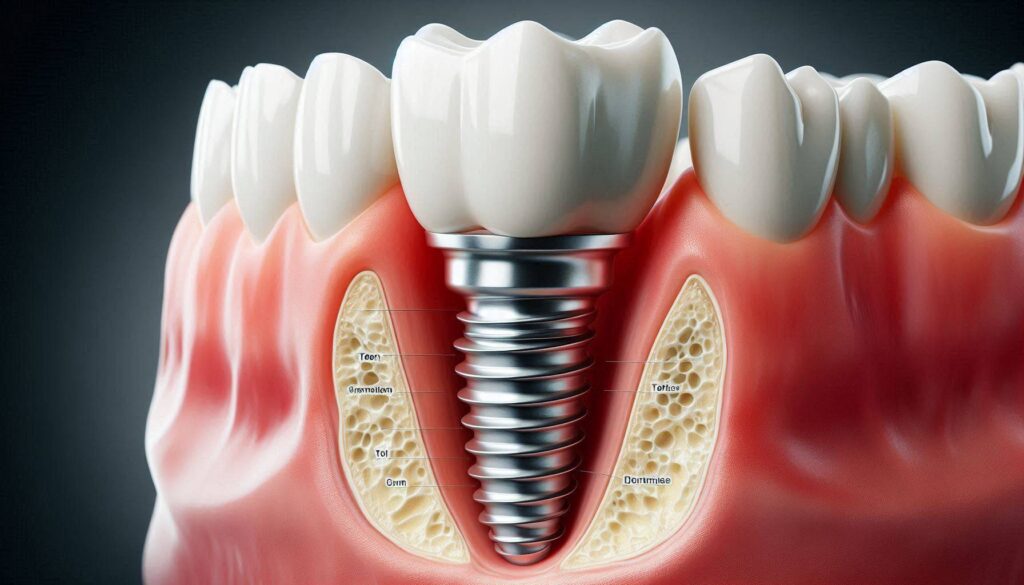
The implant-supported overdenture breaks this cycle with a simple engineering principle: it transfers the chewing forces from the gum tissue to the implants, which are anchored in the bone. The bone is now mechanically loaded, just as it was with natural teeth. The resorption slows dramatically. The ridge is preserved. The denture is stable, not because it is suctioned to the gums, but because it is mechanically locked onto the implants.
The Mechanics: How the Overdenture Attaches to Implants
The core of the system is the precision attachment. The surgeon places two, three, or four implants in the jawbone at specific, strategically planned locations. The classic, most life-changing application is the lower jaw. Because of the severe instability of the lower denture, as few as two implants placed in the anterior mandible, between the mental foramina, can transform a patient’s existence. The upper jaw typically requires a minimum of four implants to overcome the downward pull of gravity and the lack of a suction seal due to the horseshoe shape of the residual ridge.
After the implants have osseointegrated, a small, metal or plastic attachment housing is screwed into each implant. The most common attachment systems are the Locator attachment and the ball-and-socket attachment. The Locator attachment is a low-profile, precision metal housing with a nylon insert. The nylon insert provides a specific level of retention, from light to heavy, that can be changed as the patient’s needs change. The denture base has corresponding metal housings that contain the nylon inserts. When the patient presses the denture down onto the implants, the nylon inserts snap securely over the Locator abutments with an audible, satisfying “click.” The denture is locked in place. It will not lift, shift, or float during speech or chewing. To remove the denture, the patient uses their thumbs to pry it up, overcoming the retention of the nylon inserts.
The denture is still a denture. It has a pink acrylic base and a full set of acrylic or porcelain teeth. It covers the gum tissue and, in the upper jaw, covers the palate. The patient removes it at night, brushes the implants with a soft brush, and soaks the denture in a cleaning solution. This removability is the distinguishing feature from a fixed, full-arch bridge.
Implant-Retained vs. Implant-Supported: A Critical Distinction
Within the world of implant overdentures, there is a crucial biomechanical distinction that affects both the cost and the function. An implant-retained overdenture relies primarily on the implants for retention—keeping it from coming out—but the denture base still rests heavily on the gum tissue for support. The chewing force is shared between the implants and the gums. A two-implant lower overdenture is typically an implant-retained prosthesis. The back of the denture still rests on the posterior gum ridge, and the denture can still rock slightly if the posterior ridge resorbs.
An implant-supported overdenture is a more advanced design, typically using four or more implants. The denture base is fabricated so that it is supported entirely by the implants and the precision bar that connects them, with minimal contact on the posterior gum tissue. This is a rigid, highly stable design that functions more like a fixed bridge. The chewing forces are transmitted directly to the implants, almost entirely bypassing the gums. This design requires more implants and a more complex, bar-retained framework, and is consequently more expensive, but it provides a level of stability that approaches that of a fixed prosthesis.
The “Snap-On Denture” vs. the “All-on-4” Bridge
A great deal of patient confusion arises from the marketing terms “Snap-On Denture” and “All-on-4.” The implant-supported overdenture is what the public calls a “Snap-On Denture.” It is removable. The patient snaps it in and takes it out daily. The All-on-4 protocol, in its classical sense, is a fixed, full-arch implant bridge. It is screwed into the multi-unit abutments and is only removed by the dentist during maintenance visits. The patient does not take it out.
However, the term “All-on-4” is sometimes used loosely in marketing to describe any four-implant restoration. A patient may be offered an All-on-4 overdenture, which is a removable snap-on denture on four implants. This is a different treatment with a different cost and a different maintenance protocol. You must ask the explicit, clarifying question: “Is the final prosthesis I am getting fixed in my mouth, or do I take it out at night?” The answer to that question defines the treatment, not the branding.
The Surgical and Restorative Process
The pathway to an implant-supported overdenture is a carefully staged journey. The first step is a comprehensive diagnostic phase with a 3D CBCT scan. The surgeon assesses the bone volume in the anterior mandible (for a lower two-implant overdenture) or the entire arch (for a four-implant upper overdenture). If the bone is insufficient, a bone grafting procedure may be necessary, though the overdenture’s strategic implant positions are often chosen to utilize the dense, native bone and avoid grafts.
The surgery is typically performed under local anesthesia with sedation. The implants are placed. For a lower two-implant overdenture, the implants are often placed and then buried under the gum to heal for three to four months. The patient wears their existing, relined denture during this period. Once the implants have integrated, a small incision is made to expose them, and the healing abutments are placed. After the gum tissue has matured, the final attachments are placed, and the denture is retrofitted in the laboratory with the corresponding housings.
Some protocols allow for an immediate loading of the implants. The patient’s existing denture is converted on the day of surgery into a temporary, implant-supported overdenture that snaps onto the newly placed implants. This requires a high level of primary stability and is a protocol for specific, selected cases. The final, new overdenture is fabricated several months later, after the bone and the gum tissues have fully healed and stabilized.
Living With a Snap-On Overdenture: The Patient Experience
The psychological and functional transformation for a patient who moves from a conventional denture to an implant-supported overdenture is profound. The denture no longer moves. The patient can bite into an apple. They can chew a piece of steak. They can laugh, speak, and sneeze without the reflexive, subconscious guarding against a dental catastrophe.
The daily routine is simple. In the morning, the patient cleans the implant attachments with a soft toothbrush, ensuring no plaque has accumulated around the small metal abutments. They then snap the denture into place. It is secure all day. At night, they remove the denture, clean it with a denture brush and a non-abrasive cleanser, and soak it in water or a cleaning solution. They clean the implants again before bed. The nylon inserts in the denture base wear out over time and lose retention. The patient notices the denture starting to “pop off” more easily. A simple visit to the dentist takes a few minutes to replace the nylon inserts, restoring the snap to its original, firm retention.
The long-term maintenance involves professional cleaning of the implant abutments and the denture at regular recall visits. The bone levels around the implants are monitored with X-rays. The overdenture is a long-term, highly successful solution, with survival rates for the implants well above 95 percent. It is the most cost-effective way to use implants to radically improve the life of a patient with a failing or failed dentition.
Conclusion
A dental implant with dentures, clinically known as an implant-supported overdenture, is a removable full-arch acrylic prosthesis that snaps securely onto strategically placed dental implants using precision attachments, providing unmovable retention and dramatically improved chewing function. Unlike a fixed bridge, it is removed daily by the patient for cleaning, but unlike a conventional denture, it does not float, slip, or accelerate bone loss because the chewing forces are transmitted to the implants and the preserved bone. This solution represents the ideal intersection of affordability, surgical simplicity, and a transformative improvement in quality of life for the edentulous patient.
FAQ
Is a snap-on denture better than a fixed implant bridge?
“Better” depends on your needs. A snap-on overdenture is more affordable, easier to clean because it is removable, and replaces lost facial support well. A fixed bridge offers a more natural feel, no palate coverage, and no movement.
How many implants do I need for a snap-on denture?
A lower snap-on denture typically uses 2 to 4 implants. An upper snap-on denture usually requires a minimum of 4 implants due to the softer bone and the lack of natural suction.
Can my existing denture be converted to a snap-on?
In many cases, yes, if the denture is in good condition. The laboratory can retro-fix the attachment housings into your existing denture base, turning it into a temporary or even a final implant overdenture.
What is a Locator attachment?
The Locator is a low-profile, precision attachment system that connects the implant to the denture. It uses interchangeable nylon inserts with different levels of retention, which can be easily replaced as they wear out.
Do snap-on dentures still cover the roof of my mouth?
An upper snap-on overdenture typically still covers the palate for support and structural strength. A fixed, full-arch bridge does not cover the palate, allowing for better taste and temperature sensation.
Additional Resources
For more information on the benefits and protocols of implant-supported overdentures, visit the Academy of Osseointegration: https://www.osseo.org/