What Is The Cost Of The Invisalign Lab?
If you have been researching Invisalign, you have probably seen the treatment broken down into different costs. There is the consultation fee, the orthodontist’s fee, the cost of retainers, and something called the “Invisalign lab fee.” For many patients, this last item is the most confusing. What exactly is the Invisalign lab? Why is there a separate fee? And how much does it cost?
The Invisalign lab fee is the amount that Align Technology, the company that makes Invisalign, charges your dentist or orthodontist for the aligners and the treatment planning software. This fee is a significant part of the total cost of Invisalign. In fact, it often accounts for 30% to 50% of what you pay.
But here is the catch: most patients never see this fee as a separate line item. It is usually bundled into the total treatment price. However, understanding what the lab fee is and how it works can help you make sense of your Invisalign quote and even negotiate a better deal.
This guide will explain everything you need to know about the Invisalign lab fee. We will look at what it covers, how much it costs, what affects the price, and how it fits into the total cost of treatment. By the end, you should have a clear picture of where your money goes and how to get the best value for your smile.
What Is The Invisalign Lab?
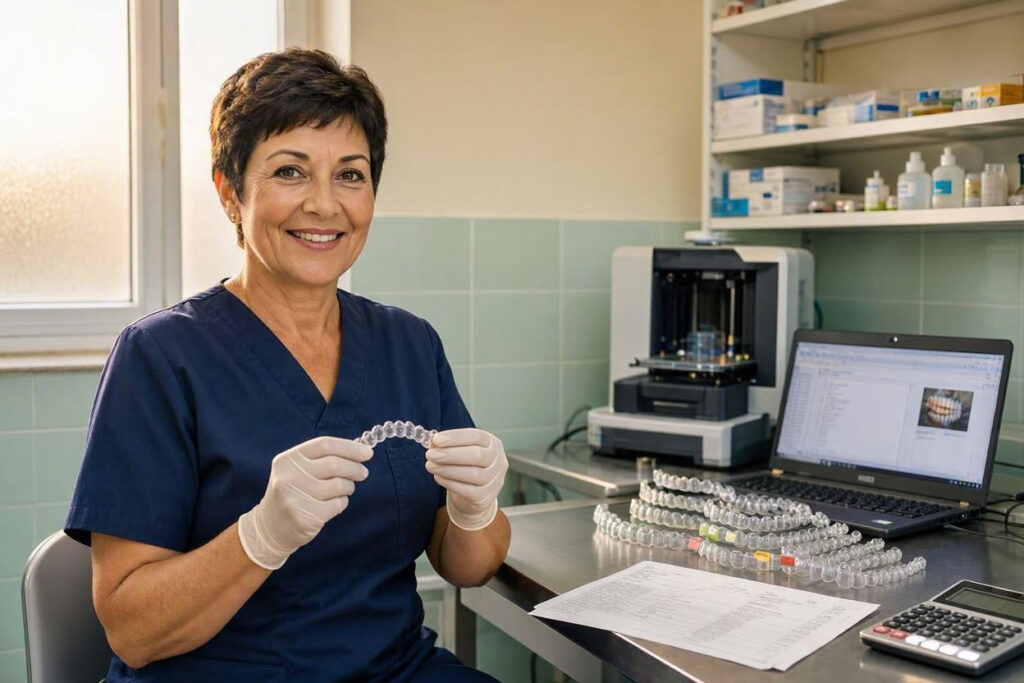
The Invisalign lab is not a physical laboratory that you visit. It is the manufacturing and treatment planning service provided by Align Technology, the company behind Invisalign. When your dentist or orthodontist submits your case to Align Technology, the company:
- Creates a 3D digital model of your teeth
- Develops a treatment plan using proprietary software (ClinCheck)
- Manufactures the custom aligners
- Ships the aligners to your provider
Align Technology is headquartered in the United States, but it has manufacturing facilities around the world. The aligners are made from a patented thermoplastic material called SmartTrack. Each set of aligners is custom-made for your teeth based on the digital scan or impression your provider sends.
The “lab fee” is what Align Technology charges your provider for this service. It covers the cost of the software, the materials, the manufacturing, and the shipping.
How Invisalign Lab Fees Work
Understanding how lab fees work can help you see the bigger picture.
Step 1: Your Provider Signs Up With Align Technology
Dentists and orthodontists must be certified Invisalign providers. They pay a fee to Align Technology and receive training. They also agree to pay lab fees for each case they submit.
Step 2: Your Case Is Submitted
Your provider takes a digital scan or impression of your teeth and submits it to Align Technology. They also provide instructions about how your teeth should move.
Step 3: Align Technology Creates A Treatment Plan
Using its software, Align Technology creates a 3D treatment plan. Your provider reviews it and may request changes. Once approved, the plan is finalized.
Step 4: Aligners Are Manufactured
The aligners are manufactured based on the approved plan. They are shipped to your provider in sets.
Step 5: Your Provider Pays The Lab Fee
Your provider pays Align Technology the lab fee for your case. This fee is usually based on the complexity of your case and the type of Invisalign treatment you need.
Step 6: The Lab Fee Is Passed On To You
Most providers include the lab fee in the total price they quote you. You may not see it as a separate charge. However, some providers break it out so you can see where your money goes.
The Average Cost Of The Invisalign Lab Fee
Now let us get to the numbers. The Invisalign lab fee varies depending on the type of treatment and the complexity of your case.
Here are average lab fees in the United States:
| Type Of Invisalign | Average Lab Fee (USD) |
|---|---|
| Invisalign Express (5 aligners or fewer) | $800 – $1,200 |
| Invisalign Lite (up to 14 aligners) | $1,200 – $1,800 |
| Invisalign Full (moderate to complex) | $1,800 – $2,500 |
| Invisalign Teen | $1,800 – $2,500 |
| Invisalign First (children) | $1,500 – $2,200 |
| Complex cases with refinements | $2,500 – $3,500+ |
These are the fees that Align Technology charges your provider. They do not include your provider’s professional fees, which cover their time, expertise, and overhead. The total cost of Invisalign is usually two to three times the lab fee.
For example, if the lab fee is $2,000, the total treatment cost might be $5,000 to $7,000.
What Affects The Invisalign Lab Fee?
Several factors influence the lab fee. Let us look at the most important ones.
1. Type Of Invisalign Treatment
Invisalign Express is the cheapest because it uses fewer aligners. Invisalign Full is more expensive because it allows for unlimited aligners over a set period. The more aligners you need, the higher the lab fee.
2. Complexity Of Your Case
Complex cases require more planning, more aligners, and more refinement. This increases the lab fee. Simple cases with minor crowding or spacing are cheaper.
3. Number Of Refinements
Sometimes teeth do not move exactly as planned. Your provider may need to order refinement aligners. Each refinement adds to the lab fee. Some Invisalign packages include refinements; others charge extra.
4. Length Of Treatment
The longer your treatment, the more aligners you will need. More aligners mean a higher lab fee.
5. Provider’s Contract With Align Technology
Providers who submit many cases may negotiate lower lab fees. Newer providers may pay higher fees. This can affect the price you are quoted.
6. Geographic Location
Lab fees can vary by country. In the United States, lab fees are generally higher than in other countries. In Europe, Asia, and Latin America, lab fees may be lower.
7. Currency Exchange Rates
If you are paying in a currency other than the US dollar, exchange rates can affect the cost. Align Technology is a US company, so lab fees are often set in US dollars.
8. Time Of Year
Align Technology occasionally offers promotions or discounts to providers. These may be passed on to patients. It never hurts to ask if there are any current specials.
Comparative Table: Invisalign Lab Fees By Country
Lab fees vary around the world. Here is a comparison of approximate lab fees for Invisalign Full in different countries.
| Country | Average Lab Fee (Local Currency) | Approx. USD |
|---|---|---|
| United States | $1,800 – $2,500 | $1,800 – $2,500 |
| Canada | $1,800 – $2,500 CAD | $1,300 – $1,800 |
| United Kingdom | £1,200 – £1,800 | $1,500 – $2,300 |
| Australia | $2,000 – $3,000 AUD | $1,300 – $2,000 |
| Ireland | €1,400 – €2,000 | $1,500 – $2,200 |
| Germany | €1,400 – €2,000 | $1,500 – $2,200 |
| France | €1,200 – €1,800 | $1,300 – $2,000 |
| Spain | €1,000 – €1,600 | $1,100 – $1,700 |
| Mexico | $25,000 – $40,000 MXN | $1,200 – $2,000 |
| Costa Rica | $1,500 – $2,200 | $1,500 – $2,200 |
| Thailand | ฿50,000 – ฿80,000 | $1,400 – $2,300 |
| India | ₹100,000 – ₹180,000 | $1,200 – $2,200 |
| Turkey | $1,200 – $1,800 | $1,200 – $1,800 |
Prices vary by provider and case. These ranges are for general comparison only.
Lab Fee Vs. Total Invisalign Cost
The lab fee is only one part of the total cost of Invisalign. The total cost includes:
- Lab fee: What Align Technology charges your provider
- Professional fee: What your provider charges for their time, expertise, and overhead
- Retainers: Usually an extra cost after treatment
- Additional services: X-rays, scans, whitening, or accelerated treatment devices
Here is a breakdown of how the total cost is typically divided:
| Component | Percentage Of Total Cost |
|---|---|
| Lab fee | 30% – 50% |
| Professional fee | 50% – 70% |
| Retainers | 5% – 10% (often separate) |
| Additional services | Varies |
For example, if you pay $6,000 for Invisalign, the lab fee might be $2,000, and the professional fee might be $4,000.
Why Do Lab Fees Seem So High?
Many patients wonder why the lab fee is so high. Here is what goes into it.
1. Research And Development
Align Technology invests heavily in research and development. The company continuously improves its software, materials, and treatment protocols.
2. Proprietary Technology
Invisalign uses patented technology that is not available from other clear aligner companies. This technology is expensive to develop and maintain.
3. Custom Manufacturing
Every aligner is custom-made for your teeth. This is not a mass-produced product. Each set requires precision manufacturing.
4. Treatment Planning Software
The ClinCheck software is a powerful tool that allows providers to plan and visualize your treatment. Developing and maintaining this software is costly.
5. Customer Support
Align Technology provides support to providers and patients. This includes technical support, training, and patient education materials.
6. Shipping And Logistics
Aligners are shipped to providers around the world. This requires a sophisticated logistics network.
7. Clinical Research
Align Technology conducts clinical research to validate its products. This research is expensive but ensures that Invisalign is safe and effective.
Does Insurance Cover The Invisalign Lab Fee?
Insurance does not cover the lab fee separately. If your insurance covers Invisalign, it covers the total treatment cost, which includes the lab fee. The lab fee is not billed separately to insurance.
Here is what you need to know:
- Medical necessity: If orthodontics is medically necessary, insurance may cover part of the total cost.
- Cosmetic purposes: If Invisalign is for cosmetic reasons, insurance is less likely to cover it.
- Lifetime maximum: Many plans have a lifetime orthodontic benefit, such as $1,500 or $2,000.
- In-network providers: You may get better coverage if you see a provider in your insurance network.
Always call your insurance company before starting treatment. Ask specific questions:
- Is Invisalign covered?
- What percentage is covered?
- Is there a lifetime maximum?
- Do I need pre-authorization?
How To Save Money On The Invisalign Lab Fee
The lab fee is set by Align Technology, so you cannot negotiate it directly. However, you can reduce the total cost of Invisalign in other ways.
1. Choose A Provider With Lower Professional Fees
Since the lab fee is fixed, the best way to save is to find a provider who charges less for their professional fee. Get quotes from multiple providers.
2. Ask About Invisalign Express Or Lite
If your case is mild, you may qualify for Invisalign Express or Lite. These use fewer aligners and have lower lab fees.
3. Use Insurance
If you have orthodontic coverage, use it. Even a few hundred dollars helps.
4. Flexible Spending Accounts (FSAs) And Health Savings Accounts (HSAs)
If you have an FSA or HSA, you can use pre-tax dollars to pay for Invisalign. This can save you 20% to 30% depending on your tax bracket.
5. Payment Plans
Most providers offer in-house payment plans. You pay a down payment and then monthly installments. Some plans are interest-free.
6. Third-Party Financing
Companies like CareCredit, LendingClub, and OrthoFi offer loans for dental and medical procedures. Check the interest rates and terms carefully.
7. Dental Schools
Dental schools often offer orthodontic treatment at reduced costs. Students perform the work under supervision. Treatment takes longer, but you can save a lot.
8. Compare Providers
Get quotes from at least three providers. Prices can vary by thousands of dollars for the same treatment.
9. Consider Other Clear Aligners
Invisalign is the most famous brand, but there are cheaper alternatives like Zenyum, WonderSmile, and other clear aligner systems. Some are mail-order and do not require office visits. Be careful: these options may not be suitable for complex cases, and you may not get the same level of care.
The Process Of Getting Invisalign: Where The Lab Fee Fits In
Understanding the process helps you see where the lab fee fits in.
Step 1: Consultation
You meet with a dentist or orthodontist. They examine your teeth, discuss your goals, and take X-rays or scans. Some offices charge for the consultation; many offer it for free.
Step 2: Treatment Plan
Using 3D imaging, the provider creates a digital treatment plan. You can see a preview of your future smile. You approve the plan before proceeding.
Step 3: Case Submission
Your provider submits your case to Align Technology. This is when the lab fee is incurred.
Step 4: Aligners Are Made
Your custom aligners are manufactured by Align Technology. This takes one to two weeks.
Step 5: You Wear The Aligners
You wear each set for 20 to 22 hours per day, changing to a new set every one to two weeks. You visit your provider every 6 to 8 weeks for check-ups.
Step 6: Refinements
Sometimes teeth do not move exactly as planned. Your provider may order refinement aligners. This may incur additional lab fees.
Step 7: Retainers
After treatment, you must wear retainers to keep your teeth from shifting back. Retainers are often an extra cost.
Quotations From Dental Professionals
“The lab fee is a significant part of the cost of Invisalign. It covers the technology, the planning, and the manufacturing. Patients should understand that they are paying for a premium product.”
— Dr. Tan Wei Ming, Orthodontist, Singapore
“I always explain the lab fee to my patients. It helps them understand why Invisalign costs what it does. It is not just a markup; it is a real cost that we pay to Align Technology.”
— Dr. Lim Mei Ling, General Dentist, Singapore
“If you want to save money on Invisalign, focus on the professional fee. The lab fee is fixed, but different providers charge different amounts for their time.”
— Dr. Rajesh Kumar, Orthodontist, Singapore
Important Notes For Readers
- The lab fee is set by Align Technology. Your provider cannot change it.
- Most providers bundle the lab fee into the total cost. You may not see it as a separate charge.
- The lab fee typically accounts for 30% to 50% of the total cost of Invisalign.
- Insurance does not cover the lab fee separately. It covers the total treatment cost if Invisalign is covered.
- If you want to save money, compare professional fees from multiple providers.
- Consider Invisalign Express or Lite if your case is mild.
- Always get a written treatment plan and cost breakdown before you pay.
FAQ
1. What is the Invisalign lab fee?
It is the amount Align Technology charges your provider for the aligners and treatment planning. It is a significant part of the total cost.
2. How much is the Invisalign lab fee?
The lab fee ranges from $800 for Invisalign Express to $3,500 or more for complex cases.
3. Do I pay the lab fee separately?
Usually not. Most providers include it in the total price they quote you.
4. Can I negotiate the lab fee?
No. The lab fee is set by Align Technology. However, you can negotiate the professional fee with your provider.
5. Does insurance cover the lab fee?
Insurance does not cover the lab fee separately. It covers the total treatment cost if Invisalign is covered.
6. Why is the lab fee so high?
It covers research and development, proprietary technology, custom manufacturing, treatment planning software, and customer support.
7. Is the lab fee the same for everyone?
No. It depends on the type of Invisalign treatment and the complexity of your case.
8. Can I get a refund if I stop treatment?
Refund policies vary by provider. Ask about the refund policy before you start treatment.
9. Are there cheaper alternatives to Invisalign?
Yes. Other clear aligner brands may have lower lab fees. However, they may not offer the same level of technology or support.
10. How can I save money on Invisalign?
Compare professional fees, use insurance, use an FSA or HSA, ask about payment plans, and consider Invisalign Express or Lite.
Conclusion
The Invisalign lab fee is what Align Technology charges your provider for aligners and treatment planning. It ranges from $800 to $3,500 or more, depending on the type of treatment and case complexity. While you cannot negotiate the lab fee, you can save money by comparing professional fees, using insurance, and choosing a simpler treatment option. Understanding the lab fee helps you see where your money goes and make a smarter decision for your smile.
Additional Resource
For more information on Invisalign and clear aligners, visit the American Association of Orthodontists:
https://www.aaoinfo.org