What Should Dental Implants Look Like?
You are about to invest in a dental implant, and you have a fundamental and deeply personal question: what should the final result look like? You do not want a tooth that looks fake, bulky, or out of place. You want a restoration that is indistinguishable from a natural, healthy tooth. This guide will provide a meticulous, detailed standard for evaluating the aesthetics of a dental implant. We will move beyond the simplistic “it looks white and straight” and explore the sophisticated visual parameters of color, contour, texture, and how the gum tissue frames the restoration. This is your comprehensive, patient-centered resource for understanding the hallmarks of world-class implant aesthetics, so you know exactly what to expect and what to demand from your restorative dentist.
The White Crown: Color, Translucency, and Characterization
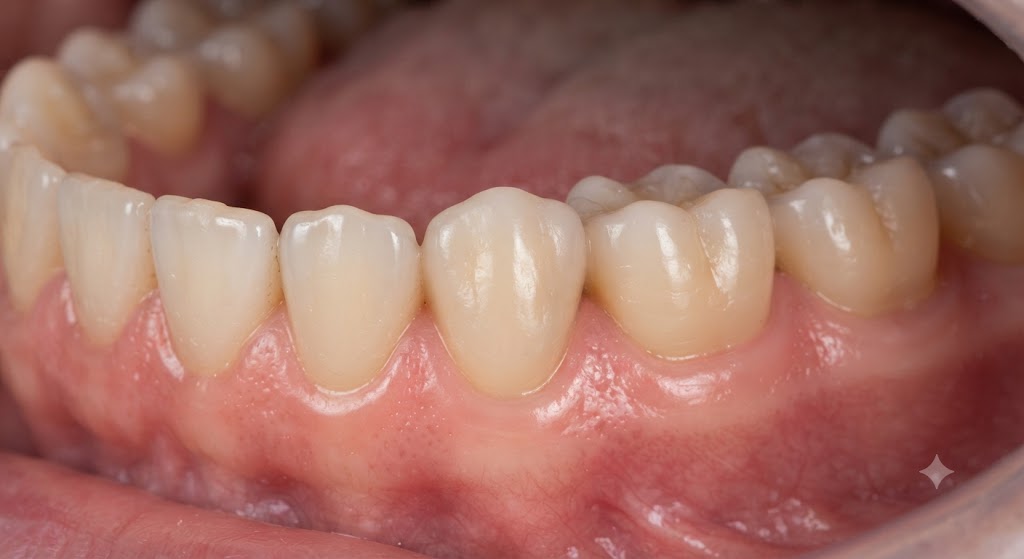
The visible part of your dental implant is the crown, and its aesthetics begin with a deep, sophisticated understanding of color. A natural tooth is not a single, flat, opaque shade of white. It is a living, dynamic structure with layers of color and translucency. The underlying dentin, the core of the tooth, provides the deep, warm chroma—the yellow, amber, or brown undertones. The outer enamel shell is translucent, like frosted glass. A single-shade, monolithic block of porcelain that lacks this internal depth will look fake, opaque, and plastic, an effect known as the “Chiclet” or “piano key” tooth.
A high-quality implant crown must exhibit polychromatic layering. The dental laboratory technician builds the crown in layers, using different porcelain powders to mimic the internal dentin core and the translucent enamel shell. The incisal edge, the biting edge of the tooth, should have a subtle, blue or gray translucent halo, just like a natural young tooth. The surface should have macro-texture, the anatomical grooves and lobes that give a tooth its characteristic shape. Even more critically, it should have micro-texture, a finely stippled, matte surface that mimics the natural light scattering of enamel. An overly polished, perfectly smooth surface looks unnatural. Your implant crown should not be a perfect, sterile, unblemished white. It should have subtle, natural characteristics and should harmonize in color value with your adjacent natural teeth, matching not just the base shade but the pattern of chroma distribution.
The Critical Role of the Emergence Profile
The crown does not just sit on the gum. It emerges from it. The emergence profile is the contour of the crown from the implant platform, through the gum tissue, to the visible tooth surface. This is the single most technically challenging and critical aesthetic parameter. A natural tooth has a specific, organic shape where it meets the gum. It narrows slightly at the gum line before flaring out to its full anatomical form, creating a scalloped, parabolic gum line.
A poorly designed implant crown has an unnatural, straight, stovepipe-like or bulky, shelf-like emergence profile. This pushes on the gum tissue, blocks blood flow, and creates a blunted, puffy, or inflamed gum line. A master ceramist and restorative dentist design an emergence profile that gently and gradually transitions from the round shape of the implant abutment to the natural, triangular or oval shape of the tooth at the gum line. This contour supports the gum papilla, the little triangle of gum tissue between the teeth. Recreating a natural emergence profile is what makes an implant crown look as though it is growing out of the gum, not just sitting on top of it.
The Pink Aesthetics: The Frame Around the Picture
The white tooth is the painting. The pink gum tissue is the frame, and a beautiful painting in a broken frame is ruined. A perfect implant crown with unhealthy, red, swollen, or receding gums is an aesthetic failure. The gum tissue surrounding a successful implant should be a pale, coral pink color, identical to the surrounding healthy tissue. It should be firm and stippled, with a surface texture like an orange peel. There should be no bleeding when you brush or floss. Most critically, the gum line height should be in perfect harmony. The implant crown’s gum line should be at the same level as the adjacent teeth. The dreaded “black triangle” or missing interdental papilla between the implant and a natural tooth is one of the most common and difficult-to-fix aesthetic complications. A pink triangle of missing gum is a dead giveaway of an implant. Achieving a full papilla requires precise surgical technique, proper implant placement in three dimensions, and a perfectly contoured restoration.
How an Implant Should Not Look: The Warning Signs
You must know the red flags of a poorly executed implant restoration. It should not look like a single, opaque, bright-white rectangle that stands out from your other teeth. It should not have a flat, featureless, or overly polished surface. It should not look as though it is emerging from a swollen, red, or puffy mass of gum tissue. The crown should not have a visible, gray, thin, or receded gum line that exposes the metal abutment underneath. A grayish hue shining through the gum at the neck of the crown is an aesthetic catastrophe, often caused by a thin gum biotype and a metal abutment that has not been adequately masked by the ceramic or by a zirconia abutment. This can sometimes be corrected by using a pink ceramic at the neck of the crown to mimic the gum. The implant should not be positioned so that it is sunk in, looking shorter than its neighbors, or pushed out facially, looking overly prominent. The bite should feel seamless. The tooth should not be the first one you see when you smile, either because it is too big, too white, or protruding.
The Role of Digital Smile Design and a Wax-Up
The pathway to a predictable, beautiful implant outcome is through pre-planning. A world-class restorative dentist will not guess. They will use a digital smile design protocol. A 3D digital scan or a traditional impression is taken. A digital mock-up or a physical wax-up is created on a model, showing you exactly what the final implant crown will look like in terms of shape, size, and proportion, before any surgery is even done. This wax-up is used to create a surgical guide, which dictates the exact, ideal three-dimensional position of the implant for the planned final crown. This is called prosthetically-driven implant placement. The bone is not driving the tooth position; the ideal tooth position is driving the implant placement. If you are not shown a mock-up or a wax-up of your final tooth, you are being treated with a non-restorative driven approach.
The Material Matters: Zirconia vs. PFM
The material of the final crown plays a huge role in the long-term aesthetics. A traditional porcelain-fused-to-metal (PFM) crown has a metal core. This can block light transmission and create opacity. More critically, over years, the gum tissue can recede slightly, exposing a dark gray line of metal at the gum line. This is a delayed aesthetic failure. A full-contour, monolithic zirconia crown or a layered zirconia crown is the modern aesthetic standard. Zirconia is a white, high-strength ceramic. It is tooth-colored all the way through. If gum recession occurs, there is no dark line. It is biologically inert and highly aesthetic.
Conclusion
A dental implant should look absolutely indistinguishable from a natural, healthy tooth, achieving this through a masterfully layered porcelain crown with polychromatic color, internal translucency, and a lifelike micro-textured surface that harmonizes perfectly with adjacent teeth. The critical aesthetic parameter is the emergence profile, a gentle, biologically supportive contour that creates a natural gum line with intact, healthy pink papillae, framing the crown as if it is growing organically from the tissue. The key to this predictable, world-class result is a prosthetically-driven digital workflow that plans the ideal tooth shape first and then guides the implant into its perfect, hidden position, eliminating the tell-tale signs of a fake tooth.
Frequently Asked Questions
My implant crown looks slightly darker than my other teeth. Is this normal?
It is a common, but not desirable, result. It can be caused by a metal abutment shining through a thin, translucent gum tissue, a material known as the “substrate effect,” or by a monolithic crown that lacks the internal dentin layer to reflect light properly. A skilled restorative dentist can often correct this by replacing the crown with a custom-shaded, layered restoration on a tooth-colored zirconia abutment.
What is the “black hole” at the gum line of my implant?
This is an open, missing interdental papilla, the “black triangle.” It is caused by a lack of supporting bone and gum tissue height between the implant and the adjacent tooth. It is an aesthetic problem and a food trap. Fixing it surgically with a soft tissue graft is a delicate and unpredictable procedure, making its prevention through proper surgical placement the paramount strategy.
Can I whiten my dental implant crown?
No. Porcelain and ceramic are inert materials. They do not respond to bleaching chemicals. The shade of an implant crown is permanent. This is why you must whiten your natural teeth to your desired shade before the implant crown is fabricated.
Should the implant tooth look exactly identical to the matching tooth on the other side?
It should be a mirror image in shape and position, creating symmetry. However, in nature, teeth are never perfectly identical. A touch of slight, natural character—a subtle variation in translucency or a tiny developmental groove—is what elevates a crown from a factory-made product to a piece of living art.
How long will my implant crown maintain its aesthetic appearance?
With proper care, a well-made porcelain or zirconia crown will maintain its color and gloss for a decade or more. The primary aesthetic threat is gum recession, which is caused by chronic inflammation from poor hygiene or aggressive brushing. The aesthetics of the gum tissue are the long-term critical factor.
Additional Resource: Link
To see examples of high-end aesthetic implant dentistry, you can explore the patient gallery of the American Academy of Cosmetic Dentistry. Visit the AACD Patient Gallery