What to Expect When Getting Sealants
We often wish our teeth came with a permanent shield. Daily brushing and flossing take dedication, and even the most diligent among us have moments of weakness with a late-night snack. Deep grooves on our back teeth act like magnets for tiny food particles. You scrub and rinse, but a microscopic speck of bread or candy finds a hiding spot. That is where a simple, modern solution steps in. We are talking about dental sealants.
You might feel a twinge of anxiety when you hear about a new dental procedure. That feeling is completely normal. We tend to imagine loud drills or uncomfortable poking. I want to put your mind at ease right now. Getting sealants feels nothing like a filling. There is no drilling. There is no numbing shot. You simply sit in the chair while the dentist or hygienist paints a protective layer onto your tooth.
This guide will walk you through the entire journey. We will look at the science behind the liquid shield, the exact steps from check-in to rinse, and the sensations you might notice. We will also cover costs, longevity, and the big question on everyone’s mind: does it hurt? Let’s demystify the process so you walk into your appointment feeling calm, informed, and ready.
Understanding the Science Behind the Shield
Before we step into the treatment room, let’s get familiar with the “why.” Understanding the landscape of your tooth makes the procedure feel less like a mystery and more like a logical step.
The Anatomy of Your Molars
Look at the top of your back teeth in a mirror. You see peaks and valleys. The pointed peaks are called cusps. They help you grind food. The narrow valleys between them are called pits and fissures.
These fissures can be incredibly deep. Sometimes, they are narrower than a single toothbrush bristle. Imagine trying to clean a narrow-necked bottle with a broomstick. The bristles simply glide over the top, never reaching the trapped debris inside. Bacteria settle in these hidden grooves. They feast on sugars and produce acid. Because the spot is so secluded, your saliva cannot wash it away. Cavities form.
A sealant works by flowing into these valleys. It smooths out the chewing surface. Food particles cannot get a foothold. Bacteria lose their favorite hiding spot. Your toothbrush can finally glide across a flat, clean surface.
A Brief History of Protective Coatings
This concept is not new. Dentists in the mid-20th century started experimenting with resins to close off grooves. Early versions wore down quickly. The science improved dramatically. Today, we use sophisticated liquid plastics. Some release fluoride over time. Others turn a slight color when they need a touch-up. Modern sealants bond directly to the enamel, creating a microscopic mechanical lock. This is not a temporary wax that floats away. It becomes part of the tooth’s surface.
“Think of a sealant as a raincoat for a tooth. It doesn’t mean you stop brushing. It means you have a waterproof barrier during the heaviest storm of sugary snacks or acidic drinks.”
Comparing Sealants to Fillings
The most common fear I hear is the confusion between sealants and fillings. Because both happen in a dental chair, people assume they feel similar. They could not be more different.
| Aspect | Dental Sealant | Dental Filling |
|---|---|---|
| Reason | Prevention; the tooth is healthy. | Restoration; the tooth has a cavity. |
| Tooth Preparation | None; no drilling. | Requires drilling to remove decay. |
| Anesthesia | Not required. | Usually requires a numbing injection. |
| Sensation | A smooth brush stroke; tasting plastic. | Pressure, vibration, and pinching. |
| Time per Tooth | About one to two minutes. | Five to twenty minutes. |
| Recovery | Immediate; eat right away. | Numbness lasts for hours; avoid hard foods. |
This table clarifies why we approach sealants with a completely different mindset. You do not brace for impact. You sit back and relax.
Who Truly Benefits from Sealants?
We often associate sealants with children. The image of a kid in a dental chair is the standard marketing photo. Yet, the benefit stretches far beyond the playground. If you have deep grooves and a desire to prevent decay, you are a candidate.
The Golden Window for Children
Dental professionals emphasize the timing for kids. The six-year molars erupt around age six. They are permanent teeth. Many parents mistake them for baby teeth and neglect their care. A cavity in a six-year molar means trouble for decades. The twelve-year molars arrive in the pre-teen years.
The ideal moment to seal a tooth is right after it fully erupts. The tooth is new. The enamel is pristine. We have not yet bombarded it with years of sticky candy. If you seal it before decay starts, you get the maximum return on investment. The Centers for Disease Control and Prevention state that school-age children without sealants have almost three times more cavities than children with sealants. That is a staggering statistic.
Why Adults Should Reconsider
I have heard adults say, “I’m too old for sealants.” That is a myth. If you have healthy molars with deep grooves, decay does not care about your age. Adult diets often include acidic coffees, wines, and refined carbs. Dry mouth, a common side effect of many medications, also raises cavity risk. Saliva is the mouth’s natural cleanser. When saliva flow slows, bacteria thrive.
If you reach your thirties or forties without cavities in your back teeth, a sealant is a beautiful insurance policy. It preserves that winning streak. If you have early, non-cavitated lesions—microscopic spots that have not yet broken through the enamel—a sealant can seal over them and starve the bacteria of nutrients. This halts the decay process without a drill.
A Note on Baby Teeth
Parents often ask if baby teeth need sealants. The answer is sometimes yes. If a primary tooth has unusually deep grooves and the child struggles with hygiene or diet, a sealant can prevent painful abscesses. Losing a baby tooth too early due to decay can cause orthodontic issues later. The sealant simply falls out when the tooth exfoliates naturally. There is no harm in protecting the baby molar if a dentist recommends it.
The Pre-Appointment Mindset
You have booked the appointment. Maybe it is for you, maybe for your nervous ten-year-old. The hours leading up to the visit can shape the experience.
Managing Dental Anxiety
It is completely okay to feel jittery. Dental anxiety is real. The sounds, the smells, the vulnerability of lying back—it triggers a stress response. I want to reframe the appointment. Do not view it as a “procedure.” View it as a “spa treatment for your molars.” There is no threat.
If you feel panic rising, try box breathing. Inhale through your nose for four seconds. Hold for four. Exhale through your mouth for four. Hold for four. This technique signals your parasympathetic nervous system to calm down. You are in control.
Eating Before the Visit
Unlike a filling or a surgical extraction, you do not need to alter your diet before getting sealants. The dentist does not use a numbing agent. You will not have a floppy lip or a drooling accident on the drive home. Eat a normal breakfast or lunch. Drink water. A stable blood sugar level helps you feel less irritable and anxious. Arriving hungry only amplifies stress.
What to Tell Your Dentist
Transparency helps. If you have a strong gag reflex, mention it during the check-in. The dental team handles this daily. They will adjust the chair position or use distraction techniques. If you have allergies—specifically to plastics, acrylics, or latex—disclose this, though allergies to sealant materials are extraordinarily rare. If you are pregnant, sealants are safe, but informing the team allows them to use extra pillows for your comfort.
What to Expect When Getting Sealants: The Step-by-Step Procedure
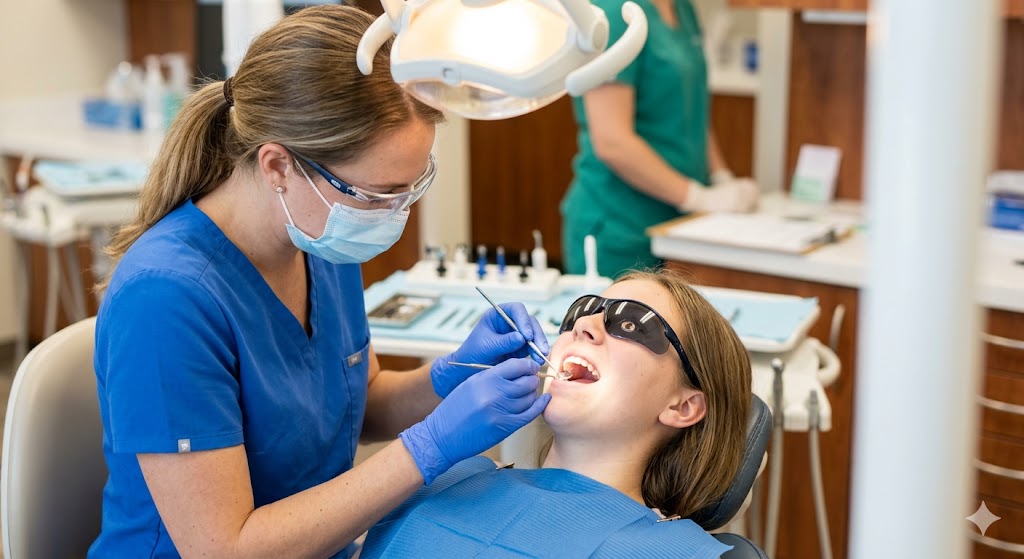
Now we arrive at the core of our guide. You are in the chair. The overhead light clicks on. You see the tray of instruments. Let’s break down the exact sequence. Knowing these steps eliminates the fear of the unknown.
Step 1: The Inspection and Triage
The dentist or hygienist first visually inspects the tooth. They use a small mirror and an explorer tool. They look for soft spots or deep staining. If they find a suspicious shadow, they might take a quick X-ray or use a laser cavity detector. A sealant can only protect a healthy surface or a very early, non-cavitated lesion. If decay has already broken through the enamel, a sealant would trap the active bacteria and cause a disaster. The inspection is the triage phase. It ensures the tooth qualifies for the shield.
Step 2: The Cleaning Protocol
You cannot glue something to a dirty surface. The tooth must be pristine. The clinician places a tiny, stiff rotary brush on a slow-speed handpiece. Think of it as a power wash for a single tooth. They polish the pits and fissures with a pumice-like paste. You feel a mild vibration and a gritty texture. It is similar to a professional cleaning but highly targeted. They rinse the tooth with water and air.
Step 3: The Isolation Dance
Moisture is the enemy of adhesion. Even a microscopic droplet of saliva can cause the sealant to fail. The tooth must stay bone-dry for about two minutes. The team achieves this in several ways.
They might place cotton rolls in the cheek and between the teeth. These act like tiny sponges. They might use a small rubber sheet called a rubber dam, though this is less common for simple sealants. Most commonly, they wrap tiny cotton holders around the tooth. The assistant positions the suction tip to catch any rogue saliva. You help by keeping your tongue still and breathing through your nose. If you feel a pool of water building up, raise your hand. The assistant will vacuum it immediately. The dry environment is non-negotiable.
Step 4: The Etching Gel (The Tooth Conditioner)
This step sounds aggressive. It is not. The clinician applies a blue or clear gel to the chewing surface. This gel contains a mild acid, usually 37% phosphoric acid. It is similar in consistency to toothpaste.
The Purpose: Tooth enamel is smooth on a microscopic level. To bond the liquid plastic, the dentist must create micro-porosities—tiny, microscopic pores. The acid etches the enamel, making it look frosted like sea glass.
The Sensation: You taste something sour or lemony. It is not painful. The gel sits on the tooth for about 15 to 30 seconds. It only touches the enamel; the dentist keeps it off the gums or any exposed root surface because that would sting.
Step 5: The Rinse and Dry Cycle Redux
The assistant sprays water to wash every trace of etching gel away. The sour taste disappears. The suction whisks the water away. Now the tooth undergoes a crucial drying phase. The high-pressure air stream blows on the tooth. The goal is to achieve a chalky, frosty-white appearance on the enamel. If the enamel does not look frosty, saliva has contaminated it, and the etching must start over. The team is extremely meticulous here. The frosty enamel proves the microscopic locks are open and ready for the resin.
Step 6: The Application of the Liquid Shield
Now the magic happens. The dentist or hygienist uncaps a small bottle of the sealant material. It looks like a clear or slightly opaque nail polish. They use a small brush or a syringe tip to paint the liquid directly into the pits and fissures.
They do not just slap it on top. They gently tease the liquid into the depths of the grooves, often using a tiny probe to pop any air bubbles. The material flows like very thin honey, seeking every microscopic crevice. You feel the coolness of the liquid and the tickle of the brush. There is zero pain. It is actually quite soothing, like painting a tiny model.
Step 7: The Curing Light (Setting the Seal)
The sealant is currently a wet liquid. It must harden into a solid shield. The dentist uses a hand-held blue light. This is a high-intensity curing light. The light activates a photo-initiator in the resin, causing it to polymerize or harden in seconds.
The clinician holds the light a few millimeters from the tooth. They may protect your eyes with a small orange shield or ask you to close your eyes. You might feel a slight warmth. Some curing lights generate a tiny thermal reaction. It is never hot enough to hurt. It just feels cozy. The light usually stays on for 20 to 30 seconds per tooth.
Step 8: The Occlusion Check and Final Polish
The sealant is hard now. The clinician wets the surface and asks you, “Does this feel high?” You bite down. You grind side to side. The dentist checks the marking paper—a thin carbon paper you bite on. If the sealant is too thick on a high spot, your natural bite will wear it down unevenly or cause soreness.
If a spot is too high, the dentist smooths it with a gentle finishing bur or a polishing cup. This does not hurt. It just feels like a vibration. Finally, they polish the sealant so it feels glossy and natural. Your tongue will instinctively find the tooth. It feels slippery for a few hours, then normal.
Sensory Guide: What You Will Feel, Hear, and Taste
Let’s get specific about the senses. Many people close their eyes during a dental visit and focus entirely on the sounds and smells.
| Sense | What to Expect |
|---|---|
| Taste | Sour citrus during the etch; a faint plastic or “band-aid” taste during sealant placement; fresh minty polish. |
| Smell | The clove-like or antiseptic smell of the clinic; a faint acrylic odor from the sealant bottle. |
| Sound | The low hum of the cleaning brush; the whoosh of the air/water syringe; the high-pitched beep of the curing light timer. |
| Touch | Cool water spray; a gritty polish; a tickling brush; a gentle vibration from polishing; a smooth, glassy tooth surface afterward. |
| Pressure | Very minimal. Holding the cotton rolls in place may press slightly on the gum, but it is not painful. |
Post-Procedure Care: The First 24 Hours
You have the sealants. They are set and hard. You are free to go. The immediate aftermath is remarkably simple.
Eating and Drinking
Modern light-cured sealants reach maximum hardness instantly. You can eat and drink right away. There is no waiting period, unlike some older materials. However, a bit of caution helps. If you were numb for another procedure (like a cleaning), avoid hot coffee until the numbness fades. But for sealants alone, grab a sandwich on the way out if you wish. The sealant will not stick to your food.
The Texture Curiosity
Your tongue will become obsessed with the tooth. The smooth, glassy surface feels different from the natural rough grooves of a molar. This sensation usually fades within 24 hours. The sealant does not wear away that fast; your brain simply rewrites the sensory map of your mouth. It stops feeling like a foreign object.
Managing Rare Soreness
After the procedure, you might feel a slight tightness or a bruised sensation in the gums surrounding the tooth. This does not come from the sealant. It comes from the clamps, cotton rolls, or the suction tip pressing against the tissue. If you feel this, rinse with warm salt water. The discomfort dissipates within a few hours.
The Longevity Question: How Long Do Sealants Last?
This is the most practical question you can ask. A sealant is not a one-and-done miracle that lasts forever. It is a durable but sacrificial barrier.
The Average Lifespan
Research indicates sealants can last up to 10 years with proper care. However, the average is closer to 5 to 7 years. Annual inspections are vital. The dentist checks the integrity of the sealant at every check-up. They look for chips, peeling edges, or wear.
Factors That Shorten Lifespan
- Bruxism (Grinding): If you grind your teeth at night, the shearing forces will sand the sealant down.
- Sticky Foods: Chewing caramel, taffy, or gummy bears regularly can pull at the edges of the resin.
- Acidic Drinks: Heavy consumption of sodas or lemon water can etch the bond, causing the edges to lift.
- Chewing Ice: Hard objects fracture the thin resin.
The Repair Protocol
A lost sealant does not automatically mean a cavity. If the sealant falls out after five years, the underlying tooth often remains healthy. The dentist simply cleans the groove and reapplies a new layer. The process takes half the time because the inspection is faster.
Important Note: A sealant protects only the chewing surface. It does not protect between the teeth. Flossing remains non-negotiable. Interproximal cavities (between teeth) still require floss to prevent them.
Cost Analysis: An Investment in Prevention
Finances often dictate our healthcare choices. Let’s look at the numbers objectively. Dental economics show sealants as one of the highest returns on investment in healthcare.
The Price Tag of a Sealant
The cost varies by location, provider, and insurance. Without insurance, a single sealant typically ranges from $30 to $80 per tooth. This price seems like a luxury until you compare it to a filling.
Sealants vs. Fillings: A Financial Table
This comparison illustrates the stark economic reality.
| Treatment | Cost (Per Tooth) | Time Lost | Future Risk |
|---|---|---|---|
| Sealant | $40 – $80 | 5 minutes | Tooth remains intact. |
| Small Filling | $150 – $300 | 30 minutes | Filling lasts 5-10 years; needs replacement. |
| Root Canal + Crown | $2,000 – $3,500 | Multiple visits | Tooth is weakened for life. |
| Implant (for extraction) | $4,000 – $5,000 | 6-12 months | Surgical risks. |
Spending $50 today to avoid a $2,500 root canal ten years from now is a mathematical no-brainer.
Insurance Coverage
Most dental insurance plans cover sealants at 100% for children under a certain age (usually 14 to 18). The Affordable Care Act mandates that health plans include pediatric dental coverage, and sealants are a key preventive benefit. For adults, coverage varies. Some plans cover them partially; others classify them as an elective child-only benefit. Always check your “Summary of Benefits” for code D1351 (sealant-per tooth).
BPA and Safety: Addressing the Plastic Concern
I must address the elephant in the room. We hear warnings about BPA (Bisphenol A) in plastics. Some dental resins contain trace amounts of BPA derivatives.
The Chemistry of Modern Sealants
Most modern dental sealants are BPA-free or contain only trace elements that are undetectable in saliva after curing. The concern stemmed from older bis-GMA resins that could theoretically degrade into BPA. The exposure from a sealant is magnitudes lower than the exposure from a plastic water bottle or a receipt. Studies show the exposure lasts for a maximum of three hours after placement, measured in parts per trillion. The benefit of preventing the bacterial infection of a cavity far outweighs this negligible, transient exposure. If you remain worried, ask for a BPA-free sealant. Your dentist likely uses one already.
The Pediatric Perspective: Preparing Your Child
Convincing a six-year-old to sit still with their mouth open requires strategy. The clinical term “sealant” means nothing to them. The phrase “painting a tooth shield” means everything.
The “Tooth Jewelry” Analogy
I recommend telling children the dentist is going to paint a clear, sparkling jewel onto their tooth. They can choose a flavor. They have to help the assistant by keeping their tongue “asleep” so the paint dries. Avoid the words “needle,” “shot,” “drill,” or “pain.” Those words trigger panic even if none of those instruments are present. Keep the vocabulary artistic and fun.
Bribery and Positive Reinforcement
Dentists are experts at positive reinforcement. The “treasure chest” at the end of the visit is a powerful tool. Promise a sticker or a small toy. After the procedure, exaggerate the bravery. “You didn’t flinch once!” Build a positive association so the next visit feels like a reunion, not a punishment.
Complications and Troubleshooting
While sealant application is straightforward, things occasionally go sideways.
The Problem of a “High” Bite
If the dentist misses a tiny excess blob, your bite feels uneven. You might avoid chewing on that side. The tooth might ache because the periodontal ligament is stressed. Do not wait. Call the office. A quick polish adjustment takes 30 seconds. Never try to file it down yourself with a nail file. You will damage the surrounding enamel.
Sealant De-bonding
Sometimes a sealant falls off within days. This usually happens due to salivary contamination during the procedure. The enamel looked frosty but a micro-droplet of moisture broke the bond. The tooth feels rough again. Most dentists guarantee their sealants for a short period. If it fails immediately, they will replace it free of charge. You simply notice it feels gone.
Food Impaction
Occasionally, a sealant edge lifts slightly, creating a microscopic shelf where food catches. You notice floss shredding or a pressure feeling. Again, a quick visit fixes this. The dentist can smooth the edge or add a flowable composite to the margin.
The Link Between Sealants and Orthodontics
Brackets and wires create plaque traps. Teenagers in braces struggle to keep molars clean. Cavities can develop rapidly behind the bands. If your child is about to get braces, ask the orthodontist about pre-treatment sealants. Sealing the grooves of the molars before cementing molar bands adds a layer of defense. It is much harder to fill a cavity on a tooth that has a metal band cemented around it. A pre-emptive sealant is wise.
Sealants and Teeth Whitening: A Note on Color
Sealants do not whiten. If you whiten your teeth later, the natural enamel lightens, but the sealant stays its original color. This difference is usually invisible because sealants are placed on back teeth in low-visibility zones. If you plan extensive bleaching, do it before getting sealants on highly visible premolars. The dentist can match the sealant shade to your newly whitened enamel.
Global Guidelines and Expert Consensus
The World Health Organization and the American Dental Association strongly support sealant use. The evidence base is decades deep. In communities with fluoridated water, sealants add a synergistic benefit. Fluoride protects smooth surfaces, and sealants protect deep grooves. This dual protection approach is the gold standard of preventive dentistry.
“Dental sealants are one of the few interventions in medicine that cost almost nothing, hurt nothing, and prevent devastating disease. They are an unsung hero of public health.” — A sentiment echoed in preventive dentistry circles.
Advanced Technologies: Looking to the Future
The sealant of tomorrow is already here in some clinics. Bioactive sealants release calcium and phosphate ions to re-mineralize the tooth from within. Self-adhesive sealants skip the etching step entirely, reducing sensitivity. Smart sealants change color as they wear away, signaling the dentist visually. These innovations make the process even faster and safer.
The Psychological Benefit: Peace of Mind
There is a profound psychological relief in knowing you are armored. You go to a movie, eat popcorn, and a kernel gets stuck. You floss it out and realize your sealant is standing guard. You no longer panic at the sight of dark grooves. This peace of mind reduces dental-related stress globally. It turns a reactive relationship with dentistry (filling cavities) into a proactive one (keeping teeth whole). That shift is empowering.
Common Myths We Need to Bust
Let’s address folklore that might deter someone.
Myth 1: “Sealants contain dangerous chemicals.”
Fact: Modern sealants are biologically inert. The trace elements do not cause systemic disease. The cavity they prevent is a live bacterial infection that can enter the bloodstream.
Myth 2: “If a sealant falls out, the tooth is weaker.”
Fact: The removal of a sealant does not scrape away enamel. The tooth is exactly as strong as it was pre-sealant. The only loss is the protective cover.
Myth 3: “Adults don’t get cavities in grooves.”
Fact: Root decay and pit decay are common in adults, especially as gums recede. Age does not confer immunity.
Myth 4: “It hurts to get them removed.”
Fact: Sealants are not removed with a drill. They wear down naturally or are peeled off with a gentle ultrasonic scaler if necessary.
Environmental and External Factors
Your sealant’s longevity interacts with your lifestyle. Swimmers in highly chlorinated pools may experience faster wear. Chlorine is acidic. If you swim daily, rinse your mouth with fresh water immediately after leaving the pool. Chewing on pens or opening bags with your teeth will destroy a sealant instantly. Treat your teeth like fine china, not a Swiss Army knife.
The Nutritional Perspective
After getting sealants, you have a window of heightened protection. Use it to build good habits. Reduce grazing on fermentable carbohydrates. The sealant protects the groove, but the acid from soda still attacks the smooth enamel around it. Pair sealants with a diet rich in crunchy vegetables. Carrots and celery naturally scrub smooth surfaces. Cheese raises the mouth’s pH, neutralizing acid. Water dilutes sugar. The sealant is the star player, but it needs a supporting team.
Table of Sensory Timeline
This snapshot gives you a minute-by-minute expectation.
| Timeframe | Activity | Dominant Sensation | Emotional State |
|---|---|---|---|
| Minute 0-2 | Inspection & Cleaning | Gritty polish, vibration | Assessment, mild curiosity |
| Minute 3-4 | Etching | Sour taste, gentle swabbing | Momentary weirdness |
| Minute 5 | Rinse & Dry | Cold air blast, water spray | Relief, slight dryness |
| Minute 6-7 | Application & Cure | Cool paint, faint warmth | Relaxation, satisfaction |
| Minute 8 | Bite Check & Polish | Smooth grinding, rubber vibration | Completion, confidence |
Sealants in Combination with Fluoride Varnish
Some pediatric visits combine both. Fluoride varnish is painted on all teeth. Sealants go on specific back teeth. The varnish treats sensitivity and stops early decay on smooth surfaces. The sealant locks down the deep grooves. They work in perfect harmony. You leave with a comprehensive shield.
A Special Note on Special Needs Patients
Children and adults with sensory processing disorders, autism, or physical disabilities often struggle with saliva control. Dentists can use specialized isolation devices like Isolite or DryShield. These combine suction, light, and cheek retraction. The sealant procedure under these conditions is still entirely painless and often quicker than a traditional cleaning. If your loved one has special needs, communicate with the dentist to schedule extra time and gentle desensitization.
The Re-Treatment Cycle
Sealants are not permanent. You will be on a re-treatment cycle. A sealant placed at age 7 might need a touch-up at age 12, then a re-evaluation at age 18. By age 18, the fissures are often less deep due to natural wear, or the wisdom teeth are the new concern. This cycle integrates seamlessly into annual check-ups. It is not a burden; it is a ritual of maintenance.
The Environmental Impact of Dental Materials
We increasingly care about sustainability. Sealant waste is minimal. The plastic used for one sealant equals a fraction of a drinking straw. The prevention of a cavity avoids the need for plastic barriers, anesthetic carpules, sterilization wraps, and the carbon footprint of emergency dental visits. Prevention is, in fact, the greenest dentistry.
Psychological Techniques for the Chair
If you feel panic rising:
- Count the ceiling tiles. Distraction grounds you.
- Wiggle your toes. This releases nervous energy.
- Hold a tissue. Wringing a tissue in your hands channels anxiety away from the mouth.
- Agree on a “stop” signal. A raised left hand means “I need a break.” Knowing you control the situation reduces panic.
A Comparative Look: Glass Ionomer vs. Resin Sealants
Some clinics offer glass ionomer sealants. They release fluoride and tolerate a slightly moist environment. They are useful for teeth that are partially erupted and hard to isolate. However, they are more opaque (white) and less wear-resistant than resin. Your dentist chooses the material based on the tooth’s cooperation level. Both are valid. Both feel the same.
The Effect of Saliva pH
A highly acidic oral environment (pH below 5.5) accelerates the degradation of the bond. This links back to diet. If you sip acidic drinks all day, the enamel bond weakens. Baking soda rinses can neutralize the pH. Testing your salivary pH with litmus paper gives you a data point to discuss with your dentist.
Understanding the “Watch” Recommendation
Sometimes a dentist says, “Let’s watch this groove.” They see a shadow but no catch with the explorer. If they seal over a deep stain that is actually an active cavity, they trap the bacteria. The decay progresses silently under the shield until the tooth breaks down. If the diagnosis is unclear, “watching” for six months is safer than sealing prematurely. Trust their judgment. A cautious dentist is a good dentist.
The Economic Multiplier Effect
Preventing a cavity in a child’s molar saves direct dental costs. It also saves indirect costs. Parents miss fewer workdays. Children miss fewer school days. The pain and infection cycle breaks. In low-income populations, school-based sealant programs have drastically reduced absenteeism. The ripple effect of a 5-minute clear paint job touches education, employment, and quality of life.
How to Check Sealants at Home
You cannot see wear easily in a mirror. Run your tongue over the tooth. Is it smooth? Or do you feel a sharp edge or a crater? A sudden roughness indicates a lost sealant. Food sticking to a spot it never stuck before is another clue. During your home inspection, look with a flashlight. A retained sealant looks glossy and flat. A lost one exposes the dark, grooved natural tooth. Call for a repair if you notice a change.
The Connection to Gum Health
A sealant placed poorly can overhang the side of the tooth. This traps food near the gumline, causing inflammation. A well-placed sealant stays strictly on the biting surface. The hygienist flosses the contact point after sealing to ensure nothing squeezed between the teeth. If your gums bleed around a newly sealed tooth, the margin needs polishing. Do not ignore bleeding.
The Evolution of My Own Dental Routine
I used to view the dentist as a repair shop. Something broke, I fixed it. Learning about sealants shifted my perspective to asset management. I am protecting my portfolio of teeth. The upfront cost is trivial. The peace of mind is immense. I recommend sealants not because I read about them, but because they have kept my own deep-grooved molars cavity-free into adulthood.
Conclusion
- Getting sealants is a swift, pain-free painting process that shields deep tooth grooves from decay without any drilling, numbing, or recovery time.
- The procedure involves a meticulous clean, a sour-tasting etch to roughen the enamel, a liquid resin painted into the fissures, and a bright light that hardens the shield in seconds.
- Lasting up to a decade with proper care, sealants are a profoundly cost-effective preventive measure that saves significant money, time, and discomfort compared to treating cavities.
Frequently Asked Questions
Can you get sealants on teeth that already have tiny cavities?
You cannot seal over a cavitated, soft hole. If the decay has just started and is a “non-cavitated” white spot, a sealant can starve it. The dentist must confirm this via X-ray or laser detection. Sealing over active decay leads to a hidden cavity explosion.
Why did my sealant turn brown or yellow?
Discoloration usually comes from surface staining from coffee, tea, or tobacco. The sealant itself is porous to stains over years. The color change does not signal failure unless the edge is leaking. Polishing at a check-up often removes surface stains.
Are sealants vegan or cruelty-free?
Most synthetic resin sealants contain no animal-derived ingredients. The materials are purely chemical polymers. Ask the manufacturer if this aligns with your ethics, but generally, there are no animal products in the bonding agents.
Can a sealant fix tooth sensitivity?
Yes, if the sensitivity stems from an exposed deep groove. The sealant covers the microscopic nerve endings in the dentin. If sensitivity comes from gum recession, a sealant on the biting surface will not help. The dentist applies a different desensitizer to the root surface.
Is it safe to get sealants while wearing an orthodontic retainer?
Absolutely. The sealant does not interfere with the fit. However, you should remove the retainer during the procedure. The dentist checks the bite afterward without the retainer, then confirms the retainer still seats properly.
Additional Resource:
For in-depth research data and safety profiles, visit the American Dental Association’s dedicated page on pit-and-fissure sealants. ADA Sealants Resource
Disclaimer: This article is for informational purposes only and does not constitute medical advice. Always consult a licensed dentist for a diagnosis and personalized treatment plan. Do not delay seeking professional dental care based on information read here.