What Would Cause Nose And Mouth Ulcers?
The simultaneous appearance of painful ulcers in both the nose and the mouth is a red flag that demands attention. This is not a common presentation of a simple canker sore or a minor nasal irritation. When two distinct mucosal surfaces break down in ulceration at the same time, the cause is almost always a systemic condition, an autoimmune process, or a serious underlying disease. Isolated mouth ulcers are common and usually benign. The addition of nasal ulcers changes the clinical picture entirely and narrows the diagnostic possibilities to a specific list of conditions that a physician or specialist must urgently investigate.
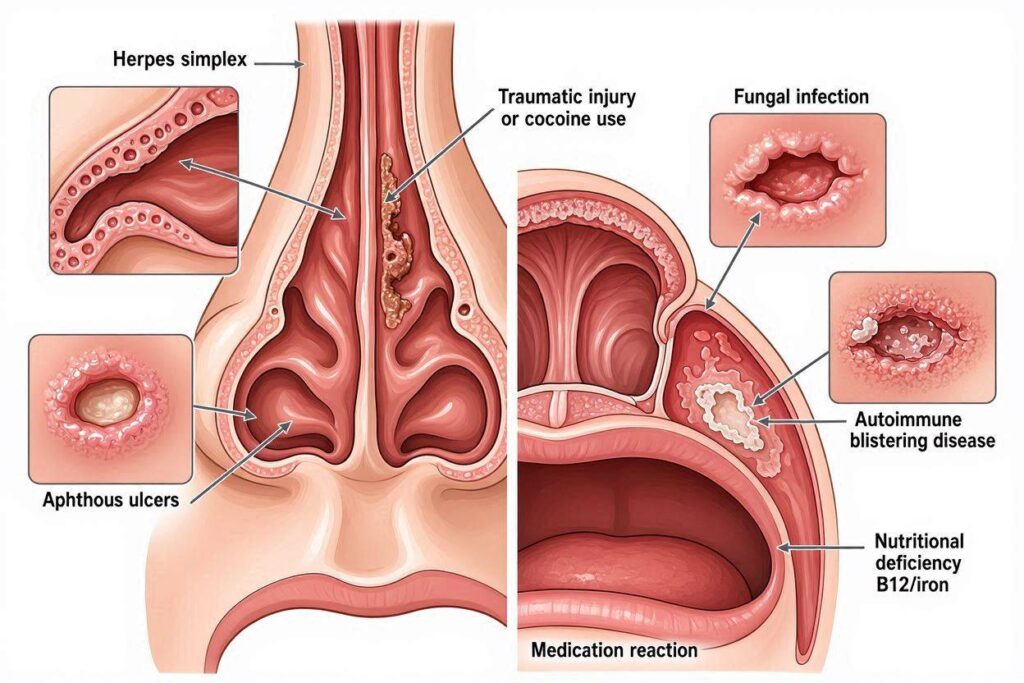
The Significance of Dual-Site Mucosal Ulceration
The mouth and the nose are lined by a continuous mucosal membrane of stratified squamous epithelium (in the mouth and anterior nose) and respiratory epithelium (in the deeper nasal passages). They share a similar embryological origin and are both exposed to the external environment. Because they are part of the same mucosal immune system, a systemic disease that attacks mucosal tissue can manifest in both locations.
Nasal ulcers are not always obvious. They may be hidden inside the nostril, presenting as a painful spot that bleeds easily when you blow your nose, a persistent crusting, or a sensation of obstruction. The combination of a crusted, bloody nose and a painful mouth sore that resists the usual topical treatments is the specific symptom pattern that points toward a deeper pathological process. The list of potential causes is short but serious.
Autoimmune and Inflammatory Disorders
The most common category of disease causing dual nose and mouth ulcers is autoimmune. In these conditions, the body’s immune system mistakenly targets the adhesion proteins that hold the skin and mucosal cells together or attacks the blood vessels that supply these tissues.
Pemphigus Vulgaris
Pemphigus vulgaris is a rare, potentially fatal autoimmune blistering disease. The immune system produces antibodies against desmoglein, a protein that acts like a molecular glue holding the epithelial cells together in the skin and mucosa. The attack causes the cells to separate, a process called acantholysis, leading to thin-walled, fragile blisters that rupture almost immediately, leaving large, painful, shallow ulcers.
The mouth is the first site of involvement in almost all cases. These oral ulcers can be widespread and persistent. They often precede skin lesions by months. The Nikolsky sign, where gentle lateral pressure on healthy-appearing mucosa causes the top layer to slide off, leaving a raw surface, is a classic clinical finding. Nasal involvement presents as painful, bleeding crusts and ulcers inside the nostrils. The disease is diagnosed by a perilesional biopsy for direct immunofluorescence, which shows a characteristic fishnet pattern of antibody deposition between the cells. Treatment involves high-dose systemic corticosteroids and steroid-sparing immunosuppressant drugs.
Granulomatosis with Polyangiitis
Granulomatosis with Polyangiitis, formerly called Wegener’s granulomatosis, is a rare form of vasculitis. The immune system attacks and inflames the walls of small and medium-sized blood vessels, leading to necrosis and granuloma formation. It has a predilection for the upper and lower respiratory tracts and the kidneys.
The classic oral presentation is a very specific lesion: a hyperplastic, granular, strawberry-colored gingivitis that is painful, bleeds easily, and does not respond to routine dental cleaning. The nasal symptoms are even more prominent. Chronic sinusitis, persistent nasal crusting, bloody nasal discharge, and deep, destructive ulcers inside the nose that can eventually perforate the nasal septum and cause a saddle-nose deformity are classic. The disease is diagnosed by a blood test for anti-neutrophil cytoplasmic antibodies, specifically the c-ANCA pattern with PR3 antibodies, and a biopsy of the affected tissue. Treatment is with high-dose steroids and cyclophosphamide or rituximab, and without treatment, the disease is rapidly fatal.
Lupus Erythematosus
Systemic lupus erythematosus can involve the oral and nasal mucosa. The oral ulcers of lupus are typically painless, discoid lesions with a central erythematous depression surrounded by a white, radiating keratotic border. They appear most often on the hard palate. Nasal ulcers in lupus are similarly chronic, painless, and crusted, found on the nasal septum. The combination of these mucosal findings with the classic malar butterfly rash, photosensitivity, arthritis, and a positive antinuclear antibody test confirms the diagnosis.
Infections That Bridge the Nose and Mouth
Although less common than autoimmune causes in the modern developed world, certain chronic, granulomatous infections can cause destructive lesions in both the nasal and oral cavities. These infections are slow, insidious, and can mimic vasculitis or malignancy.
Tuberculosis and Leprosy
Extrapulmonary tuberculosis can manifest in the oral cavity and the nose. A painless, irregular, chronic ulcer that does not heal and is resistant to all topical and antibiotic treatments is the typical presentation. The base of the ulcer may be granular. Nasal tuberculosis causes a nasal discharge, crusting, and ulceration. Diagnosis requires a biopsy showing caseating granulomas and acid-fast bacilli, along with a positive interferon-gamma release assay or a culture.
Leprosy, or Hansen’s disease, caused by Mycobacterium leprae, has a predilection for the cooler areas of the body, including the nasal mucosa and the anterior maxillary oral cavity. Chronic, painless ulcers and nodules form. The destruction of the anterior nasal spine and the alveolar bone can cause the classic facies leprosa, with loss of the upper central incisors and a collapsed nasal bridge.
Chronic Fungal Infections
In severely immunocompromised patients, such as those with uncontrolled AIDS or those on long-term immunosuppressive therapy, invasive fungal infections like mucormycosis or aspergillosis can simultaneously attack the palate and the sinuses. The infection begins in the nose and paranasal sinuses and then invades the hard palate, causing a black, necrotic, painless ulcer as the fungus invades the blood vessels and causes tissue infarction. This is a rapidly progressive, life-threatening surgical emergency.
Malignancy and Drug Reactions
A persistent, non-healing, solitary ulcer in the nose and a separate lesion in the mouth should always raise the suspicion of a malignant process. Extranodal natural killer/T-cell lymphoma, previously called lethal midline granuloma, is a rare, aggressive lymphoma strongly associated with Epstein-Barr virus. It presents with progressive, destructive ulceration of the midface, involving the nose, the palate, and the surrounding structures. The ulcers are deep, necrotic, and relentlessly progressive. A deep incisional biopsy and immunohistochemistry are essential for diagnosis.
Certain medications can cause a severe mucocutaneous reaction that involves the mouth and the nose. Stevens-Johnson syndrome and toxic epidermal necrolysis are severe, life-threatening hypersensitivity reactions, most commonly to medications like sulfonamides, allopurinol, and certain anticonvulsants. The condition begins with fever and flu-like symptoms, followed by the rapid eruption of painful, widespread target-like lesions and extensive, sheet-like ulceration of the oral and nasal mucosa, along with the eyes and genitals. This is a medical emergency requiring immediate cessation of the culprit drug and intensive care in a burn unit.
Conclusion
The simultaneous presence of nose and mouth ulcers is a serious clinical sign that strongly suggests a systemic autoimmune condition like pemphigus vulgaris or granulomatosis with polyangiitis, a chronic granulomatous infection, or, more rarely, a malignancy or severe drug reaction. This dual-site mucosal breakdown is not a self-limiting, benign problem and must trigger an urgent referral to an oral medicine specialist, rheumatologist, dermatologist, or otolaryngologist for a biopsy, serological workup, and definitive diagnosis. The underlying diseases are often treatable, but early intervention is critical to prevent irreversible tissue destruction and systemic organ damage.
Frequently Asked Questions
Q: Can simple allergies cause nose and mouth ulcers at the same time?
A: Severe seasonal allergies can cause nasal irritation and occasional minor ulceration from vigorous nose blowing, but they would not typically cause true deep oral ulcers. The combination of distinct, deep ulcers in both sites is not a typical allergy presentation.
Q: If I have a mouth ulcer and a small, painful spot in my nose, should I panic?
A: A single, small mouth ulcer and a pimple or folliculitis inside the nostril can occur coincidentally. The concerning pattern is recurrent, multiple, and persistent ulcers at both sites that do not heal normally within two weeks, especially if accompanied by crusting, bleeding, or systemic symptoms like fatigue or joint pain.
Q: What type of doctor should I see for this?
A: Start with your primary care physician, but you will likely need a referral to a multi-specialty team. An oral medicine specialist is the dentist who specializes in mucosal diseases. A rheumatologist manages autoimmune diseases, and an otolaryngologist manages complex nasal conditions. A diagnostic biopsy is often the critical first step.
Additional Resource
For comprehensive, patient-focused information on rare oral and nasal autoimmune and vasculitic conditions, the following national institute is the most authoritative source.
- National Institute of Allergy and Infectious Diseases: niaid.nih.gov