When A Dental Implant Feels Loose?
You are going about your day, eating, talking, perhaps just touching the area with your tongue. Then you feel it. A subtle but unmistakable movement. Your dental implant, which has been a solid, reliable part of your mouth for months or years, feels loose. A wave of anxiety washes over you. You know that a healthy implant should be rock-solid, immobile, fused to the bone. Does this mean it is failing? Is it an emergency? What should you do right now? This guide will walk you through the critical moments and decisions that follow the unsettling discovery of a loose dental implant. We will differentiate between a loose crown, a loose abutment, and a loose implant fixture. We will explain the causes, the urgency, and the steps you must take to maximize the chance of saving your implant.
Stay Calm and Assess: What Exactly Is Loose?
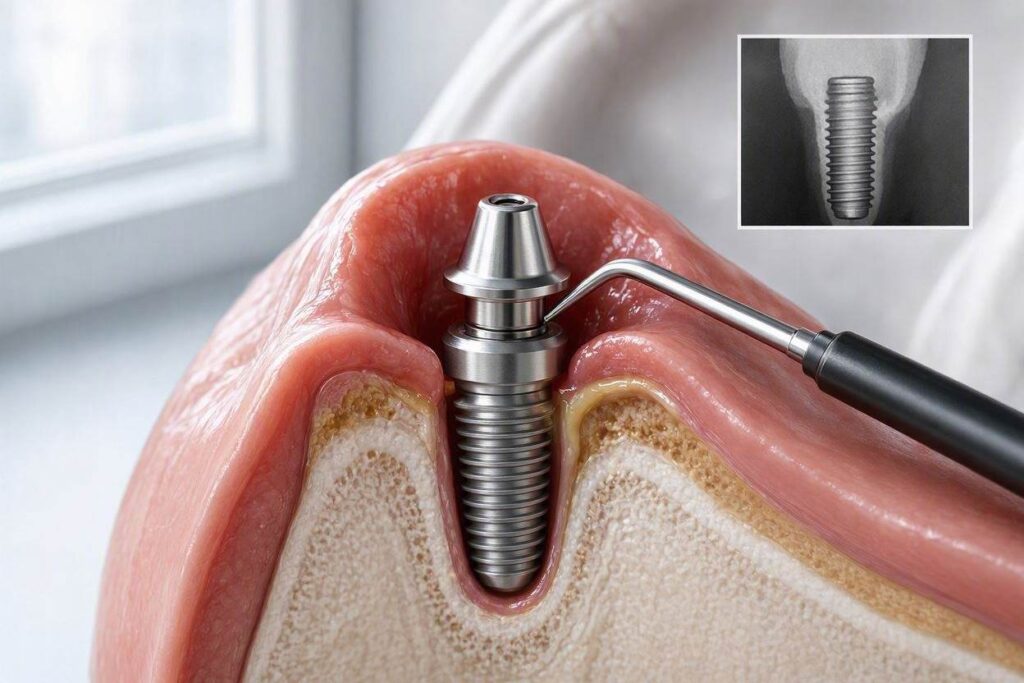
The first and most important step is to determine what, exactly, is loose. The word “implant” is often used loosely by patients to refer to the entire assembly, but the implant fixture, the abutment, and the crown are three distinct components. Each has a different cause and treatment for looseness, and the implications range from trivial to catastrophic.
The Implant Crown Is Loose. You feel the visible tooth part, the crown, moving. The movement may be a slight rotation, a rocking, or a feeling that the crown lifts slightly when you chew sticky food. If the crown is loose but there is no pain and the gum around it looks normal, the problem is likely with the cement that holds the crown onto the abutment, or with the abutment screw. This is a relatively minor problem.
The Entire Implant Is Loose. You feel the metal post moving in the bone. This movement is often accompanied by a dull ache, bleeding, or a bad taste. When you touch the crown, the entire thing, including what feels like the root, moves. This is a true implant failure. The osseointegration, the bone-to-implant connection, has been lost. This is a serious problem.
Try to gently wiggle the implant with a clean finger or your tongue. Do not forcefully manipulate it. The goal is to determine the nature of the movement. A crown that is slightly mobile but the base feels solid is very different from an implant that feels like a wiggly tooth.
The Loose Crown: A Restorative Problem
If the crown is loose but the underlying abutment and implant are stable, you have a restorative complication, not an implant failure. This is the best-case scenario.
Cause 1: Cement Failure. If your crown is cemented onto the abutment, the dental cement can degrade over time, or it may not have had a perfect bond initially. The crown simply breaks loose from the cement seal. The abutment remains firmly attached to the implant.
Cause 2: Abutment Screw Loosening. If your crown is screw-retained, meaning it is attached to the implant by a tiny screw that goes through the crown and into the abutment, or directly into the implant, that screw can loosen over time. This is the most common mechanical complication with implant restorations. The screw loosens microscopically, and the crown begins to rock. You may feel a clicking sensation.
What to Do for a Loose Crown. Call your restorative dentist immediately. Do not attempt to glue the crown back on yourself with household adhesives. These are toxic and will permanently damage the crown and the abutment. If the crown comes off completely, save it in a safe container and bring it to your appointment. The dentist will examine the abutment, clean any residual cement, and either re-cement the crown or tighten the abutment screw. If the screw is loose, the dentist will check the fit, retighten the screw to the precise torque specification, and replace the filling material over the access hole. This is usually a quick, straightforward visit.
The Loose Abutment: The Middle Ground
Sometimes, the abutment itself, the connector between the implant and the crown, is loose, but the implant is still integrated. The crown and abutment move together as a unit. This can feel similar to a loose crown but is more significant because the connection between the abutment and the implant is compromised.
Cause: Abutment Screw Loosening or Fracture. The abutment is held to the implant by a screw. That screw can loosen or, rarely, fracture. The movement can allow bacteria to seep into the implant-abutment connection, causing inflammation.
What to Do. See your dentist promptly. The dentist will remove the crown and abutment assembly, inspect the internal threads of the implant for damage, and either retighten the existing abutment or replace the screw. If the screw is fractured, retrieving the broken piece can be a delicate procedure. A loose abutment left untreated can lead to implant failure because the micromotion can stress the bone and the screw can fatigue and break.
The Loose Implant Fixture: A True Failure
If the implant fixture itself, the titanium post, is loose in the bone, you are facing an implant failure. The bone has not successfully fused with the implant, or the bone that once supported it has been destroyed by infection.
Causes of a Loose Implant Fixture.
- Failed Osseointegration. The implant never fully integrated with the bone. This is an early failure.
- Peri-Implantitis. Chronic bacterial infection has destroyed the supporting bone around a once-integrated implant. The bone loss progresses until the implant loses its anchorage.
- Occlusal Overload. Excessive biting forces, often from grinding or a poorly designed bite, have caused microfractures in the bone-implant interface, leading to loss of integration.
- Implant Fracture. The implant body itself has cracked. This is rare but catastrophic.
- Trauma. A direct blow to the mouth can dislodge an implant.
What to Do for a Loose Implant Fixture. This is a dental emergency, though not in the same category as a knocked-out natural tooth. You must see your implant surgeon or dentist as soon as possible, ideally within a day or two. Do not chew on that side. Do not wiggle the implant. The movement will further damage any remaining bone.
The Emergency Appointment: What the Dentist Will Do
When you arrive with a loose implant, the dentist will perform a systematic evaluation.
Clinical Examination. The dentist will test the mobility of the implant. An implant that moves even slightly in the bone is considered a failure. They will check for signs of infection, such as redness, swelling, bleeding, and pus. They will measure the probing depths around the implant. Deep pockets and bleeding indicate bone loss.
Radiographic Evaluation. A periapical X-ray will be taken immediately. The dentist will compare it to previous X-rays taken at the time of crown delivery. They will look for a radiolucent line, a dark halo around the implant, which indicates a lack of bone contact. They will measure the bone level and look for a crater-shaped defect typical of peri-implantitis.
Mobility Testing. The dentist may use a device like the Periotest or Osstell to measure the implant’s stability quantitatively. A low stability reading confirms the loss of osseointegration.
The Verdict and Treatment Options
Based on the examination, the dentist will determine if the implant can be saved or if it must be removed.
If the Implant Is Salvageable. In rare cases of very early detection of occlusal overload, where the implant is slightly tender but not mobile, adjusting the bite and immobilizing the implant may allow the bone to heal. This is uncommon. More often, if there is any clinical mobility, the implant is already lost.
If the Implant Must Be Removed. The dentist will schedule you for implant explantation. The procedure involves numbing the area, gently removing the loose implant, debriding the infected or damaged tissue from the socket, and often placing a bone graft to preserve the ridge for a future implant. The removal of a loose, failing implant is typically straightforward and less traumatic than the original surgery because the bone has already separated from the implant surface.
The Aftermath: Healing and Planning for Replacement
After the implant is removed, you will need a healing period of three to six months. During this time, you may wear a temporary removable tooth, such as a flipper or a modified partial denture, to maintain aesthetics and function. The site must heal fully, and the cause of the failure must be identified and addressed before a new implant can be placed.
Was the failure due to poor oral hygiene? Was the patient a smoker? Was there uncontrolled diabetes? Was the implant overloaded by a clenching habit? Addressing the root cause is essential to prevent the next implant from suffering the same fate. The bone graft must mature. A new CBCT scan will be taken to assess the bone volume. A new implant can then be planned, often with a slightly wider or longer implant, and with a more carefully managed loading protocol.
The Psychological Impact
We must acknowledge the emotional toll of a loose implant. You invested money, time, and hope into this tooth. Feeling it move can trigger feelings of dread, anger, and defeat. You may feel you did something wrong. You may feel your body has failed you. These feelings are valid. Speak with your dentist about them. Understand that implant failure, while uncommon, is a known risk in a minority of cases. It is not a personal failing. Modern implant dentistry has excellent protocols for managing failure and successfully re-implanting. A failed implant is a setback, not the end of your journey to a restored smile.
Summary of Key Points About a Loose Dental Implant
- Determine what is loose: the crown, the abutment, or the implant fixture. The treatment and urgency vary dramatically for each.
- A loose crown is a restorative issue, typically fixed by re-cementation or screw tightening, and is not an emergency.
- A loose abutment requires prompt attention to prevent further complications.
- A loose implant fixture is a true failure. It requires immediate evaluation and likely removal.
- Do not attempt to self-fix a loose implant with household glues or adhesives.
- After removal, a healing period and bone graft prepare the site for a successful replacement implant.
Conclusion
When a dental implant feels loose, the first moments are defined by anxiety, but your rational response can make all the difference. Carefully assess what is moving. If it is just the crown or abutment, a relatively simple dental visit can restore stability. If the implant fixture itself is moving, you are facing implant failure, and prompt professional removal is necessary to preserve the surrounding bone for future reconstruction. In all cases, do not delay seeking care. The sooner a loose implant is evaluated, the more options you have for saving it or successfully replacing it.
Frequently Asked Questions (FAQ)
1. Can a loose dental implant be saved without surgery?
If the looseness is due to a loose crown or abutment screw, it can be saved with a simple, non-surgical procedure. If the implant fixture is loose in the bone, it cannot be saved and must be removed.
2. Is a loose implant an emergency?
It is urgent and requires prompt evaluation, ideally within 24 to 48 hours, especially if accompanied by pain, swelling, or signs of infection. It is not a life-threatening emergency but requires timely professional care.
3. What does a loose implant feel like?
It may feel like a slight rocking, a clicking sensation, or a definite wiggle when touched with your finger or tongue. There may be a dull ache, bleeding, or a bad taste if infection is present.
4. Can I eat with a loose implant?
No. Avoid chewing on that side entirely. Eating on a loose implant can worsen the bone loss and drive bacteria deeper into the tissues.
5. Will my dental insurance cover the removal and replacement of a failed implant?
Insurance coverage varies. Some plans may cover a portion of the removal. Coverage for a replacement implant is often subject to limitations and exclusions. Check your specific policy.
6. How long does it take to replace a failed implant?
After removal and bone grafting, the healing period is typically three to six months before a new implant can be placed. The entire process to a new crown may take eight to twelve months.
7. Can a loose implant cause an infection?
Yes. The movement of a loose implant creates a pathway for bacteria to enter the bone, which can lead to an acute infection or abscess.
Additional Resource
For more information on managing dental implant complications, visit the American Academy of Periodontology:
American Academy of Periodontology – Dental Implants