When to Place Implants for Dentures
Living with dentures presents daily challenges. They move when you eat, slip when you speak, and never feel quite secure. You have heard about implant-supported dentures that snap into place and stay put, but you wonder about the timing. Should you get implants before your dentures, at the same time, or years after you have been wearing them? The answer depends on your current dental situation, the condition of your jawbone, and your treatment goals.
Timing matters tremendously for implant-supported denture treatment. The decisions you make about when to transition from conventional dentures or failing teeth to implant-supported restorations affect treatment complexity, cost, healing time, and final results. Understanding your options helps you work with your dental provider to plan optimal timing for your situation.
I wrote this guide because patients struggling with dentures often believe they missed their window for implant treatment. They think implants must be placed when teeth are removed, and years of denture wearing have disqualified them. The truth is more encouraging. Implant treatment remains possible for most patients regardless of how long they have worn dentures.
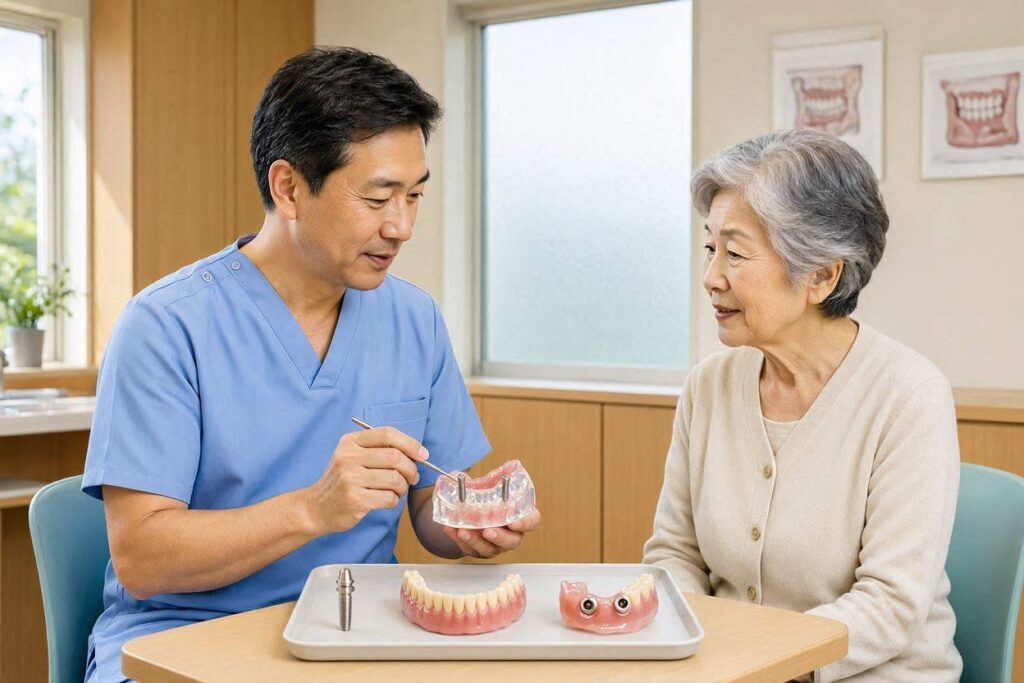
Understanding Implant-Supported Dentures
Before discussing timing, you need to understand what implant-supported dentures are and how they differ from conventional dentures.
Types of Implant Denture Support
Implant-retained overdentures use implants to hold a removable denture securely in place. The denture snaps onto attachments connected to the implants. You remove the denture for cleaning but enjoy stability during daily function. This approach typically uses two to four implants per arch.
Fixed implant-supported restorations replace an entire arch of teeth with a restoration that only your dentist removes for maintenance. These restorations feel most like natural teeth and typically require four or more implants per arch. You clean them like natural teeth without removing them.
The choice between removable and fixed restorations affects treatment planning, cost, and timing considerations. Your provider will discuss which option suits your needs and anatomy.
How Implants Change the Denture Experience
Conventional dentures rest on gum tissue and rely on suction, adhesion, and muscular control for stability. Lower dentures in particular often perform poorly because the tongue and floor of the mouth constantly dislodge them.
Implant-supported dentures anchor to the jawbone through the implants. This mechanical retention eliminates movement during function. You can bite, chew, and speak without the denture shifting. The implants also transmit chewing forces into the bone, helping preserve jawbone that would otherwise resorb under conventional dentures.
Timing Scenario One: Teeth Still Present But Failing
Many patients considering implant-supported dentures still have some or all of their natural teeth, but those teeth are failing due to decay, gum disease, or other problems.
Immediate Implant Placement After Extraction
In some cases, implants can be placed immediately after tooth extraction during the same surgical appointment. This approach, called immediate implant placement, works best when the extraction sites are free of infection and adequate bone remains around the sockets.
Immediate placement offers several advantages. It reduces the total number of surgical procedures. It may help preserve the natural bone and gum tissue contours around the extraction sites. It shortens the overall treatment timeline.
However, immediate placement is not always possible. Active infection at extraction sites, inadequate bone around sockets, or anatomical considerations may require extraction with healing before implant placement.
Delayed Implant Placement After Extraction
When immediate placement is not advisable, teeth are extracted and the sites are allowed to heal before implant placement. This healing period typically ranges from two to four months, allowing bone and soft tissue to mature in the extraction sites.
Delayed placement provides a more predictable surgical environment. The healed ridge is stable, infection has resolved, and the bone has completed its initial remodeling after extraction. The implant can be placed into mature, healthy tissue.
The disadvantage is additional treatment time and the potential for bone loss during the healing period. Bone grafting at the time of extraction, called socket preservation, helps minimize this bone loss and maintain the ridge for future implant placement.
Staged Extractions for Full Arch Cases
When all remaining teeth require extraction, staging the process may optimize outcomes. Strategic teeth may be retained temporarily to support a transitional denture while implants heal. These retained teeth are extracted later when the implants are ready for loading.
This approach maintains function and esthetics during the implant healing period. You never need to wear a conventional complete denture as a temporary measure. The transitional prosthesis supported by remaining teeth provides better function than a temporary denture.
Timing Scenario Two: Existing Denture Wearer Seeking Implants
Many patients have worn conventional dentures for years before deciding to pursue implant support. This is entirely possible, though it presents specific considerations.
Bone Assessment After Years of Denture Wearing
Conventional dentures accelerate bone loss in the jaws. The pressure of the denture on the ridge stimulates bone resorption rather than preservation. After years of denture wearing, significant bone volume may have been lost, particularly in the lower jaw.
Before implant planning, your provider will assess available bone through clinical examination and three-dimensional imaging. This assessment determines whether sufficient bone exists for implant placement and whether grafting procedures will be necessary.
Bone loss does not typically prevent implant treatment, but it may influence the number and location of implants that can be placed. Your provider may recommend grafting to rebuild adequate bone volume for optimal implant positioning.
Converting Existing Dentures to Implant Support
In some cases, your existing denture can be converted to an implant-supported prosthesis. If the denture fits well, has adequate structural integrity, and provides acceptable esthetics, it may be adapted to attach to implants.
This conversion approach saves the cost of a new denture and allows you to continue wearing a familiar prosthesis. The denture is modified to incorporate attachments that connect to the implants. This works best for removable overdentures rather than fixed restorations.
However, many existing dentures are not suitable for conversion. They may be worn, ill-fitting, or esthetically compromised. In these cases, a new prosthesis fabricated specifically for implant support provides better results.
The Timeline for Existing Denture Wearers
The process typically begins with comprehensive examination and imaging to assess bone. If bone is adequate, implants can be placed and allowed to heal. During healing, you continue wearing your existing denture, modified with a soft lining to avoid pressure on the healing implants.
After implants integrate, attachments are placed and your denture is converted or replaced. The total timeline from implant placement to functioning implant-supported denture typically ranges from three to six months, depending on healing and whether grafting was required.
Timing Scenario Three: Planning for Future Implant Support
Some patients know they want implant support eventually but cannot proceed immediately due to finances, medical issues, or other circumstances. Strategic planning helps optimize future implant treatment.
Socket Preservation at Extraction
If teeth require extraction now but implants must wait, socket preservation grafting at the time of extraction maintains bone volume for future implant placement. The extraction socket is filled with bone graft material, which serves as a scaffold for new bone formation.
Without socket preservation, extraction sites lose significant width and height during healing. This bone loss can complicate or prevent future implant placement without additional grafting. Socket preservation is a relatively simple, cost-effective procedure that preserves future treatment options.
Strategic Denture Design
If you will wear conventional dentures temporarily before transitioning to implant support, discuss this plan with your dentist. The denture can be designed with future conversion in mind.
Dentures intended for future conversion may be fabricated with specific dimensions, materials, and structural features that facilitate later modification. Investing in a quality denture that can be converted later costs more initially but saves money long-term compared to fabricating a new denture for implant attachment.
Maintaining Bone Health While Wearing Dentures
During the period between tooth extraction and implant treatment, certain practices help maintain bone health. Leaving dentures out at night removes pressure that contributes to bone resorption. Adequate nutrition, particularly calcium and vitamin D, supports bone metabolism. Avoiding tobacco supports bone health along with all other aspects of oral and general health.
The Role of Immediate Load Protocols
Traditional implant treatment requires waiting months between implant placement and loading the implants with a prosthesis. Immediate load protocols, sometimes called same-day teeth, place a temporary prosthesis on implants at the time of surgery.
When Immediate Loading Is Possible
Immediate loading requires adequate bone quality and quantity to achieve high initial implant stability. The implants must be placed with sufficient torque that they resist movement even with immediate loading. The temporary prosthesis must be designed to distribute forces appropriately across all implants.
Not all patients qualify for immediate loading. Poor bone quality, inadequate bone volume, or inability to achieve primary stability prevent this approach. Your provider will determine whether immediate loading is appropriate for your situation.
Advantages and Disadvantages
Immediate loading eliminates the period of wearing a conventional denture during implant healing. You leave the surgical appointment with fixed teeth, even if temporary. This appeals significantly to patients who dread the prospect of removable dentures.
The disadvantages include higher treatment complexity, restricted diet during healing, and potentially higher implant failure risk in some patient populations. The temporary prosthesis must be treated carefully to avoid overloading the healing implants.
Factors Influencing Optimal Timing
Several factors specific to your situation influence when implants should be placed for denture support.
Medical and Dental Health Status
Active dental disease must be addressed before implant placement. Decayed teeth requiring extraction, periodontal disease, and oral infections all require treatment before implant surgery can proceed safely and predictably.
Medical conditions affecting healing must be optimized. Uncontrolled diabetes, immunocompromise, and certain medications may require medical management before implant surgery. Your dental provider will coordinate with your physician when necessary.
Bone Quantity and Quality
Adequate bone volume in appropriate positions determines whether implants can be placed immediately or whether grafting must precede implant placement. Three-dimensional imaging provides the information needed for this assessment.
When significant bone loss has occurred, grafting procedures may be necessary before implants can be placed. These procedures add months to the treatment timeline. Your provider will discuss whether grafting can be performed simultaneously with implant placement or whether it requires a separate surgical phase with additional healing time.
Financial and Practical Considerations
Implant treatment represents a significant financial investment. Some patients choose to stage treatment over time to manage costs. Extractions and socket preservation may be completed first, with implant placement following when finances permit.
Insurance considerations may also affect timing. Annual maximum benefits may be used across calendar years to maximize coverage. Flexible spending accounts and health savings accounts have annual contribution limits that may affect treatment timing.
Frequently Asked Questions About Implant Denture Timing
How long after tooth extraction can I get implants?
Immediate placement at the time of extraction is possible in some cases. When not possible, two to four months of healing is typically recommended before implant placement. If bone grafting is performed at extraction, four to six months of healing may be necessary. Your specific situation determines the appropriate timing.
I have worn dentures for twenty years. Can I still get implants?
Most likely yes. Bone loss after years of denture wearing is expected, but grafting procedures can rebuild adequate bone for implant placement in most patients. Three-dimensional imaging will determine your current bone status and what procedures may be necessary before implant placement.
Can my existing denture be used with implants?
Possibly. If your existing denture fits well, has adequate structural integrity, and provides acceptable esthetics, it may be converted to attach to implants. Your dentist will evaluate whether conversion is appropriate or whether a new prosthesis would provide better results.
How many implants do I need for a denture?
For removable implant-retained overdentures, two to four implants per arch typically provide excellent stability. For fixed implant-supported restorations, four or more implants per arch are usually required. The exact number depends on your anatomy, bone quality, and functional needs.
Is it too late if I have already lost significant bone?
Bone grafting procedures can rebuild lost bone volume for most patients. While grafting adds complexity and treatment time, it makes implant treatment possible even for patients with significant bone loss. Very few patients are truly unable to receive implants due to bone deficiency.
How long does the entire implant denture process take?
Timelines range from same-day temporary restoration to six months or more for traditional protocols with grafting. Simple cases without grafting may complete in three to four months. Cases requiring extensive grafting may extend beyond a year.
Conclusion
The timing of implant placement for denture support depends on your current dental status, bone condition, and treatment goals. Patients with failing teeth may qualify for immediate implant placement at extraction or delayed placement after healing. Existing denture wearers can transition to implant support regardless of how long they have worn dentures, though bone grafting may be necessary. Patients planning future implant treatment benefit from socket preservation at extraction and strategic interim denture design. Immediate loading protocols allow same-day teeth for appropriate candidates. Your dental provider will recommend optimal timing based on thorough examination, imaging, and discussion of your priorities.