Who Do I See For Dental Implants?
You have a missing tooth, or perhaps several. You have done your research and decided that dental implants are the best solution for restoring your smile and your ability to chew comfortably. Now you face a new and surprisingly confusing question: who actually places dental implants? The dental profession has splintered into specialties and subspecialties, and the titles can blur together. General dentist, prosthodontist, oral surgeon, periodontist. Each claims expertise in implants. Each has a different training path and a different focus.
Making the right choice of provider is one of the most consequential decisions in your implant journey. The skill and experience of the clinician placing your implant directly affect the likelihood of success, the aesthetics of the final result, and the longevity of the restoration. This guide will walk you through every type of dental professional involved in implant treatment, what their training means, what questions to ask, and how to assemble the right team for your specific situation.
By the end of this article, you will understand the roles and qualifications of each provider type. You will know how to evaluate a clinician’s experience and credentials. You will understand the difference between having one dentist handle everything versus having separate surgical and restorative providers. Most importantly, you will feel confident walking into a consultation and making an informed choice.
The Dental Implant Team Model
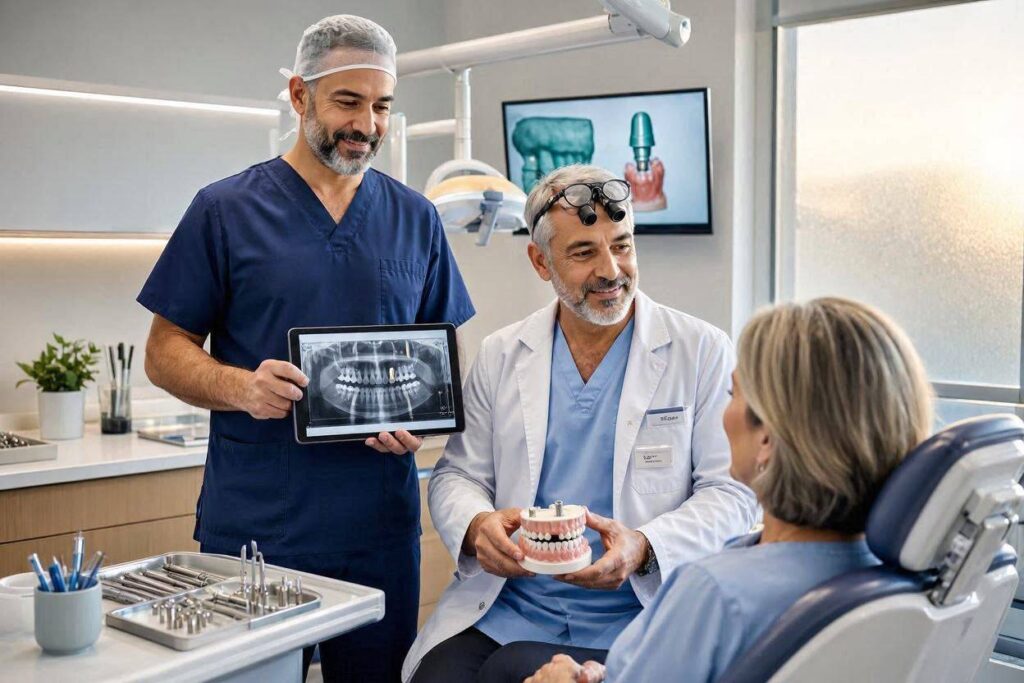
Dental implant treatment is rarely a one-person show. Even when a single dentist performs both the surgical placement and the final restoration, a team of auxiliaries supports the process. Understanding this team model clarifies who does what and why.
The Surgeon and the Restorative Dentist
At its simplest, implant treatment divides into two phases. The surgical phase involves placing the implant fixture into the jawbone. The restorative phase involves designing and attaching the visible tooth or teeth that the implant will support. Sometimes one dentist performs both phases. Sometimes two different dentists handle them.
When two dentists are involved, they must communicate closely. The surgeon needs to know exactly where the restorative dentist wants the implant positioned to support the planned restoration. The restorative dentist needs to know the exact position and angle of the implant to design the abutment and crown properly. A breakdown in this communication can lead to an implant placed in a position that is difficult or impossible to restore ideally.
The Laboratory Technician
Behind the scenes, a dental laboratory technician fabricates the crown, bridge, or denture that attaches to the implant. The technician is a skilled artisan who works from impressions, digital scans, and prescriptions provided by the restorative dentist. The quality of the laboratory’s work profoundly influences the aesthetics and fit of the final restoration.
Some dentists work with local laboratories where they have established relationships and can communicate directly about shade matching and contour. Others use larger regional or national laboratories. The choice of laboratory is part of what you are paying for and part of what distinguishes one restorative dentist from another.
The Dental Assistant and Hygienist
During surgery, a dental assistant supports the implant surgeon by passing instruments, managing suction, and ensuring that the surgical field remains clean and organized. After the implant is restored, a dental hygienist will perform maintenance cleanings and monitor the health of the peri-implant tissues. These team members are essential to the success of the procedure and the longevity of the implant, even though they do not hold the drill or design the crown.
General Dentists Who Place Implants
Many general dentists now place dental implants as part of their practice. This represents a significant shift from a generation ago, when implants were almost exclusively the domain of specialists.
Training and Credentialing
A general dentist holds a Doctor of Dental Surgery or Doctor of Dental Medicine degree and a state license to practice dentistry. Dental school provides a foundation in oral surgery and prosthodontics but typically does not train students to the level of independent implant placement. General dentists who place implants acquire this skill through post-graduate continuing education.
Continuing education in implant dentistry ranges from weekend introductory courses to year-long comprehensive programs with live patient surgery. Some programs award a fellowship or mastership credential from organizations like the International Congress of Oral Implantologists or the American Academy of Implant Dentistry. These credentials indicate a significant commitment to implant education beyond the dental school curriculum.
The quality and depth of implant training among general dentists varies enormously. One general dentist may have placed thousands of implants and routinely handle complex cases involving bone grafting and full-arch restorations. Another may have placed only a few dozen and refer anything beyond a straightforward single implant. Your job as a patient is to determine where on this spectrum your prospective dentist falls.
Advantages of Choosing a General Dentist
Having a single dentist handle both the surgery and the restoration offers logistical convenience. You attend all appointments in one office with one team. Communication between the surgical and restorative phases is seamless because the same brain is planning both. If a problem arises, there is no question of which provider is responsible.
General dentists who focus on implant dentistry often price their services somewhat lower than specialists. Their overhead may be lower, and they may not command the same premium as a board-certified surgeon. For a straightforward implant case in a healthy patient with good bone, a skilled general dentist can produce results equal to any specialist.
When a General Dentist May Not Be the Best Choice
Complex cases require the expertise that comes from focused specialty training and high surgical volume. If you need major bone grafting, have medical conditions that complicate surgery, require implants in difficult anatomical locations, or need full-arch reconstruction, a specialist surgeon is usually the better choice.
A general dentist who places implants occasionally may lack the experience to handle intraoperative complications. What happens if the implant does not seat properly, if bleeding is excessive, or if a nerve is in an unexpected location? A specialist who has seen and managed these complications hundreds of times is better equipped to handle the unexpected.
Oral and Maxillofacial Surgeons
Oral and maxillofacial surgeons are dental specialists who complete a hospital-based surgical residency after dental school. They are the surgeons of the dental world.
Training Pathway
After four years of dental school, an oral surgery resident enters a program lasting four to six years. This residency includes training in anesthesia, general surgery, plastic surgery, ear, nose and throat surgery, and trauma surgery. Residents rotate through hospital services, manage inpatients, and perform complex surgeries under general anesthesia.
At the conclusion of residency, oral surgeons are proficient in removing impacted wisdom teeth, treating facial trauma, correcting jaw deformities, managing oral pathology, and placing dental implants in the most challenging anatomical situations. Many pursue board certification through the American Board of Oral and Maxillofacial Surgery, which requires passing rigorous written and oral examinations.
The Oral Surgeon’s Role in Implant Dentistry
Oral surgeons handle the full spectrum of implant surgery, from straightforward single-tooth replacements to complex full-arch reconstructions with extensive bone grafting. They are particularly valuable when anatomical challenges exist, such as limited bone near the maxillary sinus, proximity to the inferior alveolar nerve, or atrophic jaws that require reconstruction before implant placement.
Oral surgeons routinely provide intravenous sedation and general anesthesia. For anxious patients or those undergoing lengthy surgical procedures, this is a significant advantage. The surgeon can manage your airway, administer sedation medications, and perform the surgery while you are completely comfortable.
Oral surgeons are also the go-to specialists for managing implant complications. Failed implants that require removal, infections that require surgical drainage, and nerve injuries require the expertise of a surgeon trained to manage complex oral and maxillofacial pathology.
Periodontists
Periodontists are specialists in the supporting structures of the teeth: the gums, the periodontal ligament, and the jawbone. Their expertise in these tissues makes them natural implant surgeons.
Training Pathway
A periodontist completes three years of specialty training after dental school, earning a certificate and often a master’s degree in periodontics. This training focuses on the diagnosis and treatment of periodontal disease, placement of dental implants, and surgical procedures to regenerate lost gum and bone tissue.
Periodontists are experts in soft tissue management. They understand how to manipulate gum tissue to create natural-looking results around implants, a critical skill in the aesthetic zone where the implant crown will be visible when you smile. Their training in bone grafting and guided tissue regeneration is directly applicable to preparing compromised sites for implant placement.
The Periodontist’s Role in Implant Dentistry
A periodontist is an excellent choice when gum health is a concern or when the implant must emerge through gum tissue in a highly visible area. If you have a history of periodontal disease and have lost teeth because of it, a periodontist can address the underlying disease, graft deficient bone, and place implants in a treated and stabilized environment.
Periodontists also manage peri-implantitis, the inflammatory condition that affects implants similarly to how periodontitis affects natural teeth. If you develop problems with an existing implant, a periodontist has the specialized instruments and surgical techniques to treat the infection and attempt to save the implant.
The periodontist typically does not place the final crown. They work in collaboration with a restorative dentist, either a general dentist or a prosthodontist, who designs and places the visible restoration. This team approach leverages the periodontist’s surgical skills and the restorative dentist’s prosthetic skills.
Prosthodontists
Prosthodontists are specialists in restoring and replacing teeth. They are the architects of the implant treatment plan and the master craftspeople behind the final restoration.
Training Pathway
Prosthodontic training requires three years of post-doctoral education after dental school. The curriculum covers fixed prosthodontics like crowns and bridges, removable prosthodontics like dentures, implant prosthodontics, maxillofacial prosthetics for patients with congenital defects or cancer resections, and the management of complex temporomandibular joint disorders.
Prosthodontists are trained to see the big picture. While a surgeon focuses on placing the implant in bone, the prosthodontist focuses on where the tooth needs to be and works backward to determine the ideal implant position. This restorative-driven approach is the modern standard of care in implant dentistry.
The Prosthodontist’s Role in Implant Dentistry
Some prosthodontists place implants as well as restore them. Others focus exclusively on the restorative phase and work with a surgical partner. Either way, the prosthodontist typically takes the lead in treatment planning, determining the number, type, and location of implants needed to support the planned restoration.
For complex cases involving multiple missing teeth, full-arch reconstruction, or patients with worn dentitions and bite problems, a prosthodontist’s comprehensive approach is invaluable. They consider the entire stomatognathic system: teeth, muscles, joints, and how they function together. An implant restoration designed without this comprehensive view may function well for a time but create problems elsewhere in the system.
Prosthodontists are also the specialists most likely to handle implant complications related to the restoration itself: fractured abutments, loose screws, worn or broken crowns, and aesthetic failures. They have the advanced training to troubleshoot these problems and fabricate replacements that work properly.
The Team Approach and Combined Cases
For many implant patients, the best care comes from a team of specialists working together. Understanding how this collaboration works helps you navigate the process.
The Restorative-Driven Treatment Plan
In a team approach, you typically start with the restorative dentist, either a general dentist with advanced implant training or a prosthodontist. This dentist conducts a comprehensive examination, takes diagnostic records including photographs, X-rays, and sometimes cone beam CT scans, and develops a preliminary treatment plan.
The restorative dentist then communicates with the surgeon, providing a prescription for implant placement. This prescription may include a surgical guide, a custom-made template that fits over your teeth or gums and directs the surgeon’s drill to the exact planned position and angle. The surgeon reviews the plan, discusses it with the restorative dentist if modifications are needed, and performs the surgery.
After the implants integrate with the bone, you return to the restorative dentist for fabrication of the final crowns, bridges, or dentures. Throughout the process, both providers remain in communication, sharing records and coordinating your care.
Finding a Coordinated Team
Some dental practices house multiple specialists under one roof. A periodontist or oral surgeon may work in the same office as a prosthodontist or general dentist, allowing you to see both providers in the same location. This arrangement streamlines communication and record-sharing.
If your providers are in separate practices, they should have established referral relationships and systems for sharing information. Ask each provider about their experience working with the other. A team that has collaborated on many cases will have developed an efficient workflow and mutual trust.
Your Role as the Patient
Even when a team handles your care, you remain the central figure. Ask questions. Understand the plan. Know which provider to contact for which concerns. If something seems inconsistent between what the surgeon tells you and what the restorative dentist tells you, raise the issue. Clear communication prevents mistakes.
Credentials and Qualifications to Look For
When evaluating a potential implant provider, credentials matter. Here is what to look for and what the various letters after a name actually mean.
Board Certification
Board certification indicates that a specialist has passed rigorous examinations beyond the minimum requirements for licensure. An oral and maxillofacial surgeon may be board-certified by the American Board of Oral and Maxillofacial Surgery. A periodontist may be board-certified by the American Board of Periodontology. A prosthodontist may be board-certified by the American Board of Prosthodontics.
Board certification is voluntary and demanding. It represents a commitment to the highest standards of the specialty. Not every excellent clinician is board-certified, but board certification provides an external validation of knowledge and skill.
Fellowship Credentials in Implant Dentistry
Several organizations offer fellowship credentials specific to implant dentistry. The International Congress of Oral Implantologists awards fellowship and diplomate status based on continuing education, case documentation, and examination. The American Academy of Implant Dentistry offers a similar pathway culminating in board certification in implant dentistry.
These credentials are not recognized as dental specialties by the American Dental Association, but they indicate that a general dentist has pursued advanced training and demonstrated competence in implant dentistry beyond the minimum continuing education requirements.
Experience and Case Volume
Credentials tell part of the story. Experience tells the rest. A dentist who places five implants a year has a very different level of current competence than one who places 200. Do not be shy about asking how many implant procedures the dentist performs annually and how many they have performed over their career.
Ask to see before-and-after photographs of cases similar to yours. A confident, experienced provider will have a portfolio of completed cases and will be happy to share examples of their work. If a dentist cannot or will not show you results, consider that a red flag.
Questions to Ask During a Consultation
Your initial consultation is an interview. You are hiring a professional to perform a surgical procedure on your body. Ask the right questions and listen carefully to the answers.
Questions About Training and Experience
Where did you learn to place dental implants? How many implant surgeries have you performed? How many do you perform in a typical month? Do you handle cases like mine regularly, or would you typically refer a case of this complexity? Have you ever had to manage a complication, and how did you handle it?
Listen for direct, confident answers. A provider who is evasive or defensive about their experience is communicating something important. A provider who acknowledges their limitations and is clear about what they will and will not do is demonstrating professional integrity.
Questions About the Treatment Plan
What type of implant system do you use, and why? Will I need bone grafting? What is the timeline from start to finish? How many appointments will I need? What sedation options are available to me? Who will make my crown, and what material will it be made from?
The answers should be specific to you, not generic. A provider who tailors the treatment plan to your anatomy, your medical history, and your aesthetic goals is practicing personalized care. A provider who offers the same plan to every patient is not.
Questions About Fees and Guarantees
What is the total fee for the surgical phase and the restorative phase? What does this fee include? Are there any additional costs that might arise, such as the need for bone grafting or a temporary crown? Do you offer a warranty or guarantee on your implant work? What happens if the implant fails?
Get the financial picture in writing before you commit to treatment. Understand what is included and what is not. A clear, transparent fee schedule is a mark of an ethical practice.
Special Considerations for Complex Cases
Not all implant cases are equal. Certain situations demand specific expertise.
Full-Arch Implant Reconstruction
Patients who need to replace all of their teeth on one or both arches face a different level of complexity than single-tooth implant patients. Full-arch restorations like All-on-Four, implant-supported fixed bridges, or implant-retained overdentures require precise planning, coordinated surgical and restorative phases, and experience with the specific prosthetic system being used.
A prosthodontist-led team is the gold standard for full-arch cases. The prosthodontist designs the final prosthesis and works backward to determine implant positions. The surgeon, often an oral surgeon or periodontist, executes the surgical plan. The laboratory technician fabricates the prosthesis to the prosthodontist’s specifications.
Implants in the Aesthetic Zone
Replacing a missing front tooth with an implant is one of the most technically demanding procedures in dentistry. The implant must emerge from the gum in exactly the right position, with exactly the right amount of soft tissue support, to support a crown that is indistinguishable from the natural adjacent teeth.
A periodontist with expertise in aesthetic soft tissue management, or a prosthodontist who performs surgery, is often the best choice for anterior implant placement. These specialists understand how to preserve or recreate the gum architecture that frames the crown and how to manage the transition from the round implant to the natural tooth shape at the gum line.
Medically Compromised Patients
Patients with uncontrolled diabetes, immunosuppression, bleeding disorders, history of head and neck radiation, or current bisphosphonate therapy require special consideration. These conditions affect healing, increase infection risk, and may alter the risk-benefit analysis of implant treatment.
An oral and maxillofacial surgeon with hospital-based training is best equipped to manage medically complex implant patients. The surgeon can coordinate with your physician, obtain medical clearance, and manage any complications that arise during or after surgery.
Red Flags When Choosing an Implant Provider
Certain warning signs should give you pause when evaluating a potential implant dentist.
Unusually Low Fees
Dental implants are expensive because the materials, equipment, and expertise required to do them well are expensive. A fee that is dramatically lower than the local average should prompt scrutiny. Does the dentist use high-quality implant systems from reputable manufacturers? Is the dentist cutting corners on sterilization, materials, or laboratory work? Does the low fee reflect inexperience or a lack of demand for the dentist’s services?
Bargain implants can become very expensive if they fail and require removal and replacement. The cost of redoing a failed implant often exceeds the cost of doing it right the first time.
Pressure to Decide Immediately
A reputable implant dentist will give you time to think. The decision to proceed with implant surgery is significant and should not be rushed. If a dentist pressures you to sign a contract or put down a deposit on the day of your consultation, using high-pressure sales tactics or limited-time offers, consider finding a different provider.
Lack of Cone Beam CT Imaging
Three-dimensional imaging is the standard of care for implant planning. A dentist who places implants without cone beam CT is working blind, unable to see the full anatomy of the jaw, the location of nerves and sinuses, and the true dimensions of available bone. Insist on three-dimensional imaging as part of your diagnostic workup.
The Role of Dental Tourism and Overseas Providers
Some patients choose to travel abroad for dental implants to reduce costs. This decision involves different considerations for provider selection.
Evaluating Overseas Credentials
Dental training and licensing standards vary internationally. A dentist trained in a country with rigorous dental education and strong professional regulation may be equally competent to a dentist trained in the United States or New Zealand. A dentist trained in a country with lax standards may not be.
Research the dental education system and licensing requirements in the country you are considering. Look for providers who have trained or completed continuing education in North America, Europe, Australia, or New Zealand. Check whether the provider is a member of international implant organizations.
The Continuity of Care Problem
The primary risk of dental tourism is not the quality of the surgery but the lack of continuity afterward. If a complication develops after you return home, your local dentist may be reluctant to manage another provider’s work. You may find yourself needing to travel back to the original provider for follow-up care, adding cost and complexity.
If you choose to go abroad, have a plan for local follow-up before you leave. Identify a dentist at home who is willing to see you for post-operative care and potential complications. Discuss this with the overseas provider and ensure that all records are transferred.
Conclusion
The choice of who places your dental implant depends on the complexity of your case, your medical and dental history, and the importance of aesthetics in your final result. General dentists with advanced implant training can handle straightforward single-tooth cases, while complex, full-arch, or aesthetically demanding cases benefit from a specialist-led team involving an oral surgeon or periodontist for surgery and a prosthodontist for restoration. Evaluate credentials, ask about experience and case volume, insist on three-dimensional imaging, and look for a provider who communicates clearly and gives you a transparent, personalized treatment plan.
Frequently Asked Questions
Can my regular dentist place my implant?
Many general dentists place implants and can do so successfully for straightforward cases. Ask about their specific implant training, annual case volume, and whether they would handle your particular situation or refer it to a specialist.
What is the difference between a periodontist and an oral surgeon for implants?
Both are surgical specialists. Periodontists focus on the gums and bone supporting teeth and are experts in soft tissue aesthetics. Oral surgeons have broader hospital-based surgical training and are often preferred for complex cases, medically compromised patients, and those needing deep sedation.
Should I see the surgeon or the restorative dentist first?
Ideally, start with the restorative dentist, either a prosthodontist or a general dentist who will make your final crown. This dentist designs the restoration and directs where the implant should be placed. The surgeon then executes that plan.
Do I need a prosthodontist for a single implant?
A prosthodontist is not strictly necessary for a single, straightforward implant. However, if the implant is in the front of your mouth where aesthetics are critical, a prosthodontist’s expertise in creating lifelike restorations can be valuable.
How many implants should a dentist place per year to be competent?
There is no fixed threshold, but a dentist placing fewer than 20 to 30 implants annually may lack the regular practice needed to maintain surgical skills and manage complications. Higher volume generally correlates with better outcomes.
Additional Resource:
To find board-certified specialists in your area, visit the American Board of Dental Specialties at https://dentalspecialties.org.