Why Can’t They Glue Dental Implants In?
The idea seems logical. A dental implant is a post placed in the jawbone. A crown sits on top. Why not simply glue the crown to the implant and be done with it? The question reflects a common and understandable desire for simplicity. Glue holds things together in countless other applications. Why not in the mouth, on a dental implant? The answer lies in the fundamental biology of how implants work, the mechanics of chewing forces, and the engineering demands of a restoration that must survive decades in one of the most hostile environments in the human body. This article explains, in clear detail, why glue is not the primary attachment method for dental implants and what holds the implant system together instead.
The Difference Between Glue and What Dentistry Actually Uses
First, a clarification of terms. Dental professionals do use adhesives and cements in certain aspects of implant dentistry. The word “glue” is not entirely absent from the process. However, the way glue works in everyday life—forming a sticky bond that holds two surfaces together by adhesion alone—is not how the critical structural connections in an implant system are maintained. The primary retention mechanism for the components of a dental implant is mechanical: precision-fit connections tightened with a screw. When cement is used, it is a secondary, specific application with significant risks. Understanding why requires a look at the biology first.
The Biological Miracle: Why the Implant Is Not Glued to the Bone
The most fundamental “gluing” question is not about the crown to the implant. It is about the implant to the bone. Why is the implant not simply glued into the jawbone with some kind of surgical adhesive?
The answer is osseointegration. The dental implant is not held in the bone by a chemical bond, a mechanical interlock that works like a screw in wood, or a surgical glue. It is held by a living, biological fusion. Bone cells grow directly onto the titanium oxide surface of the implant. They deposit new bone that interlocks with the microscopic roughness of the implant surface. The implant becomes biologically integrated with the skeleton.
This process is why dental implants work. It cannot be replicated with glue. No adhesive exists that can withstand the constant, cyclic loading of chewing forces in a wet, warm, enzyme-rich environment over decades. Any adhesive bond to bone would eventually hydrolyze, degrade, or provoke an inflammatory foreign body response. Osseointegration is nature’s solution. It is not gluing. It is healing.
The Implant-Abutment Connection: Why Screws, Not Glue
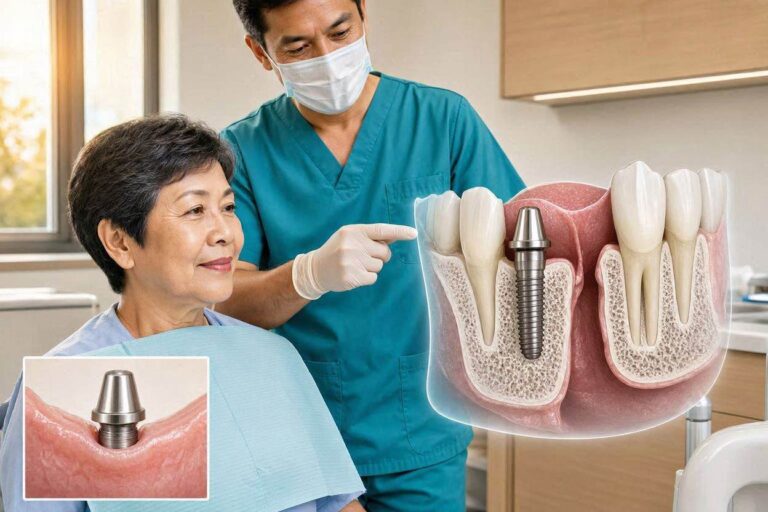
The implant fixture is buried in the bone. The abutment is the connector that attaches to the implant and projects through the gum. The crown is attached to the abutment. The connection between the implant and the abutment is critical. This connection must be stable, precise, and capable of being disassembled if necessary.
The overwhelming standard for this connection is a mechanical screw joint. The abutment is secured to the implant with a small titanium or gold alloy screw tightened to a precise torque, typically 20 to 35 Newton-centimeters. This is not arbitrary. The torque preloads the screw, creating a clamping force that holds the abutment against the implant with significant pressure. The interface between the abutment and the implant is engineered to extremely tight tolerances, often a conical Morse taper connection where the abutment wedges into the implant body. When properly tightened, this connection forms a bacterial seal and eliminates micromovement between the components.
Could this connection be glued instead? In theory, yes. In practice, no, for several compelling reasons.
Removability
One of the fundamental design principles of modern implant systems is retrievability. The abutment and crown must be removable without destroying the implant. If an abutment is cemented or glued into the implant, accessing the screw, replacing a damaged component, or treating peri-implantitis becomes impossible without destroying the abutment and potentially damaging the implant. The screw allows the restorative dentist to remove the prosthesis, assess the implant, and replace components as needed.
Precision and Strength
A screw joint achieves a precise, predictable clamping force that resists the chewing forces that try to separate the components. Glue introduces variables: the viscosity of the adhesive, the film thickness between components, the potential for voids, the degradation of the adhesive over time in the oral environment. A screw joint is a known, reproducible engineering solution. Glue is a chemical compromise.
Biocompatibility
Any adhesive placed inside the implant body would be in contact with peri-implant tissues. The potential for leaching of monomers, inflammatory response, and biofilm formation makes an internal adhesive a biological risk. The screw is made of titanium or gold alloy, materials with documented biocompatibility.
When Cement Is Used: The Crown to Abutment Connection
Cement, the closest thing to glue in routine dentistry, does appear in implant dentistry. It is used to attach the crown to the abutment in a cement-retained restoration. In this approach, the abutment is screwed onto the implant and torqued to specification. Then the crown is cemented onto the abutment, much like a traditional crown is cemented onto a prepared natural tooth.
This is common, and it works. But it carries a specific risk that is so significant that it has driven many implant dentists to prefer screw-retained restorations exclusively: excess cement.
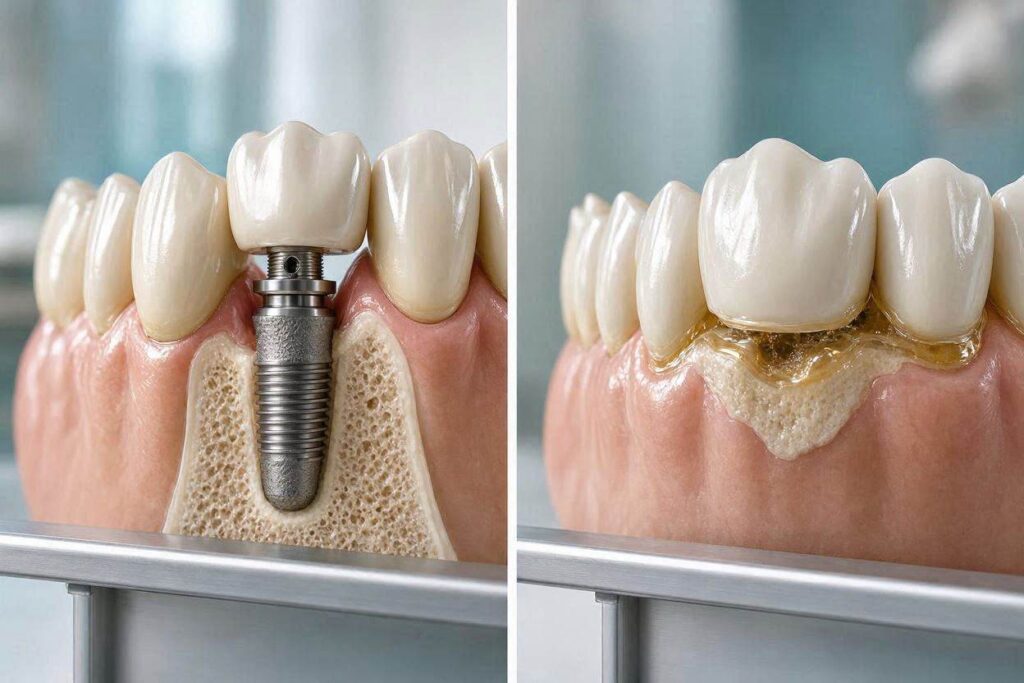
When a crown is cemented onto an implant abutment, the cement is applied to the internal surface of the crown, and the crown is seated. Excess cement squeezes out at the margin. In a natural tooth, the margin is often above the gum, and excess cement can be visualized and removed. In an implant, the margin is often below the gum. Excess cement can be expressed into the peri-implant sulcus, where it is impossible to see and very difficult to remove completely.
Retained cement is a potent inflammatory agent. It provides a rough surface for bacterial colonization. It directly irritates the soft tissue. The result is peri-implant mucositis, peri-implantitis, bone loss, and implant failure. This is well-documented in the dental literature. Retrieval of cement-retained implant crowns is more difficult than screw-retained ones.
Because of the excess cement risk, many clinicians now prefer screw-retained restorations. The crown is fabricated with a small access hole on the chewing surface or the back surface. The crown is screwed directly onto the abutment or the implant. There is no cement. The access hole is filled with a composite resin that can be removed if the crown needs to be retrieved. This eliminates the risk of cement-induced peri-implant disease entirely.
Why Not Glue the Implant Directly Into a Fresh Extraction Socket?
A related question is whether an implant can be glued into a fresh extraction socket. The tooth is removed, and an implant is immediately inserted. Could surgical adhesive stabilize it?
The short answer is no. Primary stability, the initial mechanical lock of the implant in the bone, is essential for osseointegration. Micromovement above a certain threshold inhibits bone healing and leads to fibrous encapsulation instead of osseointegration. Primary stability is achieved by the mechanical engagement of the implant threads in the bone. A gap-filling adhesive would not provide the rigidity required. The adhesive would also act as a barrier between the implant surface and the bone, preventing the direct bone contact that defines osseointegration. Surgical adhesives exist for soft tissue closure, but they have no role in stabilizing a dental implant in bone.
The Exceptional Cases: When Adhesive Is Used in Implant Dentistry
Adhesives do have limited, specific applications in implant prosthetics.
Luting Cement for Cement-Retained Crowns
As described, this is the attachment of the crown to the abutment with dental cement. It is a valid technique when excess cement can be meticulously cleaned and the margin is accessible. It is not gluing the system together; it is cementing the final restoration to a component that is already mechanically secured to the implant.
Repair of Prosthetic Components
If a porcelain chip occurs on an implant crown, a composite resin may be bonded to the ceramic as a repair. This is an adhesive application, but it is a repair, not a primary connection.
Bonding of Access Hole Fillings
In screw-retained crowns, the access hole through the crown is filled with composite resin bonded to the surrounding ceramic or metal. This is a small, retrievable adhesive application.
Resin Cements for Specific Indications
In some full-arch implant restorations, the prosthetic teeth are bonded to the metal framework with resin cement. The framework is still screwed to the implants. The bonding is a prosthetic laboratory step, not a clinical connection between implant components.
The Core Principle: Mechanical Retention, Not Adhesion
The fundamental reason dental implants are not glued in is that the demands placed on the implant system exceed the capabilities of adhesives. The chewing forces are high, cyclic, and applied in multiple directions. The oral environment is wet, with temperature fluctuations, pH changes, enzymatic activity, and a constant bacterial challenge. The restoration must last decades and must be retrievable for maintenance.
Mechanical connections—screw joints with precise torque, taper locks, friction-fit interfaces—meet these demands. They are predictable, durable, and retrievable. Adhesives have a role in specific, limited applications, but they cannot replace the mechanical foundation of the implant system. The patient who asks about glue is envisioning a simplicity that the biological and mechanical realities of the human mouth do not permit.
Conclusion
Dental implants are not glued in because no adhesive can match the strength, durability, biocompatibility, and retrievability of mechanical connections. The implant fuses to the bone through osseointegration, a living bond that no surgical glue can replicate. The abutment is secured to the implant with a precisely torqued screw, creating a stable, retrievable connection. Crowns may be cemented to abutments in specific cases, but the risk of retained cement has driven a shift toward screw-retained restorations. Adhesives play minor roles in prosthetic repair and access hole filling, but the core architecture of the implant system is mechanical, not chemical. The screw, not the glue, is the foundation of implant dentistry.
Frequently Asked Questions
Can dental cement hold an implant crown securely?
Yes, dental cement can securely attach a crown to an abutment. However, excess cement below the gum can cause inflammation and bone loss, making screw-retained restorations a preferred option for many clinicians.
Why can’t the implant itself be cemented into the bone?
The implant must osseointegrate, meaning bone cells must grow directly onto its surface. A cement layer would act as a barrier, preventing this direct biological attachment and leading to failure.
What is the difference between cement-retained and screw-retained implant crowns?
A cement-retained crown is cemented onto an abutment. A screw-retained crown is secured with a screw through an access hole in the crown. Screw retention eliminates the risk of excess cement but requires an access hole that must be filled.
Is dental cement the same as glue?
Dental cement is a specialized material that fills the microscopic gap between a restoration and the abutment or tooth. It provides retention through a combination of micromechanical interlocking and chemical bonding. It is not a general-purpose glue.
Can a screw-retained implant crown come loose?
Yes, the abutment or prosthetic screw can loosen over time, though this is uncommon with modern conical connections and proper torque protocols. A loose screw is retrievable and can be retightened or replaced.
Why not use a permanent adhesive that never needs removal?
No permanent adhesive exists that can withstand decades of intraoral forces and moisture without degradation. The ability to retrieve the restoration for maintenance is also a fundamental design requirement.
Additional Resource:
American Academy of Implant Dentistry – Implant Restoration Options
https://www.aaid.com/patient_education/