All On 4 Dental Implants Bruising
If you are considering All-on-4 dental implants, you have probably spent hours researching the benefits. You know about the smile transformation, the ability to eat normally again, and the long-term investment in your health.
But there is one part of recovery that often catches people off guard: bruising.
You might see videos online of patients looking perfect just a few days after surgery. While that is possible for some, the reality for many others includes swelling, tenderness, and—yes—bruising.
Let me be clear right away: bruising is normal. It is not a sign that something went wrong. In fact, it is often a sign that your body is doing exactly what it should be doing: healing.
In this guide, we will walk through everything you need to know about All-on-4 dental implants bruising. You will learn why it happens, where to expect it, how long it lasts, and—most importantly—exactly what you can do to make it go away faster.
No fluff. No false promises. Just honest, practical information from a professional perspective.
Why Do All-on-4 Dental Implants Cause Bruising?
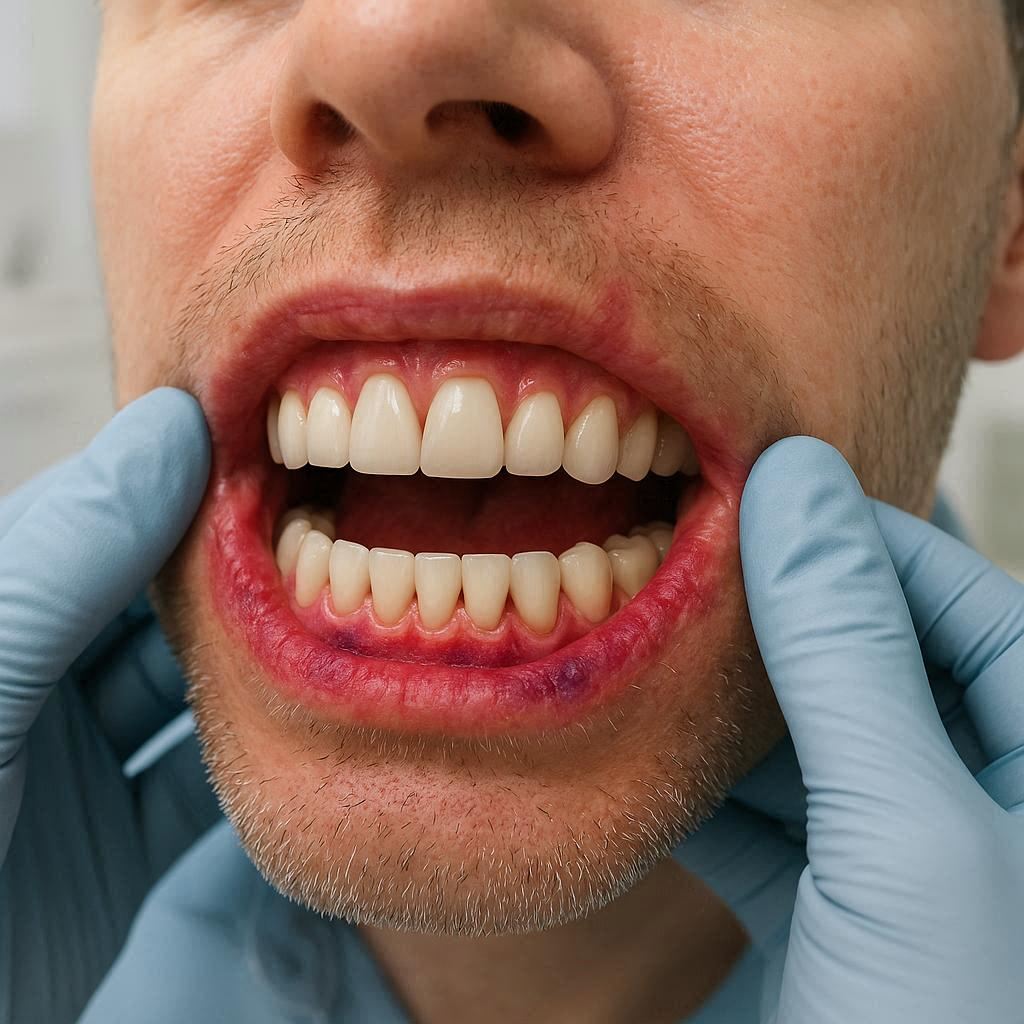
Let us start with the basics. Bruising happens when small blood vessels called capillaries break under the skin. Blood leaks into the surrounding tissues. That is what creates those purple, blue, yellow, or green marks you see.
But why would dental surgery cause bruising on your face or neck?
The Surgical Reality of All-on-4
All-on-4 is not a simple filling or a routine cleaning. It is a significant surgical procedure. Your oral surgeon or periodontist makes incisions in your gum tissue. They reshape bone in some cases. Then they place four (or more) titanium posts deep into your jawbone.
This process involves:
- Tissue manipulation: The surgeon lifts flaps of gum tissue to access the bone.
- Bone drilling: Creating osteotomies (precise holes) for the implants.
- Suturing: Closing the incisions with stitches.
All of these actions create trauma to the area. Your body responds by sending blood and healing cells to the site. Sometimes, that blood does not stay perfectly contained. It follows gravity and seeps into surrounding soft tissues.
Gravity is Not Your Friend (At First)
Here is something many patients do not expect: bruising from All-on-4 surgery often appears away from the actual surgical site.
You might have implants placed in your upper jaw, but the bruising shows up under your eyes or on your cheeks. Lower jaw implants can cause bruising on your chin, jawline, or even your neck.
Why? Gravity.
Blood and fluids from the surgical site slowly travel downward through the natural tissue planes of your face. Think of it like dropping a drop of food coloring onto a paper towel. It does not stay in one spot. It spreads.
The same principle applies here.
Important Note: Bruising can take 24 to 72 hours after surgery to become fully visible. Do not panic if you look fine on day one but see colors appearing on day two or three. That is completely normal.
Where Does Bruising Typically Appear?
Every patient is different. The extent of your bruising depends on several factors including your age, overall health, medications, and the complexity of your surgery.
However, there are common patterns.
Upper Jaw (Maxilla) All-on-4 Bruising
When implants are placed in the upper jaw, the surgical site is close to your sinuses and the floor of your eye sockets. Bruising often appears in these areas:
| Location | When It Typically Appears | Color Progression |
|---|---|---|
| Under the eyes | Day 2 to 4 | Purple to yellow-green |
| Cheekbones | Day 1 to 3 | Red-purple to blue |
| Along the nose | Day 3 to 5 | Dark purple to brown |
| Upper lip | Day 1 to 2 | Swollen with blue tint |
Lower Jaw (Mandible) All-on-4 Bruising
Lower jaw implants affect different areas. The mental nerve and blood supply in the mandible can lead to bruising that travels downward:
| Location | When It Typically Appears | Color Progression |
|---|---|---|
| Chin | Day 2 to 4 | Dark purple to green |
| Jawline | Day 1 to 3 | Blue to yellow |
| Under the chin | Day 3 to 5 | Purple to brown |
| Upper neck | Day 4 to 6 | Yellow to light brown |
Can Bruising Go All the Way to Your Chest?
In rare cases, patients with significant bleeding tendencies or those undergoing very complex surgeries (like extensive bone grafting along with All-on-4) may see bruising extend to the collarbone or upper chest.
This is uncommon but not dangerous. The blood simply follows gravity and fascial planes. If you see bruising spreading far from your face, send a photo to your surgeon for reassurance. But do not assume the worst. Most of the time, it is just an aggressive version of a normal process.
The Timeline of Bruising After All-on-4 Surgery
Understanding the timeline helps you stay calm. Bruising is not static. It changes day by day. Here is what a typical healing journey looks like.
Day of Surgery (Hours 0 to 24)
- Bruising: Minimal or none visible.
- Swelling: Begins to increase.
- What you feel: Numbness from anesthesia. Some oozing from incisions is normal.
- Action: Rest with your head elevated. Apply ice packs.
Days 1 to 2
- Bruising: Starts to appear. Usually dark red or purple.
- Swelling: Peaks around day 2.
- What you feel: Moderate discomfort. Difficulty opening mouth wide.
- Action: Continue ice for first 48 hours. Stick to cold soft foods.
Days 3 to 4
- Bruising: Most visible now. Colors may deepen to dark blue or purple-black.
- Swelling: Begins to stabilize or slowly decrease.
- What you feel: Bruised areas may feel firm or lumpy. That is normal.
- Action: Switch from ice to warm compresses after 48 hours.
Days 5 to 7
- Bruising: Color changes to green, yellow, or brown.
- Swelling: Significantly reduced.
- What you feel: Bruises may look worse before they look better. The yellow phase is actually healing.
- Action: Gentle facial massage if approved by your surgeon. Stay hydrated.
Days 8 to 14
- Bruising: Fades to light yellow or brown. Becoming patchy.
- Swelling: Minimal or gone.
- What you feel: Bruises are not painful to touch anymore.
- Action: Resume normal activities. Use concealer if desired.
Weeks 2 to 4
- Bruising: Completely gone for most patients.
- Swelling: Gone.
- What you feel: Back to normal appearance.
- Action: Enjoy your healing smile.
A friendly reminder: Everyone heals at a different speed. Smokers, older adults, and people with certain medical conditions may heal more slowly. Do not compare your day 7 to someone else’s day 7. Compare yourself to your own day 1.
7 Proven Ways to Reduce All-on-4 Bruising
You cannot completely prevent bruising. But you can definitely reduce how bad it gets and how long it lasts. These strategies are backed by surgical recovery principles and real patient experiences.
1. Ice, Ice, Ice (But Do It Right)
Ice is your best friend for the first 48 hours. It constricts blood vessels, which limits the amount of blood that leaks into tissues.
The correct way:
- Use gel packs or frozen peas wrapped in a thin cloth (never directly on skin).
- Apply for 15 to 20 minutes at a time.
- Take a 20-minute break.
- Repeat as often as possible while awake.
Common mistake: Leaving ice on for hours. That damages skin and actually slows healing.
Pro tip: Buy two sets of gel packs so one is always freezing while you use the other.
2. Keep Your Head Elevated
Sleeping flat allows blood to rush to your face. That increases both swelling and bruising.
What to do:
- Sleep with two or three pillows for the first week.
- Consider a recliner for the first two to three nights.
- When resting during the day, do not lie completely flat.
Why it works: Elevation uses gravity to drain fluids away from your face instead of letting them pool there.
3. Switch to Warm Compresses After 48 Hours
After the first two days, you want to increase blood flow to the bruised area. Warmth dilates blood vessels and helps your body reabsorb the leaked blood.
How to do it:
- Use a warm, damp cloth.
- Apply for 15 minutes, three to four times per day.
- Make sure it is warm, not hot (test on your inner wrist first).
4. Gentle Arnica Montana
Arnica is a natural remedy that many oral surgeons recommend for bruising and swelling. It comes in gels, creams, and oral tablets.
What research says: Some studies show arnica reduces bruising compared to placebo. Other studies show minimal difference. But many patients swear by it.
Safe use:
- Ask your surgeon before taking anything.
- Do not apply arnica gel to open incisions or stitches.
- Follow package directions exactly.
5. Bromelain (Pineapple Enzyme)
Bromelain is an enzyme found in pineapples. It has anti-inflammatory properties that may reduce swelling and bruising after surgery.
How to use it:
- Take bromelain supplements (500 to 1000 mg per day) starting a few days before surgery if your surgeon approves.
- Eat fresh pineapple (not canned, which has heat-deactivated enzymes).
Important: Bromelain can increase bleeding risk in high doses. Always clear supplements with your surgical team.
6. Avoid Blood Thinners (With Medical Approval)
Certain medications and supplements make bruising worse because they stop your blood from clotting normally.
Common things that increase bruising:
- Aspirin (unless prescribed for heart conditions)
- Ibuprofen (Advil, Motrin) – though often allowed for pain, it does increase bleeding risk
- Fish oil (Omega-3s)
- Vitamin E (high doses)
- Ginkgo biloba
- Garlic supplements
- Ginger supplements
- Alcohol
Your job: Give your surgeon a complete list of everything you take. Prescriptions. Over-the-counter. Supplements. Herbal teas. Everything.
Do not stop prescription medications without talking to your doctor first. Some blood thinners are necessary for your survival.
7. Eat a Healing-Friendly Diet
Your body needs raw materials to repair tissues and clear away bruised blood. Give it what it needs.
Foods that help:
- Vitamin C: Oranges, strawberries, bell peppers, broccoli (helps collagen formation)
- Vitamin K: Kale, spinach, Brussels sprouts (helps blood clotting)
- Zinc: Meat, shellfish, beans, nuts (supports tissue repair)
- Protein: Eggs, yogurt, protein shakes (rebuilds tissues)
Foods to avoid (temporarily):
- Alcohol (dilates blood vessels, increases bleeding)
- Spicy foods (can cause sneezing or coughing)
- Hot foods and drinks (increase blood flow to the area)
Swelling vs. Bruising: What is the Difference?
Patients often confuse swelling and bruising because they happen at the same time. But they are different processes that require different treatments.
| Feature | Swelling (Edema) | Bruising (Ecchymosis) |
|---|---|---|
| What it is | Fluid accumulation in tissues | Blood leaking from vessels |
| Appearance | Puffy, tight, shiny skin | Discoloration (purple, blue, yellow) |
| When it peaks | Day 2 to 3 | Day 3 to 5 |
| Best treatment (first 48h) | Ice, elevation | Ice, elevation |
| Best treatment (after 48h) | Warm compresses, gentle movement | Warm compresses, arnica, bromelain |
| How long it lasts | 5 to 10 days | 10 to 14 days |
You will likely have both. Treat them as partners in the healing process, not separate problems.
When Should You Worry About Bruising?
Here is the honest truth: most bruising is harmless. It looks dramatic. It feels scary. But it goes away on its own.
However, there are situations where you need to call your surgeon.
Call Immediately If You Experience:
- Bruising that continues to expand after day 4 (not just changing color, but actually growing larger)
- A hard, expanding lump under the bruise (could be a hematoma)
- Difficulty breathing or swallowing (very rare, seek emergency care)
- Numbness that spreads beyond the surgical area
- Fever over 101°F (38.3°C) with bruising
- Bruising that appears without any trauma on the other side of your face
Call During Office Hours If:
- Bruising lasts longer than 3 weeks without improvement
- You have yellowing of the whites of your eyes (could indicate a different issue)
- You are concerned about your appearance for an upcoming event (your surgeon may have solutions)
A word of reassurance: True complications that cause dangerous bruising are extremely rare with All-on-4 surgery when performed by a qualified professional. Most of what you see in the mirror is just normal healing.
Realistic Expectations: Photos vs. Reality
We have all seen the marketing photos. A patient sits in a dental chair before surgery, looking worried. Then the “after” photo shows them smiling brightly 24 hours later with zero swelling and perfect skin.
Is that real?
Sometimes, yes. A small percentage of patients heal with minimal to no visible bruising. These patients tend to be:
- Younger (under 50)
- Non-smokers
- In excellent overall health
- Having less complex surgery (no bone grafting)
- Following post-op instructions perfectly
But for most patients? The reality looks different. And that is okay.
Realistic healing includes:
- Some yellow-green discoloration under the eyes
- A bruised, tender chin or jawline
- Swelling that makes you look like a chipmunk for a few days
- Stitches that feel weird or annoying
- A liquid or soft food diet for the first week or two
The truth: Bruising does not mean your surgery went badly. It does not mean your surgeon made a mistake. And it certainly does not mean your implants will fail.
It means you had surgery. That is all.
How to Cover Bruising After All-on-4 Surgery (If You Want To)
Maybe you have a wedding to attend. Maybe you cannot take two weeks off work. Maybe you just do not want to answer questions about your face.
You have options.
Makeup for Post-Surgical Bruising
What works best:
- Green color corrector: Green neutralizes purple and blue tones. Apply a thin layer over bruised areas before foundation.
- Yellow color corrector: Yellow neutralizes purple and blue tones on darker skin.
- Full-coverage foundation: Look for words like “full coverage,” “high pigment,” or “camouflage.”
- Setting powder: Locks everything in place.
What to avoid:
- Powder-based products over unhealed incisions (can introduce bacteria)
- Heavy rubbing or pulling on your skin
- Makeup on or near stitches
A safe approach: Apply makeup only to areas that are completely closed (no scabs, no open skin). Keep it away from your mouth and nose by at least half an inch.
Other Camouflage Options
- Tinted sunscreen: Provides light coverage while protecting healing skin.
- Scarves or turtlenecks: For neck and chin bruising.
- Sunglasses: For under-eye bruising (bonus: they look stylish).
- Cold compresses in public: No one questions someone holding ice to their face after “dental work.”
Medications and Bruising: What You Need to Know
Your surgeon will prescribe medications after All-on-4 surgery. Some of these affect bruising. Others do not.
Pain Medications
- Acetaminophen (Tylenol): Does NOT increase bruising. Safest choice for pain if bruising is a concern for you.
- Ibuprofen (Advil, Motrin): Can increase bruising slightly because it reduces platelet function. However, it also reduces swelling. Many surgeons prescribe it anyway because the benefits outweigh the risks.
- Prescription opioids (Norco, Percocet, etc.): Do not directly increase bruising. But they can cause nausea, which increases pressure in your head and face (potentially worsening bruising if you vomit forcefully).
Antibiotics
Antibiotics do not cause or worsen bruising. Take them exactly as prescribed to prevent implant infection.
Steroids (Dexamethasone, Medrol Dose Pack)
Some surgeons prescribe steroids to reduce swelling. Steroids do not increase bruising. In fact, by reducing overall inflammation, they may reduce bruising secondarily.
Sedation and Anesthesia Medications
The drugs used for IV sedation or general anesthesia do not cause bruising. However, the placement of IV lines can cause bruising at the injection site (usually your arm or hand). That bruise is unrelated to your dental implants.
Long-Term Healing: Does Bruising Affect Implant Success?
Let me answer this directly: No.
Bruising has absolutely no effect on whether your dental implants fuse with your jawbone (osseointegration). Bruising is a soft tissue issue. Implant success is a bone issue.
Your implants are buried deep in your jaw. Surface bruising on your cheek or under your eye does not touch them. It does not affect blood supply to the bone. It does not increase infection risk.
What actually matters for implant success:
- Following your post-op instructions (especially no smoking)
- Keeping the surgical sites clean (gently)
- Eating soft foods as directed
- Attending all follow-up appointments
- Wearing your temporary prosthesis as instructed
- Waiting for full healing before loading implants with heavy chewing forces
Bruising is a cosmetic nuisance. Nothing more.
A comforting fact: Even patients who look like they lost a fight with a door handle on day 4 go on to have perfectly successful All-on-4 restorations. Do not let the mirror discourage you.
Special Cases: When Bruising Might Be Different
Not every patient bruises the same way. Certain groups need different expectations.
Older Adults (Over 65)
- Bruising tends to be more extensive because skin and blood vessels become more fragile with age.
- Healing takes longer (expect bruising to last 3 weeks instead of 2).
- Ice carefully (older skin burns more easily).
Patients on Blood Thinners
If you take warfarin (Coumadin), apixaban (Eliquis), rivaroxaban (Xarelto), or clopidogrel (Plavix), you will likely bruise more than average.
Important: Your surgeon should coordinate with your prescribing doctor before surgery. You may need to stop or adjust your medication temporarily. Do not change anything on your own.
Patients with Bleeding Disorders
Conditions like hemophilia or von Willebrand disease significantly increase bruising and bleeding risk. These patients require special planning with a hematologist before All-on-4 surgery.
Smokers
Smoking constricts blood vessels. That sounds like it would reduce bruising, right? Actually, no. Smoking impairs overall healing, which means bruises stick around longer. Plus, smoking dramatically increases implant failure risk. If you needed another reason to quit, this is it.
Patients with Diabetes
Poorly controlled diabetes impairs healing and increases infection risk. Bruising may last longer and take more time to resolve. Well-controlled diabetes (HbA1c under 7.0) heals almost normally.
What About Bruising from Bone Grafting?
Many All-on-4 patients also need bone grafting. The sinuses (for upper jaw) or the back of the lower jaw may need additional bone to support implants.
Bone grafting causes more bruising than implants alone. Here is why:
- Sinus lifts: The surgeon accesses your sinus cavity through the side of your upper jaw. That area has a rich blood supply. Bruising under the eyes and along the nose is very common.
- Ridge augmentations: Adding bone to a deficient ridge requires more incisions and more tissue manipulation.
- Block grafts: Taking bone from your chin or lower jaw (ramus) creates a second surgical site. You will have bruising at both the donor site and the recipient site.
If your treatment plan includes bone grafting, add 3 to 7 days to your expected bruising timeline. That is normal. Do not panic.
Frequently Asked Questions (FAQ)
1. How long does All-on-4 bruising last?
For most patients, visible bruising lasts 10 to 14 days. Yellowish remnants may linger for up to 3 weeks. Complete resolution (back to normal skin tone) happens by day 21 for the vast majority.
2. Can I take Arnica before surgery to prevent bruising?
Some surgeons recommend starting arnica 3 to 5 days before surgery. Others see no benefit. Ask your specific surgeon. Never start any supplement without approval.
3. Does bruising mean my implants are failing?
Absolutely not. Bruising is a soft tissue response to surgery. It has no relationship to osseointegration (bone healing around implants). Thousands of patients with severe bruising go on to have perfectly successful implants.
4. Should I use ice or heat for bruising?
Ice for the first 48 hours. Warm compresses after 48 hours. Using heat too early increases bruising. Using ice too late does nothing.
5. Can I exercise with facial bruising?
Light walking is fine after day 3. But avoid heavy lifting, running, or any activity that increases blood pressure for at least 2 weeks. Increased blood pressure can worsen bruising and cause bleeding from surgical sites.
6. Why is my bruise turning yellow?
Yellow is good. That means your body is breaking down hemoglobin from the leaked blood. It is the final stage before the bruise disappears completely.
7. When can I wear makeup over bruising?
Wait until any incisions are fully closed and there are no scabs. For most patients, that is around day 7 to 10. When in doubt, ask your surgeon at your first post-op visit.
8. Will my bruising be worse if I have all four implants placed at once?
All-on-4 means placing four implants in one surgery. Yes, that causes more bruising than a single implant. But it causes less overall trauma than placing four implants in four separate surgeries. The single surgery approach is actually better for healing.
9. Does the type of sedation affect bruising?
No. Whether you have local anesthesia only, IV sedation, or general anesthesia, the bruising depends on the surgery itself, not the sedation method.
10. Can I prevent bruising completely?
No. Bruising is a normal physiological response to surgical trauma. Claims that any product or technique completely prevents bruising are false. You can reduce it. You cannot eliminate it.
Additional Resources
For more detailed information about All-on-4 dental implants, recovery timelines, and patient experiences, visit the American Academy of Implant Dentistry (AAID) patient education section.
👉 Recommended link: AAID Patient Resources – Dental Implant Recovery
This resource provides dentist-reviewed information about implant safety, healing expectations, and how to find qualified implant surgeons in your area.
A Final Word of Encouragement
Recovery from All-on-4 surgery is a journey. Some days are harder than others. Looking in the mirror and seeing purple, blue, and yellow patches on your face can be discouraging.
But remember why you started this journey.
You wanted to smile without hiding your mouth. You wanted to eat an apple or a steak without pain or embarrassment. You wanted to stop worrying about loose dentures or failing teeth.
Bruising is temporary. Your new smile is permanent.
Follow your surgeon’s instructions. Be patient with your body. Give yourself permission to rest, heal, and look a little rough for a week or two. Every day brings you closer to the finish line.
And when the bruising fades—which it will—you will look in the mirror and see not just clear skin, but a transformed smile. That is the moment it all becomes worth it.
Conclusion (Three Lines)
All-on-4 dental implants bruising is a normal, temporary part of healing that usually appears 1-3 days after surgery and resolves within two to three weeks. You can reduce bruising significantly with proper ice application, head elevation, warm compresses after 48 hours, and avoiding blood-thinning medications and supplements. Remember that bruising does not affect implant success—stay patient, follow your surgeon’s guidance, and your new smile will be worth the temporary discoloration.
Disclaimer: This article is for informational purposes only and does not constitute medical advice. Every patient heals differently. Always follow the specific post-operative instructions provided by your oral surgeon or dental implant specialist. If you have concerns about your recovery, contact your surgical team immediately. Do not stop or adjust prescribed medications without consulting your doctor.