Will Dental Implants Move with Braces?
You have a dental implant, or are planning one, and you are now facing the prospect of orthodontic treatment. A critical, and potentially alarming, question arises: will my expensive, surgically placed dental implant move if I put braces on it? The answer is an unequivocal, biologically grounded no. A healthy, osseointegrated dental implant will not move with orthodontic forces. This guide will explain the fundamental biological reason for this immovability, the disastrous consequences of applying force to an implant, and how this very property can be brilliantly harnessed by an orthodontist as a supreme anchorage device. This is your comprehensive, clear explanation of the immovable nature of the titanium tooth root.
The Biological Foundation: Ankylosis vs. the Periodontal Ligament
The entire answer to this question rests on a single, profound biological difference between a natural tooth and a dental implant. A natural tooth is not rigidly fused to your jawbone. It is attached by a specialized, elastic, living tissue called the periodontal ligament. This ligament is a network of collagen fibers that suspends the tooth in its socket, acting as a shock absorber and a signaling organ. When a light, sustained force is applied to a natural tooth with braces, the pressure side of the ligament compresses. This compression signals specialized cells called osteoclasts to resorb the bone on that side, creating space. On the tension side, the ligament fibers are stretched, signaling osteoblasts to lay down new bone. This process allows the tooth to move, safely and biologically, through living bone. This is the basis of all orthodontic tooth movement.
A dental implant is a piece of titanium that has undergone osseointegration. There is absolutely no periodontal ligament. The titanium surface is in direct, microscopic, physical contact with the living bone. It is ankylosed—a medical term meaning stiffened or fused. There are no intervening fibers, no fluid, and no signaling cells for bone remodeling. When an orthodontic force is applied to an implant, there is no ligament to compress, no osteoclasts to activate, and no biological mechanism for bone resorption. The implant will not move.
What Happens if You Try to Move an Implant with Braces?
Applying orthodontic force to an integrated implant does not result in a slow, harmless slide. Because the implant cannot move, the force is concentrated at the implant-bone interface. One of three things will happen. The most benign outcome is that nothing happens. The light force is completely absorbed by the immobile implant and the surrounding bone, and no movement occurs. The second outcome is a mechanical failure of the prosthetic components. The force can cause the small titanium retaining screw that holds the crown to the abutment, or the abutment to the implant, to loosen or fracture. The patient will notice a loose crown.
The third and most destructive outcome, particularly with a heavier, uncontrolled force, is that the stress exceeds the physiological tolerance of the bone. The bone around the implant will begin to fail. Osseointegration will be lost, the implant will become mobile, and it will fail. This is a catastrophic complication. For this reason, no competent orthodontist will ever intentionally apply active, moving force to a healthy dental implant with the goal of moving it.
The Brilliant Flip Side: The Implant as an Absolute Orthodontic Anchor
The very property that makes an implant impossible to move—its rigid ankylosis—makes it one of the most powerful tools in an orthodontist’s arsenal. An implant is the perfect anchor. In complex orthodontic cases, moving specific teeth without causing unwanted reciprocal movement of other teeth is a constant challenge. For every action, there is an equal and opposite reaction. A Temporary Anchorage Device, or TAD, which is essentially a mini-screw implant, is frequently used to provide a fixed, immovable point from which to pull teeth. The TAD does not move. It allows the orthodontist to achieve tooth movements that were previously impossible without headgear or surgical intervention. A permanent dental implant can serve the same function. The orthodontist can attach an elastic chain from a tooth that needs to move to the implant crown. The implant remains completely stationary, a rock-solid post, while the natural tooth is slowly and predictably drawn toward it. This is a deliberate, sophisticated use of the implant’s immobility.
The Clinical Scenario: What Your Orthodontist Will Do
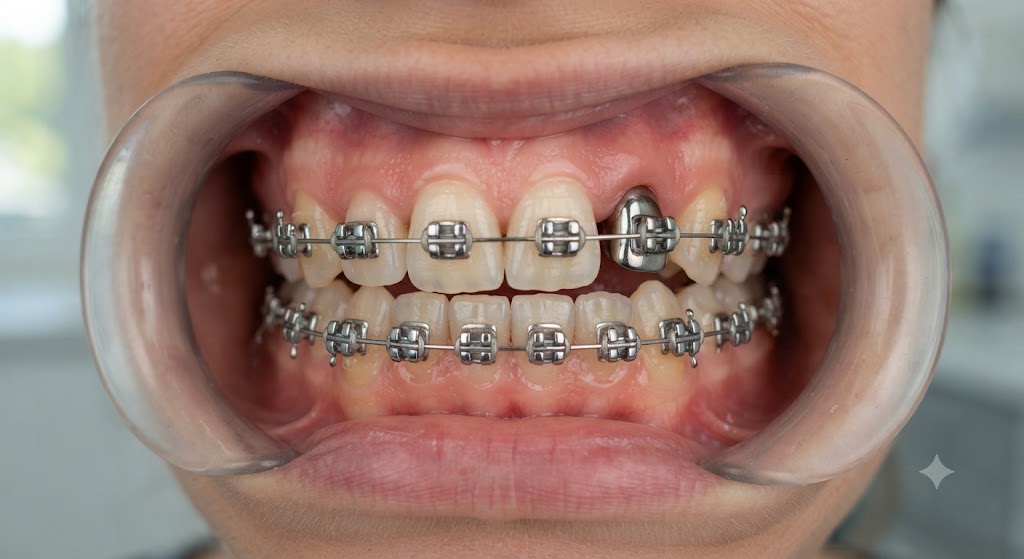
If you have an existing implant and need braces, your orthodontist will design the entire force system around the immovable implant. The implant is a known, fixed, three-dimensional landmark in the arch. The braces or aligners will be programed to move the natural teeth around it. The bracket placed on an implant crown is not for applying force to the implant. It is for passively connecting the implant to the archwire, using the implant as a stable reference point or an anchor. The implants in the back of the jaw can be used to pull the front teeth back. The orthodontist’s digital treatment plan, created in software, will explicitly map the final position of the teeth, with the implant staying exactly where it is. This is a sophisticated, predictive process.
What About a Failing, Mobile Implant?
A critical distinction must be made. A healthy, integrated implant is immovable. A failing, non-integrated implant is mobile. If an implant is already loose, it can sometimes be moved, but this is not a therapeutic orthodontic strategy. This is a pathological state. A mobile implant is a sign of a fibro-encapsulated, non-osseointegrated foreign body. The treatment for this is not orthodontic movement; it is surgical removal, site debridement, and bone grafting. You cannot “salvage” a failing implant by moving it with braces. It must be removed.
Conclusion
Dental implants will never move with braces because they are biologically ankylosed to the jawbone, lacking the vital periodontal ligament that provides the cellular signaling mechanism for a natural tooth to resorb and remodel bone under orthodontic force. Any force applied to a healthy implant will either result in no movement, a mechanical screw failure, or a catastrophic loss of osseointegration. This immovability is instead a supreme clinical advantage, allowing the orthodontist to use the implant as an absolute, stationary anchor for moving adjacent natural teeth with unparalleled precision and predictability.
Frequently Asked Questions
Can my implant be moved with Invisalign?
No. The biological principle is the same. Clear aligners work by the same mechanism of controlled pressure on the periodontal ligament. The implant has no ligament and cannot be moved by an aligner.
What if my implant is in the wrong place and I want it moved before getting braces?
It cannot be moved. If the implant is severely malpositioned and cannot be functionally or aesthetically restored, it must be surgically removed. After removal and healing, the site can be prepared for orthodontic alignment, and a new implant can be placed in the correct position.
Can a dental implant be used to close a gap without braces?
An implant is a fixed post; it cannot close a gap by moving. If a gap exists, the teeth must be moved orthodontically to close it, or a restorative prosthesis like an implant crown must be placed to fill the space.
Is it safe to have braces if I have a full arch of implants?
Yes. The entire implant-supported prosthesis is a single, rigid, immovable structure. The orthodontist can work with this as a stable unit. This is a highly complex, interdisciplinary case.
Will the implant feel loose after the braces are removed?
No. A healthy, integrated implant is rigidly stable and will not be loosened by the presence of orthodontic forces on the other teeth, as long as the forces are correctly designed to bypass the implant.
Additional Resource: Link
For a deeper understanding of the biological principles of orthodontic tooth movement, you can explore the educational resources of the American Association of Orthodontists. Visit the AAO Patient Information Page
Meta Description
Will dental implants move with braces? The definitive biological answer is no. Learn why an ankylosed implant is immovable, why trying to move it is dangerous, and how orthodontists use this property as a supreme anchorage advantage.
What to Look for in an Implant Dentist: The Essential Guide to Choosing Your Surgeon
The decision to get a dental implant is a life-changing investment. The single most important factor determining your outcome is not the implant brand, the type of crown, or the cost. It is the human being holding the surgical drill. Choosing the right implant dentist is the most consequential decision you will make in this entire process. This guide will provide you with a rigorous, uncompromising framework for evaluating and selecting a clinician. We will move beyond the generic “find a dentist you like” advice and give you specific, verifiable credentials to demand, technology to look for, questions to ask, and red flags to avoid. This is your patient’s bill of rights for implant surgery.
Specialist vs. General Dentist: The Credential That Matters Most
The first and most critical filter is the clinician’s formal training. Dental implant placement is a surgical procedure. While many skilled general dentists successfully place implants, the depth and rigor of surgical training vary enormously. A dentist can legally place an implant after a weekend continuing education course. The question you must answer is: who do you want placing a permanent titanium fixture into your jawbone? The three specialties that receive comprehensive, years-long, hospital-based surgical residency training in implant placement are oral and maxillofacial surgeons, periodontists, and prosthodontists.
An oral and maxillofacial surgeon is a dentist who has completed a four to six-year hospital surgical residency. They are trained in the full scope of surgery on the mouth, jaw, and face, including complex bone grafting, intravenous sedation, and management of surgical complications. A periodontist has completed a three-year residency specializing in the gums and supporting bone. They are masters of soft and hard tissue management around teeth and implants. A prosthodontist has completed a three-year residency specializing in complex restorative dentistry, including implant restoration, and some are surgically trained. The safest, most predictable path for a patient, particularly for a complex case involving major bone grafting, multiple implants, or full-arch rehabilitation, is to have the surgical phase performed by a board-certified oral surgeon or periodontist. Ask your clinician directly: “Are you a board-certified specialist? In which specialty? How many years of surgical residency did you complete?” A confident, transparent answer is a green flag. A vague or defensive answer is a red flag.
The Technology Test: CBCT and Guided Surgery
Modern implant dentistry is 3D. A clinician who places implants based only on a two-dimensional panoramic X-ray is not practicing to the current standard of care. You must ask: “Do you use a Cone Beam CT scan for planning? Do you have one on-site?” The CBCT scan is the surgical road map. It reveals the exact volume of bone, the location of the inferior alveolar nerve and the maxillary sinus, and any hidden pathology. The clinician who uses this data to plan your surgery virtually is working with a level of precision that a 2D image simply cannot provide.
The next level of technological sophistication is the use of a custom, 3D-printed surgical guide. This is a rigid stent that fits over your teeth and has drill sleeves that dictate the exact angle, depth, and position of the implant. This digitally-driven, prosthetically-planned, guided surgery is the current gold standard. It minimizes surgical trauma, shortens procedure time, and leads to highly predictable, safe, and aesthetic outcomes. Ask to see your 3D scan. Ask to see the virtual implant plan. A cutting-edge implant surgeon is a digital surgeon, and they will proudly walk you through your own 3D anatomy.
The Question of Volume and Experience
Implant surgery is a tactile, psychomotor skill. There is a direct correlation between the number of implants a clinician places annually and their surgical proficiency. You have the right to ask: “How many dental implants do you place in a year? How many of my specific procedure (single tooth, sinus lift, All-on-4) have you completed?” A clinician who places hundreds of implants a year has an intuitive, deeply ingrained understanding of bone density, drilling speed, and torque. They have encountered and managed complications. Experience is the irreplaceable teacher.
You should also ask to see before-and-after photos of their own work, not stock images. A portfolio of actual cases, with photographs and radiographs, demonstrates a clinician’s pride in their outcomes. Ask about the implant system they use. A premium, research-backed system with a documented long-term survival rate is a marker of quality. Ask: “Why do you use this implant system?” The answer should be grounded in scientific evidence and clinical experience, not cost.
The Interdisciplinary Team: The Surgeon and the Restorative Dentist
A dental implant is not a one-doctor job. It is a team sport. The surgeon places the implant. The restorative dentist designs and places the final crown, bridge, or denture. The ideal scenario is a close, communicative, and collaborative relationship between these two clinicians. Ask your surgeon: “How do you communicate with my restorative dentist? Is the case planned together from the beginning?” The hallmark of a well-managed case is a prosthetically-driven approach. The final desired tooth position is planned first. The surgeon then places the implant to support that plan. A surgeon who works in isolation, without a clear line of communication to the restoring dentist, is missing a critical piece of the puzzle. If you do not have a restorative dentist, a good surgical practice will have a trusted network they work with seamlessly.
Red Flags and Warning Signs
There are specific red flags that should prompt you to seek a second opinion. Be wary of the clinician who promises a guarantee of 100% success. No honest surgeon does this. Be wary of a fee that is shockingly, suspiciously lower than all other quotes, as this often signals the use of a clone implant, an uncertified laboratory, or corners cut on sterility. Be wary of a clinician who does not take a thorough, detailed medical history or who dismisses your medical conditions and medications as irrelevant. Be wary of high-pressure sales tactics, “today only” discounts, and a treatment coordinator who focuses more on financing and closing the deal than on answering your clinical questions. A legitimate surgical consultation is a medical visit, not a sales pitch. Trust your gut. You should feel fully informed, respected, and unrushed.
Conclusion
The most critical factor to look for in an implant dentist is the depth of their formal surgical training, with a board-certified oral surgeon or periodontist representing the highest and safest level of specialized residency-based expertise. You must demand the use of a 3D CBCT scan and ideally a digitally-guided surgical plan, as this technology is the modern standard of care that separates a meticulous, predictable surgeon from one working with an incomplete map. Finally, seek a transparent, communicative, experienced clinician who works in an interdisciplinary team with your restorative dentist, and run from any high-pressure, bargain-priced environment that cannot clearly answer your questions about their credentials, their materials, and their outcomes.
Frequently Asked Questions
Is it safe to have a general dentist place my implant?
A general dentist with extensive, documented additional implant training and a high volume of successful cases can place implants safely, particularly straightforward single-tooth cases. For anything complex, involving a sinus, a nerve, multiple implants, or significant bone loss, a surgical specialist is the safer choice.
What is a Diplomate of the American Board of Oral and Maxillofacial Surgery?
This is the highest credential an oral surgeon can achieve. It means they have completed an accredited residency, passed a rigorous written and oral examination, and are board-certified. This is a gold-standard credential.
How important is the dental lab the dentist uses?
Extremely important. The dental laboratory technician is the unseen artist who fabricates your crown or bridge. A premium surgeon uses a high-end, certified laboratory with master ceramists. Ask about the lab and the materials they will use for your restoration.
Should I get multiple consultations?
Yes. This is a significant medical and financial investment. Consulting with an oral surgeon, a periodontist, and potentially a prosthodontist will give you a spectrum of perspectives and treatment plans, allowing you to make a fully informed decision.
What is the single best question to ask an implant dentist?
“Can you show me a case identical to mine that you treated, and walk me through the final x-ray and photographs?” A surgeon who can show you their own work, transparently and with justifiable pride, is worth their weight in gold.
Additional Resource
To find a board-certified oral and maxillofacial surgeon in your area, you can use the “Find a Surgeon” tool on the official website of the American Association of Oral and Maxillofacial Surgeons. Visit the AAOMS Find a Surgeon Page