How to Flip In a Dental Implant? Understanding the Sinus Lift and Crestal Elevation Procedures
You have been told you need a sinus lift or have heard the term “flip” used in a very specific, technical context related to dental implant surgery. This term is not a formal medical procedure name. It is dental colloquialism, a piece of internal clinical shorthand that you might have overheard or encountered in a patient forum. It most commonly refers to a specific, advanced technique: the sinus membrane elevation performed from a crestal approach during implant placement. This guide will define exactly what “flipping in a dental implant” means in clinical practice. We will explore the biology of the maxillary sinus, the internal or crestal sinus lift technique, and the step-by-step surgical process your surgeon uses to gently elevate the sinus membrane and place bone graft material and an implant simultaneously. This is your in-depth, clarifying resource.
Decoding the Jargon: What “Flip” Means in an Implant Context
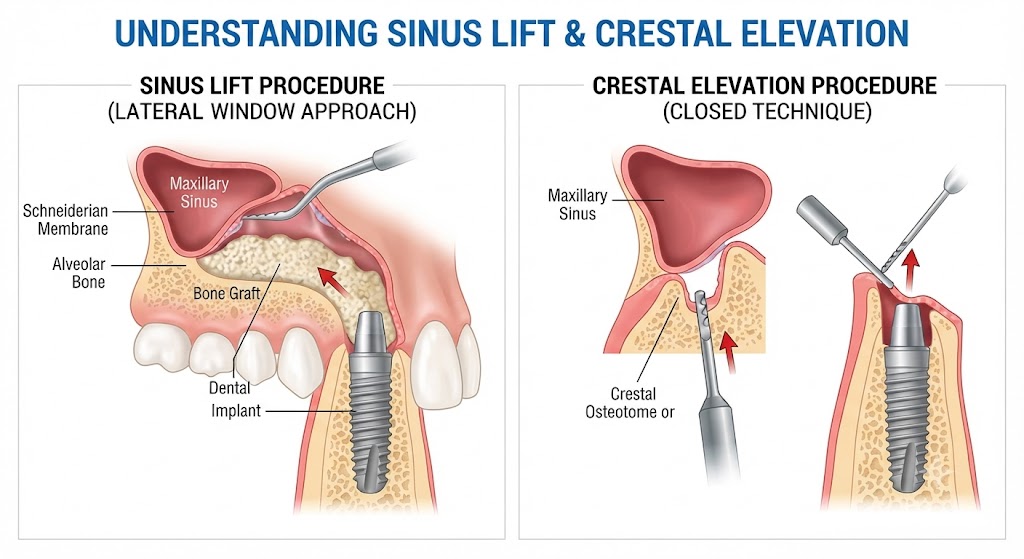
When a dental professional uses the phrase “flip” or “flipping the sinus” in the context of an implant, they are speaking in shorthand about the delicate, controlled elevation of the Schneiderian membrane, which is the thin, fragile lining of the maxillary sinus. The sinus is a hollow, air-filled cavity above the upper back teeth. When these teeth are lost, the sinus expands downward, a process called pneumatization, leaving only a thin shelf of bone between the oral cavity and the sinus. The goal of a sinus lift is to elevate, or “flip up,” this membrane from the underlying bone floor, creating a space underneath it. This newly created, dome-shaped space is then packed with bone graft material. Over months of healing, this graft matures into living bone, increasing the vertical bone height and allowing a standard-length implant to be placed securely without invading the sinus cavity. The act of reflecting that membrane gently upward is the “flip.”
The Two Ways to “Flip”: Lateral Window vs. Crestal Approach
There are two fundamentally different surgical approaches to achieving this membrane elevation, and the term “flip” is most closely associated with the less invasive one. The first is the lateral window sinus lift. The surgeon makes an opening in the side wall of the sinus, creates a small, hinged trapdoor of bone, and carefully elevates the membrane through this window. The graft is packed in, and the window is covered. This is the classic, major sinus lift surgery, used for cases with very little bone height, typically less than 4-5mm.
The second, and the one that is often the subject of the “flip” terminology, is the crestal, or internal, sinus lift. The surgeon accesses the sinus floor directly through the implant osteotomy, the channel they are drilling for the implant. Using specialized instruments called osteotomes, which are blunt-tipped, concave punches, the surgeon gently taps upward on the thin layer of bone at the floor of the sinus. This bone and the attached membrane are delicately fractured and elevated, like lifting a delicate eggshell. A small amount of graft material is then pushed up through the implant channel, further elevating the membrane. The implant is then placed into this site, simultaneously stabilizing the graft and the elevated membrane. This is a brilliantly efficient, single-surgery technique that combines the sinus lift and the implant placement into one procedure. This is the “flip in a dental implant” that is most often being described. The implant is “flipped in” along with the elevated membrane and graft.
The Osteotome Technique: A Step-by-Step Surgical View
Understanding the crestal sinus lift process reduces the mystery. After profound local anesthesia, the surgeon prepares the implant channel in the thin bone ridge, stopping short of the sinus floor. The final 1 to 2 millimeters of bone are carefully “tapped up” using the osteotomes. The surgeon uses a gentle, controlled malleting force. The patient feels a deep, rhythmic tapping sensation, like a firm drumming, but no sharp pain. The surgeon listens for a change in sound and feels for a subtle change in resistance, which signals that the bone plug and the membrane have been released and elevated. A small amount of sterile bone graft material is introduced into the channel. The osteotome is used to gently push this material up, which further elevates the membrane. The implant is then threaded into the prepared site, which seals the graft and the membrane into its new, elevated position. This entire procedure is performed without an external incision.
The Critical Risks: Membrane Tear and Gentle Touch
The sinus membrane is extraordinarily thin and fragile, often compared to a delicate piece of wet single-ply tissue paper. A tear or perforation of this membrane is the primary intraoperative risk of any sinus lift procedure. A small tear can sometimes be managed by carefully placing a resorbable collagen membrane over the tear, which acts as a patch and allows the elevation and grafting to continue. A large, uncontrollable tear is a serious complication. The surgeon must abort the procedure, allow the membrane to heal for several months, and then attempt the surgery again. The skill and experience of the surgeon in performing the membrane elevation with absolute finesse and a gentle touch is the single most important factor in preventing this complication. The crestal osteotome technique has the advantage of being a blind, tactile technique performed through a small channel, which minimizes the extent of membrane dissection compared to a large lateral window.
The Healing and Integration
After the implant and the graft are placed, the site is closed, and a quiet healing period of six to nine months begins. During this time, the bone graft material will be slowly replaced by the patient’s own living bone, a process called creeping substitution. Simultaneously, the implant surface will undergo osseointegration. The sinus membrane will heal and reattach above the new bone. The patient must follow strict sinus precautions for several weeks. These include no nose-blowing, no sneezing with a closed mouth, no drinking through straws, and no scuba diving or flying with a head cold. These precautions prevent pressure changes in the sinus that could displace the graft or rupture the membrane. After the healing period, the implant is uncovered and restored.
Conclusion
The phrase “flip in a dental implant” is the clinical colloquialism for the internal, crestal sinus lift procedure, a single-stage surgery where the surgeon delicately elevates, or “flips up,” the sinus membrane through the implant channel using specialized osteotomes, simultaneously placing bone graft and the implant itself. This minimally invasive technique eliminates the need for a separate, larger sinus surgery and is ideal for cases with a limited but definite amount of remaining vertical bone height. The critical risk is a perforation of the paper-thin Schneiderian membrane, a complication managed by the surgeon’s tactile skill and a meticulously gentle technique.
Frequently Asked Questions
How do I know if I need a sinus lift?
Your oral surgeon will make this determination based on a 3D CBCT scan. The scan will measure the exact height of bone between your gum ridge and the sinus floor. If the available bone is less than the length of the planned implant, a sinus lift is indicated.
What does the osteotome tapping feel like?
You will feel a firm, rhythmic, dull tapping or knocking sensation through your head, not a sharp pain. The local anesthetic ensures the site is numb. The sensation is often described as strange and vibratory, but tolerable.
Why is the “no nose-blowing” rule so strict?
Forceful nose-blowing creates a sudden, dramatic increase in pressure inside the sinus cavity. This positive pressure can blow out the delicate, newly elevated membrane and displace the fragile bone graft particles, leading to a complete failure of the procedure.
Is the crestal or lateral sinus lift better?
Neither is universally better; the choice is dictated by anatomy. The crestal approach is less invasive and faster, suitable for 5-7mm of bone. The lateral window is for cases with very little bone, less than 4mm, and allows the surgeon to see the membrane directly and manage large tears.
Can an implant fail because of a sinus infection?
Yes. A pre-existing, chronic sinus infection must be treated by an ENT physician before a sinus lift. A post-operative sinus infection or a graft infection can lead to graft failure and loss of the implant. Good sinus health is a pre-requisite.
Additional Resource
For an authoritative medical explanation of the maxillary sinus and sinus lift procedures, you can consult the patient education section of the American Association of Oral and Maxillofacial Surgeons. Visit the AAOMS Patient Information Page