Towson MD What Are Dental Implants?
Tooth loss is a challenge that affects more than just your smile. It impacts your ability to eat the foods you love, speak with clarity, and feel confident in social and professional settings. For residents of Towson, Maryland, finding a stable, long-term solution is a priority. Dental implants have transformed restorative dentistry by offering a replacement option that looks, feels, and functions like a natural tooth. But what exactly is a dental implant, and how does the process work?
This article provides a comprehensive, patient-focused guide for anyone in the Towson area who wants to understand dental implants. You will learn about the components of an implant, the detailed step-by-step procedure, the different types of implant solutions available, and the critical health benefits that set implants apart from other tooth replacement options.
The Fundamental Problem of Tooth Loss
To understand the value of a dental implant, you must first understand what is lost when a tooth is removed. A natural tooth consists of two main parts: the visible crown above the gum line and the root that sits below the gum, anchored firmly in the jawbone. The root is not just a passive anchor. Every time you chew, the root transmits mechanical forces to the jawbone. This stimulation signals the body that the bone is needed and active. The body responds by continuously regenerating bone cells in that area.
When a tooth is lost, this vital stimulation stops. The body interprets the lack of activity as a sign that the bone is no longer required. Over time, the jawbone in the space begins to resorb, or melt away. This process is called bone atrophy. It changes the shape of your face, giving it a sunken, prematurely aged appearance. It also weakens the jaw and compromises the stability of adjacent healthy teeth. A successful tooth replacement must address this root-level problem.
What is a Dental Implant? The Complete System
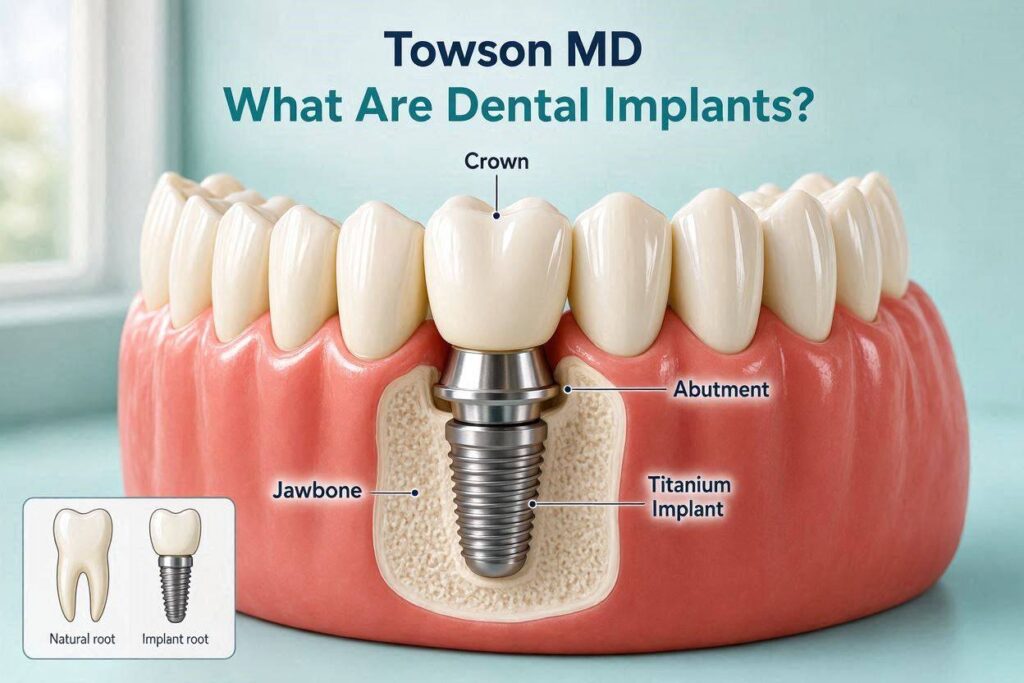
A dental implant is not a single object. It is a complete tooth replacement system composed of three distinct, interconnected parts. Each component plays a specific role in restoring function and aesthetics.
Part 1: The Implant Fixture (The Artificial Root)
The implant itself is a small, high-strength post, similar in shape to a screw or cylinder. It is surgically placed into the jawbone in the exact space left by the missing tooth root. The implant is made from biocompatible titanium or a titanium alloy. Biocompatibility means the material is non-toxic and is not rejected by the body’s immune system. In fact, the bone has a unique affinity for titanium. Through a natural biological process called osseointegration, the living bone cells grow directly onto the microscopic surface of the titanium post, locking it permanently into the jaw. Once osseointegration is complete, the implant fixture acts as a rock-solid, standalone foundation.
Part 2: The Abutment (The Connector)
Once the implant is fully integrated with the bone, a small connector piece called the abutment is attached to the top of it. The abutment sits above the gum line and serves as the anchor point for the new tooth. Abutments can be custom-designed using CAD/CAM digital technology to perfectly shape the gum tissue and provide an ideal emergence profile for the final crown.
Part 3: The Implant Crown (The Visible Tooth)
The final component is the dental crown, the visible part of the new tooth that you see and use to chew. In a high-quality implant restoration, this crown is custom-milled from a solid block of ceramic material, like layered zirconia or lithium disilicate (e.max). These materials are chosen for their strength and their ability to mimic the translucency and color of natural enamel. The crown is either cemented onto the abutment or secured with a small screw, depending on the dentist’s preferred technique.
The Step-by-Step Dental Implant Process in Towson, MD
The journey from a missing tooth to a fully restored smile typically involves several appointments over a period of a few months. The timeline is dictated by the body’s healing rate and cannot be rushed. A reputable Towson implant dentist will guide you through each phase.
Step 1: The Comprehensive Consultation and 3D Imaging
Your journey begins not with a surgical instrument but with a computer mouse. The implant dentist performs a thorough clinical examination of your mouth. They review your medical and dental history. The most critical part of this first appointment is the acquisition of a Cone Beam Computed Tomography (CBCT) scan. This is a specialized 3D X-ray that creates a precise, virtual, three-dimensional model of your jaw. A standard two-dimensional panoramic X-ray is insufficient for safe implant planning.
Using the CBCT scan, the dentist evaluates the height, width, and density of the available jawbone. They identify the exact path of the inferior alveolar nerve in the lower jaw and map the floor of the maxillary sinuses in the upper jaw. The dentist uses advanced software to perform a virtual “trial surgery” on the screen, planning the exact diameter and length of the implant and its ideal three-dimensional position for the final crown.
Step 2: Preparatory Procedures (If Needed)
For some patients, the CBCT scan reveals that the jawbone is too thin, too short, or too soft to support an implant. This is a common consequence of tooth loss and bone resorption. This does not mean you are not a candidate. It means a preparatory procedure is needed to rebuild the foundation.
A bone graft is the most common preparatory procedure. The surgeon adds bone grafting material to the deficient area to restore its width and height. The material can be your own bone harvested from another site, processed donor bone, or synthetic grafting compounds. This graft creates a biological scaffold that your own body will remodel into strong, vascularized bone over 3 to 6 months. If an implant is needed in the upper back jaw near the molars, the sinus floor may be too low. A sinus lift procedure gently elevates the sinus membrane and places bone graft material underneath it, creating enough vertical bone height for an implant.
Step 3: The Surgical Placement of the Implant Fixture
On the day of the surgery, your comfort is the primary concern. The procedure is performed under local anesthesia, often combined with a form of dental sedation like nitrous oxide or oral conscious sedation, to ensure you are relaxed and pain-free. The surgeon makes a small incision in the gum tissue to expose the jawbone. Using a sequence of precisely sized drills based on the digital surgical plan, the surgeon creates a space in the bone and gently inserts the titanium implant fixture. The gum tissue is then closed over the implant, leaving it completely buried under the gum, or a small healing cap is attached that sits above the gum line. The surgery for a single implant is often completed in under an hour.
Step 4: The Healing Phase and Osseointegration
This is the most biologically remarkable phase and the one that defines implant dentistry. Over the next 3 to 6 months, the patient goes about their normal life. Beneath the gum, the body is busy. New bone cells slowly and steadily grow onto the roughened surface of the titanium implant. This is osseointegration, a process discovered by Swedish researcher Per-Ingvar Brånemark. This biological fusion is what gives the implant its exceptional strength and stability. During this healing period, the patient wears a temporary tooth to maintain appearance and a degree of function.
Step 5: Uncovering and Final Restoration
Once the implant has passed a stability test and is confirmed to be fully integrated, the patient returns for the restorative phase. The surgeon uncovers the top of the implant and attaches the abutment. The restorative dentist then captures a digital scan of the implant’s exact position using an intraoral scanner. This scan is sent to a high-end dental laboratory. A master ceramist designs and mills a custom crown that perfectly matches the shape, size, and shade of the surrounding natural teeth. In a final short appointment, the dentist checks the fit, the bite, and the aesthetics, and then secures the permanent crown to the abutment.
Types of Dental Implant Restorations
The implant system can replace a single tooth, multiple teeth, or an entire arch of missing teeth.
Single Tooth Implant
The most common application. A single implant fixture supports a single implant crown. It is a one-to-one replacement that is fully self-supporting and does not involve the adjacent healthy teeth in any way.
Implant-Supported Bridge
When multiple teeth are missing in a row, placing one implant for each missing tooth may not be necessary or possible. In this case, two or more strategically placed implants can support a fixed bridge. The implants serve as abutments for a span of ceramic replacement teeth. This is a fixed solution that avoids a removable partial denture.
Full-Arch Implant Restoration (All-on-4)
For patients missing all or most of their teeth on an arch, a full-arch implant restoration is a life-changing option. Using as few as four (All-on-4) or six (All-on-6) strategically angled implants, the surgeon can support a full, permanent set of prosthetic teeth. This technique often allows for immediate function, meaning the patient leaves the surgical appointment with a fixed, non-removable provisional set of teeth. It provides exceptional stability and completely eliminates the need for a removable denture.
Implant-Retained Overdenture
This is a hybrid solution that significantly improves a standard removable denture. Two to four implants are placed in the jaw, and a custom denture is fabricated with special attachments on its underside. The denture snaps firmly onto the implants. It stays securely in place while eating and speaking but can still be removed for cleaning. It is far more stable and comfortable than a traditional denture that rests solely on the gums.
The Health Benefits Beyond a Beautiful Smile
The functional and health advantages of dental implants are profound and long-term.
Preservation of Jawbone
A traditional denture or a tooth-supported bridge sits on top of the gum. It does nothing to stimulate the underlying jawbone. The bone continues to resorb over time. Only a dental implant, which replicates a natural tooth root, transmits the forces of chewing down into the bone. This stimulation stops bone loss and preserves the natural contours of your face and jaw.
Protection of Adjacent Healthy Teeth
A traditional fixed bridge requires the dentist to grind down the two perfectly healthy teeth adjacent to the gap. These teeth, called abutment teeth, are permanently shaved down to support the bridge. This process irreversibly weakens them. A dental implant is a standalone unit. It fills the space without touching or damaging any neighboring healthy teeth, preserving the maximum amount of your natural tooth structure.
Restored Bite Force and Function
Anchored in the bone, a dental implant restores a bite force that is nearly equivalent to a natural tooth. You can eat steak, apples, and crunchy vegetables with complete confidence. Patients with traditional dentures often lose a significant amount of their chewing power.
Lifetime Solution Value
While the initial investment for a dental implant is higher than a bridge or denture, it is often the most cost-effective solution over a lifetime. A bridge typically needs replacement every 10 to 15 years. An implant, with proper home care and regular professional maintenance, can last a lifetime. The single largest variable in long-term success is the patient’s commitment to daily oral hygiene and non-smoking status.
Are You a Candidate for Dental Implants?
Most adults in good general health who have lost one or more teeth are candidates. The key limiting factor is the quantity and quality of the jawbone. However, as discussed, bone grafting can create a suitable foundation for most patients.
Factors that complicate candidacy include uncontrolled systemic diseases like diabetes, which impairs healing, and a history of radiation therapy to the jaws. Smoking is a very significant risk factor for implant failure and is a contraindication for many dentists until the patient has quit. A thorough medical review with your Towson implant dentist is essential.
Finding Your Dental Implant Provider in Towson, MD
When searching for a “dental implant dentist in Towson MD,” look for a provider who performs a significant volume of implant cases annually. Verify their training. The ideal provider is an oral surgeon or periodontist with advanced, post-doctoral surgical residency training, or a general dentist with a Diplomate status in an organization like the ICOI or AAID. The practice must use 3D CBCT technology for planning and offer a full range of sedation options for your comfort.
Conclusion
Dental implants are a sophisticated, three-part tooth replacement system consisting of a titanium root, an abutment, and a custom ceramic crown. They address tooth loss at its root cause by surgically replicating a natural tooth root, stimulating the jawbone, and stopping bone loss through osseointegration. Unlike traditional bridges or dentures, implants are standalone structures that protect adjacent teeth, restore full chewing power, and provide a lifelong solution. For Towson, MD residents, the journey involves a comprehensive 3D-planned process with a qualified surgical provider, resulting in a new smile that is virtually indistinguishable from nature.
FAQ
1. Is the surgical procedure painful?
No. The surgery is performed under local anesthesia, so you will not feel pain. Post-operative discomfort is typically manageable with over-the-counter or prescribed pain medication and usually subsides within a few days.
2. How long does the entire implant process take in Towson?
For a single implant with no bone grafting, the total time from surgery to final crown is typically 3 to 6 months. If grafting is needed, the timeline can extend to 6 to 12 months.
3. Will my medical insurance cover dental implants?
Medical insurance rarely covers the implant procedure, but it may cover portions of the reconstructive surgery, such as the bone graft, if it is deemed medically necessary. Your dentist’s office will help you file the correct codes with your medical insurer.
4. How do I care for a dental implant?
Care for it exactly like a natural tooth. Brush it twice a day, floss around it daily using implant-specific floss or a water flosser, and see your dentist for a professional cleaning and check-up at least twice a year.
5. What is the success rate of dental implants?
In healthy patients with good oral hygiene, the success rate for dental implants is consistently documented at 95-98%, making it one of the most predictable and successful procedures in all of medicine.
Additional Resource
To learn more about the scientific basis of the material used in dental implants, you can review the official documentation on biocompatible materials from the U.S. Food and Drug Administration (FDA) – Dental Implants.