Will Implants Alleviate Denture Pain?
Denture pain is a silent epidemic. Millions of people suffer daily from the physical discomfort, the oral sores, the difficulty eating, and the deep social anxiety that come with wearing conventional removable dentures. They have been told that pain is just a part of life with false teeth. This is not true. Dental implants offer a definitive, transformative solution to the root causes of denture pain, not just a temporary numbing of the symptoms.
This article provides a comprehensive, honest exploration of how dental implants can alleviate the suffering caused by conventional dentures. You will learn about the specific mechanical and biological sources of denture pain, how different types of implant-retained prostheses directly eliminate these problems, and what you can realistically expect during the transition to a pain-free, functional life.
The Root Causes of Conventional Denture Pain
To understand how implants solve the problem, you must first understand why conventional dentures cause pain. The pain is not from “getting used to them.” It is a biomechanical and physiological mismatch between a rigid, removable device and a dynamic, living oral environment.
The Sliding and Friction of Unstable Lower Dentures
The single greatest source of pain is the instability of a lower denture. A lower denture is a horseshoe-shaped piece of acrylic resting on a narrow, resorbed ridge of bone. It has no natural suction. It is held in place by a delicate, learned balance of tongue and cheek muscles. When you chew, the denture rocks, shifts, and slides. This constant micromovement creates chronic friction against the thin, delicate mucosal tissue that covers the jawbone. The result is recurrent traumatic ulcers, calloused tissue, and a constant, raw, burning sensation.
The Compression of the Nerve-Rich Alveolar Ridge
The jawbone was not designed to be a load-bearing surface for a hard plastic plate. The mucosal covering over the bone is thin, and the underlying bone itself is densely innervated. When you bite down on a conventional denture, the entire force of your bite is transmitted as direct pressure onto this sensitive ridge. This causes a deep, compressive pain that is often described as a dull, aching bruise. This is especially acute in the lower jaw, where the bone has resorbed to a thin, knife-edge ridge.
The Gag Reflex from a Full Upper Palatal Coverage
A full upper denture covers the entire hard palate. For many patients, the posterior border of the denture extending into the soft palate triggers an uncontrollable, exhausting gag reflex. This is not psychological; it is a somatic reflex. The constant presence of the acrylic plate makes the patient feel like they are choking.
Progressive Bone Resorption Making the Fit Worse
This is the cruel irony of conventional dentures. They do not just sit on a resorbing bone; they actively accelerate its loss. Because there are no tooth roots to stimulate the bone, the pressure of the denture on the ridge actually promotes further resorption. The jawbone shrinks over time. The denture that once fit acceptably well becomes progressively looser, more unstable, and more painful. The patient enters a downward spiral of more bone loss, more relines, more pain, and less function.
How Dental Implants Solve the Pain Problem
Dental implants do not just “hold a denture better.” They fundamentally change the physics and biology of tooth replacement by shifting the support and retention of the prosthesis from the soft tissue and bone surface to a rigid, internal bone structure.
From Soft Tissue Support to Bone-Anchored Support
A conventional denture is a soft-tissue-borne prosthesis. It rests on your gums. An implant-retained prosthesis is an implant-borne or implant-mucosa-supported prosthesis. The primary load and retention come from the titanium fixtures that are biologically fused to the jawbone. The chewing forces are transmitted through the implants directly into the bone, bypassing the sensitive, thin gum tissue entirely. The gum is freed from the pathological pressure that causes the deep, aching compressive pain.
Eliminating Friction: The End of Slipping and Rocking
When a denture snaps securely onto a set of implants, it cannot slide. It cannot rock. It is locked in place by a precision mechanical attachment. The chronic, low-grade friction that causes ulcers and raw spots is eliminated. The denture is stable during function, so it does not rub. This is often the most immediate and profound relief a patient experiences.
The Open Palate Design: Liberating the Gag Reflex
For an implant-supported upper prosthesis, the acrylic does not need to cover the entire palate for suction. The implants provide the retention. The dentist can design a “horseshoe” or U-shaped prosthesis with an open palate. The roof of your mouth is uncovered. You can taste food again. You can feel the temperature of a cold drink. And for those with a gag reflex, this change is nothing short of life-changing. The sensory trigger is removed.
Halting the Cycle of Bone Loss and Relines
This is the most crucial long-term biological benefit. A dental implant replaces the root of the missing tooth. When you chew, the implant transmits forces into the surrounding bone. This mechanical stimulation signals the body to maintain the bone. The process of disuse atrophy is stopped. By halting bone resorption, implants stabilize the foundation. The patient escapes the repeating cycle of a progressively looser denture and frequent, painful relines.
The Different Levels of Implant Solution for Denture Pain
The degree of pain relief and functional improvement depends on the type of implant solution you choose.
The Implant-Retained Overdenture (Removable)
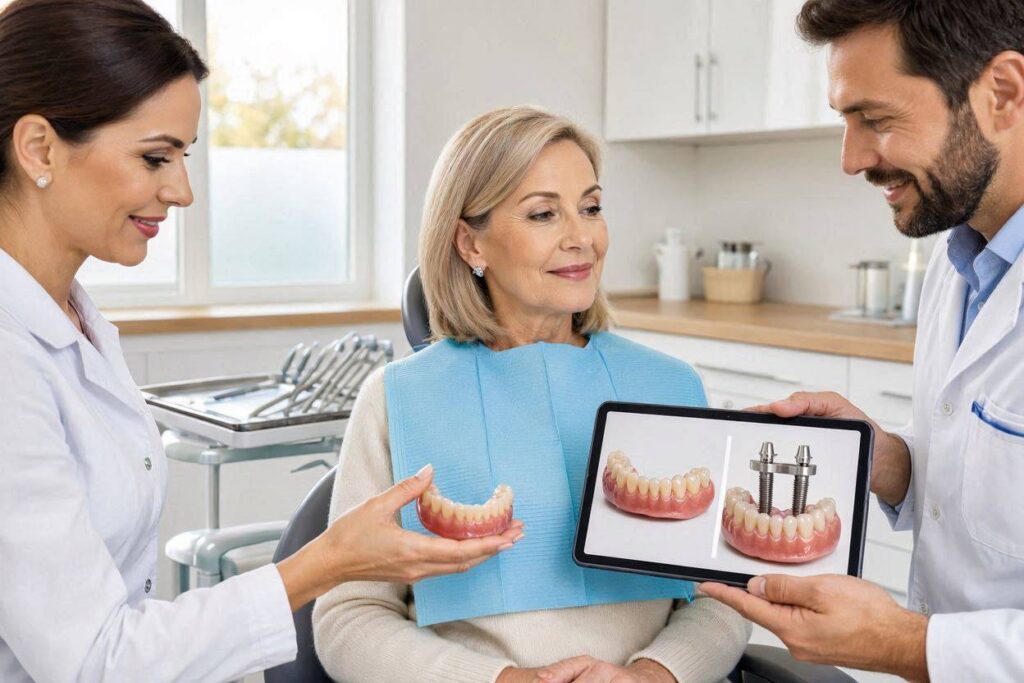
This is often the minimum standard for eliminating denture pain. Two to four implants are placed in the jaw, and the denture is fitted with special snap-attachments (locators). The denture clicks firmly onto the implants. It is retained securely against vertical and lateral displacement. The patient removes it at night for cleaning. This solution eliminates the instability, the sliding, and the sharp ridge compression pain. It provides dramatic relief at a more accessible cost than a fixed prosthesis.
The Fixed Full-Arch Implant Bridge (Non-Removable)
This is the premium solution for total liberation from denture pain. A full arch of beautiful, ceramic teeth is permanently screwed onto four to six implants. It is not removable by the patient. There is no acrylic baseplate covering the gum or the palate. It is the closest prosthetic equivalent to having your natural teeth back. The force is delivered to the implants and the bone. There is no soft tissue loading, no friction, no palatal coverage, and no removable parts. A patient with this restoration does not think about denture pain because they no longer have a denture in any meaningful sense of the word.
The Transition and Healing: A Realistic Expectation
It is important to have a realistic expectation of the timeline. The day a new set of implants is placed, there is surgical post-operative healing to manage. This is a different kind of discomfort—temporary and treatable with medication—and it resolves predictably. In an “All-on-4” immediate load protocol, a fixed provisional bridge is attached on the day of surgery, meaning the patient never wears a loose, painful denture again. The soft tissue will be tender as it heals around the abutments. This healing discomfort is not denture pain; it is a healthy, biological response to a controlled surgical procedure. Within weeks, this fades, and the patient begins to experience the full benefit of a stable, pain-free platform.
Conclusion
Yes, dental implants definitively alleviate the specific, debilitating pain caused by conventional removable dentures. They solve the root mechanical problems by transferring the load-bearing function from the sensitive, soft tissue to the rigid, integrated bone of the jaw, thereby eliminating the friction of a sliding lower denture and the compressive pain on the nerve-rich alveolar ridge. For upper denture pain, an implant-supported prosthesis allows for an open-palate design, which permanently resolves the gag reflex and restores the sensory experience of eating. By halting the underlying bone resorption, implants also break the painful cycle of progressive looseness and chronic relines. The result is not an improved denture; it is a fundamentally different, pain-free quality of life.
FAQ
1. Will a dental implant completely eliminate all my denture pain?
Yes, the specific pain caused by a loose, unstable, and pressure-inducing denture will be eliminated. Post-surgical healing discomfort is a separate, temporary issue that resolves as the tissues heal.
2. Is an implant overdenture really that much more comfortable than a regular denture?
The difference is dramatic. An implant-retained overdenture is locked in place and cannot slip. This eliminates the friction sores and the deep bruising feeling from a rocking denture.
3. How do implants stop the gagging from my upper denture?
A removable upper implant denture can be designed without the thick acrylic plate covering the roof of your mouth. This open-palate design removes the physical trigger that causes the gag reflex.
4. I have a very shrunken, flat lower jawbone. Can implants still help me?
Yes, this is a classic situation where implants are life-changing. A flat, painful ridge is a very poor foundation for a conventional denture. Placing implants, sometimes with a preliminary bone graft, provides a fixed anchor point and ends the pain of the denture rocking on the flat surface.
5. Is the implant surgery painful?
The surgery is performed under local anesthesia and sedation. It is not painful during the procedure. Post-operative soreness is managed with medication and typically lasts a few days.
Additional Resource
To understand the complete range of implant-based solutions for denture wearers and the science behind them, explore the patient resources at the American College of Prosthodontists (ACP).