Will They Give Young People Dental Implants?
Dental implants are widely considered the gold standard for replacing missing teeth. They offer durability, functionality, and aesthetics that other options cannot match. But when it comes to young people, the question arises: are dental implants appropriate? Will dentists even perform the procedure on teenagers or young adults?
The answer is nuanced. While dental implants are generally safe and effective for adults, young patients present unique considerations. This guide explores the factors that determine whether a young person is a candidate for dental implants, the risks involved, and the alternatives that may be recommended.
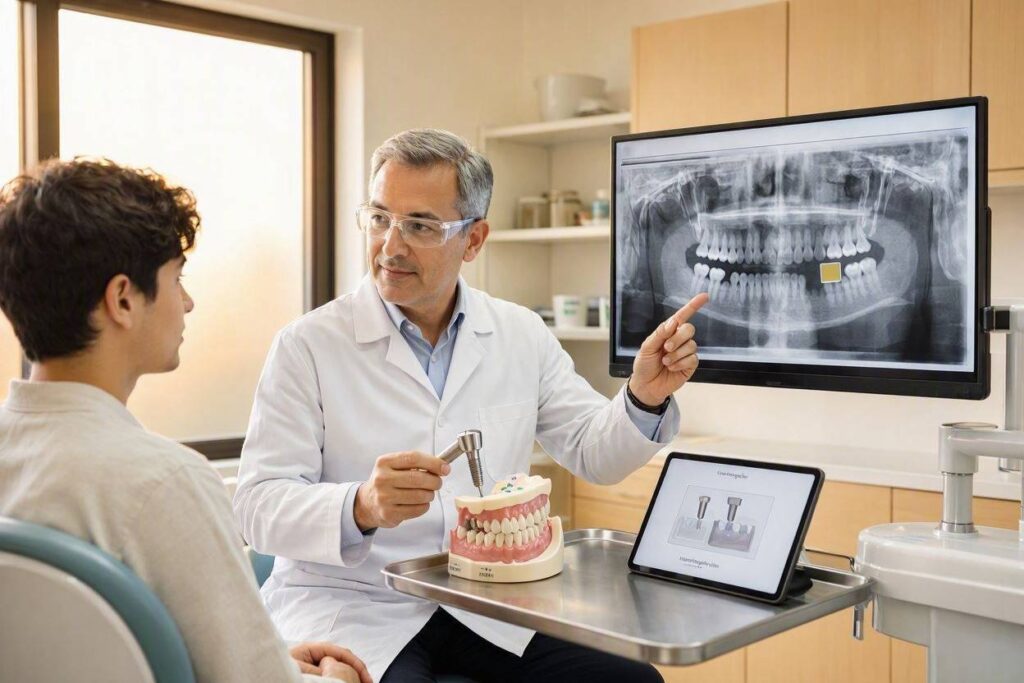
Understanding Dental Implants
Before discussing age considerations, it helps to understand what dental implants are and how they work.
What Is a Dental Implant?
A dental implant is a titanium post surgically placed into the jawbone. It serves as an artificial tooth root, providing a foundation for a crown, bridge, or denture. The implant fuses with the bone through a process called osseointegration, creating a stable and permanent restoration.
The Components of a Dental Implant
- Implant Post: The titanium screw placed in the jawbone
- Abutment: The connector piece attached to the implant post
- Crown: The visible artificial tooth attached to the abutment
Why Dental Implants Are Preferred
Dental implants offer several advantages over alternatives like bridges or dentures:
- Durability: Can last a lifetime with proper care
- Functionality: Restore full chewing ability
- Aesthetics: Look and feel like natural teeth
- Bone Preservation: Prevent bone loss that occurs with missing teeth
- Independence: Do not rely on adjacent teeth for support
Age Considerations for Dental Implants
The primary concern with dental implants in young people is jawbone growth.
Jawbone Development
The human jawbone continues to grow and develop throughout adolescence and into early adulthood. Dental implants, unlike natural teeth, do not move or adapt to this growth. If an implant is placed before the jaw has finished growing, it can end up in the wrong position as the surrounding bone continues to develop.
When Does Jaw Growth Stop?
Jaw growth typically completes at different ages for males and females:
- Females: Growth usually completes around ages 16 to 18
- Males: Growth usually completes around ages 18 to 21
However, individual variation exists. Some people continue growing into their early twenties.
The Risk of Premature Implant Placement
If an implant is placed before the jaw has finished growing, several problems can occur:
- The implant may appear “sunken” as surrounding bone grows
- The implant may become misaligned with adjacent teeth
- Aesthetic problems may develop
- The implant may require removal and replacement
Important Note: For these reasons, most dentists recommend waiting until jaw growth is complete before placing dental implants.
When Dental Implants Are Appropriate for Young People
There are situations where dental implants may be appropriate for younger patients.
After Jaw Growth Is Complete
Once jaw growth has finished—confirmed through X-rays and growth assessments—dental implants are generally safe for young adults. A 19-year-old female or a 21-year-old male with complete jaw development may be an excellent candidate.
Congenital Missing Teeth
Some young people are born with congenitally missing teeth (hypodontia). This condition affects approximately 2% to 5% of the population. In these cases, dental implants may be considered earlier if jaw growth has completed.
Trauma or Injury
Young people who lose teeth due to accidents or sports injuries may need replacement. While dentists often recommend temporary solutions until growth completes, implants may be placed earlier in certain circumstances.
Medical Conditions
Some medical conditions or treatments, such as certain cancer therapies, may necessitate tooth removal. In these cases, dental implants may be considered at a younger age.
The Evaluation Process
Determining whether a young person is ready for dental implants involves careful evaluation.
Growth Assessment
Dentists use several methods to assess jaw growth:
- Dental X-rays: Show bone development
- Cephalometric Analysis: Measures facial growth patterns
- Hand-Wrist X-rays: Assess skeletal maturity
- Growth Charts: Track overall development
Clinical Examination
The dentist evaluates:
- Overall oral health
- Gum health
- Bone density and volume
- Bite alignment
- Adjacent teeth condition
Medical History Review
The dentist reviews:
- Underlying medical conditions
- Medications
- Allergies
- Previous dental treatments
Alternatives for Young People
When dental implants are not yet appropriate, several temporary solutions exist.
Removable Partial Dentures
A removable partial denture replaces one or more missing teeth. It is held in place by clasps attached to adjacent teeth.
Advantages:
- Affordable
- Non-invasive
- Removable for cleaning
- Can be adjusted as the jaw grows
Disadvantages:
- Less stable than implants
- May be uncomfortable
- Requires regular adjustment
- Does not prevent bone loss
Dental Bridges
A bridge replaces a missing tooth by attaching to adjacent teeth, which are crowned to support the artificial tooth.
Advantages:
- Fixed in place
- Natural appearance
- Restores chewing function
Disadvantages:
- Requires alteration of healthy adjacent teeth
- Does not prevent bone loss
- May need replacement every 10 to 15 years
Orthodontic Space Maintenance
If a young person loses a tooth, orthodontic treatment may maintain or close the space.
Space Maintainers:
Devices that hold the space open until an implant can be placed.
Orthodontic Closure:
In some cases, braces can close the gap left by a missing tooth, eliminating the need for replacement.
Temporary Implants
In rare cases, temporary mini-implants may be used as placeholders until the patient is old enough for permanent implants.
The Risks of Delaying Implants
While waiting for jaw growth is prudent, delaying too long has consequences.
Bone Loss
When a tooth is missing, the jawbone in that area begins to deteriorate. This process, called resorption, accelerates over time. If too much bone is lost, bone grafting may be required before implant placement.
Tooth Shifting
Adjacent teeth may drift into the gap left by the missing tooth. This can cause bite problems and make future implant placement more difficult.
Aesthetic Concerns
A missing tooth in a visible area affects self-esteem and confidence, especially for young people.
Functional Problems
Missing teeth can affect chewing and speech.
Bone Grafting for Young Patients
In some cases, young patients may benefit from bone grafting before implant placement.
What Is Bone Grafting?
Bone grafting involves adding bone material to the jaw to create a stable foundation for implants. This may be necessary if bone loss has occurred.
When Is Bone Grafting Recommended?
- After trauma that damaged the bone
- If a tooth has been missing for an extended period
- If congenital defects affected bone development
- To augment thin or insufficient bone
Cost of Bone Grafting
Bone grafting costs $300 to $1,200 per site, adding to the total implant cost.
The Role of Parents and Guardians
For young patients, parents and guardians play a crucial role in the decision-making process.
Informed Consent
Parents must understand:
- The risks and benefits of implants
- The importance of timing
- The alternatives available
- The financial commitment
Financial Planning
Dental implants are expensive. Parents should consider:
- Dental insurance coverage
- Payment plans
- Health savings accounts
- Long-term budgeting
Emotional Support
Young patients may feel anxious about dental procedures. Parents can provide:
- Reassurance
- Information about the process
- Support during recovery
Case Studies: Realistic Scenarios
Understanding real-world examples helps illustrate the decision-making process.
Scenario 1: 15-Year-Old with Traumatically Lost Tooth
A 15-year-old boy loses a front tooth in a sports accident. His jaw is still growing, so implants are not recommended yet.
Recommendation:
- Temporary removable partial denture
- Orthodontic space maintenance
- Re-evaluation at age 18 or 19
- Implant placement once growth is confirmed complete
Scenario 2: 19-Year-Old Female with Congenitally Missing Tooth
A 19-year-old woman has a congenitally missing premolar. X-rays confirm jaw growth is complete.
Recommendation:
- Dental implant placement is appropriate
- No need for temporary solutions
- Proceed with implant surgery
Scenario 3: 17-Year-Old Male with Severe Decay
A 17-year-old male needs a molar extracted due to severe decay. His jaw is still growing.
Recommendation:
- Extraction followed by space maintainer
- Consider removable partial denture
- Wait until age 20 or 21 for implant placement
- Bone grafting may be needed if bone loss occurs
The Cost of Dental Implants for Young People
Dental implants are a significant financial investment.
Average Costs
| Component | Average Cost |
|---|---|
| Implant Post | $1,000 – $3,000 |
| Abutment | $300 – $500 |
| Crown | $1,000 – $3,000 |
| Bone Graft (if needed) | $300 – $1,200 |
| Total | $2,300 – $6,700 per tooth |
Insurance Coverage
- Dental insurance may cover a portion of the crown
- Medical insurance may cover implant surgery in certain cases
- Most plans have annual maximums that limit coverage
Conclusion
Dental implants are generally not recommended for young people whose jaws are still growing. Placing implants too early can lead to misalignment and aesthetic problems as the jaw continues to develop. Most dentists recommend waiting until growth is complete—around ages 16 to 18 for females and 18 to 21 for males. During this waiting period, temporary solutions like removable dentures or space maintainers preserve the space and prevent complications. Once growth is confirmed complete, young adults can safely receive dental implants and enjoy their lifelong benefits.
Frequently Asked Questions (FAQ)
Q: What is the minimum age for dental implants?
A: There is no universal minimum age. Implants are placed once jaw growth is complete, typically around age 16 to 18 for females and 18 to 21 for males.
Q: Can a teenager get a dental implant?
A: Most teenagers are not candidates for implants because their jaws are still growing. Temporary solutions are used until growth completes.
Q: What happens if an implant is placed too early?
A: The implant may become misaligned as the jaw grows, leading to aesthetic and functional problems. The implant may need removal and replacement.
Q: What are the alternatives to implants for young people?
A: Alternatives include removable partial dentures, dental bridges, and orthodontic space maintenance.
Q: How do dentists determine if jaw growth is complete?
A: Dentists use X-rays, cephalometric analysis, and hand-wrist X-rays to assess skeletal maturity.
Q: Are dental implants safe for young adults?
A: Yes, dental implants are safe and effective for young adults once jaw growth is confirmed complete.
Additional Resource
For more information on dental implants and age considerations, visit the American Academy of Implant Dentistry (AAID) at www.aaid.com. They provide educational resources for patients.