Cost of Dental Implants in PA: A Complete 2026 Guide
If you’re missing one or more teeth, you’ve likely heard that dental implants are the gold standard for replacement. They look natural, feel secure, and can last a lifetime. But let’s be honest: the first question almost everyone asks is, “What will this actually cost me in Pennsylvania?”
You might have seen ads for “$399 implants” or “teeth in a day” promotions. And you’re right to be skeptical.
The truth is, the cost of dental implants in PA varies widely depending on where you live, who you see, and what your mouth needs. A simple implant in rural Crawford County will not cost the same as a full-mouth reconstruction in Center City Philadelphia.
This guide gives you real, realistic numbers. No hype. No hidden agendas. Just clear information to help you plan your budget and make a confident decision.
What Exactly Is a Dental Implant? (And Why the Price Varies)
Before we talk dollars, it helps to understand what an implant actually is. Many people think an implant is the whole tooth. But that’s not quite right.
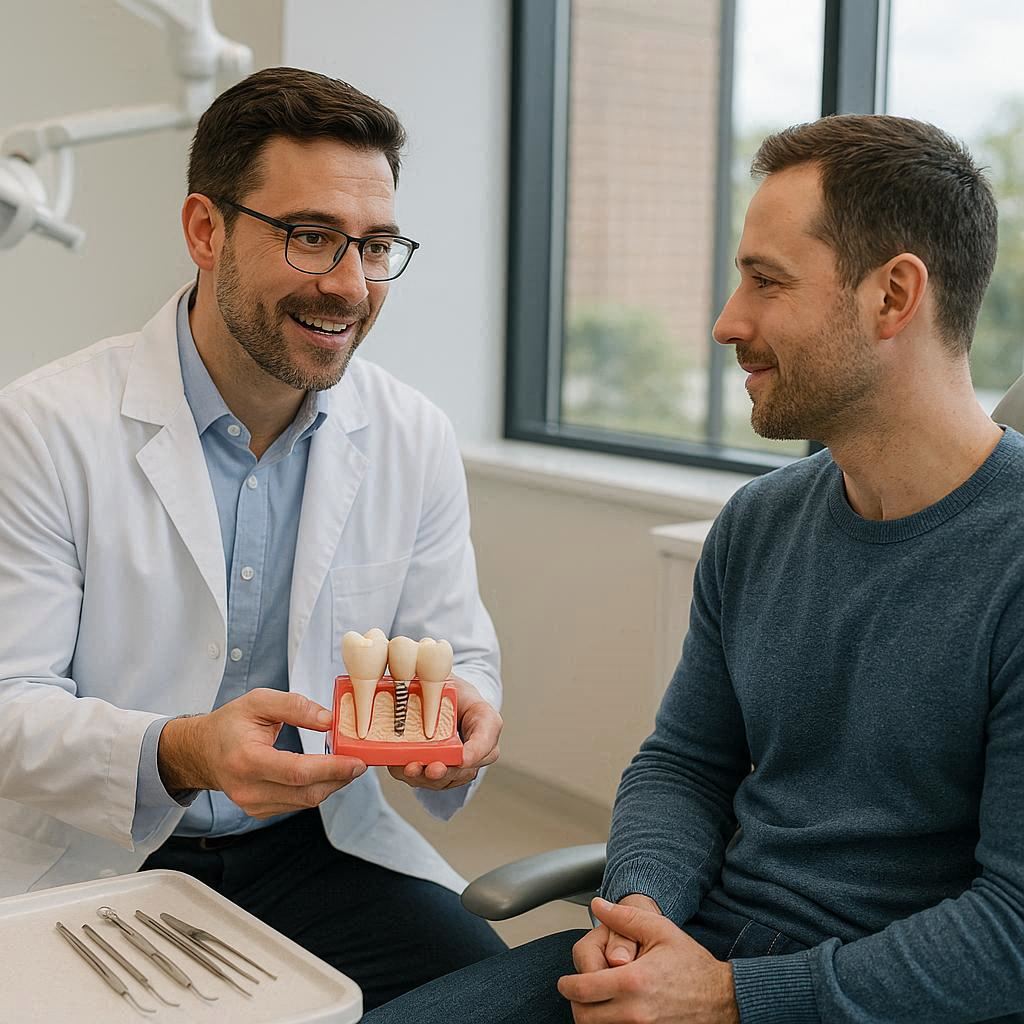
A complete dental implant has three parts:
- The Implant Post: A small titanium screw (or zirconia) that your surgeon places into your jawbone. This acts like a natural tooth root.
- The Abutment: A small connector piece that sits on top of the implant post.
- The Crown: The visible, tooth-colored part that you see when you smile.
When a dentist quotes you a price, always ask: Does that include all three parts? Sometimes, a low quote only covers the post.
Why Prices Are Not One-Size-Fits-All in PA
Pennsylvania is a big state. The cost to run a dental practice in Harrisburg is different from one in Scranton or Erie. Here are the main factors that change your final bill:
- Geographic location: Urban centers have higher overhead (rent, staff wages).
- Provider type: A private periodontist or oral surgeon usually charges more than a general dentist who also places implants.
- Bone health: Many patients need a bone graft or sinus lift before an implant. That adds 500–3,000.
- Materials: Titanium vs. zirconia. Generic vs. brand-name (like Nobel Biocare or Straumann).
- Urgency: “Same-day” or “teeth-in-a-day” procedures cost a premium.
Important note: Dental insurance rarely covers the full cost of implants. Most plans consider them “cosmetic” or “major restorative” with a yearly cap. We’ll cover insurance later.
The Real Numbers: Average Cost of Dental Implants in PA (2026)
Let’s cut to the chase. Based on real patient data, provider surveys, and insurance claims from across the state, here are the average costs you can expect in Pennsylvania.
Keep in mind: these are out-of-pocket estimates before insurance.
| Procedure | Low End (Rural PA) | Average (Suburbs) | High End (Pittsburgh/Philly) |
|---|---|---|---|
| Single implant (post + abutment + crown) | $3,200 | $4,500 | $6,000+ |
| Implant-supported bridge (3-4 teeth) | $7,000 | $10,000 | $15,000+ |
| Full arch fixed implant (All-on-4 per arch) | $15,000 | $24,000 | $35,000+ |
| Full mouth implants (both arches) | $28,000 | $40,000 | $60,000+ |
| Bone graft (simple, per site) | $500 | $800 | $1,500 |
| Sinus lift (per side) | $1,200 | $1,800 | $3,000 |
| CT scan (3D imaging) | $250 | $400 | $650 |
Breaking Down a Single Tooth Implant in PA
Let’s say you live near Allentown and need one implant for a molar. Here’s a realistic itemized estimate from a mid-range oral surgeon:
- Consultation and exam: $150
- 3D CBCT scan: $350
- Implant post placement: $1,800
- Abutment: $500
- Porcelain crown: $1,800
- Total: $4,600
If you need a simple bone graft (common for molars): add 800.∗∗Newtotal:5,400**
That’s the real, everyday cost for most Pennsylvanians. It’s not cheap. But it is an investment in something that can last 30+ years.
Why Some Ads Say “$1,999 Implants”
Yes, you will see lower prices. They are usually real — but only for the implant post itself. The crown, abutment, and final placement are not included. Or they are offered at a dental school where supervised students perform the work.
“I called a clinic in South Philly advertising 1,800implants.AftertheCTscanandconsultation,myactualquoteforonetoothwas1,800implants.AftertheCTscanandconsultation,myactualquoteforonetoothwas5,200. The $1,800 was just for the first surgery.” — David, Philadelphia
Always ask for a written treatment plan with all phases included.
Cost Breakdown by Region in Pennsylvania
Pennsylvania has distinct economic zones. Let’s look at how prices differ.
Southeastern PA (Philly Suburbs, Main Line, Bucks, Delaware, Montgomery Counties)
This is the most expensive region. High demand, high rent, and specialized providers drive prices up.
- Single implant: 5,000–7,000
- All-on-4 per arch: 25,000–45,000
Southwestern PA (Pittsburgh, Washington, Uniontown)
Pittsburgh offers more competition and lower overhead than Philly, but still urban pricing.
- Single implant: 3,800–5,500
- All-on-4 per arch: 22,000–35,000
Central PA (Harrisburg, Hershey, Lancaster, York, State College)
The “sweet spot” for value. You get good quality without the big-city markup.
- Single implant: 3,500–5,000
- All-on-4 per arch: 18,000–28,000
Northeast PA (Scranton, Wilkes-Barre, Stroudsburg, Poconos)
More affordable, but fewer specialists. You may travel for complex cases.
- Single implant: 3,200–4,800
- All-on-4 per arch: 16,000–26,000
Northwest PA (Erie, Meadville, Oil City)
The lowest costs in the state. However, experience varies more widely.
- Single implant: 2,800–4,200
- All-on-4 per arch: 14,000–22,000
Hidden Costs Most Dentists Don’t Mention Upfront
A big mistake patients make is focusing only on the implant quote. There are several additional fees that often surprise people.
1. Tooth Extraction (if needed)
If the damaged tooth is still in your mouth, you must remove it first.
- Simple extraction: 150–300
- Surgical extraction (impacted or broken): 300–600
2. Temporary Tooth During Healing
While the implant heals (3–6 months), you may want a temporary partial or flipper.
- Flipper (removable): 300–800
- Resin bonded bridge: 500–1,200
3. Sedation or Anesthesia
Many patients choose sedation for comfort. This is rarely included in the base quote.
- Local anesthesia only: Often included
- Oral sedation (pill): 150–300
- IV sedation (twilight): 400–800
- General anesthesia (hospital setting): 1,000–2,500
4. Final Crown Material Upgrades
The base quote often uses a standard porcelain-fused-to-metal crown. If you want all-ceramic (zirconia or lithium disilicate), expect to pay more.
- PFM crown: included in base
- All-ceramic upgrade: +300–700
5. Follow-up Visits and Uncover Surgery
After the implant fuses to your bone (osseointegration), a minor procedure to “uncover” the implant may be billed separately.
- Uncovering fee: 150–350
Pro tip: Ask your provider for a “global fee.” Some clinics offer a single all-inclusive price for the entire implant process.
Dental Insurance in PA: What It Actually Covers
Let’s be realistic. Most dental insurance in Pennsylvania is not designed for implants. It was created for fillings, extractions, and basic crowns.
However, you can still use insurance to lower your out-of-pocket costs.
Typical PA Dental Plan Structure
- Annual maximum: 1,000–2,000 (this hasn’t changed in 40 years)
- Deductible: 50–150
- Coverage for implants: Often 0% – 50%
- Waiting period: 6–12 months for major services
What You Can Do
- Use insurance for the extraction and crown. Some plans cover 50% of a crown.
- Use FSA/HSA dollars. Pennsylvania residents can use pre-tax funds for implants.
- Double insurance. If you and a spouse both have dental plans, you may coordinate benefits.
- Look for “implant riders.” A few PA plans (like some Delta Dental or Cigna plans) now offer implant coverage with a higher premium.
Example: Insurance in Action
Let’s say your single implant costs 5,000.YourPADeltaDentalPPOplancovers30100 deductible, with a $1,500 annual max.
- Procedure: $5,000
- Minus deductible: –100=4,900
- 30% of 4,900=1,470 covered
- Insurance pays: $1,470 (hits annual max)
- You pay: $3,530
That’s still a large sum. But it’s better than $5,000.
Low-Cost and No-Cost Options for Dental Implants in PA
What if you cannot afford 4,000or40,000? There are still legitimate paths forward.
Dental Schools in Pennsylvania
Dental schools offer reduced fees (often 30–50% less) because licensed students perform the work under expert supervision.
- University of Pennsylvania School of Dental Medicine (Philadelphia)
- University of Pittsburgh School of Dental Medicine (Pittsburgh)
- Temple University Kornberg School of Dentistry (Philadelphia)
Estimated cost at a PA dental school for a single implant: 2,200–2,200–3,500
The main trade-off: longer appointment times (3–4 hours per visit) and more visits overall.
Federally Qualified Health Centers (FQHCs) with Dental Services
Some FQHCs offer sliding scale fees based on your income. Not all do implants, but many offer extractions, bone grafts, and referrals.
Find a PA FQHC near you: Search “HRSA health center lookup Pennsylvania.”
Payment Plans and In-House Financing
Many private PA dental offices now partner with financing companies.
- CareCredit: Very common. 6, 12, or 18 months no interest if paid in full.
- LendingClub Patient Solutions: Fixed monthly payments.
- Cherry Payment Plans: No interest, longer terms (up to 60 months).
*“My dentist in Lancaster offered a 24-month payment plan with 0% interest through a third party. I pay $150/month for my implant. That’s cheaper than my car payment.”* — Maria, Lancaster
Nonprofit and Grant Programs
- Dental Lifeline Network: Provides free care for elderly or permanently disabled adults.
- Mission of Mercy (MOM) clinics: Occasional free dental events in PA (check their website for dates).
- PA Donated Dental Services (DDS): Volunteer dentists and labs.
These programs have long waiting lists. Apply early.
Comparing Implants to Other Tooth Replacement Options (With Real PA Prices)
You should always compare implants to alternatives. Here is an honest look.
| Option | Average Cost in PA (Single Tooth) | Lifespan | Pros | Cons |
|---|---|---|---|---|
| Dental implant | 3,500–6,000 | 20+ years | Preserves bone, natural feel | Expensive upfront, surgery needed |
| Fixed bridge | 2,000–4,000 | 7–15 years | No surgery, faster | Shaves down healthy teeth, doesn’t stop bone loss |
| Removable partial denture | 700–1,800 | 5–10 years | Cheap, non-invasive | Uncomfortable, affects eating/speaking, can damage adjacent teeth |
| Do nothing | $0 | N/A | Free short-term | Adjacent teeth shift, bone loss, bite problems |
When a Bridge Might Make More Sense
If you have two healthy teeth on either side of the gap, and you are on a tight budget, a bridge is a reasonable choice. It is not as good as an implant, but it is much better than leaving the gap.
If you are under 40, however, most dentists will strongly recommend an implant. Shaving down healthy teeth for a bridge at a young age often leads to more dental work later.
The Timeline: How Long from Start to Finish?
The cost is not only financial. It is also a time investment. Here is a realistic timeline in Pennsylvania.
Month 1:
- Initial consult + CT scan
- Extraction (if needed) + bone graft (if needed)
- Healing begins (3–6 months for graft)
Month 4–7:
- Implant post placement (30-minute surgery)
- Healing period (3–6 months for osseointegration)
Month 7–10:
- Uncover implant + place healing abutment (2 weeks healing)
- Impression for final crown (1 hour)
Month 8–11:
- Final crown placement
Total: 8–12 months for a single tooth with no complications.
For All-on-4 with immediate loading: 2–4 months.
Keep this in mind: Do not let a clinic rush your healing. Bone needs time. Quicker is not better.
Questions to Ask Your PA Dentist Before You Agree to Anything
Before you pay a deposit, ask these exact questions. Write down the answers.
- “Is this a global quote that includes the post, abutment, crown, and all surgeries?”
- “Do you use brand-name implants (Straumann, Nobel Biocare, Zimmer) or generics?”
- “Who places the implant — you (general dentist) or a specialist (periodontist/oral surgeon)?”
- “What happens if the implant fails? Do you replace it for free?”
- “Do you offer any warranty or guarantee on the crown?”
- “What type of sedation is included in this price?”
- “Can you give me three recent patient references for the same procedure?”
- “Are you board-certified? Can I verify your license with the Pennsylvania State Board of Dentistry?”
A confident, ethical provider will answer these without hesitation.
Real Patient Stories from Pennsylvania (Names Changed)
Case 1: Single Implant in Beaver County
Patient: Tom, 52
Missing: Tooth #19 (lower left first molar)
Provider: Private periodontist in Beaver
Extraction + bone graft: 850∗∗Implant+abutment+crown:∗∗4,200
Total paid: 5,050∗∗Insurancepaid:∗∗1,250 (Delta Dental)
Out-of-pocket: $3,800
Financing: 12 months at 0% via CareCredit
Tom says: “It took ten months, but I forget it’s even an implant now. Worth every penny.”
Case 2: All-on-4 Upper Arch in Scranton
Patient: Linda, 67
Problem: Failing upper denture, severe bone loss
Provider: Prosthodontist in Scranton
All-on-4 upper arch (titanium bar + acrylic teeth): 22,000∗∗Sinuslift+bonegraft:∗∗3,200
IV sedation: 600∗∗Total:∗∗25,800
Insurance: 0(Medicaredoesnotcoverimplants)∗∗Out−of−pocket:∗∗25,800
Financing: Home equity loan
Linda says: “I cried when I ate an apple for the first time in ten years. But I did wait until I could pay without credit card debt.”
Case 3: Full Mouth Implants at Temple Dental School
Patient: Marcus, 44
Problem: Advanced periodontal disease, all teeth failing
Provider: Temple University Kornberg School of Dentistry
Full mouth extractions + immediate dentures: 1,800∗∗Fourimplantsperarch(snap−ondentures):∗∗12,000
Total: 13,800∗∗Insurance:∗∗1,500
Out-of-pocket: 12,300∗∗Marcussays:∗∗∗“Ittook18monthsandaboutfifteenappointments.ButIsavednearly30,000 versus a private clinic. I’d do it again.”*
Frequently Asked Questions (FAQ)
1. Does Medicare or Medicaid in PA cover dental implants?
Original Medicare (Parts A and B) does not cover routine dental care or implants. Some Medicare Advantage plans (Part C) offer limited dental benefits, but rarely for implants.
Pennsylvania Medicaid (HealthChoices) covers dental for adults only for emergency extractions. Implants are not covered.
2. How long do dental implants last?
With good home care and regular cleanings, 20–30 years is common. Many last a lifetime. The crown may need replacement after 10–15 years, but the titanium post often remains solid.
3. Is the procedure painful?
Most patients report less pain than a tooth extraction. With local anesthesia, you feel pressure but not sharp pain. After the numbing wears off, over-the-counter ibuprofen usually handles the discomfort for 2–3 days.
4. Can I get dental implants if I smoke?
Yes, but your risk of failure is significantly higher (up to 20% vs 5% for nonsmokers). Many PA dentists require you to stop smoking for at least two weeks before and two months after placement. Some will refuse treatment if you actively smoke.
5. What is the cheapest dental implant option in PA?
A dental school (Temple, Pitt, or Penn) is your most affordable legitimate option. Expect to pay 50–60% of private practice fees. The trade-off is time, not quality.
6. Do I need a bone graft?
Not always. If your natural tooth was removed recently and your bone is healthy, you may not need a graft. A CT scan will tell you. In the back upper jaw (maxilla), sinus lifts are common.
7. Can I get a refund if my implant fails?
Most reputable PA dentists offer a “limited warranty” (1–5 years) on the implant fixture itself. However, if you lose bone due to gum disease or grinding, that is not covered. Always get the warranty in writing.
Additional Resources for Pennsylvania Residents
Pennsylvania Dental Association (PDA) Find-a-Dentist Tool
Use this to verify licensure and find implant providers near you.
➡️ padental.org/find-a-dentist
PA Department of Health – Dental Clinic Directory
List of low-cost and sliding scale clinics by county.
➡️ health.pa.gov (search “dental clinics”)
CareCredit Provider Locator (PA)
Find local dentists who accept CareCredit financing.
➡️ carecredit.com
Temple University Dental Implant Clinic
Call 215-707-2900 for current pricing and waitlist.
University of Pittsburgh Implant Program
Call 412-648-8648 for screening appointments.
Conclusion: What You Should Do Next
The cost of dental implants in PA ranges from 3,200toover60,000 depending on the number of teeth, location, and your bone health. Dental schools offer the lowest prices. Private specialists offer the fastest service. Insurance helps only a little. Payment plans make monthly costs manageable.
Your three next steps:
- Get two written quotes — one from a dental school and one from a private specialist.
- Check your insurance annual maximum and FSA/HSA balance.
- Apply for CareCredit or Cherry financing before your consultation so you know your monthly budget.
Take your time. Ask questions. Your smile is worth the investment.
Disclaimer:
This article provides general cost estimates and information based on 2026 data from Pennsylvania. Prices change, and individual cases vary. Always consult a licensed Pennsylvania dentist or oral surgeon for a personalized treatment plan and exact fees. The author does not provide medical or financial advice.