False Teeth How to Put Them In
Putting in false teeth for the first time can feel a little strange. You might worry about them falling out, hurting your gums, or just not staying in place. That is completely normal.
Whether you have full dentures or partial ones, learning how to handle them with confidence makes a huge difference.
This guide walks you through everything you need to know. No complicated dental school language. Just clear, honest, and useful advice.
Understanding Your False Teeth
Before you put false teeth in, you need to know what you are working with. Not all dentures are the same.
Full Dentures vs. Partial Dentures
| Type | What it replaces | How it stays in |
|---|---|---|
| Full dentures | All teeth on upper or lower arch | Suction (upper) + muscle control (lower) |
| Partial dentures | Several missing teeth | Metal or gum-colored clasps around natural teeth |
| Immediate dentures | Placed right after extractions | Temporary fit, needs adjustments later |
Common Materials Used
- Acrylic resin – Most common, affordable, looks natural.
- Metal framework – Used in partial dentures for strength.
- Flexible dentures – Softer, lighter, more comfortable for some people.
Important note: No false teeth fit perfectly on day one. Your gums and bone change shape over time. Even well-made dentures need adjustments.
Preparing to Put Your False Teeth In
Rushing this step leads to sore spots and loose dentures. Take your time.
Step 1: Wash Your Hands Thoroughly
Dentures are smooth and slippery when wet. Clean, dry hands give you a better grip.
Step 2: Clean Your Dentures
Never put dirty dentures into your mouth. Bacteria, food particles, and old adhesive can irritate your gums.
- Rinse dentures under lukewarm water.
- Use a soft denture brush and non-abrasive cleanser.
- Avoid hot water – it warps the plastic.
Step 3: Clean Your Mouth
Gently brush your gums, tongue, and the roof of your mouth with a soft toothbrush. If you have natural teeth, brush and floss them too.
A clean mouth helps dentures stay in place longer.
Step 4: Check for Damage
Before insertion, inspect your dentures:
- Cracks or chips
- Rough spots
- Loose artificial teeth
- Bent metal clasps
If you notice any damage, do not wear them. Call your dentist.
How to Put in Upper False Teeth (Full Denture)
The upper denture usually feels more secure than the lower one. That is because it uses suction across the roof of your mouth.
Step-by-Step Insertion
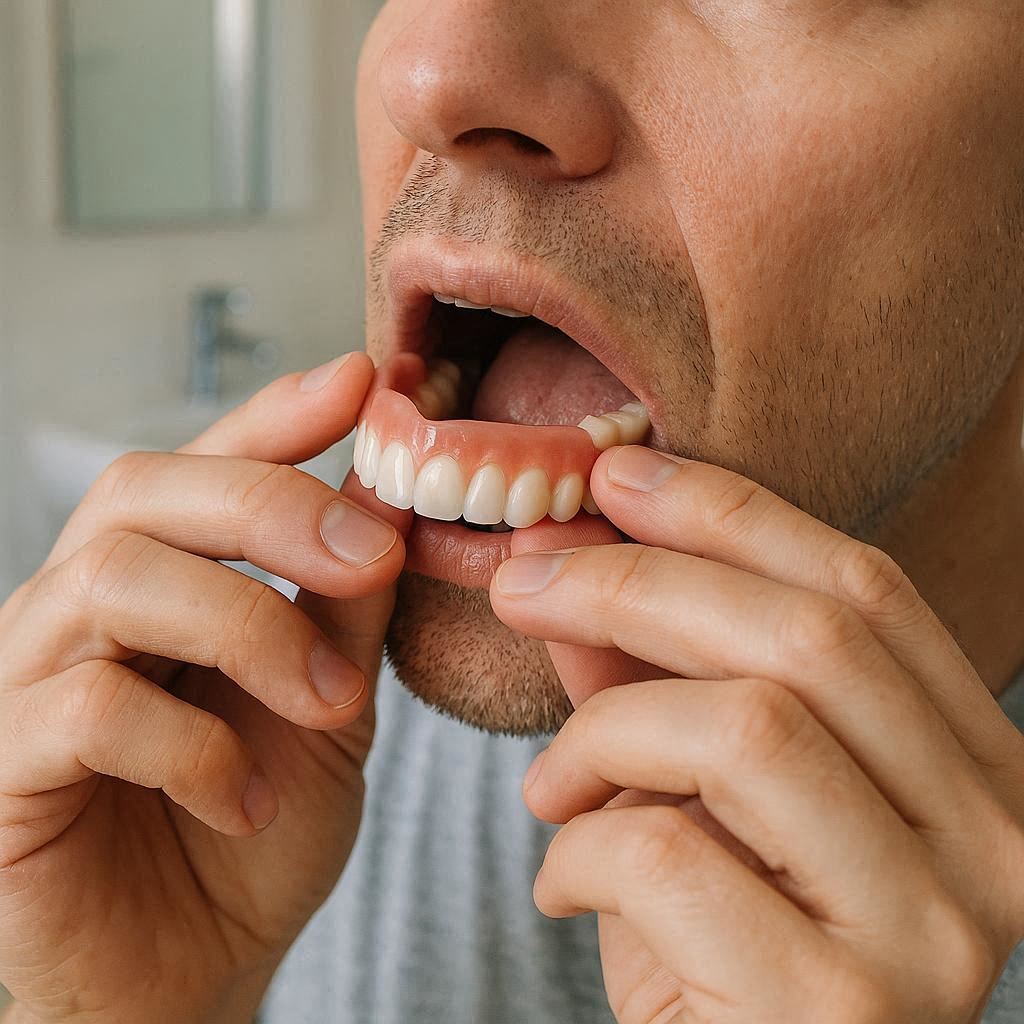
- Hold the denture between your thumb and fingers. Use your thumb on the front teeth and fingers on the back edges.
- Rinse it again with cold or lukewarm water. Cold water helps it feel crisper.
- Line it up with your natural gum line. The front teeth should sit where your natural teeth used to be.
- Press it into place using firm but gentle pressure. Start at the front and then press the back up toward the roof of your mouth.
- Bite down lightly and swallow. This helps push out extra air and secures the suction.
- Check the seal. Run your tongue along the back edge. It should feel snug but not painful.
Typical user quote:
“At first, I felt like my upper denture was going to drop. But after a few days, the suction got better as my gums healed.”
How to Put in Lower False Teeth (Full Denture)
The lower denture is trickier. The tongue and floor of the mouth move a lot, so there is less natural suction.
Step-by-Step Insertion
- Hold the lower denture with your thumb and index finger on both sides.
- Rinse it with cool water.
- Tilt it slightly so the back teeth go in first.
- Press down gently as you straighten it over your lower gum ridge.
- Use your tongue to help settle it. Push your tongue forward and slightly down.
- Close your mouth naturally and bite together softly.
- Check movement. If it rocks side to side, it may need a denture adhesive or a professional reline.
Using Denture Adhesive: Yes or No?
Many people ask: do I really need glue?
The honest answer: it depends.
When to Use Adhesive
| Situation | Adhesive helpful? |
|---|---|
| Well-fitting dentures | Rarely needed |
| New dentures (first month) | Sometimes for confidence |
| Lower dentures | Often helpful |
| Dry mouth (low saliva) | Yes |
| Eating in public (peace of mind) | Yes |
How to Apply Adhesive Correctly
Most beginners use too much. That causes oozing and a bad taste.
Cream adhesive steps:
- Apply small dots or a thin line along the denture.
- Do not put adhesive near the edges.
- For lower dentures, use 3 to 4 small dots.
- Rinse your mouth before inserting.
- Press denture in place and hold for 15 seconds.
- Do not eat or drink for 5 minutes.
Powder adhesive steps:
- Wet the denture slightly.
- Sprinkle a thin, even layer of powder.
- Tap off excess.
- Insert as usual.
Important warning: Never use household glue, superglue, or any product not made for dentures. This is dangerous and toxic.
How to Put in Partial False Teeth
Partials clip onto your remaining natural teeth. The process is similar but with extra attention to the clasps.
Correct Insertion for Partials
- Locate the clasps (metal or pink plastic hooks).
- Hold the partial at an angle.
- Hook the clasps around your natural teeth first.
- Press the false teeth section down into place.
- Check each clasp – it should not feel loose or dig into your gum.
- Try to wiggle it. A small amount of movement is normal. Large movement means a poor fit.
What to Avoid with Partials
- Biting down hard before clasps are seated
- Using adhesive on clasps
- Sleeping with partials in (increases decay risk under clasps)
Common Problems When Putting False Teeth In
Even when you follow all the steps, things can go wrong. Here is how to handle the most frequent issues.
The Denture Won’t Go All the Way In
Possible causes:
- Food or old adhesive on the denture or gums
- Swollen gum tissue
- Denture warped from hot water
What to do:
Rinse everything and try again. If it still won’t seat fully, see your dentist. Do not force it.
It Hurts When You Press
Possible causes:
- Sore spot from previous wear
- Sharp edge on the denture
- Gum infection
What to do:
Remove the denture immediately. Check for redness or white spots. Let your gums rest for a few hours. If pain continues, book a dental adjustment.
The Denture Falls Out When You Talk or Eat
Possible causes:
- Poor suction (especially lower)
- Too much saliva or too little
- Denture needs relining
What to do:
Try a denture adhesive first. If that does not help within a week, your denture likely needs professional relining. Do not live with loose dentures – they cause bone loss.
Gagging Sensation
This is very common for upper dentures. The back edge touches the soft palate.
Solutions:
- Give it 1 to 2 weeks – many people adapt
- Use a smaller amount of adhesive at the back
- Ask your dentist to shorten the back edge slightly
Note: If gagging continues beyond 3 weeks, a simple dental adjustment usually fixes it.
Step-by-Step: Removing False Teeth Safely
To put dentures in well, you also need to know how to take them out without breaking them.
Removing Upper Denture
- Rinse your mouth with warm water.
- Hook your thumb or fingernail under the back edge near the molars.
- Pull down gently and forward.
- Do not yank. Rock it side to side if needed.
Removing Lower Denture
- Place your thumb on the front teeth.
- Press down and outward toward your lip.
- Use your tongue to help push up from below.
Removing Partial Dentures
- Locate the clasp on each side.
- Use your fingernail to lift the clasp away from your natural tooth.
- Rock the partial out gently.
Never use:
Knives, forks, spoons, or tools to pry out dentures. They will crack.
Daily Routine for False Teeth Wearers
Consistency makes wearing false teeth easier. Here is a reliable daily plan.
Morning
| Step | Action |
|---|---|
| 1 | Rinse dentures under cool water |
| 2 | Brush gums and tongue |
| 3 | Apply adhesive (if used) |
| 4 | Insert dentures using the steps above |
| 5 | Wait 5 minutes before eating |
After Meals
- Remove dentures briefly if food gets trapped.
- Rinse mouth and dentures with water.
- Reinsert.
Evening
- Remove dentures over a sink filled with water or a soft towel.
- Brush dentures thoroughly with a soft brush.
- Soak dentures overnight in water or a cleaning solution.
- Brush your gums, tongue, and roof of mouth.
- Leave dentures out for at least 6 hours to let gums rest.
Critical point: Sleeping in false teeth every night raises your risk of pneumonia, gum inflammation, and bone loss. Take them out.
Troubleshooting Table: Quick Reference
| Problem | Likely cause | Easy fix |
|---|---|---|
| Sore spot on gum | High spot on denture | Dental adjustment |
| Clicking sound while talking | Denture too loose | Adhesive or reline |
| Bad taste | Old adhesive or poor cleaning | Deep clean denture and soak |
| Redness under denture | Fungal infection (stomatitis) | See dentist for antifungal |
| Dropping dentures while inserting | Too wet | Dry hands and denture edges |
| Difficulty swallowing | Overextended back edge | Dental trim needed |
How to Practice Putting False Teeth In
Skill improves with practice. Do not expect perfection on day one.
Daily Practice Drills
- Mirror practice – Insert and remove 3 times each morning.
- Speech drills – Read aloud for 5 minutes. Focus on words with S, F, and V sounds.
- Bite training – Practice biting on both sides at once. Many new wearers bite on one side, which pops the denture loose.
Realistic Expectations
- Week 1: Awkward, possible soreness, insertion takes 2 minutes
- Week 2: Easier, less salivation, insertion takes 1 minute
- Month 1: Natural, minimal discomfort, 15 seconds insertion
- Month 6: Second nature – you stop thinking about it
Denture Adhesives: Product Comparison
If you decide to use adhesive, here is how common types compare.
| Type | Pros | Cons | Best for |
|---|---|---|---|
| Cream | Strong hold, widely available | Can ooze, cleans off slowly | Lower dentures |
| Powder | No ooze, thin hold, easy cleaning | Less strong than cream | Upper dentures |
| Strips | No mess, pre-cut | Expensive, weaker hold | Travel or beginners |
| Cushions | Adds soft layer | Temporary (1 day), shifts easily | Sore spots |
Honest advice: Many people do not need adhesive at all with properly fitted dentures. Try without it first.
When to Avoid Putting False Teeth In
Sometimes the right choice is to leave them out.
Do not insert false teeth if:
- You have a sore, bleeding, or swollen spot on your gums
- You have a fever or mouth infection (thrush, cold sore)
- Your denture is cracked or has a sharp edge
- You just had oral surgery and your dentist said to keep them out
Healing comes first. Wearing dentures over damaged tissue makes things worse.
Long-Term Fit Changes (Why It Gets Harder to Put Dentures In)
Your mouth changes over time. This is normal but often overlooked.
What Happens Over Months and Years
- Bone resorption – Jawbone slowly shrinks where teeth are missing.
- Gum tissue changes – Becomes thinner or uneven.
- Denture base – Gradually warps from use and cleaning.
These changes mean the same denture that fit perfectly 2 years ago may now feel loose or hard to insert.
Signs Your Denture No Longer Fits Well
- You need more adhesive than before
- Denture rotates or rocks when you bite
- Food gets under the denture constantly
- You have recurring sore spots
Solution: Denture reline (soft or hard) or remake. Do not wait longer than 2 years between dental checkups for denture wearers.
Special Situations
Immediate Dentures (Right After Extractions)
These are placed the same day teeth are pulled. They will be loose very quickly as swelling goes down.
Insertion tips:
- Be very gentle – your gums are raw
- Use only dentist-approved adhesive (some forbid it for 2 weeks)
- Expect to need a soft reline within 3 to 6 months
One Denture (Upper Only or Lower Only)
If you have natural teeth on the other arch, your denture will feel more stable.
Insertion advice:
- Insert the denture before eating or sleeping
- Check how your natural teeth touch the denture teeth – they should meet evenly
Snapping Dentures (Implant-Retained)
These use locators or bars. Insertion is different.
How to put them in:
- Line up the denture with the implants.
- Press straight down firmly until you hear or feel a click.
- Do not rock side to side – this damages the attachments.
- Removal usually requires a special tool.
Cleaning Between Insertions
You do not always need a full cleaning. But you should never let food dry on dentures.
Quick Clean Before Reinsertion
- Rinse under running water.
- Use a soft cloth or paper towel to wipe off adhesive residue.
- For stubborn adhesive, use a denture wipe or brush gently.
Deep Clean Weekly
Soak dentures in a 50/50 white vinegar and water solution for 30 minutes (no metal parts). Then brush and rinse well. This removes calcium deposits and mild odors.
Frequently Asked Questions (FAQ)
1. Can I put false teeth in without adhesive?
Yes. Many people do. Adhesive is a helper, not a requirement. Well-fitting dentures stay in using suction and muscle control alone.
2. Why do my false teeth feel loose when I put them in?
Common reasons: swelling has gone down, bone loss over time, or the denture was never fitted perfectly. See your dentist for a reline or adjustment.
3. How long does it take to learn how to put false teeth in properly?
Most people feel confident within 2 weeks of daily practice. Full mastery (without looking in a mirror) takes about 4 to 6 weeks.
4. Can I sleep with my false teeth in?
No. You should remove them every night for at least 6 hours to let your gums rest and to prevent fungal infections.
5. What is the best way to put in lower false teeth?
Tilt the back in first, press down evenly, then use your tongue to push forward slightly. Adhesive is often helpful for lower dentures.
6. My false teeth hurt when I press them in. What should I do?
Remove them immediately. Check for red spots. Wait 24 hours before trying again. If pain returns, see your dentist – you likely need a pressure adjustment.
7. Can I use regular toothpaste on false teeth?
No. Most toothpastes are too abrasive and scratch the acrylic. Use a denture-specific cleanser or mild dish soap.
8. How do I put in partial dentures without breaking the clasps?
Always insert the clasp side first. Never force the partial into place by biting down. Use your fingers to seat the clasps gently around your natural teeth.
Additional Resource
For more trusted information on denture care, adjustments, and finding affordable dental care, visit:
Colgate’s Denture Care Guide – Free, expert-reviewed articles on insertion, cleaning, and troubleshooting.
Conclusion
Putting in false teeth correctly is a skill you build over a few weeks. Clean your dentures and mouth first. Press upper dentures straight up for suction. Tilt lower dentures in at the back. Use adhesive only when needed. Take them out every night. If insertion ever hurts or feels impossible, see your dentist – do not force it.
Disclaimer:
This article is for informational purposes only and does not constitute medical or dental advice. Individual needs vary. Always consult a licensed dentist for diagnosis, treatment, or adjustments related to your false teeth. Never modify your dentures at home with tools, glues, or adhesives not specifically approved for dental use.