Clear Aligners Beyond Invisalign
We need to talk about a common misconception. When most people think about straightening their teeth with invisible trays, one brand name immediately jumps to mind. It has become the generic term for the entire category, much like people say “Kleenex” instead of tissue. But the world of orthodontics has evolved dramatically. The market is now rich with alternatives that often provide better technology, lower costs, or specialized treatments that the famous brand simply does not offer.
If you are researching how to achieve a straighter smile without a mouth full of metal, you have landed in the right place. Sticking solely with the default, most-advertised option might mean leaving money on the table or missing out on a faster treatment plan. This guide explores the full universe of Clear Aligners Beyond Invisalign.
We will strip away the marketing hype. We will look at the clinical differences, the cost structures, and the ideal patient for each system. By the end of this comprehensive guide, you will understand the distinct advantages hiding in a competitive market. You will have the knowledge to choose a treatment that aligns perfectly with your dental needs, lifestyle, and budget.
The Changing Landscape of Modern Orthodontics
Orthodontic treatment has undergone a seismic shift in the last five years. The days when metal braces were the only rite of passage for teenagers are fading. Adults now make up a massive portion of the teeth-straightening market. These adults demand discretion, comfort, and speed.
Why the Monopoly Is Ending
The original pioneer in the clear aligner space held patents that prevented competition for years. Those key patents expired in 2017. The floodgates opened. Material science companies began selling advanced multilayer plastic sheets to anyone who wanted to manufacture aligners. This shift democratized the industry.
You now have dozens of manufacturers producing high-quality medical-grade trays. Competition drove innovation. While the household name brand focused on mass-market marketing, smaller labs focused on material thickness, gingival trimming, and AI-powered treatment planning. The patient wins when companies compete for your attention.
The Rise of Direct-to-Consumer Models
Perhaps the biggest disruption came not from new plastics, but from new business models. The direct-to-consumer (DTC) industry removed the orthodontist’s office visit from the equation. Companies started shipping impression kits directly to your door. You make a mold of your teeth, send it back, and receive a full course of aligners in the mail.
This model drastically reduced the price point. Suddenly, mild to moderate cases could access treatment for a fraction of the traditional cost. This model is not perfect—we will discuss its risks in detail—but it undeniably opened the door for millions who could not afford the $6,000 price tag of traditional treatment.
Material Innovation Driving Change
We must understand the “plastic” that moves your teeth. Early aligners relied on single-layer materials. They stained easily and delivered inconsistent force. Today’s leading alternatives often use triple-layer materials. Zendura FLX, for example, offers a hard inner core for predictable force sandwiched between soft outer layers for comfort.
The plastic matters more than the brand name printed on the box. Many orthodontists now argue that specific material platforms outperform the legacy brand’s proprietary “SmartTrack” material in terms of force retention over a two-week wear cycle. This means your teeth move more predictably, reducing the dreaded “tracking” errors where a tooth stops fitting into the tray.
Comprehensive Comparison of Leading Provider Categories
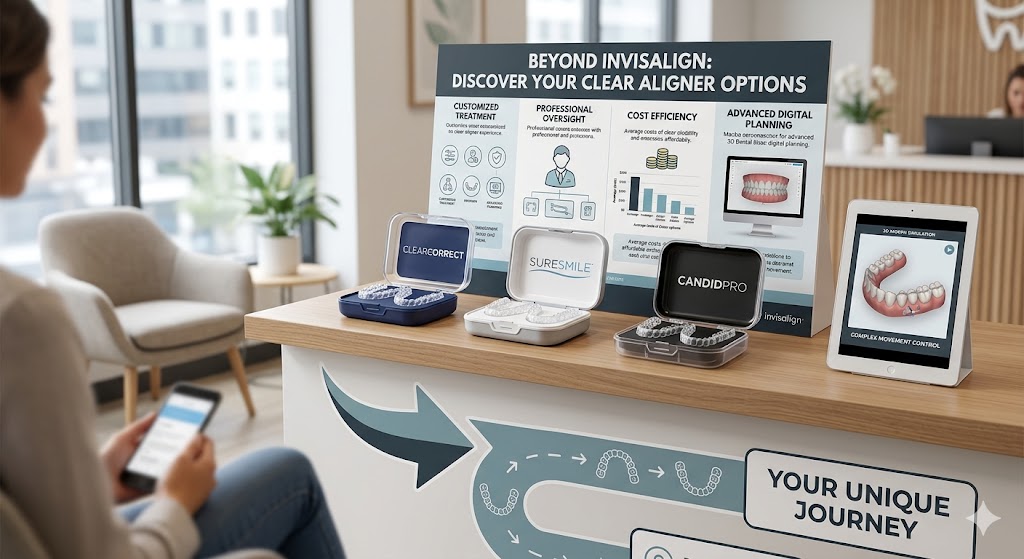
To understand your choices, we must segment the market. We generally see four categories: Premium In-Office, Affordable In-Office, Hybrid Monitoring, and Direct-to-Consumer. Each serves a different demographic and clinical need.
Premium In-Office Solutions
These are the orthodontist-supervised systems that compete directly with the dominant brand on a clinical level. They are not the “cheap” option. They represent the pinnacle of custom dentistry.
Spark Clear Aligners
Spark has rapidly emerged as the arch-rival in orthodontic offices. They are manufactured by Ormco, a company with decades of experience in braces. The most striking difference you will notice with Spark is the clarity. They use a material called TruGEN, which resists clouding better than almost any other plastic on the market.
Orthodontists often prefer Spark for complex cases. The plastic is designed to reflect less light. This means when you take a selfie, you don’t get that glossy, artificial plastic sheen that screams “I’m wearing a retainer.” The scalloped gingival edges are also laser-trimmed with extreme precision. This creates a smoother, less irritating margin against your gums compared to trays cut by dull mechanical bits.
Key Feature: Integrated hooks for rubber bands do not require unsightly metal attachments glued to the canine teeth in many cases. The plastic itself is cut to hold the band.
3M Clarity Aligners
3M is a giant in material science. They entered the aligner market with a very specific clinical philosophy. They focus heavily on the force system, not just the aesthetics. Their system uses two distinct materials in a single treatment plan. One material offers gentle, continuous force. The other offers high, intermitted force for difficult movements.
You might start with one plastic type in tray one and switch to a second type in tray ten. The lab analyzes exactly what each tooth needs at each stage. They also treat the aligner surface at a microscopic level to increase the friction grip on the tooth, reducing the need for large, visible attachments (bumps glued to your teeth). For a patient with a history of short roots or gum recession, the controlled force system offered by 3M is a significant safety advantage.
Key Feature: The force-based prescription system is unique, treating the root of the tooth, not just the crown.
ClearCorrect
ClearCorrect was one of the first competitors to appear. They position themselves as a flexible, doctor-friendly option with a variety of product tiers. You can choose from “Flex,” which is a traditional two-week wear schedule, or “Unlimited,” which offers a specific number of refinement phases.
The recent version of ClearCorrect, the “Ultra” material, is a significant upgrade. It feels more rigid than the earlier versions, which were sometimes criticized for being too soft and losing grip quickly. The aesthetic is high, with a frosted interior texture that masks the appearance of saliva bubbles getting trapped behind the plastic.
Key Feature: They offer a “Go” model that treats minor relapse in as few as 12 stages, making it a quick, cost-effective fix for someone whose teeth shifted after previous braces.
Here is a quick reference for the premium in-office segment:
| Feature | Spark (Ormco) | 3M Clarity | ClearCorrect |
|---|---|---|---|
| Material | TruGEN (Multi-layer) | Dual-material platform | ClearCorrect Ultra |
| Clarity | Extremely High (Low Refractive Index) | High | High (Frosted surface) |
| Trim Accuracy | Laser-cut, scalloped | Laser-marked, straight cut | Hand-finished scalloped |
| Ideal For | Complex aesthetic demands | Biologically compromised cases | General comprehensive treatment |
| Typical Cost | $4,000 – $7,000 | $4,500 – $7,000 | $3,500 – $6,000 |
The At-Home Revolution: Convenience vs. Control
The following segment of the market specifically addresses Clear Aligners Beyond Invisalign that do not require a monthly trip to the orthodontist. These are the remote-monitored or fully direct-to-consumer models. They generate the most controversy in dentistry. Let’s cut through the noise to see who they actually serve.
CandidPro: The Hybrid Gold Standard
CandidPro represents the middle ground. You never buy CandidPro yourself; an orthodontist must diagnose you. The twist? You do not visit that orthodontist every month. You scan your teeth using a highly advanced smartphone device that attaches to your phone.
CandidPro uses proprietary software that reconstructs your 3D mouth model from smartphone photos. It tracks movement remotely. Your doctor reviews your progress in the cloud and pushes the “go” button for the next tray only if things look perfect. This is the ideal solution for the disciplined adult. You get specialist oversight without the commute. The aligner material is a high-quality, medical-grade polyester that is BPA-free and manufactured in the U.S.
Why choose it? It cuts the cost of traditional orthodontic monitoring by about 30%, yet you remain under a doctor’s care.
Byte: The Speed and Lifetime Guarantee
Byte has positioned itself as the “hyper-speed” company. Their selling proposition relies on High-Frequency Vibration (HFV). They ship a device called the HyperByte, a vibrating mouthpiece that you bite down on for five minutes a day. The clinical theory suggests that vibrations accelerate bone remodeling, letting you switch trays every 7 days instead of 14.
This is attractive if you have a wedding or event coming up. The treatment times are often estimated at 3-4 months for mild cases. Byte also famously offers a “Byte for Life” guarantee. If your teeth shift later, they provide additional treatment at no cost, provided you have purchased their retainers. This safety net resonates deeply with people worried about relapse.
The Risk: The speed can be aggressive. You must adhere to the vibration therapy. Without strict compliance, the fast switching can theoretically harm root health. Byte is best for simple crowding of the front six teeth.
SmileDirectClub: A Cautionary Tale
We must address the elephant in the room—or rather, the elephant that left the room. SmileDirectClub shut down operations in late 2023. If you are reading this, you might encounter old referral links or positive reviews. Do not attempt to purchase from them. The closure left many customers without clinical support or retainers.
The SmileDirectClub saga serves as the industry’s warning. The model relied on no supervision whatsoever. The bankruptcy highlights the vulnerability of consumer healthcare without medical oversight. If a company in the “clear aligners beyond Invisalign” space has no physical address for a licensed doctor in your state, proceed with extreme caution.
Innovative Niche Players Changing the Game
Beyond the massive in-office labs and the generic at-home models lies a fascinating layer of niche innovators. These companies address specific problems the big guys have ignored.
InBrace: The Invisible Wire
Technically, InBrace falls into the “lingual” category, but it deserves a mention because it competes directly for the “invisible” patient. Instead of removable trays, InBrace uses a custom smart-wire cemented to the back surface of your teeth. You never take anything in or out. The wire is programmed using nitinol’s shape-memory properties.
If you lack the discipline to wear trays for 22 hours a day, InBrace solves that compliance issue instantly. It works 24/7. You eat whatever you want. While the cost is higher (often $7,000 to $9,000), it represents the ultimate “clear aligner” escape hatch. You get the aesthetics of a tray without the responsibility.
Reveal: Printed vs. Pressed
Most aligners are “thermoformed,” meaning a machine presses hot plastic over a 3D-printed model of your teeth. Reveal does the opposite. They use direct 3D printing of aligners using a resin approved for long-term mucosal contact. This skips the stone model stage entirely, eliminating a source of potential dimensional error.
The result is a thinner, more precise wall thickness. Reveal can also print “gradient thickness.” An area needing more root torque can be printed slightly thicker, while non-moving areas remain thin and comfortable. This is a massive paradigm shift that rivals the legacy methods.
LightForce: 3D-Printed Brackets
Let’s include a wildcard. If clear aligners cannot fix your case, you might default to braces. LightForce makes 3D-printed ceramic brackets. They match your tooth color exactly. More importantly, each bracket is designed to fit the exact contour of your specific tooth. This eliminates the guesswork of the orthodontist’s initial bracket placement.
It is a “best of both worlds” scenario for severe surgical cases. You get the efficiency of fixed braces with a visual appearance far superior to metal. It is not a tray, but it is the direct technological relative of the “beyond Invisalign” movement in digital customization.
| Niche System | Type | Unique Technology | Best Patient Profile |
|---|---|---|---|
| InBrace | Lingual Fixed | Programmed Nitinol wire | Non-compliant teens/adults |
| Reveal | Printed Aligner | Direct 3D resin printing | Tech-enthusiasts, complex torque needs |
| LightForce | Custom Ceramic Braces | 3D-printed tooth-specific brackets | Surgical, severe malocclusion |
| uLab | In-Office Platform | Doctor-controlled planning software | Patients wanting fast, same-day starts |
The Cost Matrix: What You Actually Pay
The primary driver for exploring options beyond the market leader is cost. However, the sticker price is deceptive. We need to break down the Total Treatment Value.
Insurance and FSA/HSA Integration
Most premium alternatives work with standard dental insurance. If your plan covers “orthodontics,” it covers Spark or 3M just as it would the mainstream brand. The coding is identical (D8090 for comprehensive). However, hybrid models like CandidPro might be coded differently or processed out-of-network, potentially lowering your reimbursement.
Always verify with the provider if they are in-network with Delta Dental, MetLife, Cigna, or your specific carrier. In-office providers usually handle the billing for you. With a DTC model, you pay upfront and fight for reimbursement yourself with a superbill.
The Hidden Cost of “Free” Refinements
Premium in-office labs offer unlimited refinement phases within a set time frame. If your teeth stop tracking at tray 14 of 20, the doctor takes a new scan and orders “mid-course correction” trays. This is free.
Some lower-cost remote companies charge for these “revision” trays. Or they limit you to one revision. If you need a second round of tweaks, you pay a fee of $200-$400. This rarely gets mentioned in the shiny Instagram ads. Ask directly: “If my teeth don’t move as predicted, how many refinement sets do I get for the initial price?”
Value Comparison Table
Here is a realistic average cost comparison for a 6-month moderate case in the United States.
| Provider Category | Avg. Total Cost (Before Insurance) | Monitoring Type | Retention Guarantee? |
|---|---|---|---|
| Traditional Market Leader | $5,500 – $6,800 | In-office (Monthly) | Yes (Doctor-driven) |
| Premium Alternative (Spark/3M) | $4,500 – $6,500 | In-office (Bi-monthly) | Yes (Doctor-driven) |
| Hybrid (CandidPro) | $3,500 – $4,500 | Remote (Doctor-reviewed) | Varies by provider |
| Fast DTC (Byte) | $1,899 – $2,299 | Remote (AI/Algorithm) | Lifetime (if you buy retainers) |
| Budget DTC (AlignerCo) | $945 – $1,200 | None (Photo uploads) | Limited warranty |
Important Note: The “Budget DTC” tier often works on a “nighttime only” model for some brands. Clinical evidence supporting the efficacy of night-only wear for complex movements is still weak. Opting for 10 hours of night wear versus 22 hours of full-time wear drastically reduces the force stimulus on the periodontal ligament. Treat night-only plans with skepticism unless your case is very minor.
Clinical Screening: Are You a Good Candidate?
This is the most vital section of this guide. Your anatomical limitations dictate your choice more than your wallet does. Not every alternative can safely treat you.
The Complexity Spectrum
Orthodontists use the Peer Assessment Rating (PAR) index or the American Board of Orthodontics (ABO) discrepancy index. However, you can visually assess your complexity.
Mild Cases (Ideal for most alternatives):
- Minor crowding (1-3mm) of front teeth.
- Relapse after previous braces with one or two rotated teeth.
- Small gaps (diastemas) between front teeth.
Moderate Cases (Require skilled doctors):
- Spacing greater than 4mm requiring significant bodily movement.
- Moderate crowding requiring Interproximal Reduction (IPR)—stripping a tiny bit of enamel to create space.
- Mild bite issues (shallow overbite).
Severe Cases (Stick to premium in-office solutions):
- Severe overbite or open bite requiring bite ramps and elastics.
- Molar movement or extraction space closure.
- Severe rotations of bicuspids. Round teeth are notoriously hard to grip with plastic.
The “Doctor-Led” Safety Net
The core difference between a $6,000 Spark treatment and a $1,500 mail-order kit is the safety net of a professional physical examination. A doctor takes X-rays. Those X-rays reveal bone levels, impacted teeth, or root resorption that absolutely prohibits tooth movement.
If you engage a direct-to-consumer company and skip the doctor visit, you assume the risk of moving teeth into diseased bone. The tragic cases of tooth loss, while rare, almost always involve an undiagnosed underlying condition that a radiograph would have caught.
“I get a lot of patients coming in for a second opinion after starting mail-order aligners. They think it’s not tracking. A quick pano shows a severely dilacerated root. That tooth was never going to move with plastic. But nobody looked before they took the money.” — A common sentiment among practicing orthodontists.
Gum Recession and Attachment Loss
If your gums have receded, making your teeth look “long,” you have less bone support. Applying standard orthodontic force can cause rapid recession and bone loss. The high-tech alternatives like 3M Clarity have specific protocols to move these teeth slowly, using half the standard force.
If you have visible “black triangles” (lack of gum tissue between teeth) already, IPR done by a skilled doctor can reduce these. A mail-order aligner cannot perform IPR, nor can it manage the biology of blunted root apices.
Material Safety and Biocompatibility
You will wear these pieces of plastic in a warm, moist, enzyme-rich environment for over 5,000 hours (assuming 12 months of wear). The chemical makeup of the tray matters.
BPA, PET-G, and Polyurethane
Many generic aligners use PET-G (the same polyester used in water bottles). It is generally safe and BPA-free. The premium alternatives often use medical-grade polyurethane with multilayer co-extruded shells.
- Zendura FLX (Used by many in-office labs): An outer layer of soft thermoplastic polyurethane (TPU) and a hard TPU core. The soft outer layer provides seating compliance; the hard core provides spring back force.
- Essix Pro (Professional retainers): This is PET-G with a high-glass transition temperature, resisting distortion in hot cars.
- Direct 3D-Printed Resins (Reveal, InBrace trays): This is a newer frontier. Ensure the resin is classified as a Class II biocompatible medical device with ISO 10993 certification for cytotoxicity, sensitization, and irritation.
The Latex and Glove Connection
It sounds trivial, but ask your doctor what gloves they use when handling your impressions or intraoral scans. If you have a latex allergy and a technician powdered the mold with latex gloves, the protein can transfer to the aligner. The majority of labs are latex-free, but it is a life-threatening detail worth verifying if you have severe allergies.
The Treatment Timeline: Fast vs. Safe
Speed sells. The promise of “4-month smile transformation” is powerful. We must differentiate between biological speed and marketing speed.
The Biology of Tooth Movement
Teeth move through bone remodeling. Osteoclasts break down the bone on the pressure side, and osteoblasts build it on the tension side. This biological process has a physiological limit. Pushing a tooth faster than 0.25mm to 0.3mm per month risks cutting off the blood supply inside the tooth (pulpal necrosis) or eating away the root tip.
Vibration Therapy: Fact or Fiction?
Byte’s HyperByte and similar devices (VPro, Acceledent) claim to accelerate the cellular response. Clinical literature on vibrational therapy is mixed. Some studies show a 30-50% increase in the rate of tooth movement. Other meta-analyses show negligible difference when placebo is controlled for. The mechanics work like this: vibration increases RANKL expression, which triggers the cells that eat bone.
However, the true advantage might be compliance. A vibrating device forces you to bite down on the tray, fully seating it for five minutes daily. This “seating” step drastically improves tracking. Was it the vibration or the perfect seating that moved the tooth? For the patient, the result is all that matters, but don’t assume a 4-month plan via vibration is biologically safer than a 12-month plan without it.
Aligner Change Frequency
- 14-Day Changes: The old-school standard. Conservative, safe, wide margin for error.
- 7-Day Changes: Current standard for rigid premium materials. Requires full compliance.
- 5-Day Changes: Used by Spark with “Stage 3” material in very healthy bone.
- 3-4 Day Changes: Experimental and risky for adults. Often seen in hard-sell marketing.
Navigating the At-Home Impression Process
If you go with a remote alternative, the treatment’s success depends entirely on the quality of the initial impression or scan.
PVS Putty vs. Phone Scanning
The classic method involves mixing two putties, filling a tray, and biting hard for 3.5 minutes. The margin for error is massive. If you gag, flinch, or remove the tray a second too early, the molar detail blurs. The lab guesses the bite, and the distal molars might not fit.
Newer hybrid models (Candid, byte) have moved almost entirely to smartphone scanning apps. An AI guides your phone’s camera around your mouth using the TrueDepth sensor. This achieves a full 3D model without choking on silicone. This is the most patient-friendly evolution in the industry.
Tips for perfect at-home impressions:
- Read the instructions three times before mixing the putty.
- Set a timer on your phone with an alarm; 3 minutes feels like 20 when your jaw is clenched on plastic.
- Take flash photos of your bite from multiple angles (front, right, left). If the lab sees the photos, they can catch a false bite registration.
- Do the impressions early in the morning before any jaw fatigue sets in.
The Refinement Phase: What Happens When Things Go Wrong
Nobody’s teeth move exactly to the computer simulation. The “tracking” rate (how perfectly your teeth follow the 3D forecast) is approximately 70-80% for even the best systems. The remaining percentage requires a mid-course correction.
Traditional “In-Office” Refinements
If you use a premium alternative dispensed by a local orthodontist, a refinement is seamless. You walk in, the doctor scans you with an iTero or Medit scanner, and selects “Mid-Course Correction” from the portal. New trays arrive in two weeks. You continue wearing your last fitting tray until the new box arrives.
The “Remote” Refinement Bottleneck
This is the friction point for DTC companies. If your scan shows a gap on tooth 10, the AI flags it. A remote dentist adjusts the plan. You wait 4-6 weeks for new trays. During this wait, you might be wearing a tray that doesn’t fit perfectly, which can allow unwanted drifting.
Pro Tip: Before signing up for any remote plan, check the average turnaround time for refinement aligners on community forums. A company with a 3-week production delay causes lost progress, whereas a company with a local 3D-printing hub might turn it around in days.
Retention: The Forever Battle
Congratulations, you finished the last tray. The orthodontic wires in your mouth have relaxed. But the gingival elastic fibers want to pull the teeth right back to where they were. Retention is the unspoken half of the treatment.
Vivera vs. Essix vs. Hawley
The market leader sells Vivera retainers (a three-pack of ultra-dense polyurethane). The alternatives offer different paths:
- Essix Plus: A low-cost, durable PET-G retainer. Excellent clarity, very thin, but can fracture if you grind your teeth.
- Vacuform Zendura: Offers a dual-material retainer. The outside is impact-resistant; the inside is soft. This is the premium choice for severe night grinders.
- Bonded Lingual Retainers: Many orthodontists using 3M or Spark will place a permanent, small twisted wire behind the front six teeth. This is the only way to truly guarantee zero relapse in the front teeth. You must floss them with threaders, but you never “forget” to wear them.
The “For Life” Pledge
We mentioned Byte’s “For Life” promise. It is a brilliant marketing tool. However, the fine print usually requires you to purchase a paid set of retainers every six months to maintain the “active” warranty. If you skip a retainer order, the warranty evaporates. Factor this recurring cost into the lifetime value equation. A single pair of in-house Essix retainers can last 2-3 years, whereas the subscription model requires continuous small payments.
Psychological and Lifestyle Factors
Choosing between these options is rarely a purely clinical or financial decision. It deeply intertwines with your personality.
The Discipline Spectrum
If you have ADHD or a chaotic schedule, a removable tray system can be a nightmare. You will leave them in a napkin at a restaurant. The “invisible” treatment will fail because you cannot maintain the wear schedule.
In such cases, looking beyond plastic to something fixed (InBrace or ceramic braces) becomes a mental health benefit. You pay more, but you remove the daily guilt of non-compliance. “Clear Aligners” do not always mean “removable,” and that pivot can save your treatment.
Social and Professional Aesthetics
One major advantage of the niche alternatives is the treatment of attachments. The dominant brand has a standard protocol for “optimized attachments”—large, rectangular bumps. 3M specifically designs smaller, beveled attachments that blend with the curvature of the tooth.
If you are a salesperson, a violinist, or a performer, the shape and number of attachments matter. Ask to see a mock-up of your teeth with attachments before paying. Sometimes, a doctor can use a specific brand (like uLab’s proprietary software) to minimize attachment visibility by moving the anchor geometry to the lingual side.
Geographic Availability and Global Access
Your zip code drastically limits or expands your options.
The U.S. Market Saturation
In the U.S., all premium alternatives (Spark, 3M, ClearCorrect) are widely distributed. Finding a doctor is easy. uLab allows your specific doctor to design the entire treatment in-house, bypassing an external lab schedule. This “chairside” manufacturing capability means you can get started on a limited number of “starter trays” on the same day as your scan. This is currently unique to the uLab platform.
Europe and APAC Options
If you are reading this from Canada, Australia, or the UK, the brand landscape shifts.
- Angel Align: A giant in the Chinese and Asia-Pacific market. Massive volume, very similar clinical approach, and a strong digital platform.
- SureSmile (Dentsply Sirona): Very popular in Europe. It is a software-centric platform that supports various materials, giving the doctor immense freedom in planning IPR, elastics cuts, and staging.
- Eon Dental (AimClear): Often the white-label supplier behind many DTC brands globally. It provides a solid clinical backend.
The Digital Platform: AI and Treatment Planning
We must talk about the software. The hardware (the plastic) is just a dumb delivery mechanism for a brilliant treatment plan.
Open vs. Closed Platforms
The household name uses a closed platform. The software dictates where the tooth goes. The doctor can tweak it but fundamentally operates within the software’s boundaries.
uLab and 3M use a more open, doctor-centric platform. An orthodontist can literally drag a tooth root and pivot it on its long axis, sequencing movements in a way that a proprietary algorithm might not allow. This is critical for finishing cases to a premium standard. If you have a picky, perfectionist orthodontist, they likely prefer an open platform where they control the torque of the lateral incisors to the precise degree.
AI in Remote Monitoring
DentalMonitoring is a third-party software merging with the “beyond Invisalign” world. It is the AI that powers many remote DTC and hybrid models. You take a scan with your phone, and the AI analyzes 150+ intraoral photos, checking for plaque, tracking, and gingival health. It is not just looking at tooth position; it is flagging if you are not brushing well enough, potentially saving you from white spot lesions (decalcification) post-treatment.
Choosing Based on Your Specific Dental Condition
Let’s get granular. We will match conditions directly to the most appropriate technology.
The Open Bite Case
Anterior open bite (front teeth don’t touch) is challenging. Tray systems tend to extrude posterior teeth, which can make the bite worse if not controlled. You need posterior bite ramps or intrusion TADs (Temporary Anchorage Devices).
Top pick: Spark. The material’s stiffness allows for effective molar intrusion when combined with mini-screws, a technique borrowed from their sister company that produces TADs.
The Deep Bite Case
You require bite ramps—shelves of plastic behind the front teeth that force the lower teeth to bite forward, leveling the curve. The plastic here gets chewed up and worn down.
Top pick: 3M Clarity. The abrasion-resistant surface modification prevents the bite ramp from wearing smooth before the week is over, maintaining the vertical opening.
The Severe Rotation
To rotate a round bicuspid, you need a “force couple.” The plastic must grip the tooth tightly. This often requires a large, rectangular attachment. Cheaper plastics “blow out” or stretch over the attachment, losing grip by day three.
Top pick: ClearCorrect Ultra or 3M. The modulus of elasticity is high. The aligner snaps tightly over the horizontal bevel of the attachment and doesn’t stress-relax too quickly.
The Importance of a Good Orthodontist Over a Good Brand
This is the uncomfortable truth the internet often ignores. An exceptional orthodontist using a budget lab will achieve a better result than a mediocre one using the most expensive lab.
The “Pilot” Analogy
Think of the aligner brand as the airplane. A Boeing 787 is a beautiful machine, but it cannot save you if the pilot doesn’t know how to fly a holding pattern. A skilled pilot can safely land a rusty Cessna. Your orthodontist is the pilot. The teeth are the terrain.
Find the doctor first. Ask them: “Why do you prefer this particular aligner system over the famous one?” A good answer involves “torque control,” “material creep,” or “lab communication.” A bad answer is “it’s cheaper.” You want a doctor who chose their tool for clinical reasons, not purely economic ones.
Red Flags in Consultations
- The doctor promises an exact end date without reviewing X-rays.
- They offer a discount for paying cash that day without a written treatment plan.
- They dismiss your concerns about tooth roots or black triangles.
- The scan shows a gross simulation result, and they say, “The lab will figure it out.”
Financial Options and Risk Assessment
Financing vs. Pay-in-Full Discounts
Nearly all these services accept CareCredit or similar medical financing. Many offer 0% APR for 12-24 months. However, if you have the cash, you can often negotiate a 5-10% “cash discount” with the private orthodontic practice, as they avoid credit card merchant fees.
The Risk of Start-Up Labs
New “clear aligner beyond Invisalign” start-ups pop up yearly, often advertised heavily on TikTok. They offer a flat fee of $599. They look identical to Byte or Candid. The risk lies in continuity of care. If they go bankrupt in month 4 of your 8-month treatment, your digital file is often locked, and a local orthodontist cannot access it. You would have to pay for a full new case from scratch. Stick with established labs that have survived the initial market correction (the post-SmileDirectClub fallout).
Table of Direct Competitor Features
| System | Material | Wear Schedule | Unique Tech | Price Indicator |
|---|---|---|---|---|
| Spark | TruGEN (Multi-layer) | 7 days | Integrated Elastic Hooks | $$$$ |
| 3M Clarity | Dual-material platform | 7-10 days | Surface texture tech | $$$$ |
| ClearCorrect | Ultra/Zendura | 7-14 days | Unlimited phase plans | $$$ |
| CandidPro | Medical-grade copolyester | 7 days | CandidMonitoring App | $$$ |
| Byte | Clear, BPA-free polymer | 7 days (with HyperByte) | HyperByte Vibration | $$ |
| uLab | uAssist software suite | 7 days | Same-Day Starter Trays | $$$$ |
| SureSmile | Varies (Doctor choice) | 7-14 days | Open digital platform | $$$$ |
| Reveal | Direct 3D-printed resin | 7-10 days | Gradient thickness walls | $$$$ |
Redefining the Patient Experience
Let’s look beyond the plastic. The ancillary experience of using these alternatives often surpasses the household name in specific ways.
Packaging and First Impressions
Some budget alternatives arrive in a stark, medical brown box. The premium alternative Spark invests heavily in the unboxing experience. They provide slim, mirror-like cases, custom-designed retrieval hooks for removing tight trays, and durable packaging that withstands a handbag.
This sounds superficial, but the “luxury” signal psychologically increases the perceived value of the medical device, which studies show correlates with better compliance. If you feel you are holding a premium medical device, you are more likely to brush it and wear it properly.
Slack and Communication Channels
Many modern orthodontics start-ups using the hybrid model (CandidPro associated practices) allow you to text your doctor via a HIPAA-compliant app. You send a photo: “Is this tracking?” You receive an answer in 4 hours. This is a stark contrast to the traditional model where you wait 6 weeks for a 10-minute chairside check. If your time is your most valuable asset, the communication efficiency of the hybrid model destroys the legacy model.
Addressing the “Clear Aligners Beyond Invisalign” Stigma
There is sometimes a stigma that if you don’t use the famous brand, you are using an “off-brand” or “generic” product. This is wildly inaccurate and often propagated by the famous brand’s massive marketing budget.
The “Generic Drug” Analogy
Generic drugs must undergo rigorous testing to prove they are bioequivalent to the brand-name drug. Similarly, Zendura FLX plastic and SmartTrack plastic are both FDA-cleared, biocompatible medical materials. One did not copy the other; they are different chemical formulations seeking the same mechanical outcome.
In fact, many independent material scientists prefer the force-transmission characteristics of the triple-layer plastics for specific cases. Being “beyond” the famous brand often means accessing superior material science, not a knock-off.
The Role of Interproximal Reduction (IPR)
A quick, essential note on creating space. IPR means polishing a fraction of a millimeter of enamel between teeth.
Manual Files vs. Mechanical Systems
In-office alternatives empower the doctor to use precise mechanical strip systems. DTC models avoid IPR entirely because a patient cannot do it themselves. If you have triangular teeth or “black triangles,” IPR is a cosmetic necessity to create a flat, tight contact point. No mail-order tray can physically close a black triangle if the tooth shape is triangular at the base.
The Protocol: 3M system integrates IPR into their software so precisely that the contact between the teeth before and after the filing is mathematically calculated down to 0.1mm. This prevents the doctor from accidentally creating “gross space” that traps food.
Summary of the 2026 Aligner Landscape
The clear aligner market has matured. The “household name” has become the safe, predictable, and expensive default. The true innovation is happening in the margins. 3D-printed aligners. Shape-memory lingual wires. AI-driven remote monitoring that flags pathology before a doctor sees it. Bi-phasic force regimes.
Your journey doesn’t begin with a brand name. It begins with an honest assessment of your case severity, a radiographic screening of your root health, and a realistic budget. The best treatment is the one you actually complete. Compliance wanes if you can’t afford retainers or if the plastic is so uncomfortable you leave it in the box. Often, a $3,000 hybrid solution worn with pride because of its sleek design yields a better outcome than a $7,000 premium plan that creates financial stress.
Building Your Shortlist: A Decision Tree
Here is a logical flow to narrow down the sea of options in the world of clear aligners beyond Invisalign.
- Do you have a complex bite issue (crossbite, jaw pain, surgery needed)?
- Yes: Disregard mail-order. Interview an orthodontist who offers Spark, 3M, or LightForce ceramic braces.
- No: Proceed to question 2.
- Do you struggle with daily habits or discipline?
- Yes: Investigate fixed lingual options (InBrace) or custom braces. Skip removable trays entirely.
- No: Proceed to question 3.
- Is budget the primary constraint?
- Yes: Hybrid models (CandidPro) offer the best safety-to-cost ratio. Avoid the cheapest DTC ($<1,000) unless you have received a physical X-ray from a dentist confirming bone health.
- No: Choose your premium in-office alternative based on the doctor’s preferred platform. Trust their diagnostic expertise.
- Do you need speed for an event?
- Yes: Discuss Byte’s HyperByte protocol with a supervising dentist, or investigate a limited 6-tooth smile-arch treatment with any premium provider. Understand the biological trade-offs.
- No: Standard 7-10 day changes with a rigid triple-layer material offer the smoothest, least painful experience.
Testimonials and Psychological Outcomes
We rarely discuss the psychological transformation of leaving the legacy brand.
Sarah, 34, Marketing Director: “I went with 3M Clarity because my orthodontist showed me the attachment design. My colleague had the famous brand and huge squares on her canines. My attachments are tiny triangles. Nobody noticed I was in treatment, even with macro photography for our brand shoots.”
James, 28, Software Engineer: “I used CandidPro remotely. My ortho was 200 miles away. I never missed a scan. The software actually caught a tiny bit of gum inflammation and told me to waterpik more. It felt like a health app, not a medical chore.”
Elena, 45, Teacher: *”Byte’s HyperByte actually really hurt my jaw joint. I stopped using the vibration but kept wearing the trays on a 10-day cycle instead of 7. I finished late, but safely. The lifetime guarantee sold me because I refuse to let my teeth shift back.”*
These stories highlight that the “perfect” system is an interplay between biology, technology, and personality. An anxious, detail-oriented patient might love the constant feedback of AI monitoring. A free-spirited artist might hate it and do better with a low-intervention, rigid material that just “works” without an app.
Final Checklist Before You Commit
- I have seen a recent panoramic X-ray (within 1 year) and a dentist confirmed my bone levels are healthy.
- I understand whether my case needs IPR, and if so, I have access to a physical provider who can perform it.
- I have verified the specific material the lab uses (Zendura FLX, TruGEN, Essix Plus, etc.).
- I have read the fine print on “unlimited refinements” and know exactly how many are included.
- I know the cost of the first set of post-treatment retainers and the price per arch for future replacements.
- The orthodontist explained the protocol for a “mid-course correction” if my teeth stop tracking.
Additional Resource
To verify the credentials of any orthodontist you are considering for your treatment, visit the American Association of Orthodontists “Find an Orthodontist” tool at https://aaoinfo.org/locator. Only board-certified specialists should manage complex tooth movement.
Frequently Asked Questions
Is clear aligners beyond Invisalign as effective as Invisalign?
Yes, provided the doctor selects the right material for the case. For complex biomechanics, many orthodontists believe systems like Spark or 3M actually deliver more predictable torque because of superior material stiffness. The plastic is a tool; the result depends on the doctor’s plan.
What is the absolute cheapest safe alternative to Invisalign?
The hybrid model (CandidPro) hits the sweet spot around $3,500. If you need truly low cost, look for generic lab aligners offered by a local dental school orthodontic residency program for around $2,000, where students treat you under strict expert supervision. This is safer than unsupervised mail-order plastic.
Do these alternative brands ship directly to the patient?
Most premium alternatives do not. Spark, 3M, ClearCorrect, and uLab sell exclusively through licensed medical providers. You cannot purchase them online yourself. Hybrids like CandidPro ship to you, but only after an in-person doctor setup.
Can I switch from one of these alternatives back to Invisalign if it fails?
Yes, but you will pay the full lab fee again. The digital scan files from one system are often not transferable to the closed platform of the other. You would require a re-scan and a brand-new case submission, essentially starting over financially.
Conclusion
The world beyond the household name is not a discount bin; it is a landscape of specialized tools. The decision matrix rests on three pillars: the complexity of your bite, the discipline of your personality, and the clinical philosophy of your doctor. Trust the material science, verify the remote monitoring safety protocols, and prioritize the long-term stability of your smile over a fast, cheap fix. The right alternative is waiting for you, but it requires the due diligence this guide has empowered you to perform.