Single Tooth Replacements: A Complete, Honest Guide for Real People
Losing a single tooth might not feel like an emergency. After all, you have plenty of other teeth. But over time, that small gap can create big problems.
You are not alone. Millions of adults have at least one missing tooth. The good news? Modern dentistry offers excellent ways to replace it. You have choices.
This guide walks you through everything you need to know. No complicated dental school language. No sales pressure. Just clear, honest information to help you make the best decision for your mouth and your budget.
Why Replacing a Single Tooth Matters More Than You Think
You might wonder, “Do I really need to replace one tooth?” The honest answer is yes for most people. Here is why.
The Hidden Consequences of Leaving a Gap
When you lose a tooth, your remaining teeth start to shift. They drift toward the empty space. This movement changes your bite. It can make cleaning between teeth harder. And harder cleaning often leads to more cavities and gum disease.
Your jawbone also notices the gap. Without a tooth root to stimulate it, the bone begins to shrink. This process is called resorption. It happens slowly, but it is permanent.
Chewing changes too. You might not notice at first. But you will start favoring one side. That puts extra pressure on your other teeth. Over time, that can cause wear, cracks, or even more tooth loss.
How a Missing Tooth Affects Your Everyday Life
Beyond the medical stuff, a missing tooth changes small things. You might smile less. You might avoid certain foods. You might feel self-conscious in photos or meetings.
These feelings are real and valid. Replacing the tooth is not just about health. It is about comfort and confidence.
Your Main Options for Single Tooth Replacements
You have three primary ways to replace one missing tooth. Each has strengths and weaknesses. Let me introduce them clearly.
| Option | What It Is | Best For | Average Lifespan |
|---|---|---|---|
| Dental Implant | A titanium post inserted into the jawbone + a crown on top | Long-term health, natural feel, bone preservation | 20+ years, often lifetime with care |
| Fixed Dental Bridge | Two crowns on adjacent teeth + a fake tooth in between | Faster results, no surgery, lower upfront cost | 10–15 years |
| Removable Partial Denture | A single false tooth attached to a gum-colored plastic base | Affordability, non-invasive | 5–8 years |
Let me break down each option in detail.
Dental Implants: The Gold Standard for One Tooth
Dental implants have become the most recommended solution for single tooth replacements. There is a good reason for that.
What Exactly Is a Single Tooth Implant?
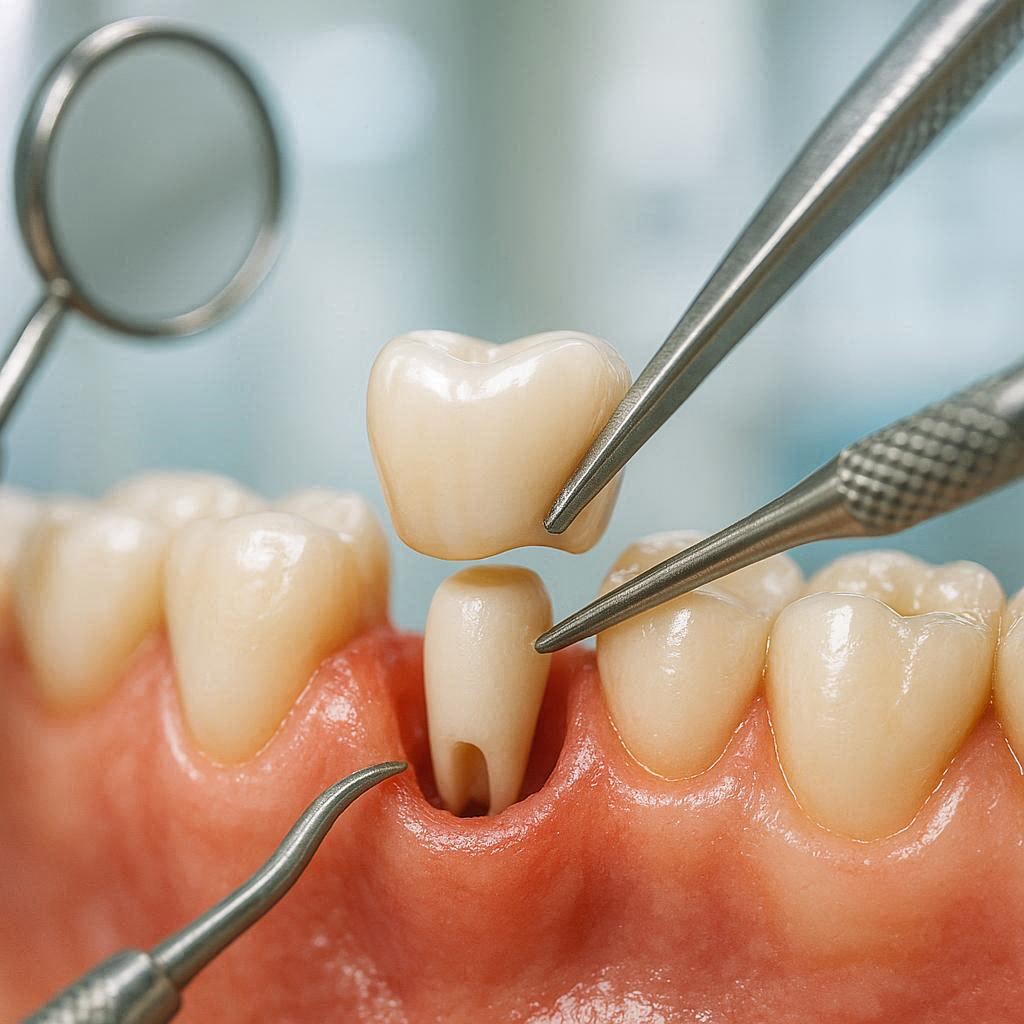
A single tooth implant has three parts. First, there is the implant post. This is a small screw made of titanium. A dentist places it into your jawbone where the old tooth root used to be.
Second, there is an abutment. This is a connector piece that attaches to the implant post. It sits just above your gum line.
Third, there is the dental crown. This is the visible part that looks exactly like a natural tooth. It attaches to the abutment.
Together, these three parts create a replacement that feels, functions, and looks like a real tooth.
The Step-by-Step Implant Process
Getting an implant is not a single appointment. It is a journey. Here is what a typical timeline looks like.
Step 1: Initial consultation
Your dentist examines your mouth. They take X-rays or a CT scan. They check your bone density. They ask about your medical history. This appointment determines if you are a good candidate.
Step 2: Tooth extraction (if needed)
If your damaged tooth is still in place, the dentist removes it. They may place a bone graft at this time if your jawbone is too thin or soft.
Step 3: Healing period
Your mouth needs time to heal after extraction. This usually takes 4 to 8 weeks. During this time, your bone starts to prepare for the implant.
Step 4: Implant placement surgery
The dentist makes a small cut in your gum. They drill a tiny hole into the jawbone. They place the titanium post into that hole. Then they close the gum over it. This surgery takes about 60 to 90 minutes for one tooth.
Step 5: Osseointegration
This is a fancy word for a simple process. Your jawbone grows around the titanium post. It fuses with it like it was always there. This takes 3 to 6 months. Patience is key here.
Step 6: Abutment placement
Once the implant is secure, the dentist reopens the gum. They attach the abutment. The gum then heals around the abutment for another 2 weeks.
Step 7: Crown placement
Your dentist takes impressions of your mouth. A lab creates your custom crown. About 2 to 3 weeks later, you return. The dentist screws or cements the crown onto the abutment.
Total timeline: 4 to 9 months from start to finish.
Who Is a Good Candidate for an Implant?
Most healthy adults can get an implant. But there are some important requirements.
Good candidates have:
- Enough jawbone density to support the implant
- Healthy gums with no active gum disease
- Good overall health (certain conditions like uncontrolled diabetes may affect healing)
- A commitment to good oral hygiene
- No smoking, or willingness to quit during the process
You might still be a candidate even if:
- You have moderate bone loss (bone grafting can help)
- You are older (age is not a barrier)
- You have well-managed medical conditions
Note for readers: Do not assume you are not a candidate without asking a dentist. Many people who think they have “too much bone loss” can still get implants after a bone graft.
The Pros and Cons of Dental Implants
Let me be completely honest about both sides.
Pros:
- Preserves your jawbone. No other option does this.
- Does not affect neighboring teeth. They stay untouched.
- Feels and functions like a natural tooth. You will forget it is there.
- Lasts decades with proper care. Many last a lifetime.
- Easy to clean. You brush and floss normally.
- High success rate. Over 95% for lower jaw, 90-95% for upper jaw.
Cons:
- Higher upfront cost (more on this later)
- Takes several months to complete
- Requires surgery, which some people want to avoid
- May need bone grafting, which adds time and cost
- Not ideal for heavy smokers or people with certain health conditions
Can an Implant Fail?
Yes. It happens, but not often. Early failure occurs within the first few months. The bone does not fuse to the implant. This is rare, occurring in about 1-2% of lower jaw implants and slightly more in upper jaws.
Late failure happens years later. Usually from gum disease or teeth grinding. The good news? Failed implants can often be replaced with a new implant.
Dental Bridges: The Faster, Non-Surgical Alternative
Not everyone wants surgery. Not everyone can afford implants. That is where bridges shine.
What Is a Traditional Fixed Bridge for One Tooth?
Imagine two crowns sitting side by side. Between them hangs a false tooth. The dentist prepares the two teeth next to your gap. They grind them down slightly. Then they cement the bridge over these prepared teeth.
The two teeth act as anchors. The false tooth fills the gap. The whole thing is one solid piece. You cannot remove it yourself.
How a Bridge Is Placed
This process is much faster than implants.
Step 1: Consultation and preparation
The dentist examines your adjacent teeth. They numb the area. They reshape these two teeth by removing some enamel. This is permanent. You cannot reverse it.
Step 2: Impressions
Your dentist takes molds of your mouth. These go to a dental lab. The lab builds your custom bridge.
Step 3: Temporary bridge
You leave with a temporary bridge. It protects your teeth and looks okay, but it is not as strong as the final one.
Step 4: Final bridge placement
About 2 to 3 weeks later, you return. The dentist removes the temporary bridge. They check the fit of your permanent bridge. Then they cement it into place.
Total timeline: 2 to 4 weeks.
The Pros and Cons of Dental Bridges
Pros:
- Much faster than implants
- No surgery required
- Lower initial cost
- Predictable and reliable
- Feels stable and secure
Cons:
- Requires grinding down two healthy teeth. This is irreversible.
- Does not preserve jawbone. The bone under the missing tooth still shrinks.
- Harder to clean. You need special floss or tools.
- Shorter lifespan than implants (10-15 years typically)
- Can lead to cavities on the anchor teeth if cleaning is poor
Important note: The two anchor teeth now carry more work. A bridge adds stress to them. If one anchor tooth fails, the whole bridge fails.
What About a Cantilever Bridge?
A cantilever bridge uses only one anchor tooth instead of two. The false tooth extends off that single tooth like a diving board.
These are less common today. Dentists usually avoid them for back teeth because the leverage can damage the single anchor. They work okay for front teeth in some cases, but most experts prefer traditional bridges or implants.
Resin-Bonded Bridges: A Gentle Option
Also called a Maryland bridge. This type uses metal or porcelain wings. The dentist bonds these wings to the backs of the adjacent teeth. No grinding or very minimal grinding needed.
Pros: Very conservative. Your natural teeth stay almost untouched.
Cons: Not very strong. Easily knocked loose. Best only for front teeth that do not bite or chew hard.
Removable Partial Dentures: The Budget-Friendly Choice
Sometimes you need a simple, affordable solution. A single tooth partial denture might be that answer.
What Is a Single Tooth Partial Denture?
This is a removable false tooth. It attaches to a pink or gum-colored plastic base. Small metal clasps or precision attachments hold it to your nearby teeth.
You take it out at night. You clean it separately. It is similar to a full denture but for just one tooth.
How It Works
The process is straightforward.
Step 1: Your dentist takes impressions.
Step 2: A lab creates your custom denture.
Step 3: You try it in. The dentist makes adjustments for comfort.
Step 4: You wear it and remove it daily.
Total timeline: 2 to 3 weeks.
The Pros and Cons
Pros:
- Most affordable option by far
- No surgery
- Does not damage neighboring teeth (no grinding)
- Quick to make
Cons:
- Least stable option. It can move when you eat.
- Can feel bulky or uncomfortable
- May affect your speech at first
- Does not stop bone loss
- Metal clasps can be visible
- Can increase plaque buildup on anchor teeth
- Needs replacement every 5 to 8 years
Who Is This Best For?
This option works well for people who:
- Cannot afford implants or bridges
- Have health conditions that prevent surgery
- Need a temporary solution while saving for a better option
- Have very low chewing demands on that tooth
Realistic advice: Most people use partial dentures as a short-term solution. They get the job done, but you will likely want to upgrade eventually.
Comparing Costs: Single Tooth Replacements
Money matters. Let me give you honest, realistic ranges. Prices vary significantly by location, dentist, materials, and insurance.
| Option | Average Cost (USD) | Insurance Coverage | Long-Term Value |
|---|---|---|---|
| Dental Implant (total package) | 3,000–6,000 | Often covers crown, not implant | Excellent |
| Implant with bone graft | 4,000–8,000 | Limited | Still excellent |
| Traditional Bridge | 2,000–5,000 | Typically 50% coverage | Good |
| Resin-Bonded Bridge | 1,500–3,000 | Often covered | Fair |
| Removable Partial Denture | 300–1,500 | Often 50% coverage | Fair to poor |
A note on implant costs: The price usually includes the surgery, the implant post, the abutment, and the crown. Sometimes you pay separately for the crown. Ask for a total all-in price.
A note on hidden costs: Bridges may lead to future costs on the anchor teeth. Implants have very low long-term costs. Partial dentures need replacement every few years.
Pain, Recovery, and What to Expect
Fear of pain stops many people from seeking treatment. Let me be real with you.
How Painful Is Dental Implant Surgery?
You receive local anesthesia. You feel pressure but not sharp pain during surgery. Most people describe the sensation as strange but not painful.
After the anesthesia wears off, you feel sore. This is like a deep bruise. Over-the-counter pain relievers usually manage it well. Most people take prescription pain medication for 1 to 3 days then switch to ibuprofen.
The worst soreness happens in the first 48 hours. By day 5, most people feel much better. By day 10, you barely notice it.
Bridge and Denture Discomfort
Getting a bridge involves no surgery. The injection for numbing might pinch. After that, you feel nothing. Later, your prepared teeth may feel sensitive to cold for a few days.
Partial dentures feel strange at first. Your tongue notices the new object. You might gag slightly. This passes within 1 to 2 weeks as your mouth adapts.
Recovery Timeline Comparison
| Procedure | First 24 Hours | First Week | Full Recovery |
|---|---|---|---|
| Implant surgery | Rest. Ice packs. Soft foods only. | Swelling peaks day 2-3. Most return to work day 2-3. | Bone fusion takes 3-6 months. |
| Bridge prep | Minor sensitivity. Normal eating after anesthesia wears off. | Fully normal. | No recovery needed. |
| Partial denture | Some sore spots possible. | Speaking and eating feel more natural. | 2 weeks for full adaptation. |
Long-Term Care for Your Replacement
Your new tooth replacement needs maintenance. Different types need different care.
Caring for a Dental Implant
Here is the beautiful truth. You clean an implant crown the same way you clean a natural tooth. Brush twice daily. Floss once daily.
But add one extra tool. An interproximal brush or water flosser helps clean around the abutment. This prevents gum inflammation around the implant, called peri-implantitis.
Do this every day:
- Brush with a soft toothbrush
- Floss normally around the crown
- Use a water flosser on low setting
Do this every year:
- See your dentist for checkups
- Get X-rays to check bone levels around the implant
Caring for a Bridge
Bridges need special attention. The area where the false tooth meets the gum under the bridge traps food easily.
Buy these tools:
- Super floss (has a stiff end to thread under the bridge)
- Interdental brushes
- A water flosser
Every night, thread the super floss under the bridge. Clean along the gum line. This takes practice, but it becomes habit.
Skipping this step leads to cavities on the anchor teeth. Those cavities can destroy your bridge.
Caring for a Partial Denture
Remove your partial denture every night. Do not sleep with it. Your gums need rest.
Daily cleaning routine:
- Rinse the denture after eating
- Brush it with a soft denture brush and mild soap (not toothpaste, which scratches)
- Soak it in denture cleaner once weekly
- Brush your natural teeth and gums thoroughly before reinserting
Never let your denture dry out. Store it in water or cleaning solution overnight.
Can You Eat Normally With Each Option?
Let me give you a practical comparison.
| Food Type | Implant | Bridge | Partial Denture |
|---|---|---|---|
| Steak | Yes, normally | Yes, normally | With caution |
| Apple | Yes, bite into it | Yes, but careful with very hard bites | Cut into slices |
| Nuts | Yes | Yes | Avoid hard nuts |
| Sticky candy | Yes (but clean after) | Avoid (can loosen bridge) | Avoid completely |
| Crusty bread | Yes | Yes | Cut into small pieces |
With a partial denture, you learn to chew more on your natural teeth side. The denture can rock or shift if you put too much pressure on it.
With an implant, you forget it is not a real tooth. Eat corn on the cob. Bite into a sandwich. Chew gum. No restrictions.
With a bridge, you are mostly unrestricted. But avoid extremely sticky or hard foods that could unseat the cement.
What About Aesthetics? Which Looks Most Natural?
You want a replacement that does not scream “fake tooth.” Here is the honest ranking.
Most Natural Appearance: Dental Implant
An implant crown emerges directly from your gum like a real tooth. No visible metal. No clasps. The gum shapes itself around the crown over time. From any angle, it looks real.
Very Good Appearance: Modern Bridge
Porcelain bridges look excellent. The material mimics natural tooth enamel. Light passes through it similarly. The only tell? A bridge is one solid piece. Very close inspection might reveal no individual flossing between the false tooth and the anchors. But for normal conversations and smiles, no one will know.
Acceptable Appearance: Partial Denture
This one is noticeable up close. You might see the metal clasps on your natural teeth. The pink plastic base can look artificial. However, high-quality flexible dentures made from Valplast or other materials look much better. They have no metal. The pink material blends well. Ask about flexible partials if aesthetics matter.
Dental Insurance: What Actually Gets Covered
Insurance coverage confuses everyone. Let me simplify.
Implant Coverage
Most dental insurance plans label implants as a “major service.” They typically cover 50% of the implant cost, up to a yearly maximum. Most yearly maximums are 1,000to2,000. So if your implant costs 4,500,insurancepays1,000 to $1,500 max.
Some plans cover the crown separately. Some cover nothing for the implant but cover the crown. Some cover nothing at all for implants. Always call your insurance before starting treatment.
Bridge Coverage
Bridges fall under “major services” too. Same 50% coverage. Same yearly maximum. Bridges generally get better coverage than implants because they have been around longer.
Partial Denture Coverage
Also a major service. Similar 50% coverage.
The key takeaway: Insurance helps, but you will pay significant money out of pocket for any of these options. Do not expect insurance to cover everything.
Dental Savings Plans and Other Options
- Dental schools: Offer reduced fees. Students perform work under expert supervision. Great option if you have flexibility.
- CareCredit: A healthcare credit card. Interest-free if paid within a promotional period.
- In-house membership plans: Some dentists offer annual plans with discounts on procedures.
- FSA/HSA accounts: Use pre-tax dollars to pay for treatment.
Which Option Is Right for You? A Decision Tool
Let me help you decide. Answer these questions honestly.
Question 1: How important is preserving your jawbone?
- Very important → Implant
- Not a concern → Bridge or partial
Question 2: Do you want to avoid surgery at all costs?
- Yes, absolutely → Bridge or partial
- Surgery is fine → Implant
Question 3: What is your budget range?
- Under $2,000 → Partial denture or save longer
- 2,000–4,000 → Bridge or basic implant
- Over $4,000 → Implant with premium materials
Question 4: Are the teeth next to the gap perfectly healthy?
- Yes, perfect and I want to keep them untouched → Implant
- They already have large fillings or crowns → Bridge may be fine
- Not sure → Ask your dentist to evaluate
Question 5: How fast do you need this done?
- Within one month → Bridge
- Willing to wait 6+ months for best result → Implant
- Need something now, upgrade later → Temporary partial, then implant
Quick Recommendation Guide
| Your Situation | Recommended Option |
|---|---|
| Under 40 years old, good health | Implant (lifetime value) |
| Over 65, good health, can afford it | Implant |
| Healthy adjacent teeth, no surgery wanted | Bridge |
| Tight budget, need something now | Partial denture as temporary |
| Front tooth, minimal bite force | Resin-bonded bridge |
| Grind your teeth at night | Implant + nightguard |
Common Myths About Single Tooth Replacements
Let me bust some persistent myths.
Myth 1: “Implants are experimental.”
False. Modern implants have been used successfully for over 50 years. Millions placed annually.
Myth 2: “Bridges last forever.”
False. The average bridge lasts 10-15 years. The anchor teeth eventually develop problems.
Myth 3: “A partial denture will damage my other teeth.”
Partially true. Poor cleaning and fit can damage anchor teeth. With good hygiene and regular adjustments, damage is minimal.
Myth 4: “I am too old for an implant.”
False. Age alone does not matter. Health matters. Many 80 and 90-year-olds get implants successfully.
Myth 5: “Implants are painful.”
False for most. Discomfort is moderate and short-lived. Most people say the anticipation is worse than the reality.
Myth 6: “A bridge is cheaper in the long run.”
Usually false. A bridge costs less upfront. But over 20 years, you might replace it once or twice. An implant costs more upfront but rarely needs replacement.
Questions to Ask Your Dentist
Before committing to any treatment, ask these questions. Write them down. Bring them to your appointment.
- “Am I a good candidate for an implant? If not, why specifically?”
- “Do I need any bone grafting? How much would that add to the cost and timeline?”
- “What is the total all-in cost for each option including everything (surgery, materials, crown, follow-ups)?”
- “How many implants or bridges have you placed in the last year?”
- “Can you show me before-and-after photos of similar cases?”
- “What is your policy if an implant fails or a bridge breaks within the first year?”
- “Do you offer any payment plans or financing?”
- “Will you coordinate with my insurance company?”
- “How long will the entire process take from start to finish?”
- “What does the warranty cover on the implant or bridge?”
Pro tip: A good dentist answers these questions patiently. If they rush you or get annoyed, consider a second opinion.
Realistic Expectations for Each Option
Let me level with you about what daily life really looks like.
Life With a Dental Implant
For the first 4 to 6 months, you have a healing implant. No crown yet. You eat on the other side. You are careful. Then the crown goes on. And life returns to normal.
You brush. You floss. You forget which tooth was replaced. At your yearly checkup, the dentist takes an X-ray. Everything looks good. You move on.
What no one tells you: The months of waiting can feel long. But then you have decades of normal function.
Life With a Bridge
You leave the dentist with your new bridge. It feels slightly tight at first. Your tongue notices the smooth connected surface where two separate teeth used to be.
Cleaning takes extra time. You thread super floss under the bridge every night. Some nights you skip it. Then a year later, the gum under the bridge bleeds. You get back on track.
What no one tells you: Ten years from now, one anchor tooth may need a root canal. The bridge will need replacement. That is normal, not a failure.
Life With a Partial Denture
You put it in each morning. It clicks into place. You eat breakfast and notice it moving slightly. You adjust.
At lunch, food gets under the denture. You excuse yourself to rinse it. By week three, you adapt. You learn which foods work. You take it out at night and soak it. Life goes on.
What no one tells you: You will always know it is there. It never feels like a real tooth. But it gets the job done for a fraction of the cost.
When You Cannot Get an Implant: Honest Alternatives
Sometimes implants are truly not possible. Here is why and what to do.
Medical Reasons You Might Not Qualify
- Uncontrolled diabetes (affects bone healing)
- Active cancer treatment involving the jaw
- Severe bleeding disorders
- Immunosuppressive medications (high doses)
- Current heavy smoking (some dentists still place implants but with lower success)
- Untreated gum disease
What to Do Instead
If you cannot get an implant today, do not despair. Get your bridge. Or get a partial denture. Both work well.
You can also take steps to become an implant candidate later. Quit smoking. Get diabetes under control. Treat gum disease. Undergo bone grafting. Many people who are not candidates today become candidates tomorrow.
The Role of Bone Grafting
Let me explain bone grafting clearly because it scares many people.
What Is a Bone Graft?
Your jawbone needs enough width and height to hold an implant. If bone has shrunk, the dentist adds graft material. This material can come from:
- Your own bone (from another part of your jaw)
- A donor (human cadaver bone, processed and sterilized)
- Animal bone (cow or pig, processed)
- Synthetic bone materials
The graft material acts as a scaffold. Your body replaces it with your own bone over time.
What It Feels Like
A bone graft adds 15 to 30 minutes to your surgery. You are numb. You feel pressure but not pain. Recovery is similar to a standard extraction or implant placement. Sore for a few days.
How Long It Adds
Small grafts allow same-day implant placement. Larger grafts need 4 to 6 months of healing before the implant goes in. The total timeline becomes 8 to 12 months.
The honest truth: About 30-40% of implant patients need some bone grafting. It is very common. Do not let it scare you away from implants.
Front Tooth vs. Back Tooth: Does It Matter?
Yes, location matters.
Replacing a Front Tooth
Aesthetics are critical here. You want perfection.
- Best option: Implant. Nothing looks more natural.
- Good option: Resin-bonded bridge (minimal tooth grinding).
- Acceptable option: Traditional bridge.
- Last choice: Partial denture with clasps (visible).
Special consideration: Front tooth implants often need a temporary crown during healing. Your dentist can make a “flipper” (small partial denture) to wear while the implant heals. You will not walk around with a gap.
Replacing a Back Tooth (Molar or Premolar)
Chewing forces are high here. Strength matters more than perfect aesthetics.
- Best option: Implant (handles high forces)
- Good option: Traditional bridge
- Acceptable option: Partial denture (but may move when chewing hard foods)
Special consideration: Back teeth do not show when you smile. A partial denture is more viable here because no one sees the clasps.
Success Rates: What the Research Really Says
Let me give you honest numbers based on real studies.
Dental implants:
- Lower jaw: 95-98% success over 10 years
- Upper jaw: 90-95% success over 10 years
- After 20 years: 85-90% still functioning perfectly
Traditional bridges:
- 10-year survival: 85-90%
- 15-year survival: 70-75%
- Most failures happen because anchor teeth get cavities or gum disease
Partial dentures:
- 5-year survival: 80-85%
- 10-year survival: 50-60%
- Most failures due to breakage or poor fit
These numbers do not mean bridges and partials are bad. They mean you should expect to replace them eventually.
What About Zirconia and Metal-Free Implants?
You may have heard about ceramic implants. Here is the truth.
Traditional titanium implants have the longest track record. They work. Zirconia (ceramic) implants are newer. They look tooth-colored. Some people prefer them for allergy concerns or aesthetics.
Pros of zirconia implants:
- White color (no metal showing if gum recedes)
- No metal allergy concerns
- Very biocompatible
Cons of zirconia implants:
- Less research on long-term success
- More brittle (higher risk of fracture)
- Often one-piece design (harder to customize)
- More expensive
My honest advice: Titanium remains the gold standard for most people. Zirconia is promising but ask a specialist if you truly need it.
How to Find a Qualified Dentist
Your outcome depends heavily on who does the work.
For Implants
Look for one of these specialists:
- Oral surgeon: Surgical experts. Best for complex cases or bone grafting.
- Periodontist: Gum and bone specialists. Excellent for implants.
- Prosthodontist: Advanced restorative dentists. Great for complex cosmetic cases.
- General dentist with implant training: Many do excellent work. Ask how many implants they place per year.
Questions to ask a potential implant dentist:
- How many single tooth implants did you place last year?
- What is your success rate?
- Do you use 3D CT scanning for planning?
- What brand of implants do you use? (Major brands like Straumann, Nobel Biocare, Zimmer are good)
For Bridges and Partials
Most general dentists do excellent bridge and denture work. Look for:
- Before-and-after photos
- Positive patient reviews mentioning function and comfort
- A clear explanation of your options without pressure
Red Flags to Avoid
- A dentist who recommends only one option without explaining others
- Prices that seem too good to be true (they usually are)
- No discussion of risks or alternatives
- High-pressure sales tactics (“Sign today for the discount”)
Financing Your Single Tooth Replacement
Money is a real barrier for many people. Here are practical ways to afford treatment.
Payment Plans
Many dental offices offer in-house financing. You pay a down payment, then monthly installments. Interest rates vary. Ask before starting treatment.
Third-Party Financing
- CareCredit: Most common. Pays the dentist upfront. You repay them. Promotional interest-free periods available (6, 12, 18 months). After that, interest is high.
- Alphaeon Credit: Similar to CareCredit. Often used for cosmetic dentistry.
- LendingClub: Personal loans for healthcare.
Dental Schools
Major universities with dental schools offer reduced fees. Treatment takes longer. Students work under supervision. Quality is generally good because instructors check every step.
Example savings: An implant costing 5,000ataprivateofficemightcost2,500 at a dental school.
Dental Tourism
Traveling to Mexico, Costa Rica, Colombia, Hungary, or Thailand for dental work. Prices can be 50-70% lower.
Risks to consider:
- No easy follow-up care if problems develop
- Variable quality standards
- Language barriers
- Travel costs add up
- Infection or complication care back home may cost more
If you go this route: Research heavily. Use a well-known clinic with international patient reviews. Have a clear plan for follow-up care at home.
Negotiation
You can sometimes negotiate dental fees. Ask:
- “Is this your best price for paying cash?”
- “Can you match another office’s quote?”
- “Do you offer a discount for paying in full upfront?”
The worst they say is no. Many offices will offer 5-15% off for cash payment.
Frequently Asked Questions (FAQ)
How long does a single tooth implant last?
With proper care, most implants last 20+ years. Many last a lifetime. The crown on top may need replacement after 10-15 years from normal wear.
Can I get an implant years after losing the tooth?
Yes. But you may need bone grafting if the bone has shrunk. This adds time and cost but is usually possible.
Will my insurance cover a single tooth implant?
Partial coverage is common. Most plans pay 50% up to a yearly maximum. Call your insurance for specifics before starting.
Is a bridge cheaper than an implant?
Upfront, yes. Over 20 years, an implant is often cheaper because bridges need replacement and anchor teeth may need treatment.
Do implants hurt?
The surgery itself is not painful because of anesthesia. Afterward, soreness lasts 3-7 days. Most people manage with over-the-counter pain relievers.
Can I get an implant if I smoke?
Smoking reduces success rates. Many dentists still place implants but warn you of higher failure risk. Quitting before and after surgery improves outcomes significantly.
How do I clean under a bridge?
Use super floss, interdental brushes, or a water flosser. Thread the floss under the false tooth daily. This is essential for bridge longevity.
What happens if an implant fails?
Your dentist removes it. After healing (2-4 months), you can try again. Most failed implants can be replaced successfully.
Can I have an MRI with a dental implant?
Yes. Titanium implants are not magnetic. They are safe for MRI. Always tell the MRI technician about your implant.
How long does a partial denture last for one tooth?
Typically 5-8 years. Plastic wears down. Clasps loosen. Your mouth shape changes slowly. Regular adjustments help but eventually you need a new one.
Additional Resources
For more reliable, evidence-based information, visit:
The American College of Prosthodontists – Patient Resources
This site helps you find a prosthodontist (specialist in tooth replacement) and offers clear patient education materials. Highly recommended.
Conclusion
Replacing a single tooth is an investment in your health, comfort, and confidence. Dental implants offer the closest thing to a natural tooth, preserving your jawbone and lasting decades. Bridges provide a faster, non-surgical alternative that works beautifully for many people. Partial dentures remain a budget-friendly option when other choices are out of reach. Talk to your dentist, ask the hard questions, and choose the solution that fits your body, your wallet, and your life.
Disclaimer: This article provides general educational information. It does not replace professional medical or dental advice. Every person’s oral health situation is unique. Always consult with a licensed dentist before making decisions about your dental treatment. The author and publisher are not liable for any outcomes resulting from the use of this information.