partial dentures cost with insurance 2026
The gap in your smile is more than a cosmetic issue. It affects how you chew, speak, and feel about yourself. You know you need a solution. A removable partial denture often hits the sweet spot between effectiveness and affordability. But as you research, one question echoes louder than any other: what will this actually cost me, especially with my insurance?
We need to talk about the landscape of dental costs in 2026. It has shifted. Inflation touches everything, including the fine craftsmanship of dental labs and the specialized materials that go into your mouth. Navigating insurance coverage adds another layer of complexity. You are not just buying a dental appliance. You are making an investment in your daily quality of life. You deserve a clear, realistic picture, free from marketing fluff or outdated figures.
This guide is your compass. We will walk through the real-world costs you can expect for partial dentures in the current year. More importantly, we will dissect how your insurance card translates into actual savings. We will look at deductibles, annual caps, and the fine print that determines whether you pay a few hundred dollars or well over a thousand. Let’s get you the information you need to walk into the dentist’s office with confidence.
What Drives the Cost of Partial Dentures in 2026? A Candid Breakdown
Before we even open your insurance benefits booklet, we must understand the baseline. The price of a partial denture does not come from thin air. It reflects a blend of art, science, and material cost. In 2026, we see a continued trend: the cost of skilled labor in dental technology has risen. The equipment used in modern digital dentistry represents a massive investment. These factors all flow down to the patient.
Think of a partial denture not as a commodity, but as a custom medical device. A technician will spend hours crafting a framework that fits your unique oral anatomy. They will carefully set artificial teeth to restore your bite without damaging your remaining natural teeth. This process is intricate. The materials chosen dramatically alter the final bill. Here are the primary cost drivers that influence the price tag before insurance steps in.
The Framework Material: The Backbone of Your Denture
The material used for the base of your partial determines much of its strength, feel, and cost. You will generally choose between three main types. Each offers a different balance of durability, aesthetics, and price.
- Cast Metal (Cobalt-Chrome): This is the gold standard for strength and longevity. A thin, rigid metal framework clasps around your natural teeth. The base is strong, allowing for a smaller, more comfortable profile. It transmits temperature well, which your tongue appreciates. This option requires more complex lab work, pushing the cost higher. A cast metal partial offers the best long-term value.
- Acrylic (Plastic): Often called a “flipper,” especially when temporary. This is a bulky, pink plastic base with embedded teeth. It is the most affordable option to make. However, it is weaker and can trap more food debris. Many people use an acrylic partial as an immediate replacement after an extraction while a more permanent solution heals. It feels less natural and can break if dropped.
- Flexible Thermoplastic (e.g., Valplast, Duraflex): This material offers a premium, aesthetic result. The base is a flexible, gum-colored nylon that blends in seamlessly. It has no metal clasps; instead, thin, translucent “gum-colored” extensions hug the natural teeth. The comfort and aesthetics are superb. The trade-off is a higher lab cost than a standard acrylic, and repairs are difficult if the material tears.
The Number of Teeth Being Replaced
This is intuitive. Replacing one missing tooth requires less material and labor than replacing three or four. A single-tooth acrylic flipper will sit at the very bottom of the cost scale. A cast metal framework designed to carry four teeth across both sides of an arch will cost substantially more. Your dentist will classify the partial based on the location and extent of your missing teeth, which affects the complexity of the design.
The Dentist’s Location and Expertise
A general dentist in a rural clinic has different overhead costs than a prosthodontist—a specialist in tooth replacement—in a downtown metropolitan high-rise. Real estate, staff salaries, and regional lab fees all influence the price. In 2026, a patient in Manhattan or San Francisco should expect to pay significantly more than a patient in a small Midwestern town. The specialist’s fee will also be higher, reflecting their advanced training in complex rehabilitation cases.
Pre-Treatment Procedures
This is the hidden line item that catches many people off guard. Your mouth must be healthy before you receive a partial denture. If you have gum disease, active decay, or need problematic teeth extracted, that treatment must happen first. These are separate procedures with separate fees. You cannot safely place a partial denture over infected gum tissue. A clear treatment plan will separate these preparatory costs from the denture itself.
The Diagnostic Workflow
Modern dentistry increasingly relies on digital scans instead of goopy physical impressions. A practice that uses an intraoral scanner to create a 3D model of your mouth invests in high technology. This often comes with a digital impression fee, though some offices bundle it into the overall lab cost. The benefit is a highly accurate model, which can lead to a better-fitting framework.
Real-World Cost Ranges for 2026: The Numbers You Need
Let’s move past abstract concepts and into the dollar figures. The prices below represent a realistic spectrum for a patient without insurance coverage. These are national averages, refined to reflect the economic conditions of 2026. Use them as a benchmark, not an absolute guarantee. Always obtain a personalized quote from your provider.
To make this digestible, view the cost per arch (upper or lower jaw). The range depends heavily on the material and the number of teeth.
| Denture Type & Material | Best For | Estimated Cost Range (Per Arch, No Insurance) | Comfort & Aesthetics | Durability |
|---|---|---|---|---|
| Temporary Acrylic “Flipper” | Replacing 1-2 teeth temporarily during healing. | $450 – $900 | Low. Bulky plastic. Adequate for short-term use. | Low. Prone to cracking. |
| Standard Acrylic Partial | A budget-conscious permanent option for several teeth. | $850 – $1,600 | Moderate. Can feel thick. The pink plastic can look artificial. | Moderate. Weaker than metal. |
| Cast Metal Framework | A long-lasting solution for multiple missing teeth. The premium standard. | $1,500 – $3,200 | High. Thin, rigid, and secure. Small clasps are visible but minimal. | Very High. Excellent strength. |
| Flexible Partial (Valplast/Duraflex) | Patients prioritizing aesthetics and comfort, replacing 1-3 teeth. | $1,400 – $2,800 | Very High. Nearly invisible clasps. The flexible base feels natural. | Moderate. Strong material but hard to repair if torn. |
Important Note: These figures are for the denture appliance only. They do not include the cost of an oral exam (usually $50–$150), diagnostic X-rays ($50–$200), extractions ($150–$400 per tooth), or any preparatory work on the anchor teeth. Your total treatment plan will be higher.
The Insurance Equation: How Partial Dentures Cost with Insurance in 2026
Here we reach the heart of the matter. You hold a dental insurance policy, and you want to know how much of this bill it will absorb. The phrase “covered by insurance” is one of the most misunderstood terms in healthcare. It rarely means “paid in full.” Your insurance is a financial tool with specific rules. Understanding its mechanics is the difference between a pleasant surprise and a budgeting shock.
In 2026, the structure of most dental insurance plans remains conservative. The maximums have not kept pace with the actual cost of care over the decades. The average annual maximum benefit hovers between $1,000 and $1,500. Some premium employer-sponsored plans may offer $2,000 or $2,500. This is the absolute ceiling of what your plan will pay out in a single calendar year for all your dental work. Let’s walk through the exact pathway from your dentist’s total fee to your final out-of-pocket payment.
Step 1: Understanding Your Plan’s Fee Schedule
When you visit an in-network dentist, they have a contracted fee schedule with your insurance carrier. Let’s say the dentist’s standard retail fee for a cast metal partial is $2,400. The insurance company’s contracted rate with that dentist might be $1,800. You automatically receive that discount simply by using an in-network provider. This is a critical advantage. An out-of-network dentist has no such contract, and their full fee of $2,400 applies.
Step 2: The Deductible
Before your insurance pays a single dime, you must meet your annual deductible. This is typically a flat dollar amount, common at $50 or $100 per individual. This applies to all “major” work, which includes partials. If you haven’t seen a dentist this year for anything beyond a basic cleaning, you will pay the deductible first.
Step 3: The Co-Insurance (Cost-Sharing)
After you pay the deductible, the insurance company splits the remaining cost with you. This is co-insurance. For major restorative services, the most common split is 50/50. The insurance pays 50% of the approved fee, and you pay the other 50%. Some excellent plans might offer 60/40, paying 60%. You must check your plan’s “Restorative or Major Services” category.
Step 4: The Inflexible Annual Maximum
The insurance company tallies how much it has paid for your care this year. It will not pay out more than your annual maximum. If your maximum is $1,500, and they’ve already paid $400 for a crown earlier in the year, only $1,100 remains for your partial. Everything above that is your sole responsibility.
A Realistic Financial Simulation
Let’s model a scenario to make this concrete. The patient requires a cast metal partial denture. The procedure is clean; no extractions are needed.
| Transaction Line Item | In-Network Scenario | Out-of-Network Scenario |
|---|---|---|
| 1. Dentist’s Retail Fee | $2,400 | $2,400 |
| 2. Insurance Contracted Rate | $1,800 | N/A (Full fee applies) |
| 3. Your Deductible (Assume $100) | You pay $100 | You pay $100 |
| 4. Remaining Balance After Deductible | $1,700 | $2,300 |
| 5. Insurance Co-Insurance (Assume 50%) | Insurer pays $850. You pay $850. | Insurer pays $1,150 (50% of $2,300). You pay $1,150. |
| 6. Annual Maximum Applied | Plan pays $850. Remaining max is $1,500-$850 = $650 for other work this year. | Plan pays $1,150. |
| Your Total Out-of-Pocket Cost | $100 + $850 = $950 | $100 + $1,150 = $1,250 |
The Verdict: In this example, with a standard 50% co-insurance for major services and a $100 deductible, your out-of-pocket for a $2,400 denture is $950 with an in-network dentist. You save hundreds simply by staying in-network, and the insurance’s negotiated rate protects you from paying co-insurance on the inflated retail fee. Without insurance, you’d be facing the full $2,400.
A Vital 2026 Reality Check: If your plan has a low annual maximum of $1,000, that is the most the insurer will pay. In the in-network example above, your co-insurance responsibility would adjust upward to ensure the insurance payout does not exceed $1,000. You would pay $800 out-of-pocket, and insurance would pay $800 ($1,700 balance – $800 = $900; wait, let’s recalculate. $1,700 balance, max insurer payout is $1,000. So your 50% share is $850, but insurer only pays the remaining portion of the maximum. Actually, they would just pay $850 as it’s under the $1,000 max. The maximum limits the total payout, not the individual procedure share unless the share exceeds the remaining max.)
Deep Dive into Insurance Plan Types: PPO vs. HMO vs. Indemnity
Your coverage narrative changes dramatically depending on the architecture of your dental plan. The terms PPO, HMO, and indemnity define the rules of engagement. You must know which type of card is in your wallet.
The PPO (Preferred Provider Organization) Plan
This is the most common employer-sponsored dental plan. It gives you a network of dentists who have agreed to contracted, lower fees. You still enjoy the freedom to go out-of-network, but, as we saw in the simulation, your costs will be higher. A PPO plan covers partial dentures under “Class III” or “Major” services. You will almost always serve a waiting period of 6 to 12 months before major services are eligible. Do not skip this verification. If you just enrolled, your partial might not be covered until the waiting period is satisfied.
The DHMO (Dental Health Maintenance Organization) Plan
These plans operate completely differently. They have no annual maximums and no deductibles. Instead, you pay a fixed, set copay for every procedure. You must select a primary care dentist from the network, and you need a referral for any specialty care. The trade-off is limited choice. For a partial denture, a DHMO plan might set your copay at $600 to $1,100 for a cast metal partial. You pay exactly that amount, no more, no less. The insurer pays the remainder directly to the dentist. If you have access to a good DHMO provider, this can offer exceptional predictability.
The Indemnity (Fee-for-Service) Plan
This is the traditional insurance model, now less common. You can visit any dentist in the country. You pay your bill upfront, submit a claim, and the insurance company reimburses you a percentage (often 50%) of what they deem a “usual, customary, and reasonable” (UCR) fee. The danger here is UCR. If your dentist charges $2,400 and the insurer’s UCR for that procedure is $1,400, they will reimburse you 50% of $1,400, which is $700. You remain responsible for the $1,700 balance. This model places the highest financial risk on the patient.
A Comparative Look: The Out-of-Pocket Forecast for 2026
To give you a clear, at-a-glance perspective, let’s place the three main partial types side-by-side. The table below assumes a standard PPO plan with a $100 deductible, a 50% co-insurance for major services, a $1,500 annual maximum that is completely available, and that all pre-treatment approvals are done. The fees are hypothetical, in-network contracted rates.
| Partial Denture Type | Estimated Contracted Rate | You Pay Deductible | You Pay 50% Co-Insurance | Your Estimated Total Cost with Insurance |
|---|---|---|---|---|
| Temporary Acrylic Flipper | $650 | $100 | $275 | $375 |
| Standard Acrylic Partial | $1,100 | $100 | $500 | $600 |
| Cast Metal Framework Partial | $1,800 | $100 | $850 | $950 |
| Flexible Thermoplastic Partial | $1,650 | $100 | $775 | $875 |
This table represents an ideal scenario where the 50% benefit fits entirely within the annual maximum. It demonstrates that even with insurance, a major restoration like a partial denture is a significant financial event. It also highlights that the difference in your final cost between a premium metal partial and a basic acrylic one is often a matter of a few hundred dollars. For a device you will use every day for years, this premium is almost always worth the superior comfort and durability.
Navigating the Fine Print: Clauses That Catch You
Insurance companies master the art of the caveat. A “covered” service can still leave you with a hefty bill if certain conditions aren’t met. Here is what you must investigate before you schedule your first impression.
The Missing Tooth Clause
This is a ruthless piece of fine print. If you lost the tooth before your current dental insurance policy was in effect, the plan may consider it a “pre-existing condition” and deny coverage for its replacement. You must ask your provider or HR department directly: “Does my plan have a missing tooth exclusion?” If the answer is yes, your partial denture will not be covered.
The Replacement Clause
Many plans limit how often they will pay for a new denture on the same arch. A typical limit is once every five to seven years. If you are replacing a partial that you got four years ago, you will likely be paying entirely out of pocket. This is a hard frequency limitation.
Downgrading (Alternative Benefit)
Let’s say your dentist prescribes a premium flexible partial. The insurance may have an “alternative benefit” clause. They will reimburse you based on the fee for a cheaper, standard acrylic partial, not the more expensive one you chose. You must pay the difference between the two. For example, if the flexible partial costs $1,800 and the standard one costs $1,100, the insurance pays their 50% share based on the $1,100 fee. You pay the remaining $700 difference plus your standard co-insurance. This is a major source of surprise bills.
Essential Strategy: The Pre-Treatment Estimate
Never accept verbal assurances. Ask your dentist to file a pre-treatment estimate (sometimes called a predetermination) with your insurance company. The insurer will review the proposed treatment and send you a written breakdown of exactly what they will pay. This document is your financial shield. It tells you, to the dollar, your responsibility. You can then plan with certainty.
Public Insurance and Alternative Funding for 2026
What if you don’t have a commercial PPO through an employer? Other pathways exist, each with its own strict rules.
Medicaid and Adult Dental Care
Medicaid is a state-administered program. Coverage for adult dental services, especially major ones like partial dentures, is a patchwork quilt across the country. Some states view partial dentures as a medically necessary, covered benefit. Others offer only emergency extractions with no restorative follow-up. Still others provide a limited annual dollar cap, such as $500 or $1,000 for comprehensive care. You must visit your state’s official Medicaid website or call the member services number. You cannot assume coverage. In 2026, the trend continues toward expanding adult dental benefits, but it remains far from universal.
Medicare and Dental Gaps
Original Medicare (Parts A and B) remains unequivocal: it does not cover routine dental care or dentures. It will pay for a dental exam only if it’s an integral part of a covered medical procedure (like before a heart valve replacement). Some Medicare Advantage (Part C) plans, however, are heavily marketing dental benefits. These plans often bundle in a PPO dental plan with an annual maximum, usually around $1,000 to $2,000. Read the Advantage plan’s Evidence of Coverage carefully. The waiting periods and network restrictions for major services still apply.
Dental Savings Plans
These are not insurance. They are membership clubs. You pay an annual fee (typically $100–$180 for a family) and gain access to a network of dentists who have agreed to discount their fees by 20% to 50% for members. You pay the dentist directly at the discounted rate at the time of service. There are no deductibles, no maximums, no waiting periods, and no claims forms. If your insurance plan has a low annual maximum or a missing tooth clause, combining a savings plan or using one as your primary tool can be a very smart financial move in 2026.
The Real Value: Beyond the Price Tag
We have dissected numbers, percentages, and policy clauses. But let’s pull back for a moment. A partial denture is a health investment. The cheapest acrylic flipper that restores your smile and prevents your remaining teeth from drifting is infinitely better than doing nothing. When natural teeth drift into an empty space, they create food traps, misalignment, and can lead to more tooth loss and gum disease.
The conversation should shift from “What is the cheapest way to fill this gap?” to “What is the best long-term value for my health, and how do I use my insurance strategically to achieve it?” A cast metal partial with a $950 out-of-pocket cost might last ten years or more with proper care. A $375 acrylic flipper might need replacement every two to three years, or even sooner if it breaks. Over a decade, the metal partial often proves to be the more economical and far more functional choice. The security of eating an apple, the confidence in a full smile, the preservation of your remaining teeth—these have a value that far exceeds a line item on a dental claim.
Charting Your Course: A Practical Action Plan
You are not a passive participant in this process. You are the manager of your oral health finances. Here is a step-by-step plan to eliminate uncertainty and make a confident decision.
- Get Your Benefits Booklet: Do not rely on a one-page summary. Find the full, detailed Explanation of Benefits document. Look for the “Major Services” section. Find the co-insurance percentage, the deductible, and the annual maximum.
- Call the Member Services Number: Speak to a human. Ask these three direct questions:
- “Is there a missing tooth exclusion on my plan?”
- “What is the waiting period for major services, and has it been met?”
- “What is the frequency limitation on partial dentures?”
- Request a Pre-Treatment Estimate: Once your dentist develops the treatment plan, have them submit this form. Do not proceed without the written response from the insurer.
- Explore All In-Network Providers: The contracted rate is your most powerful tool. If your dentist is out-of-network, ask for a list of in-network providers and get a second consultation.
- Sequence Your Care: If you need multiple treatments, work with your dentist to stage them across two calendar years to maximize two annual maximums. Do preparatory work in December, and deliver the final denture in January. This is a completely legal and intelligent way to use your benefit.
Summary
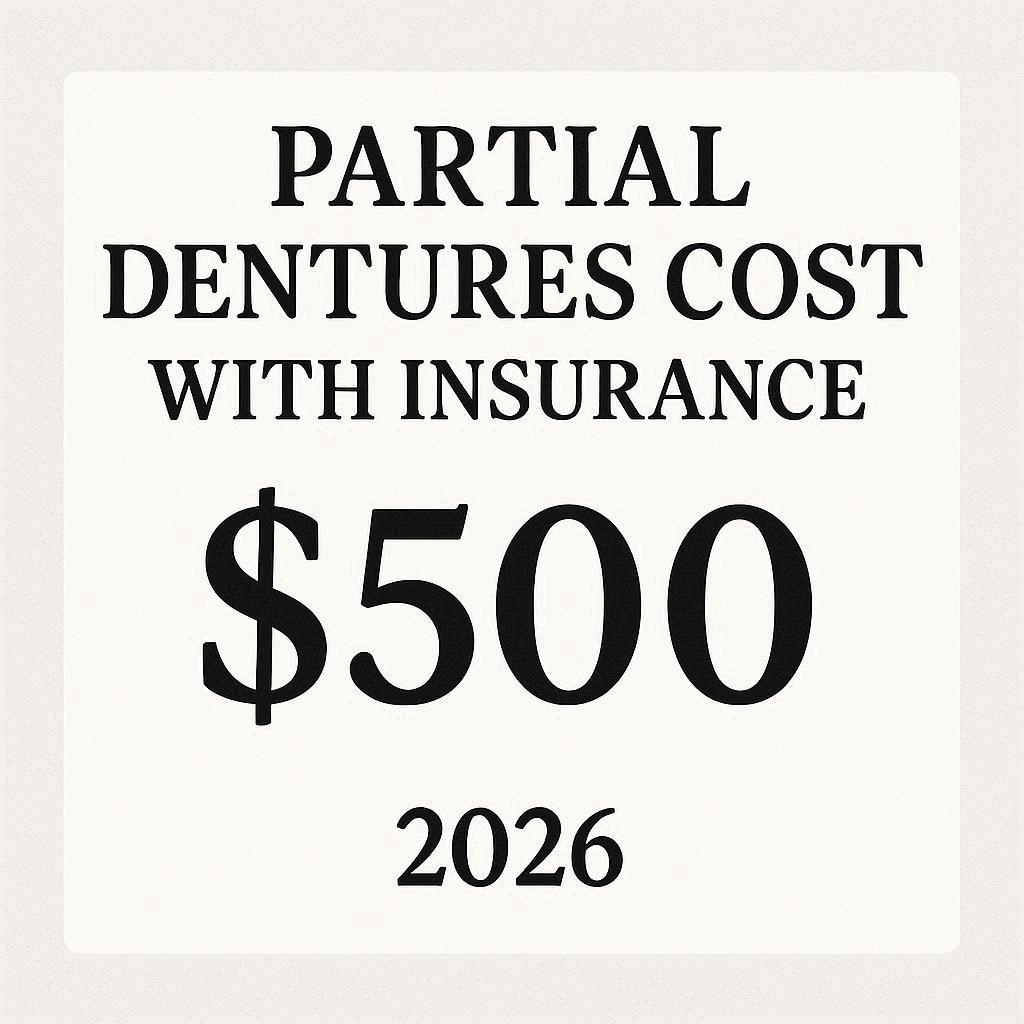
Navigating the partial dentures cost with insurance in 2026 means understanding deductibles, co-insurance, and annual maximums, which can reduce your out-of-pocket for a premium cast metal partial to between $800 and $1,200. The final bill is deeply influenced by your plan’s specific clauses, such as missing tooth exclusions and downgraded alternative benefits, making a pre-treatment estimate the most critical document to request. Ultimately, the true value lies not in finding the cheapest option, but in using your insurance strategically to invest in a durable, comfortable restoration that protects your overall health for a decade.
Frequently Asked Questions
Will my insurance cover a partial denture if I lost the tooth years ago?
Not necessarily. Many policies contain a “missing tooth clause.” This means if the tooth was extracted or missing before your coverage began, the plan will not cover its replacement. You must explicitly ask your insurer if this limitation exists on your plan.
What is the most cost-effective material for a partial in the long run?
Cast metal (cobalt-chrome). While its upfront cost is higher, its exceptional strength and precise fit mean it often lasts 10 to 15 years. The cheaper acrylic alternative is prone to fracture and staining, requiring replacement every 3 to 5 years. Over two decades, the metal option provides superior value.
How can I afford a partial denture if my insurance has a $1,000 maximum?
Sequence the treatment across two years. You can have your teeth extracted and the impressions taken in late fall, using part of your maximum. In January, when your annual maximum resets, you can have the final denture delivered, using the next year’s benefit. You can also look into a supplemental dental savings plan to discount the remaining balance.
Can I upgrade to a flexible partial and just pay the difference?
Yes, this is common. Your insurance will calculate their co-insurance based on the “least expensive alternative treatment,” usually a standard metal or acrylic partial. They pay their percentage of that lower fee. You are then responsible for the entire cost difference between the standard and the premium flexible material, plus your regular co-insurance amount.
Does dental insurance cover implant-supported partials?
Coverage varies wildly. The partial denture itself is covered as a major service. The implants and abutments that support it, however, are often classified as a separate category, sometimes with no coverage or a separate lifetime maximum. A comprehensive pre-treatment estimate is non-negotiable for this complex treatment.
Additional Resource:
For a deeper understanding of the types of partial dentures and their clinical benefits, review the educational material provided by the American College of Prosthodontists at GoToAPro.org.
Disclaimer:
This article provides estimated cost ranges and general information on dental insurance for educational purposes only. The figures are national averages projected for 2026 and do not constitute a quote, guarantee of coverage, or financial advice. Actual costs vary by provider, geographic location, and the specific complexities of your case. Insurance benefits are defined solely by your plan’s specific contract, not by this article. Always consult directly with your dental provider and your dental insurance carrier to verify your coverage, obtain a personalized treatment plan, and receive a binding pre-treatment estimate of your costs.