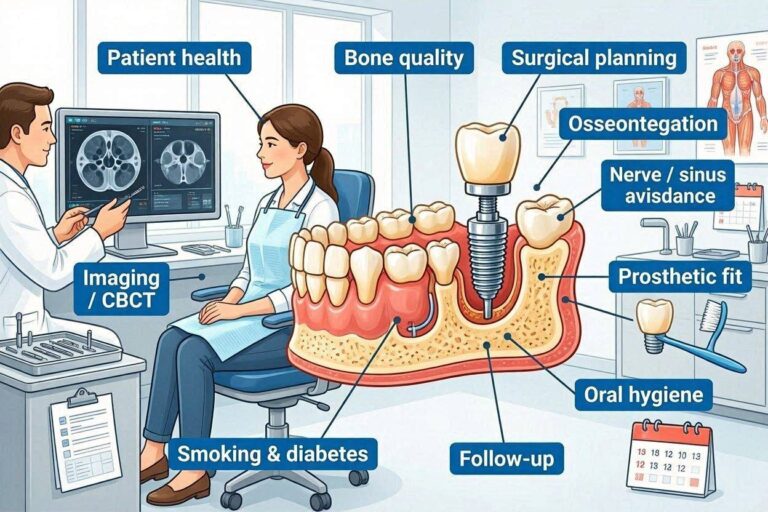
What Is a Full Dental Implant?
The phrase “full dental implant” is a patient’s term, not a clinical one. It emerges from the confusion of a market flooded with partial solutions, mini implants, and temporary fixes. When a patient asks for a “full dental implant,” they are expressing a deep, intuitive desire for something complete. They want a replacement tooth that feels, functions, and looks like a natural, rooted tooth. They want the entire system, from the root buried in the bone to the crown visible above the gum, with no compromises and no hidden gaps. This guide translates that patient desire into precise clinical reality. A full dental implant can mean a single complete tooth replacement, or it can mean a full-arch restoration that replaces every tooth in a jaw. Both are “full” in their completeness, but they are vastly different in scope. This guide will dissect both meanings, define every component, compare a full implant to a traditional bridge or denture, and explain exactly what you receive when you commit to a complete, fully functional implant restoration.
The Complete Single-Tooth Implant: The Tripartite System
The most common understanding of a “full dental implant” is the replacement of a single missing tooth in its entirety. This is not a single part. It is a system of three precisely engineered components, each with a distinct biological and mechanical function.
The Implant Fixture: The Artificial Root
This is the foundation, the titanium or zirconia post that is surgically placed into the jawbone. It is a threaded, cylindrical or tapered device. The surface is not smooth. It is a microscopically roughened, acid-etched, or sandblasted texture, designed to maximize the surface area for bone cells to attach. This is the component that osseointegrates, fusing with the living bone over a period of months. The implant fixture replaces the root of the missing tooth. It is buried under the gum during the initial healing phase. A standard full implant has a diameter of 3.5 to 6.0 millimeters and a length of 8 to 16 millimeters. This is not a mini implant. A mini implant, with a diameter under 3.0mm, is a different device for a different purpose. A full, standard-diameter implant is designed to bear the full, independent, concentrated load of a single molar chewing tough food, year after year. It has the structural robustness to resist fracture and flexure.
The Abutment: The Precision Connector
The abutment is the intermediate piece, a small, custom or stock post that is screwed into the implant fixture. It traverses the thickness of the gum tissue, emerging from the bone into the visible oral cavity. The abutment serves as the prosthetic platform for the crown. It is the component that shapes the gum, supports the soft tissue papilla, and seals the internal connection of the implant against bacterial micro-leakage. A full implant restoration includes a custom or carefully selected stock abutment. It is not a temporary plastic piece. It is a machined, medical-grade titanium or tooth-colored zirconia component, torqued to precise specifications.
The Crown: The Visible Tooth
The crown is the ceramic, porcelain, or zirconia restoration that is cemented or screwed onto the abutment. It is the part you see and chew with. A full crown for a dental implant is a custom-fabricated, laboratory-made restoration. It is not a prefabricated plastic tooth attached to a denture plate. It is a highly aesthetic, individually characterized, and functionally calibrated prosthetic tooth. It is designed to match the shade, translucency, and shape of your natural teeth. The chewing surface is precisely adjusted to harmonize with your bite.
A “full dental implant” for a single tooth is the complete set of these three components, fully seated, fully functional, with the implant osseointegrated and the crown permanently fixed in the mouth. It does not come out. It is your new tooth.
The Full-Arch Dental Implant: The All-on-4 Concept
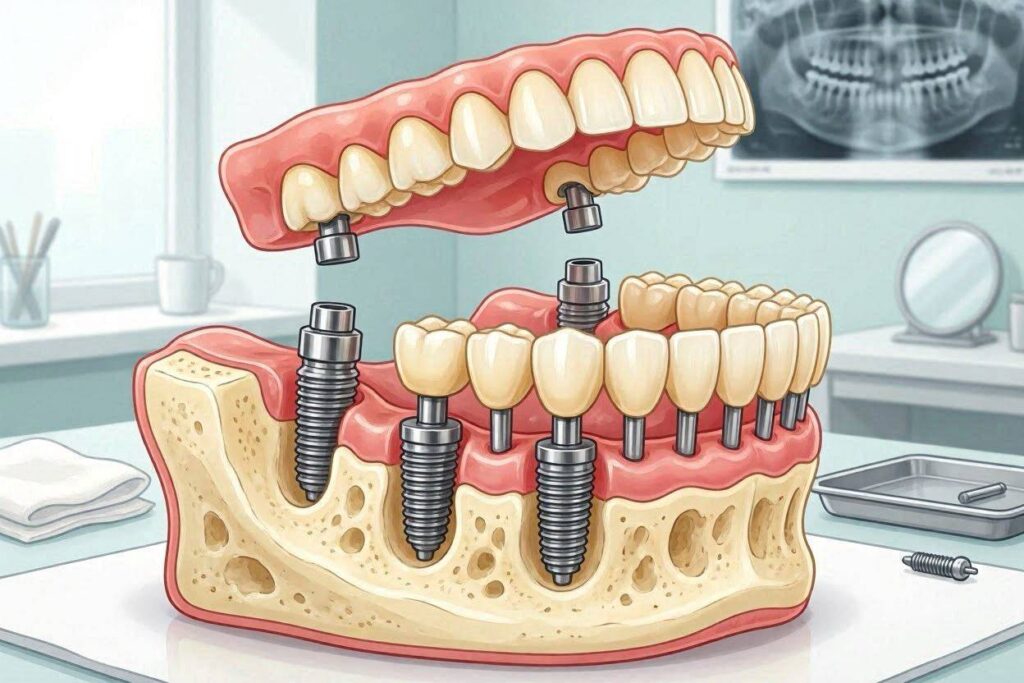
The second meaning of “full dental implant” is the complete replacement of all teeth on a single jaw, or both jaws, using a fixed, implant-supported bridge. This is the procedure that gives a patient a full set of fixed, non-removable, beautiful teeth, supported by a limited number of strategically placed implants. The most famous and well-documented protocol is the All-on-4 technique.
The All-on-4 Engineering Principle
The All-on-4 concept replaces all the teeth on a single arch using only four implants. The two front implants are placed straight, vertically. The two back implants are tilted at an angle of up to 45 degrees. This deliberate tilt achieves several biomechanical advantages. It avoids the maxillary sinus in the upper jaw and the inferior alveolar nerve in the lower jaw, eliminating the need for bone grafting. It increases the distance between the front and back implants, creating a wider support polygon for the bridge. It also allows for the use of longer implants, which engage more cortical bone and achieve higher primary stability. The final bridge is a continuous arch of 10 to 14 teeth, fabricated as a single, rigid, precision-milled structure from acrylic, composite, or solid zirconia. It is screwed into the multi-unit abutments on the implants. The patient cannot remove it. It is a permanent, fixed restoration. Only the dentist can remove it during professional maintenance visits.
This is a “full dental implant” solution in the most life-changing sense. A patient who arrives with a failing, painful set of teeth or a loose, unwearable denture leaves with a fixed, confident, functional smile. The surgery is completed in one day, with a temporary fixed bridge delivered on the same day, allowing the patient to heal with teeth. After four to six months of osseointegration, the final, durable bridge is fitted.
The Implant-Supported Bridge: Full for a Segment
There is a third interpretation, the implant-supported bridge. A patient is missing three or four teeth in a row. Instead of placing an implant for each missing tooth, the surgeon places two implants, one at each end of the gap. These two implants support a single bridge of connected crowns, filling the entire space. This is a “full” replacement for that segment, providing fixed, implant-supported teeth that do not require the grinding down of healthy adjacent teeth, which a traditional tooth-supported bridge demands.
The Direct Comparison: Full Implant vs. Traditional Alternatives
A “full dental implant” must be compared directly to the alternatives it replaces. The distinction reveals why it is the standard of care.
Full Single Implant vs. Tooth-Supported Bridge
A tooth-supported bridge uses the healthy teeth on either side of the gap as pillars. The dentist files these teeth down into small posts, sacrificing healthy enamel and dentin. A three-unit bridge is cemented over them. The false tooth, the pontic, floats over the gum. The bone under the pontic receives no stimulation and resorbs over time. The bridge has an average lifespan of 10 to 15 years before recurrent decay at the margin or root fracture of a supporting tooth causes failure. A full single implant does not touch the adjacent teeth. It preserves them in their pristine state. It preserves the bone. It is a stand-alone restoration. Its long-term success rate is 95%+ at 20 years.
Full-Arch All-on-4 vs. Removable Denture
A full upper denture covers the palate, interfering with taste, temperature sensation, and triggering a gag reflex. A lower denture floats on a shrinking ridge, becoming progressively looser and more painful. Bone resorption accelerates under the pressure of the denture base, leading to the sunken facial appearance of premature aging. A full-arch implant bridge like All-on-4 is fixed. It does not cover the palate. It stabilizes and preserves the bone. The chewing efficiency is restored to near-natural levels. The patient can bite into an apple or enjoy a steak. The psychological transformation is dramatic, restoring body image and social confidence.
| Feature | Full Single Implant | Tooth-Supported Bridge | Removable Partial Denture |
|---|---|---|---|
| Root Replacement | Yes (implant in bone) | No (floating pontic) | No |
| Adjacent Teeth | Untouched | Filed down, crowned | Metal clasps that stress teeth |
| Bone Preservation | Yes | No | No (accelerates bone loss) |
| Stability | Rigid, fixed | Fixed | Moves, clicks, food entrapment |
| Longevity | 20+ years | 10-15 years | 5-7 years |
The Materials That Constitute a Full Implant
A full implant system uses medical-grade materials with decades of biocompatibility data.
- Implant Fixture: Commercially pure titanium (Grade 4) or titanium alloy (Ti-6Al-4V ELI). In some metal-free systems, zirconia (Y-TZP) is used.
- Abutment: Medical-grade titanium alloy or Y-TZP zirconia for the aesthetic zone. The abutment screw is a titanium alloy or gold-plated titanium screw with a defined, low friction coefficient for precise torque.
- Crown: For a single implant, layered porcelain over a metal or zirconia coping, or full monolithic zirconia. For a full-arch bridge, a precision-milled PMMA (acrylic) frame reinforced with titanium, or a full monolithic zirconia arch.
The Treatment Timeline for a Full Implant
A full single implant follows a staged timeline. Stage one is the surgical placement of the fixture. The implant is submerged for three to six months for osseointegration. Stage two is the abutment connection and crown delivery, taking two to three visits over a month. A full-arch All-on-4 has a compressed, immediate-load timeline. The surgery and the delivery of a fixed temporary bridge occur on the same day. The final bridge is delivered four to six months later.
Conclusion
A full dental implant signifies a complete, three-component tooth replacement system consisting of a standard-diameter titanium fixture osseointegrated into the jawbone, a precision-machined abutment connector, and a custom-fabricated ceramic or zirconia crown, providing a permanent, stand-alone, non-removable tooth that independently bears chewing forces. On a larger scale, a full-arch implant solution like All-on-4 replaces an entire jaw of missing or failing teeth with a fixed, screw-retained bridge supported by four to six strategically placed implants. In all cases, the defining characteristics are completeness, permanence, and the biological preservation of the jawbone.
Frequently Asked Questions
Is a “full dental implant” the same as an “implant-supported denture”?
No. An implant-supported denture is a removable denture that snaps onto two to four implants for retention. It is removed nightly for cleaning. A full implant restoration, whether a single crown or an All-on-4 bridge, is fixed and non-removable by the patient. The difference in stability, bone preservation, and psychological experience is profound.
Can I have a full implant done in one day?
For a full-arch restoration like All-on-4, yes. The implants are placed and a temporary fixed bridge is delivered on the same day. The final, permanent bridge is placed months later. For a single implant, the tooth can often be extracted, the implant placed, and a temporary crown fitted on the same day, but this temporary is for aesthetics only, not for chewing.
What is a full zirconia dental implant?
There are two meanings. A full zirconia implant is a metal-free implant where the fixture itself is made of zirconia ceramic instead of titanium, chosen for patients with a proven titanium allergy or a strong desire for a metal-free mouth. A full zirconia crown is a crown or bridge milled from a single, solid block of zirconia ceramic, offering the highest strength and aesthetics.
How much does a full dental implant cost?
A full single implant with all three components ranges from $3,000 to $6,500, depending on the region, the implant brand, and the crown material. A full-arch All-on-4 restoration ranges from $20,000 to $40,000 per arch. The cost reflects the surgical expertise, the medical-grade components, and the laboratory artistry.
Additional Resource:
For further patient education on complete implant solutions, visit the American College of Prosthodontists at www.gotoapro.org.
Disclaimer: This article provides a comprehensive definition and explanation of dental implant treatment options. Your individual clinical situation and treatment plan require a thorough examination and consultation with a qualified implant dentist or prosthodontist. This information is educational and not a diagnosis.