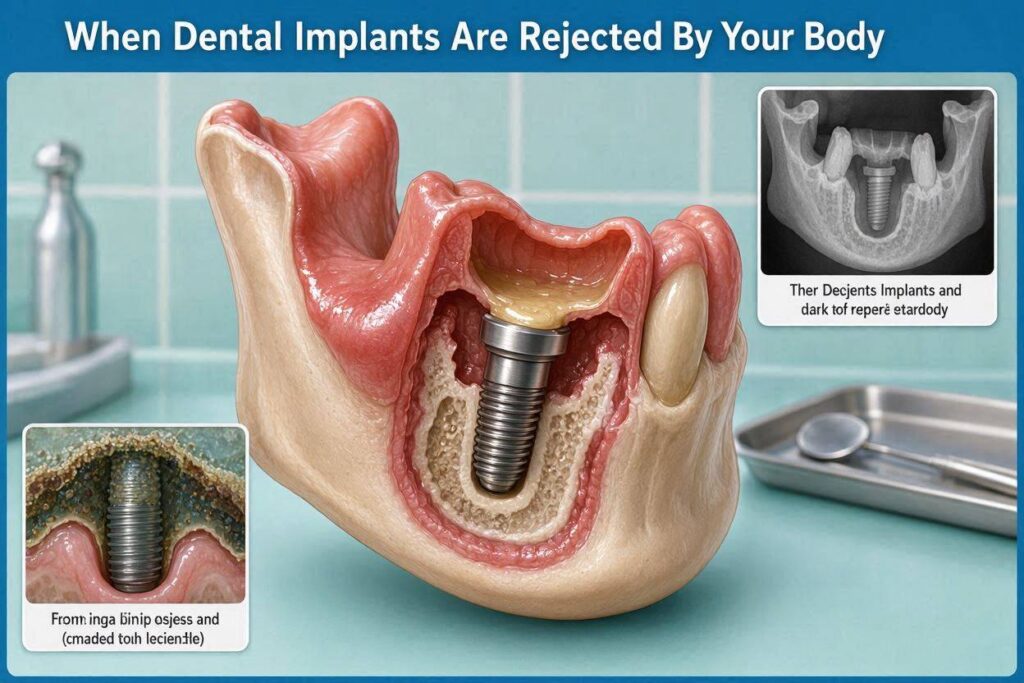
When Dental Implants Are Rejected By Your Body
The promise of dental implants is built on a biological miracle: osseointegration, the direct, structural fusion of living bone to a titanium surface. When this process unfolds as intended, the implant becomes a permanent, functional part of the body, capable of chewing, supporting a beautiful crown, and lasting for decades. But biology is not a machine, and healing is not a guarantee. There is a deep, often unspoken fear that patients bring to the consultation chair: “What if my body rejects the implant?” The language of “rejection” is powerful and visceral, evoking images of organ transplant failure and immune system attacks. However, the biological reality of a dental implant failing is distinct from the immunological rejection of a transplanted kidney or heart.
True immunological rejection of a dental implant, driven by an allergic response to the titanium alloy, is exceedingly rare and scientifically debated. What patients and clinicians commonly refer to as “rejection” is almost always a failed osseointegration—a disruption of the bone healing process that leaves the implant as a loose, fibro-encapsulated foreign body. This failure is a complex interplay of surgical technique, bacterial contamination, systemic host factors, and biomechanical overload. Understanding the timeline of failure, the clinical signs, and the underlying causes is essential for any patient considering an implant. This comprehensive guide will demystify the concept of implant rejection, clearly distinguishing between early biological failure, late septic failure, and the rare phenomenon of true hypersensitivity, empowering you to understand the risks and to recognize the warning signs.
The Biology of Integration: Why Implants Usually Succeed
To understand failure, you must first understand the intended biological process. A dental implant is typically made of commercially pure titanium or a titanium alloy. Titanium is uniquely biocompatible because, when exposed to air or bodily fluids, it instantly forms a stable, dense layer of titanium dioxide on its surface. This oxide layer is a biological masterpiece. It is inert, meaning it does not corrode or release harmful ions into the tissue. It is also bioactive, meaning it attracts calcium and phosphate ions from the blood, creating a surface that bone cells recognize as friendly. Osteoblasts, the bone-forming cells, migrate to the titanium surface, attach, and begin laying down new bone matrix directly onto the oxide layer. There is no soft tissue interface, no fibrous capsule. The implant becomes mechanically locked to the skeleton.
This process requires a blood clot to form around the implant, a cascade of growth factors to be released, and a clean, sterile, low-trauma surgical site. The body’s immune system is involved not in “rejecting” the titanium, but in orchestrating the initial inflammatory response that is necessary for healing. Macrophages clean up debris, and cytokines signal the osteoblasts. This is a process of acceptance and integration, not immune attack.
Early Failure: The Fibrous Encapsulation
What patients call “early rejection” is the failure of osseointegration to occur in the first place. Instead of bone growing onto the implant surface, the body forms a layer of soft, fibrous scar tissue around the implant. The implant is encapsulated, not integrated. It will be mobile, often painless, and will eventually spin out or be lifted out with minimal force. This is a surgical and biological failure, not an immune rejection. The implant is a foreign body that has been walled off.
The causes of this fibrous encapsulation are multifactorial. The most common is surgical trauma. If the surgeon overheated the bone during the drilling process—by using dull drills, applying too much pressure, or failing to use copious sterile saline irrigation—the bone cells around the osteotomy die. This is called thermal necrosis. The implant is placed into a ring of dead bone. The body does not heal dead bone; it resorbs it and replaces it with scar tissue. The implant never gets its chance to integrate.
Bacterial contamination at the surgical site is another major cause. Even a tiny inoculum of bacteria from saliva, from contaminated instruments, or from a pre-existing, undebrided infection in the extraction socket can colonize the implant threads. The body’s immune system attacks the bacteria, creating a pus-filled, inflammatory environment around the implant. Osteoblasts cannot work in a septic environment. The implant becomes a sequestrum, a piece of dead bone and metal surrounded by pus.
Systemic factors are the third pillar. A heavy smoker who did not cease smoking has a profound vasoconstriction that starves the healing bone. A patient with uncontrolled diabetes has non-functional white blood cells and impaired capillary growth. A patient on high-dose bisphosphonates has suppressed bone turnover. In all these cases, the body’s healing machinery is broken, and the default pathway is fibrous encapsulation.
The clinical signs of early failure are subtle. The implant may feel persistently “spongy” or slightly tender weeks after it should have felt solid. A painless, slow-growing, pus-filled pimple (a fistula) may appear on the gum. The surgeon may test the implant with a gentle torque and find it moves. A dull, hollow sound when tapped, instead of a sharp, crystalline ring, is a classic sign of a fibrous interface. The implant must be removed, the site debrided, and the healing process restarted.
Late Failure: Peri-Implantitis, The Silent Bone Destroyer
If an implant has successfully integrated and has been in comfortable function for years, a different type of biological failure can emerge. The patient may notice bleeding when brushing, a bad taste, gum recession exposing the gray titanium threads, and eventually a dull ache or mobility. The implant has not been “rejected” by the immune system; it has been slowly destroyed by a chronic, bacterial biofilm infection called peri-implantitis.
The implant surface, once clean and integrated, becomes colonized by a sticky, tenacious layer of bacteria. The host’s inflammatory response to these bacteria releases enzymes and cytokines that literally dissolve the bone supporting the implant. The bone defect is typically saucer-shaped, a crater around the implant neck. The implant may remain solid until the bone loss reaches the apical third, and then it suddenly becomes mobile and is lost. This is a late, septic failure. The body is not rejecting the titanium; it is attacking the bacteria, and the bone is the innocent bystander caught in the crossfire.
The primary causes are poor oral hygiene, lack of professional maintenance cleanings, a poorly designed crown that makes cleaning impossible, and excess residual cement from the crown cementation trapped below the gum line. The cement acts as a permanent irritant and a bacterial nest. This is why many surgeons prefer screw-retained crowns.
The Titanium Allergy Hypothesis: True Immunological Rejection?
This is the most controversial and rarest form of implant “rejection.” Titanium is considered one of the most biocompatible, inert materials ever implanted in the human body. Yet, a very small number of patients present with a constellation of symptoms that suggest a true Type IV hypersensitivity reaction—a delayed, cell-mediated allergic response to the titanium alloy.
The clinical picture of a titanium allergy is different from the typical fibrous encapsulation or the septic bone loss of peri-implantitis. The patient may develop persistent, red, swollen, painful gums around the implant that do not respond to antibiotics or debridement. There may be a burning sensation. The skin patch test for titanium may be positive, or the MELISA (Memory Lymphocyte Immunostimulation Assay) blood test may show a sensitivity. Radiographically, the bone loss may be rapid and may occur without the typical pus and bleeding of a bacterial infection. The implant is rejected by the body’s immune cells, which recognize the metal ions as foreign and attack the tissue around them.
However, the scientific validity of a true titanium allergy causing implant failure is heavily debated. Titanium dioxide is extraordinarily stable and releases vanishingly few ions. Many patients with a positive MELISA test have perfectly healthy, functioning implants. Many cases of suspected allergy are actually misdiagnosed cases of low-grade chronic infection, cementitis, or occlusal overload. The diagnosis of a titanium allergy should be one of exclusion, made only after all other mechanical and infectious causes have been meticulously ruled out. If a true allergy is diagnosed, the failed implant is removed, and the patient is restored with a zirconia implant, which is a ceramic, metal-free fixture that cannot trigger a metal hypersensitivity.
Rejection vs. Mechanical Failure: The Diagnostic Confusion
Patients often describe a loose crown or a broken screw as “my body rejected the implant.” This is a mechanical failure, not a biological one. The body is perfectly healthy; the hardware failed. A loose abutment screw causes the crown to wobble. The bone and the implant fixture are intact. A fractured implant itself is a metal fatigue failure. The implant snapped under overload. This is not a rejection; it is a material failure.
The distinction is critical because the treatment is completely different. A loose screw is simply replaced and torqued. A fractured implant must be trephined out and a new one placed. A truly failed, fibro-encapsulated implant must be removed, the site debrided of all granulation tissue, and a staged re-entry planned months later. Telling your dentist, “My body is rejecting my implant,” is a helpful starting point, but the clinician must then immediately ask, “Is it loose? Is there pus? When did it start? Does it hurt when you bite?” to distinguish between the mechanical and the biological.
Conclusion
Dental implants are rarely “rejected” by the body in the immunological sense of an organ transplant; the vast majority of biological failures are a fibro-encapsulation of the fixture due to surgical trauma, contamination, or poor systemic healing in the early phase, or a slow, septic destruction of the supporting bone by peri-implantitis in the late phase. The clinical signs of failure include persistent mobility, pus, bleeding, gum recession exposing the implant threads, and a dull, aching pain. Only an exceedingly rare titanium hypersensitivity, confirmed by exclusion and testing, approaches the concept of true immune rejection, and even this can be solved with a metal-free zirconia alternative.
FAQ
Can your body reject a dental implant years later?
Yes, but it is almost always due to a chronic bacterial infection called peri-implantitis that slowly destroys the bone, not a sudden, spontaneous immune rejection. The implant is lost to infection, not allergy.
What are the first signs of implant rejection?
The earliest signs are bleeding when brushing around the implant, a bad taste, a deep pocket detected by the dentist, or a feeling of the crown being slightly loose or squishy when you press on it.
Is it possible to be allergic to a titanium dental implant?
It is exceedingly rare, but a delayed hypersensitivity reaction to titanium is a theoretical and documented phenomenon. It presents as persistent pain, swelling, and rapid bone loss without infection, and is diagnosed after excluding all other causes.
What happens if my implant fails?
The mobile implant must be surgically removed. The site is thoroughly cleaned of infected or fibrotic tissue. After a healing period of several months, a new implant can often be placed, often with a bone graft to restore the lost bone volume.
How can I prevent my body from rejecting an implant?
You cannot control your immune system’s hypersensitivity, but you can prevent the vast majority of biological failures by choosing a skilled surgeon, ceasing smoking before and after surgery, controlling your diabetes, practicing meticulous daily oral hygiene, and attending professional implant maintenance cleanings.
Additional Resources
For a deeper understanding of the science of osseointegration and implant biology, visit the Academy of Osseointegration: https://www.osseo.org/