How Long Is an Implant Screw
The question seems like a request for a single, simple measurement. But a dental implant is not one screw. It is a system of screws. The implant fixture itself, the titanium root buried in the bone, is a threaded screw. The tiny but mechanically critical abutment screw that connects the visible crown to that fixture is also a screw. Each has its own range of precise lengths and diameters, and each is selected by the surgeon based on a three-dimensional map of your specific bone anatomy. The length of the implant screw is not a random choice. It is the single most critical dimension in ensuring the implant is securely anchored in healthy bone, avoids vital structures like the inferior alveolar nerve and the maxillary sinus, and can withstand a lifetime of chewing forces. This guide provides a complete dimensional analysis of dental implant screws. It explains the standard length and diameter ranges for implant fixtures, the engineering of the thread design, the tiny world of the prosthetic abutment screw, and the diagnostic process that determines exactly which implant screw is right for your specific missing tooth.
The Two Screws in an Implant System
To understand the dimensions, you must first separate the two completely different screws that work together.
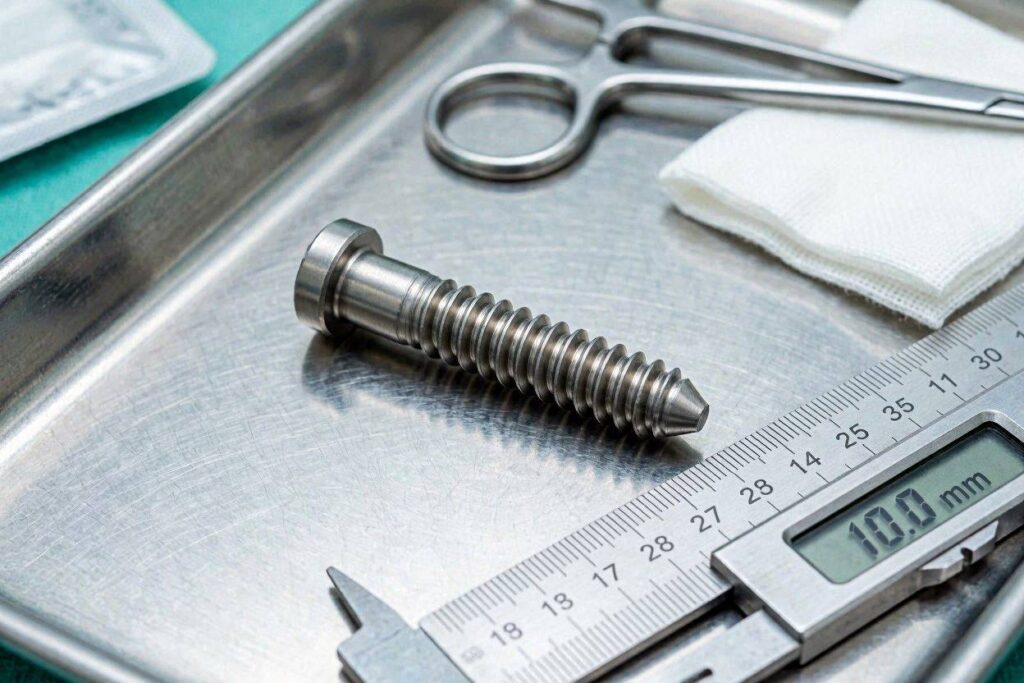
- The Implant Fixture (The Root Screw): This is the large, titanium post placed into the bone. It is a self-tapping, threaded cylinder or cone. Its dimensions—length and diameter—are measured in millimeters and are chosen based on the available bone volume. This is what the patient means by “the implant screw.”
- The Prosthetic Abutment Screw: This is a tiny, delicate, high-precision screw, typically 1.0 to 2.0 millimeters in diameter, that passes through the abutment and threads into the internal connection of the implant fixture. It clamps the abutment to the implant. It is not the implant itself. It is the connecting screw.
The Implant Fixture Length: How Long Is It?
The length of a standard dental implant fixture ranges from 6 millimeters to 18 millimeters. The most commonly used lengths for a single-tooth replacement are between 10 millimeters and 14 millimeters. This is not a random distribution. The length is directly proportional to the vertical height of the available bone in the edentulous site, minus a safety margin of 1 to 2 millimeters from any vital structure.
- Short Implants (6mm to 8mm): These are specialized implants used in situations of severe vertical bone atrophy where a bone graft or sinus lift is not possible or desired. A short implant requires a wider diameter to compensate for its reduced length, maintaining a sufficient surface area for osseointegration. They are used in the posterior mandible above the nerve or in the posterior maxilla with a very low sinus floor.
- Standard Implants (10mm to 14mm): This is the workhorse length range. The majority of single-tooth implants fall within this range. A 10mm or 11.5mm implant is commonly used in the anterior maxilla or the mandible where bone height is adequate.
- Long Implants (16mm to 18mm+): These are used in areas of generous bone height, such as the anterior mandible, or in specific protocols like the All-on-4, where the posterior implants are tilted to engage a long column of bone in the anterior sinus wall or the parasymphyseal region. A long implant maximizes the bone-to-implant contact surface.
The surgeon measures the bone height from the crest of the alveolar ridge to the roof of the mandibular canal (for a lower implant) or to the floor of the maxillary sinus (for an upper implant) on the CBCT scan. A minimum of 1.5 to 2.0 millimeters of safety distance is subtracted. The remaining number is the maximum allowable implant length.
The Implant Fixture Diameter: The Width of the Screw
The diameter of the implant fixture is as critical as its length. Standard implant diameters range from 3.25 millimeters to 6.0 millimeters. The diameter is chosen to fill the width of the bone ridge, leaving at least 1.0 to 1.5 millimeters of healthy bone on both the cheek side (buccal) and the tongue side (lingual).
- Narrow Diameter (3.25mm to 3.5mm): Used for lower incisors and upper lateral incisors, where the natural tooth roots and the mesial-distal space are very narrow. A narrow implant is not mechanically indicated for a molar, where high forces can fracture it.
- Standard Diameter (4.0mm to 4.5mm): The most common diameter for premolars and anterior teeth.
- Wide Diameter (5.0mm to 6.0mm): Used for molars, where the chewing forces are highest and the natural emergence profile of the tooth is wider. A wide-platform implant provides a broader base for the crown and greater mechanical strength. This is the “molar implant screw.”
The Thread Design: The Active Part of the Screw
The body of the implant fixture is covered in a precisely engineered thread pattern. This is not a generic wood screw thread. The thread pitch (the distance between threads), the thread depth, and the thread shape are all designed to optimize primary stability and bone stress distribution.
- Self-Tapping Threads: Most modern implants are self-tapping, meaning the threads cut their own precise path into the bone as the implant is screwed in. This compresses the bone and enhances primary stability.
- Progressive Threads: Some implants have threads that are tighter at the apex (bottom) and wider at the neck. This is designed to compress the softer trabecular bone at the apex and the denser cortical bone at the crest, achieving high stability.
- Micro-Threads at the Neck: Some premium implants have tiny micro-threads at the very top, just below the implant platform. These are designed to preserve the crestal bone, distributing the stress in this vulnerable zone.
The Prosthetic Abutment Screw: The Tiny Titan
This is the screw that patients rarely see and often do not know exists. It is a marvel of micro-engineering. The abutment screw is typically 1.0 to 2.0 millimeters in diameter and about 4 to 8 millimeters in length. It is made of a high-strength titanium alloy, and sometimes the head is coated with a low-friction material like gold or Teflon.
This screw passes through the abutment and engages the internal threaded channel of the implant fixture. It is torqued to a precise specification, typically 15 Ncm for a single anterior tooth and 25-35 Ncm for a molar. The torque is critical. Under-torquing leads to screw loosening, the most common mechanical complication in implant dentistry. Over-torquing can strip the internal threads of the implant or snap the screw head. The dentist uses a calibrated torque wrench, not a hand driver, to deliver this exact force. The abutment screw is a consumable, replaceable component. If it loosens, it can be tightened. If it fractures, it must be carefully retrieved. This is not a failure of the implant; it is a maintenance event.
How the Surgeon Selects the Implant Screw Dimensions
The selection process is a systematic analysis of the CBCT data.
- Bone Height Measurement: The distance from the bone crest to the vital structure is measured. The safety margin is subtracted. The available length determines the maximum implant length.
- Bone Width Measurement: The buccal-lingual width of the ridge is measured at multiple points. The ideal implant diameter is selected so that at least 1.5mm of bone remains on the buccal and lingual sides.
- Bone Density Assessment: The surgeon assesses the density of the bone on the scan. Soft bone requires a slightly larger diameter or a specially designed implant with aggressive threads to achieve primary stability.
- Restorative Space Assessment: The surgeon consults with the restorative dentist. The implant’s final position must be prosthetically driven, meaning the screw access hole for the crown must emerge in a cleanable, aesthetic location, not on the facial surface of an anterior tooth.
The result is a prescription: for example, a “4.1mm diameter x 11.5mm length bone-level implant.”
Conclusion
A dental implant screw, the fixture itself, ranges in length from 6mm to 18mm, with the majority of standard cases using a 10mm to 14mm post, and in diameter from a narrow 3.25mm for a lower incisor to a wide 6.0mm for a molar. The separate, tiny prosthetic abutment screw is only 1.0 to 2.0mm wide and is torqued to exact specifications to clamp the crown to the implant. The precise selection of implant length and diameter is a CBCT-driven, prosthetically guided decision that ensures a 1.5mm safety margin from vital nerves and sinuses while achieving the necessary primary stability in the patient’s unique bone volume and density.
Frequently Asked Questions
Can I feel the implant screw in my bone?
No. The implant is embedded in the bone, which has no tactile sensory nerves. You do not feel the implant fixture. You feel the crown that is attached to it, and you feel pressure on the gum around it, just like a natural tooth. A well-placed, integrated implant is completely imperceptible.
What if the implant screw is too long and hits the nerve?
This is a serious surgical error that is prevented by the CBCT scan and precise depth control during drilling. If an implant impinges on the inferior alveolar nerve, it can cause immediate, persistent numbness or tingling in the lip and chin (paresthesia). If this occurs, the implant must be removed or backed out immediately. The CBCT scan makes this error entirely avoidable.
Can a short implant be as successful as a long implant?
In the correct clinical scenario, yes. A short, wide-diameter implant has a comparable surface area to a longer, narrower implant. Short implants are a successful, well-documented alternative to complex bone grafting, but they require excellent bone density and a perfectly controlled bite. They are a specialized tool, not a universal substitute.
Does the implant screw ever need to be removed?
The implant fixture is designed to be permanent and is only removed if it fails to integrate, fractures, or develops advanced, untreatable peri-implantitis. The abutment screw, the small internal screw, is routinely removed for crown replacement, professional cleaning, or if it loosens and needs replacement.
Additional Resource:
For visual technical specifications of various implant systems, explore the professional resources of the Academy of Osseointegration at www.osseo.org.
Disclaimer: This article provides general dimensional information about dental implant components. The specific implant system, dimensions, and surgical plan for your individual mouth are determined exclusively through a clinical and 3D radiographic examination by a qualified implant surgeon. This is not a substitute for a personal consultation.