How Long Will All-on-4 Dental Implants Last?
You have lost all your teeth, or you are about to. The All-on-4 procedure promises a full arch of fixed, beautiful teeth on just four implants. You have read the success stories, seen the before-and-after photos, and you are ready to reclaim your smile. But before you commit to this life-changing investment, you need the unvarnished truth: how long will this actually last? Is this a ten-year solution, a twenty-year solution, or a true lifetime restoration?
The answer is layered. The All-on-4 concept, when executed with precision and maintained with diligence, is a long-term, durable solution with documented success beyond two decades. However, the implants themselves, the prosthetic bridge, and the individual prosthetic teeth all have different longevity profiles. Understanding these distinctions, the factors that influence lifespan, and the maintenance required will give you a realistic, honest picture of what to expect.
This guide will break down the long-term data on All-on-4 survival, differentiate between implant survival and prosthesis survival, and outline the protocols that maximize the lifespan of your new smile.
The All-on-4 System: Two Components, Two Lifespans
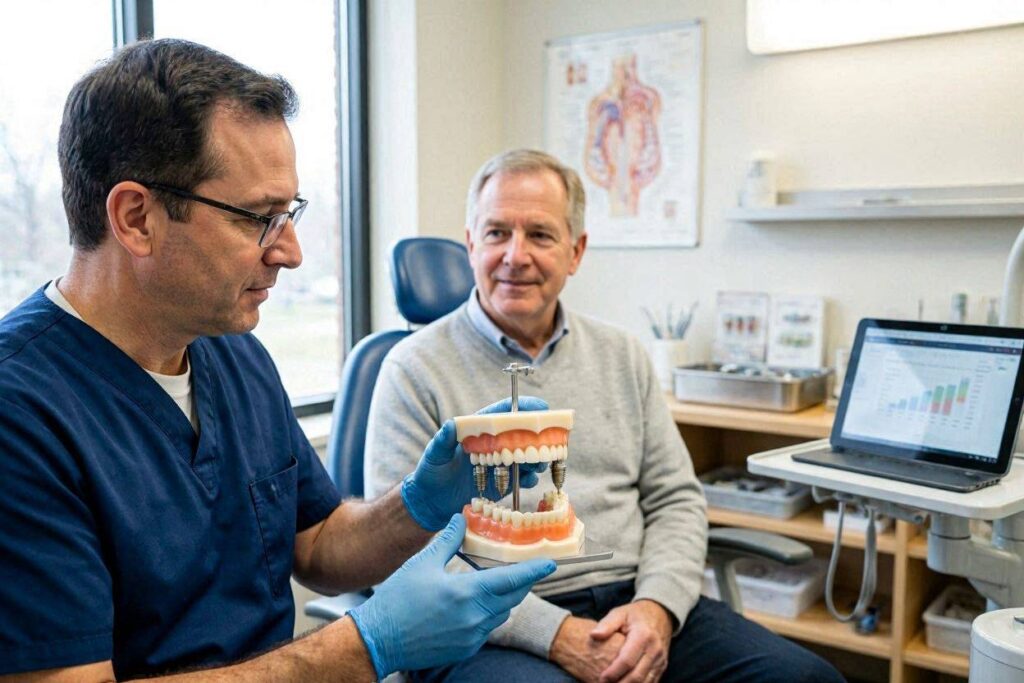
To answer the longevity question accurately, you must separate the All-on-4 system into its two main components.
- The Implant Fixtures: The four titanium posts surgically embedded in your jawbone.
- The Full-Arch Prosthesis: The bridge of teeth that is screwed onto the implants. This is typically an acrylic (PMMA) temporary prosthesis initially, followed by a definitive prosthesis made of a rigid metal framework with acrylic teeth, or a milled zirconia bridge.
The lifespan of these two components is distinctly different.
Implant Fixture Survival: The 20-Year Data
The implant fixtures are the foundation. If they fail, the entire prosthesis fails. The long-term survival of All-on-4 implants is well-documented.
A landmark prospective study by Malo and colleagues, following patients for 10 to 18 years, reported cumulative implant survival rates of 93% to 98% for the mandible (lower jaw) and 94% to 98% for the maxilla (upper jaw). These are excellent numbers by any surgical standard.
A 20-year retrospective study published in the International Journal of Oral & Maxillofacial Implants showed a cumulative implant survival rate of over 92% at two decades.
What this means in plain language: out of 100 All-on-4 implants placed, 92 to 98 of them are still functioning and solidly integrated 20 years later. The implants that are lost are typically lost early, within the first year, due to failed osseointegration, or late, due to peri-implantitis or overload.
With proper care, the titanium implants have the biological potential to last a lifetime. They do not have an expiration date. They fail because of disease, not because of material fatigue.
Prosthesis Survival: The Bridge Itself
The full-arch bridge is a complex mechanical structure subjected to intense forces. It is not a biological structure, and it will not last a lifetime without maintenance and eventual replacement.
The Definitive Prosthesis (Metal-Acrylic or Zirconia)
The definitive, long-term All-on-4 prosthesis is typically one of two types:
- Metal Framework with Bonded Acrylic Teeth: A titanium or chrome-cobalt bar supports individual acrylic denture teeth. This is a durable, repairable design.
- Monolithic Zirconia Bridge: A single block of milled zirconia with porcelain or stain-glazed teeth. This is extremely strong and aesthetic.
Studies report prosthesis survival rates of over 98% at 10 years for the definitive metal-acrylic hybrid. However, “survival” does not mean the prosthesis is free of wear or minor fractures. It means the prosthesis has not been completely replaced.
Realistically, the acrylic teeth on a metal-acrylic prosthesis will show significant wear after 10 to 15 years. They can chip, wear down, and lose their aesthetic luster. The metal framework is usually intact. Individual teeth can often be repaired or replaced without making an entirely new bridge.
A well-maintained metal-acrylic prosthesis has a realistic lifespan of 15 to 20 years before it may need to be remade or significantly refurbished.
The Monolithic Zirconia Prosthesis
Zirconia is remarkably strong and wear-resistant. Porcelain chipping on the cosmetic overlay is possible. The underlying zirconia framework is virtually indestructible in the mouth. A well-made zirconia prosthesis could easily last 20 years or more, though the scientific long-term data for this specific material in full-arch application is less extensive than for the metal-acrylic hybrid.
The Immediate Temporary Prosthesis: A Shorter Life
The temporary prosthesis you receive on the day of surgery is made of polymethyl methacrylate (PMMA), a high-quality acrylic. It is designed to be worn for four to six months while your implants osseointegrate. It is not designed for long-term use.
Some patients, for financial reasons, opt to wear the temporary as their permanent restoration, with periodic reinforcement. While this can work, the temporary prosthesis is significantly weaker and more prone to fracture than the definitive one. It typically lasts 1 to 3 years before major repairs or replacement is needed. It is not a long-term solution.
Factors That Directly Impact All-on-4 Lifespan
Why do some All-on-4 cases thrive for 25 years while others develop problems in five?
1. The Cantilever and Mechanical Forces
The posterior teeth on an All-on-4 bridge are often cantilevered, meaning they extend beyond the most distal implant. This cantilever creates a lever arm. Every bite on the back teeth generates a force that tries to pry the prosthesis off the implants. The longer the cantilever, the greater the stress on the distal implants, the prosthetic screws, and the framework.
A well-designed prosthesis limits the cantilever to the equivalent of one to two teeth. Excessive cantilever length leads to screw loosening, framework fracture, and implant overload. The skill of the restorative dentist in designing the occlusion and the cantilever is a major determinant of longevity.
2. Bruxism and Parafunction
Patients who grind or clench their teeth generate forces far beyond normal chewing. These forces are devastating to a full-arch prosthesis. They accelerate wear of the acrylic teeth, increase the risk of porcelain chipping on zirconia, loosen prosthetic screws, and can cause implant bone loss from overload. A professionally made, hard night guard is mandatory for any All-on-4 patient with bruxism. Without it, the lifespan of the prosthesis is significantly reduced.
3. Oral Hygiene and Peri-implantitis
This is the single most critical patient-driven factor. The All-on-4 prosthesis creates a large, sheltered space underneath. Food debris and plaque accumulate rapidly. If the patient does not perform meticulous daily cleaning, including using a water flosser and interdental brushes, peri-implantitis will develop. Bone loss around the implants compromises their support. This is the leading cause of late implant failure in All-on-4 cases.
4. Professional Maintenance Frequency
The All-on-4 patient must see a hygienist or dentist every three to four months. During these visits, the prosthesis is removed by the dentist, cleaned ultrasonically, the underlying abutments and implants are inspected and cleaned, the prosthetic screws are checked and re-torqued if necessary, and the occlusion is evaluated. The O-rings or seals are checked. A patient who skips these maintenance visits is on a fast track to complications.
5. Smoking and Systemic Health
Heavy smoking is a powerful risk factor for peri-implantitis and implant failure. Uncontrolled diabetes compromises healing and increases the risk of infection. Optimizing systemic health and quitting smoking are essential for maximizing All-on-4 lifespan.
The Maintenance Schedule That Maximizes Lifespan
Here is the non-negotiable maintenance protocol for an All-on-4 patient.
- Daily Home Care: Soft electric toothbrush for the prosthesis. Water flosser with non-metal tip for the underside. Interdental brushes and implant floss around the implant abutments. Superfloss under the bridge. Alcohol-free antimicrobial mouthwash.
- Every 3 to 4 Months: Professional hygiene visit. The prosthesis is removed, cleaned, and inspected. The implants are examined and cleaned with plastic or titanium instruments. Radiographs are taken annually.
- Annually: The prosthetic screws are tested for torque. The occlusion is checked and adjusted. The night guard is checked for fit and wear.
- Prosthesis Refurbishment: Expect to have the acrylic teeth rebonded or replaced, or the prosthesis relined, after 10 to 15 years.
- Prosthesis Replacement: Plan for the eventual fabrication of a new prosthesis, likely in the 15 to 20-year range, as part of the long-term budget.
The “Rescue” Scenario: What Happens When an Implant Fails?
Even with excellent care, an implant may fail years later. The beauty of the All-on-4 system is its resiliency. If one implant fails, the prosthesis can often be temporarily supported by the remaining three while the site heals. A new implant is placed, and after integration, the prosthesis is reattached. In some cases, the prosthesis can be modified to function on three implants, particularly if the failed implant is one of the anterior ones. The loss of one implant does not necessarily mean the loss of the entire restoration.
Conclusion
The All-on-4 implant fixtures have documented survival rates exceeding 92% at 20 years, with the potential to last a lifetime when protected from peri-implantitis. The definitive full-arch prosthesis itself, whether a metal-acrylic hybrid or a zirconia bridge, has a realistic functional and aesthetic lifespan of 15 to 20 years before it requires significant refurbishment or replacement. The longevity of the entire system hinges on rigorous daily hygiene, strict professional maintenance every three to four months, and the management of destructive forces like bruxism through a night guard.
FAQ
1. Can the All-on-4 prosthesis be repaired if a tooth chips?
Yes. If the prosthesis is a metal-acrylic hybrid, individual acrylic teeth can often be repaired, rebonded, or replaced directly in the mouth or by sending the prosthesis to the laboratory. Zirconia prostheses with porcelain chips are more difficult to repair and may require a new prosthesis if the damage is extensive.
2. How often do the screws in the All-on-4 bridge need to be tightened?
The prosthetic screws are initially tightened to a precise torque. At your annual maintenance visit, the dentist will remove the access hole fillings and check the screw torque. Screws rarely need tightening if everything is stable, but annual verification is standard protocol to catch early loosening before it becomes a fracture.
3. Is the All-on-4 procedure a one-time cost?
The initial fee covers the surgery, the implants, and the first set of teeth (often a temporary, then a definitive prosthesis). The long-term budget must include the cost of quarterly maintenance visits, possible repairs, and the eventual replacement of the prosthesis 15 to 20 years down the line.
4. Can I sleep without my All-on-4 prosthesis?
No. Unlike a removable denture, the All-on-4 prosthesis is fixed and is only removed by the dentist. You sleep with it in place. The prosthesis is cleaned in situ, just like natural teeth.
Additional Resource
For more on the long-term clinical outcomes of the All-on-4 technique, visit the Malo Clinic clinical research page: https://maloclinics.com/