How To Not Gag On Your Mouth Guard?
You slide your mouth guard into place, and almost immediately, your throat tightens. Your eyes water. The urge to retch rises from somewhere deep in your throat, and you yank the guard out before you embarrass yourself or worse. If you wear a mouth guard for sports, for teeth grinding, or for sleep apnea, you know this feeling. The gag reflex is powerful, involuntary, and deeply frustrating when it stands between you and the protection your teeth need.
The good news is that you are not stuck with this response forever. The gag reflex can be managed, reduced, and in many cases, largely overcome through a combination of physical techniques, gradual desensitization, and adjustments to the mouth guard itself. This guide provides practical, proven strategies to help you wear your mouth guard comfortably and gag-free.
Understanding the Gag Reflex
The gag reflex, also called the pharyngeal reflex, is a protective mechanism designed to prevent foreign objects from entering the throat and airway. When certain areas in the mouth and throat are stimulated, the muscles of the pharynx contract involuntarily. The soft palate elevates, and the sensation of needing to vomit arises.
Why Mouth Guards Trigger Gagging
Mouth guards extend into the mouth and can contact several of the trigger zones for the gag reflex. The most sensitive areas include the soft palate, the back of the tongue, the posterior pharyngeal wall, and the uvula. A mouth guard that extends too far back on the palate or that contacts the back of the tongue will reliably trigger gagging in sensitive individuals.
The material of the guard can also be a factor. The taste, smell, or texture of certain plastics can provoke a sensory reaction that compounds the physical stimulation. The psychological expectation of gagging, once established, can itself become a trigger. If you have gagged on your mouth guard before, the anticipation of doing so again primes your nervous system to react.
The Role of Anxiety
The gag reflex has a strong psychological component. Anxiety about gagging makes gagging more likely. This creates a vicious cycle: the guard triggers a mild gag response, which causes anxiety about future gagging, which sensitizes the reflex, which makes the next experience worse. Breaking this cycle involves both physical desensitization and relaxation techniques.
Choosing the Right Mouth Guard
The journey to gag-free mouth guard wear begins with the guard itself. Not all mouth guards are created equal, and the differences between them significantly affect comfort.
Custom-Fitted Guards from a Dentist
A mouth guard fabricated by a dentist from an impression of your teeth is the best option for minimizing the gag reflex. These guards are made to fit your mouth precisely. They cover only the teeth and the necessary amount of gum tissue. The borders are trimmed to avoid contact with the soft palate and to end well short of the trigger zones.
Dentists understand the anatomy of the gag reflex and can design the guard accordingly. They can also use thinner materials where possible, reducing the bulk that contributes to the sensation of something foreign in the mouth. If your current guard makes you gag, a custom guard from a dentist is the single most effective upgrade you can make.
Boil-and-Bite Guards
Boil-and-bite mouth guards, available at sporting goods stores and pharmacies, are softened in hot water and then bitten into to create a custom-ish fit. These are an improvement over stock guards but are still relatively bulky. The material extends further onto the palate and gums than a custom guard, and the fit is less precise.
If you use a boil-and-bite guard and experience gagging, you can try trimming the back edge carefully with scissors after molding. Remove material from the posterior border, the part that extends toward the throat, a little at a time. Stop when the guard no longer triggers your gag reflex while still covering your back teeth. Be conservative; you can always trim more, but you cannot add material back.
Stock Mouth Guards
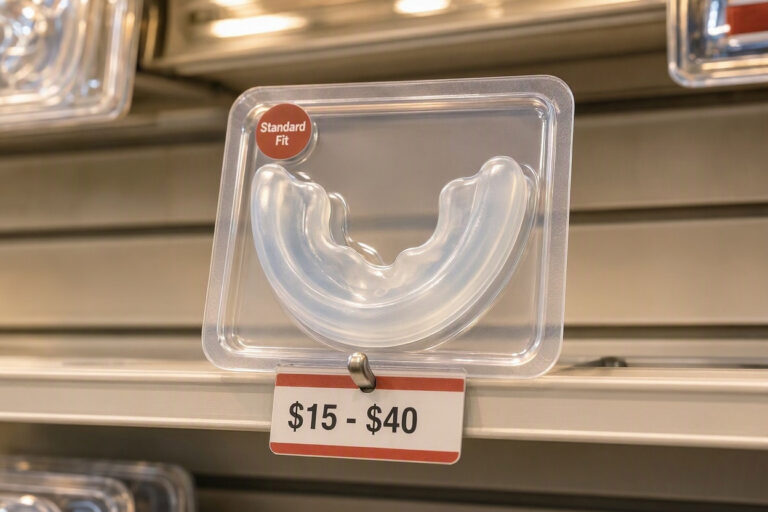
Stock mouth guards, the pre-formed kind that come in small, medium, and large, are the most likely to trigger gagging. They are bulky, they fit loosely, and they extend further back in the mouth than necessary. If you are using a stock guard and struggling with gagging, upgrading to at least a boil-and-bite guard, and ideally a custom guard, will make a substantial difference.
Considerations for Specific Uses
Sports mouth guards need to be thick enough to absorb impact. A dentist can design a custom sports guard that provides protection while minimizing bulk in the areas that trigger gagging. Night guards for bruxism, teeth grinding, can often be made thinner than sports guards because they do not need to absorb high-velocity impacts. A thin, hard acrylic night guard that covers only the biting surfaces of the teeth is often well-tolerated by gaggers.
Mandibular advancement devices for sleep apnea extend further back because they need to engage both arches to pull the lower jaw forward. These can be more challenging for gaggers. Working with a dentist experienced in sleep appliances is important, as design modifications can improve comfort significantly.
Gradual Desensitization Techniques
Even with the best mouth guard, some individuals need to train their gag reflex to tolerate the presence of an oral appliance. Desensitization is a process of gradual, controlled exposure that raises the threshold for triggering the reflex.
The Toothbrush Method
Start by identifying the area where your gag reflex begins. Use your toothbrush to gently touch the front part of your tongue, an area that should not trigger gagging. Hold the contact for a few seconds while breathing calmly. Repeat this several times over a few days.
Gradually move the toothbrush further back on your tongue, stopping when you begin to feel the first hint of a gag response. Stay at that point, just short of triggering a full gag, and breathe through your nose. Do this daily for a week or two. Each week, move slightly further back. Over time, the reflex habituates, and the trigger point moves further back in the mouth.
The key is patience. Rushing the process or pushing too hard reinforces the reflex rather than reducing it. Progress should be measured in weeks, not days.
The Finger Method
Similar to the toothbrush method, use your clean finger to apply gentle pressure to the roof of your mouth, starting behind the front teeth and moving progressively backward. The palate is a trigger zone for many people, and desensitizing this area helps with mouth guards that cover part of the palate.
Apply pressure for a few seconds, breathe through your nose, and release. Do not push to the point of gagging. Stop just before that threshold. Over time, the area that can be tolerated expands.
The Insertion Progression
Instead of inserting the mouth guard fully from day one, start by simply holding the guard in your mouth for a few seconds without biting into it. Remove it before gagging begins. Repeat several times per session, several sessions per day.
Gradually increase the time the guard stays in your mouth. Then begin biting into it gently, but do not fully seat it. Progress to full seating over the course of one to two weeks. The incremental approach prevents the association of the guard with the unpleasant gagging experience.
Pairing with a Positive Stimulus
Engage in something distracting and pleasant while wearing the guard during desensitization. Watch television, listen to music, or do a task that requires focus. The distraction reduces the conscious attention paid to the sensation of the guard, which reduces the likelihood of gagging.
Physical Techniques to Suppress the Gag Reflex
Several physical maneuvers can temporarily suppress the gag reflex enough to insert the mouth guard and allow the body to acclimate.
Nose Breathing
Breathing through the nose is incompatible with gagging to some degree. When you gag, the airway closes, and breathing stops. By consciously focusing on slow, steady nasal breathing, you override the reflex arc. Before inserting the guard, take several deep breaths through your nose. Continue this breathing as you place the guard. If the urge to gag arises, intensify your focus on the breath.
The Squeeze Technique
Make a fist with your left hand, squeezing the thumb inside the fingers. This maneuver activates a neural pathway that can inhibit the gag reflex. The mechanism is not fully understood, but many people find it helpful. Squeeze firmly as you insert the guard and for the first few moments it is in place.
Chin Tuck
Tucking your chin down toward your chest shortens the distance between the chin and the throat and can reduce the sensitivity of the gag reflex. Try inserting the guard with your chin slightly tucked rather than with your head tilted back, which stretches the throat and can increase sensitivity.
Salt on the Tongue
Placing a small pinch of salt on the back of the tongue just before inserting the guard can briefly desensitize the area. The salt stimulates sensory receptors in a way that seems to dampen the gag response for a short period. This is a temporary technique, not a long-term solution, but it can help during the desensitization phase.
Throat Spray
Over-the-counter numbing sprays containing benzocaine or similar topical anesthetics can temporarily reduce the sensitivity of the throat. Spraying a small amount on the back of the tongue and soft palate before inserting the guard can make the initial placement more tolerable. Use this sparingly and do not rely on it long-term. Numbing sprays are a bridge to desensitization, not a permanent crutch.
Adjusting the Mouth Guard for Better Comfort
If you already have a mouth guard and cannot immediately replace it, modifications can reduce the gag response.
Trimming the Posterior Border
For boil-and-bite and some custom guards, the back edge can be trimmed to end further forward in the mouth. The guard should still cover the last teeth but need not extend onto the soft palate or the tissues behind the last molar. Use small, sharp scissors and trim conservatively. Smooth any rough edges with the fine side of an emery board.
Thinning the Palatal Coverage
If the guard covers a significant portion of the palate, and you do not have a palatal trigger, the bulk may still contribute to the sensation of fullness that triggers anxiety and then gagging. A dentist can thin the palatal portion of a custom guard. For boil-and-bite guards, thinning is more difficult to do evenly and may compromise the structural integrity.
Smoothing Rough Edges
Rough or sharp edges on a mouth guard irritate the soft tissues and draw attention to the appliance, making the brain more aware of its presence. Smooth all edges with a fine emery board or a dedicated acrylic polishing tool. The guard should feel seamless against your gums and tongue.
Using Orthodontic Wax
For areas of the guard that irritate specific spots, orthodontic wax can provide a temporary smooth covering. This is more commonly used for braces but can be applied to a rough spot on a mouth guard until a permanent adjustment is made.
| Issue | DIY Solution | Professional Solution |
|---|---|---|
| Guard extends too far back | Trim with small scissors | Dentist adjusts borders |
| Guard is too bulky on palate | Difficult to modify | Dentist thins material |
| Rough edges trigger tongue | Smooth with emery board | Dentist polishes all surfaces |
| Poor overall fit | Replace with boil-and-bite | Dentist fabricates custom guard |
| Material taste or smell | Soak in mouthwash, rinse well | Use different material |
Mental Strategies and Relaxation
The psychological component of the gag reflex means that mental strategies can be as effective as physical ones.
Visualization and Distraction
Before inserting the guard, visualize yourself wearing it comfortably. Imagine the guard as a normal, harmless object, like a piece of food that you are not swallowing. Engage your mind in something else as you place the guard. Count backward from one hundred by sevens. Recite the lyrics to a favorite song in your head. The conscious brain can only focus on so many things at once, and occupying it with a cognitive task reduces its attention to the gag sensation.
Controlled Breathing and Progressive Relaxation
Before putting in the guard, sit quietly and progressively relax the muscles of your face, jaw, and throat. Unclench your jaw. Let your tongue rest heavily in the floor of your mouth. Soften the muscles around your eyes. Take slow, deep breaths, inhaling through your nose for a count of four, holding for a count of four, and exhaling through your nose for a count of four.
This relaxation response counteracts the sympathetic nervous system activation that accompanies the expectation of gagging. A relaxed throat is less reactive than a tense one.
Acceptance and Reframing
The fear of gagging can become more problematic than the physical sensation itself. Acknowledge that the sensation is uncomfortable but not dangerous. Your body is trying to protect you from something it mistakenly perceives as a threat. You are not in danger. Reframing the sensation as a harmless reflex, like a sneeze or a hiccup, reduces its emotional charge.
When to Seek Professional Help
For most people, the combination of a well-fitted guard and desensitization techniques resolves the gagging issue within a few weeks. When these approaches fail, professional help is available.
Consultation with Your Dentist
Your dentist can evaluate the fit of your current guard and may identify design issues that contribute to gagging. A new guard with a different design, coverage, or material may solve the problem. Dentists also understand the anatomy of the gag reflex and can educate you about your specific trigger zones.
Referral to a Specialist
In rare cases, an exaggerated gag reflex can be so severe that it prevents routine dental care and appliance wear. These patients may benefit from consultation with a specialist in orofacial myofunctional therapy, who can provide structured exercises to normalize oral sensation. In extreme cases, a psychologist or therapist trained in cognitive behavioral therapy can help address the anxiety component that perpetuates the gag cycle.
Acupuncture and Acupressure
Some evidence suggests that acupuncture or acupressure at specific points, particularly the P6 point on the inner wrist, can reduce gag reflex sensitivity. This approach has been studied primarily in the context of dental impressions and endoscopy, but the principles may apply to mouth guard tolerance as well.
Conclusion
Stopping a mouth guard from triggering the gag reflex involves three parallel approaches: obtaining the best-fitting guard possible, ideally a custom appliance made by a dentist with minimal posterior and palatal extension; desensitizing the reflex through gradual, consistent exposure using the toothbrush or finger method; and employing physical and mental techniques such as nose breathing, the fist squeeze, and cognitive distraction during insertion. Most people who struggle with gagging can overcome it with patience and persistence, and those who cannot should seek professional evaluation of their guard fit and reflex sensitivity.
FAQ
How long does it take to stop gagging on a mouth guard?
With consistent desensitization practice, most people see significant improvement within two to four weeks. Some achieve comfort within days, while those with severe reflex sensitivity may take longer.
Can a dentist make a mouth guard that does not trigger the gag reflex?
Yes. A custom mouth guard made by a dentist is specifically designed to avoid the trigger zones. The dentist takes an impression that captures the extent of your palate and the position of your soft palate, then fabricates a guard that stops well short of those sensitive areas.
Is it normal to gag on a mouth guard at first?
Yes. The mouth guard is a foreign object, and the body’s initial response is often to reject it. This response usually diminishes with repeated, controlled exposure. If it does not, the fit of the guard should be evaluated.
What if I need a mouth guard for sleep apnea and I gag?
Mandibular advancement devices for sleep apnea are more challenging for gaggers because they involve both arches. Work with a dentist experienced in dental sleep medicine. They can use techniques such as incremental advancement, where the lower jaw is brought forward gradually over weeks, which allows the gag reflex to adapt alongside the jaw position change.
Can I use numbing spray every night for my mouth guard?
Numbing spray should be used temporarily during the desensitization period, not as a long-term nightly solution. Relying on it prevents the natural habituation of the reflex. Reduce the amount and frequency of spray over time as tolerance improves.
Why does my mouth guard make me gag but my retainer does not?
Retainers are typically much thinner and cover less tissue than mouth guards. They are designed for passive wear and do not need the bulk required for impact absorption or bite alteration. The minimal coverage of a retainer is less likely to contact the trigger zones.
Can children overcome mouth guard gagging?
Yes. Children can be desensitized using the same gradual techniques as adults. The process should be framed as a game or challenge to reduce anxiety. A pediatric dentist can also fabricate a custom guard that fits a child’s smaller mouth appropriately.
What if nothing works and I still gag?
A very small percentage of people have an extremely sensitive gag reflex that does not respond to standard interventions. In these cases, referral to a specialist is appropriate. Options include intensive desensitization therapy, cognitive behavioral therapy, and in rare cases, pharmacological management of the reflex.
Additional Resource
For more information about custom mouth guards and managing the gag reflex, visit the American Dental Association at ada.org. The ADA provides patient education on mouth guards for sports and bruxism and can help you locate a qualified dentist in your area.