How Long Do Dental Implants Last?
You run your tongue over the new crown, feeling its smooth surface where a gap once was. The implant feels solid. Permanent. But a question lingers in the back of your mind: how long will this really last? Will it still be there in ten years? Twenty? For the rest of your life?
Dental implants represent a significant investment of time, money, and trust. You deserve honest answers about their longevity. This guide draws on decades of clinical research, real-world patient outcomes, and expert consensus to give you a complete picture of how long dental implants last and what determines their lifespan.
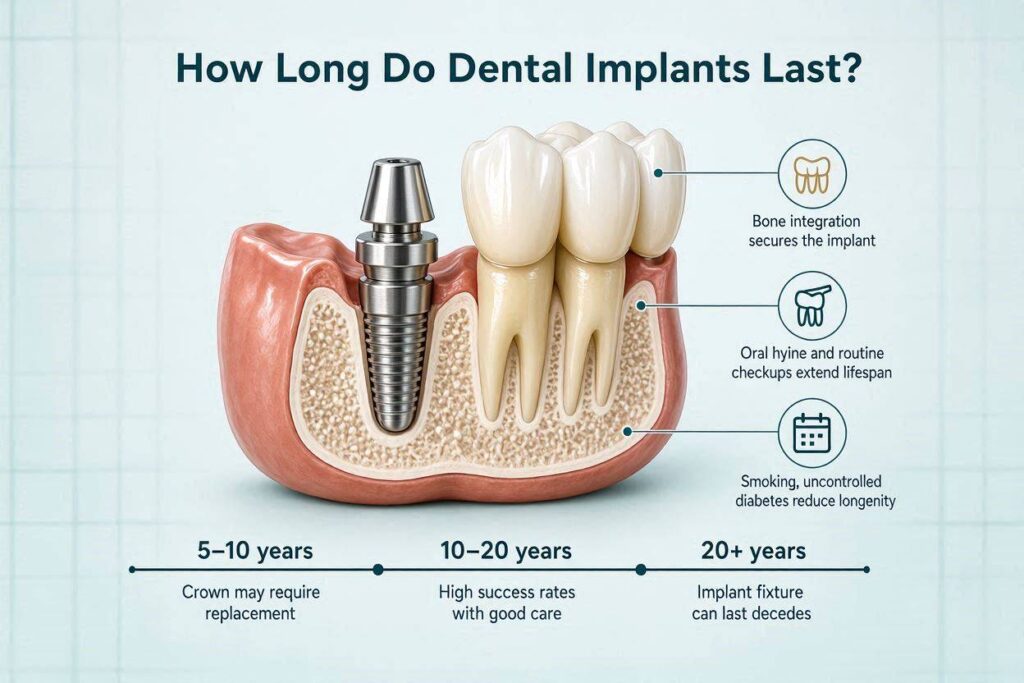
The Short Answer: How Long Do Dental Implants Last
Dental implants can last a lifetime. That statement is not marketing hyperbole. It reflects the reality documented in long-term clinical studies. However, “can last” and “will last” are different things. The distinction lies in factors you control and factors you do not.
Research tells us the following with confidence:
- Dental implant survival rates exceed 95% at 10 years
- Most well-maintained implants survive 20 to 25 years or longer
- Many patients keep their original implants for the rest of their lives
- The crown or prosthesis attached to the implant typically needs replacement before the implant itself fails
The implant fixture, the titanium or zirconia post surgically placed in your jawbone, is the most durable component. The visible crown, bridge, or denture attached to it faces daily wear and may require replacement after 10 to 15 years, sometimes longer.
Understanding Implant Success Versus Implant Survival
Researchers distinguish between implant survival and implant success. Understanding this distinction helps you interpret longevity claims.
Implant Survival
A surviving implant is one that remains in the mouth and functions. It has not been removed. However, surviving implants may have problems:
- Bone loss around the implant beyond acceptable thresholds
- Chronic inflammation of the surrounding gum tissue
- Difficulty cleaning due to exposed implant threads
- Aesthetic concerns about gum recession or metal visibility
An implant can “survive” for decades while causing ongoing problems that diminish quality of life.
Implant Success
A successful implant meets stricter criteria:
- No pain or discomfort
- No mobility (the implant does not move)
- Less than 0.2 mm of bone loss per year after the first year
- No signs of infection or inflammation
- Aesthetic appearance acceptable to the patient
- Functional loading without complications
When implant professionals talk about implants lasting a lifetime, they mean successful implants, not merely surviving ones.
The Numbers Behind Success
| Timeframe | Implant Survival Rate | Implant Success Rate |
|---|---|---|
| 5 years | 96–98% | 92–96% |
| 10 years | 93–97% | 88–94% |
| 15 years | 90–95% | 85–90% |
| 20 years | 88–93% | Variable; fewer studies |
These numbers come from systematic reviews pooling data from hundreds of studies. Individual outcomes depend heavily on patient factors and maintenance.
The Components and Their Respective Lifespans
A dental implant is not a single piece. It is a system of components, each with its own expected lifespan.
The Implant Fixture
The implant fixture is the titanium or zirconia post surgically embedded in the jawbone. This component:
- Is designed to last a lifetime
- Integrates with living bone through osseointegration
- Rarely fails once successfully integrated
- May eventually fail due to peri-implantitis or excessive forces
When implants fail, the fixture most often fails within the first year due to failed osseointegration. Late failures, occurring years after placement, typically involve bone loss from infection or overload.
The Abutment
The abutment connects the implant fixture to the visible restoration. It screws into the implant and protrudes through the gum tissue. Abutments:
- Are made of titanium, zirconia, or gold alloy
- Typically last 10 to 20 years
- May require replacement due to screw loosening or fracture
- Can be replaced without removing the implant fixture
Abutment screw loosening is one of the most common complications in implant dentistry. It is usually minor and easily corrected.
The Crown, Bridge, or Denture
The visible restoration attached to the implant bears the brunt of daily use. Crowns and bridges:
- Typically last 10 to 15 years with proper care
- May last 20 years or longer in ideal circumstances
- Fail due to wear, fracture, or aesthetic degradation
- Are replaceable without affecting the underlying implant
A patient who receives an implant at age 50 can expect to replace the crown at least once, possibly twice, in their lifetime.
Component Comparison Table
| Component | Material | Expected Lifespan | Replaceable? |
|---|---|---|---|
| Implant fixture | Titanium or zirconia | Lifetime potential | Only if it fails |
| Abutment | Titanium, zirconia, gold | 10–20 years | Yes, without removing implant |
| Crown (single) | Porcelain, zirconia, PFM | 10–15 years | Yes, straightforward replacement |
| Bridge | Porcelain, zirconia, PFM | 10–15 years | Yes, more involved replacement |
| Overdenture | Acrylic with metal framework | 5–10 years | Yes, typically relined or replaced |
Factors That Determine How Long Dental Implants Last
Longevity is not random. Specific, identifiable factors predict whether an implant will last months, years, or decades.
Surgeon Skill and Technique
The person placing your implant matters enormously. Surgical factors affecting longevity include:
- Implant positioning: Proper angulation and depth prevent future complications with hygiene and force distribution
- Avoidance of anatomical structures: Damage to nerves, sinuses, or adjacent teeth compromises outcomes
- Sterile technique: Infection introduced during surgery can cause early failure
- Primary stability: Achieving sufficient initial stability allows osseointegration to proceed
- Tissue management: Preserving adequate gum tissue around the implant supports long-term health
Choose a surgeon with specific implant training and substantial experience. Board certification in implant dentistry or oral surgery signals advanced competence.
Bone Quality and Quantity
Your jawbone is the foundation upon which the implant rests. Bone factors include:
| Bone Factor | Impact on Longevity |
|---|---|
| Density | Denser bone provides better initial stability and support |
| Volume | Adequate bone height and width are necessary for proper implant placement |
| Quality | Healthy, well-vascularized bone heals better than sclerotic or irradiated bone |
| Graft history | Grafted bone may not be as predictable as native bone |
Patients with poor bone quality may require longer healing periods, shorter implants, or adjunctive procedures to optimize outcomes.
Oral Hygiene
After the implant integrates, your daily care determines how long it lasts. Peri-implantitis, the leading cause of late implant failure, is almost entirely preventable with proper hygiene.
Effective implant care includes:
- Brushing around the implant at least twice daily
- Flossing with implant-specific floss or using interdental brushes
- Using an antimicrobial mouth rinse if recommended
- Cleaning under implant-supported bridges with specialized aids
- Attending professional cleanings every 3–6 months
Implants are not immune to plaque and bacteria. They require as much care as natural teeth, sometimes more.
Smoking and Tobacco Use
Smoking is among the strongest predictors of implant failure. The research is unequivocal:
- Smokers have implant failure rates 2 to 3 times higher than non-smokers
- Smoking impairs blood flow, reducing healing capacity
- Tobacco use increases the risk of peri-implantitis
- Long-term smoking is associated with progressive bone loss around implants
Quitting smoking before implant placement and remaining tobacco-free afterward dramatically improves long-term outcomes. Some surgeons decline to place implants in heavy smokers due to the unacceptably high failure risk.
Systemic Health Conditions
Your overall health influences how your body maintains the bone-implant interface.
| Condition | Impact on Implant Longevity |
|---|---|
| Well-controlled diabetes | Minimal impact; success rates similar to non-diabetics |
| Poorly controlled diabetes | Significantly higher failure rates |
| Osteoporosis | May affect bone healing; medication-related considerations |
| Autoimmune conditions | Variable impact; depends on condition and medications |
| History of radiation to jaws | High risk; requires specialized management |
| Bisphosphonate use | Risk of medication-related osteonecrosis of the jaw |
Disclose your complete medical history to your implant surgeon. Some conditions can be managed to improve implant outcomes.
Bruxism and Occlusal Forces
Teeth grinding and clenching (bruxism) subject implants to forces they were never designed to withstand. Natural teeth have a periodontal ligament that acts as a shock absorber. Implants lack this ligament and are rigidly fixed to bone.
Excessive forces on implants cause:
- Screw loosening or fracture
- Crown fracture
- Bone loss around the implant
- Eventual implant failure in severe cases
Patients with bruxism should:
- Wear a night guard consistently
- Discuss occlusal adjustments with their dentist
- Consider implant-protected occlusion schemes
- Be monitored for signs of overload at regular checkups
Regular Professional Maintenance
Implants require professional care, not just home hygiene. Regular maintenance visits allow early detection of problems:
- Peri-implant probing: Measuring the gum attachment around the implant detects early bone loss
- Radiographic assessment: Periodic X-rays reveal bone levels and implant integrity
- Occlusal evaluation: Checking bite forces ensures the implant is not being overloaded
- Professional cleaning: Removing calculus without scratching the implant surface
The recommended recall interval for implant patients is typically 3 to 6 months, not the 6 to 12 months common for patients without implants.
The Most Common Causes of Implant Failure Over Time
Understanding why implants fail helps you prevent those failures.
Early Failure (Within the First Year)
Early failures occur before or during the restorative phase. The implant never successfully integrates with the bone.
| Cause | Mechanism |
|---|---|
| Failed osseointegration | Bone does not attach to the implant surface |
| Surgical trauma | Overheating bone during preparation damages cells |
| Infection | Bacterial contamination at placement |
| Micromotion | Implant moves during healing period |
| Overloading | Forces applied too soon after placement |
| Compromised healing | Due to smoking, diabetes, medications |
Early failures are typically evident within weeks to months of placement. The implant either fails to become stable or shows progressive bone loss on radiographs.
Late Failure (After the First Year)
Late failures occur after successful integration and restoration. The implant was working well, then began to fail.
| Cause | Mechanism |
|---|---|
| Peri-implantitis | Bacterial infection causing progressive bone loss |
| Overload | Excessive forces causing microfractures at bone-implant interface |
| Systemic changes | New medical conditions or medications affecting bone metabolism |
| Implant fracture | Rare; usually due to material defect or extreme overload |
| Iatrogenic damage | Damage from adjacent dental procedures |
Late failures are often preventable. Peri-implantitis, the most common cause, results from inadequate oral hygiene and lack of professional maintenance.
Peri-Implantitis: The Silent Threat to Implant Longevity
Peri-implantitis deserves special attention because it is the leading cause of late implant failure and is largely preventable.
What Is Peri-Implantitis
Peri-implantitis is an inflammatory condition affecting the soft and hard tissues surrounding an osseointegrated dental implant. It involves:
- Inflammation of the peri-implant mucosa (mucositis)
- Progressive loss of supporting bone
- Bleeding on probing
- Possible suppuration (pus)
- Eventual implant mobility if untreated
Peri-implantitis is analogous to periodontitis around natural teeth, but it progresses faster and is more difficult to treat due to differences in tissue anatomy and blood supply.
Prevalence
The prevalence of peri-implantitis is higher than many patients and even some clinicians realize:
- Peri-implant mucositis (reversible inflammation without bone loss) affects approximately 43% of implant patients
- Peri-implantitis (with bone loss) affects approximately 22% of implant patients
- These rates vary widely by study, but the problem is significant
These numbers underscore the importance of long-term maintenance. Getting an implant is not a one-time event. It is the beginning of a lifelong commitment to care.
Risk Factors for Peri-Implantitis
| Risk Factor | Strength of Evidence |
|---|---|
| Poor oral hygiene | Very strong |
| History of periodontitis | Very strong |
| Smoking | Strong |
| Irregular maintenance | Strong |
| Diabetes (poorly controlled) | Moderate |
| Excess cement from crown placement | Moderate |
| Genetic susceptibility | Emerging evidence |
| Alcohol consumption | Limited evidence |
Prevention of Peri-Implantitis
Prevention strategies include:
- Meticulous home care: Brushing, flossing, and using adjunctive cleaning aids daily
- Professional maintenance: Regular cleanings with implant-safe instruments
- Risk factor management: Smoking cessation, diabetes control
- Proper restoration design: Crowns that allow access for cleaning
- Early intervention: Treating peri-implant mucositis before it progresses to peri-implantitis
Treatment of Peri-Implantitis
Once bone loss has occurred, treatment aims to stop progression and, in some cases, regenerate lost tissue:
- Non-surgical debridement: Cleaning the implant surface without surgery; limited effectiveness for advanced cases
- Surgical access and debridement: Opening the gum to access and clean the contaminated implant surface
- Bone grafting: Attempting to regenerate lost bone; results are less predictable than for natural teeth
- Implant removal: In advanced cases, the implant must be removed
The difficulty of treating peri-implantitis reinforces the importance of prevention.
How Long Different Types of Implants Last
Not all implant treatments have identical longevity profiles.
Single Tooth Implants
A single implant supporting one crown is the most studied and most predictable implant treatment. Long-term data shows:
- 95–97% survival at 10 years
- Most failures occur early
- Crowns typically need replacement at 10–15 years
- Excellent long-term prognosis with proper care
Implant-Supported Bridges
Bridges supported by two or more implants carry more variables:
- More implants mean more potential failure points
- Bridge design affects cleanability
- Forces are distributed across multiple implants
- Survival rates are generally comparable to single implants when properly designed
- Bridge fracture or screw loosening may occur
Full Arch Implant Restorations (All-on-4, All-on-6)
Full arch restorations replacing all teeth in a jaw involve multiple implants supporting a fixed prosthesis:
| Component | Expected Lifespan |
|---|---|
| Implants (4–6 fixtures) | 90–95% survival at 10 years |
| Metal framework | 10–20 years |
| Acrylic teeth and base | 5–10 years |
| Screws and attachments | May need periodic tightening or replacement |
The prosthesis typically needs replacement or significant refurbishment more often than the implants themselves.
Implant-Supported Overdentures
Overdentures are removable prostheses that snap onto implants. Longevity considerations include:
- Implants: 90–95% survival at 10 years
- Locator attachments or bars: Require replacement of plastic components every 6–12 months
- Overdenture itself: 5–10 years before relining or replacement
- Maintenance visits: More frequent than fixed restorations
Mini Dental Implants
Mini implants have a smaller diameter than standard implants. Long-term data is less robust, but available evidence suggests:
- Higher failure rates than standard-diameter implants in some applications
- May be more susceptible to fracture due to smaller diameter
- Often used for overdenture retention rather than single tooth replacement
- Long-term studies with 10+ year follow-up are limited
The Impact of Age on Implant Longevity
Age itself is not a contraindication to dental implants, but it influences the longevity calculus.
Implants in Younger Patients
Patients in their 20s and 30s who receive implants face unique considerations:
- The implant must last 50, 60, or 70 years
- Natural teeth may shift over decades, potentially affecting implant position
- Wear and tear accumulate over a longer period
- The patient will likely need multiple crown replacements over their lifetime
- Jaw growth in very young patients (under 18–21) is a contraindication
Implants in Middle-Aged Patients
Patients in their 40s and 50s represent the typical implant demographic:
- Implants placed at this age often last for the remainder of life
- One or two crown replacements may be needed
- Existing dental conditions (wear, grinding) should be addressed
- The investment typically pays off over decades of use
Implants in Older Patients
Patients over 65 can successfully receive and maintain implants:
- Healing may be slightly slower, but success rates remain high
- Medical comorbidities require careful management
- Manual dexterity for hygiene may be a concern
- The implant may outlive the patient, which is a positive outcome
- Cognitive decline affecting hygiene ability should be considered
Comparing Dental Implants to Other Tooth Replacement Options
Understanding how implants compare to alternatives helps contextualize their longevity.
Implants vs. Dental Bridges
| Factor | Dental Implant | Traditional Bridge |
|---|---|---|
| Lifespan of restoration | 10–15 years for crown | 10–15 years for bridge |
| Impact on adjacent teeth | None; preserves natural teeth | Requires reduction of adjacent teeth |
| Bone preservation | Preserves underlying bone | Bone loss continues under missing tooth |
| Long-term cost | Higher initial, lower lifetime | Lower initial, more replacements |
| Failure consequences | Implant loss, possible grafting needed | Bridge failure, adjacent tooth damage |
Implants preserve natural tooth structure and prevent bone loss, offering advantages beyond simple tooth replacement.
Implants vs. Removable Partial Dentures
| Factor | Dental Implant | Partial Denture |
|---|---|---|
| Lifespan | Decades | 5–10 years |
| Stability | Fixed; does not move | May shift or dislodge |
| Bone preservation | Preserves bone | Accelerates bone loss under the denture |
| Comfort | Like natural teeth | Can cause sore spots and discomfort |
| Maintenance | Routine hygiene | Removal, cleaning, adjustments |
| Cost | Higher initial | Lower initial |
Implants vs. Complete Dentures
| Factor | Implant-Supported Restoration | Complete Denture |
|---|---|---|
| Retention | Fixed or snap-in stability | Adhesive-dependent |
| Bone preservation | Significantly better | Progressive bone loss |
| Function | Near-natural chewing | Reduced chewing efficiency |
| Quality of life | Higher patient satisfaction | More complaints about fit and function |
| Lifespan | Implants: decades; prosthesis: 5–10 years | Denture: 5–7 years before replacement |
How to Maximize the Lifespan of Your Dental Implants
You have significant control over how long your implants last. These strategies give you the best odds.
Daily Home Care
Your daily routine is the single most important factor in implant longevity:
- Brush twice daily with a soft-bristled brush, paying special attention to the implant crown margins
- Floss daily using implant-specific floss, interdental brushes, or water flossers
- Use antimicrobial rinse if recommended by your dentist
- Clean under bridges with floss threaders or specialized brushes
- Remove and clean overdentures daily if applicable
- Inspect your implants for signs of gum redness, swelling, or bleeding
Professional Maintenance
Schedule and keep regular professional maintenance appointments:
| Recall Interval | Patient Type |
|---|---|
| 3 months | History of periodontitis, smokers, complex restorations |
| 4 months | Most implant patients |
| 6 months | Excellent home care, no risk factors, stable long-term |
During maintenance visits, your clinician should:
- Probe around implants gently with plastic or titanium probes
- Assess for bleeding, suppuration, and pocket depth
- Take periodic radiographs to evaluate bone levels
- Check occlusion and adjust if needed
- Clean implant surfaces with appropriate instruments
- Replace overdenture attachments as needed
Lifestyle Modifications
| Behavior | Recommendation |
|---|---|
| Smoking | Quit; if unable, reduce and inform your dentist |
| Alcohol | Moderate consumption |
| Diet | Balanced nutrition supporting bone health |
| Bruxism | Night guard use |
| Hard foods | Avoid chewing ice, hard candy, bones |
| Sports | Mouthguard for contact sports |
Warning Signs to Report
Contact your dentist if you notice:
- Bleeding around the implant when brushing or spontaneously
- Redness or swelling of the gum around the implant
- Bad taste or odor from the implant area
- Implant mobility or a sensation of movement
- Changes in how the implant feels when you bite
- Pain or discomfort around the implant
- Recession of the gum exposing metal components
Research Data on Implant Longevity
The scientific literature provides substantial evidence on how long implants last.
Landmark Studies
| Study | Follow-Up | Key Finding |
|---|---|---|
| Adell et al. (1990) | 15 years | 86% success in maxilla, 94% in mandible |
| Lekholm et al. (1999) | 10 years | 95% survival for single implants |
| Buser et al. (2012) | 10 years | 98.8% survival for titanium-zirconium implants |
| French et al. (2021) | 20 years | 89% survival in a private practice setting |
Systematic Reviews
Systematic reviews pool data from multiple studies to provide more robust estimates:
- A 2019 review in the Journal of Dental Research found 94.6% survival at 10 years across more than 200 studies
- A 2020 review found implant-supported overdentures had 95% survival at 10 years
- A 2021 review found single implants had 97% survival at 5 years and 95% at 10 years
These numbers represent averages. Individual outcomes vary based on all the factors discussed in this guide.
What Happens When an Implant Fails
Despite best efforts, some implants fail. Understanding the process helps you plan.
Recognizing Implant Failure
Signs of a failing implant include:
- Mobility: A successfully integrated implant should be immobile. Movement indicates loss of osseointegration.
- Pain: While some discomfort after surgery is normal, persistent or late-onset pain suggests problems.
- Infection: Pus, swelling, or persistent bleeding signals infection.
- Progressive bone loss: Visible on radiographs, progressive bone loss around the implant is a hallmark of failure.
- Implant exposure: As bone recedes, implant threads may become visible.
Removal and Replacement
When an implant fails, removal is typically straightforward:
- The implant is unscrewed or, if osseointegration has failed, simply lifted out
- The site is debrided and allowed to heal
- Bone grafting may be performed if significant bone loss has occurred
- After healing (typically 3–6 months), a new implant can often be placed
- Success rates for replacement implants are generally comparable to initial implants
The Emotional Impact
Implant failure carries psychological weight. Patients invest hope, money, and time. A failed implant can feel like a personal failure. It is important to understand:
- Implant failure is rarely the patient’s fault
- Most failures result from biological factors outside patient control
- Replacement is usually possible
- Support from your dental team is available
The Financial Perspective: Longevity and Value
Implants cost more upfront than other tooth replacement options. Their longevity determines whether they represent good value.
Cost Per Year Analysis
Consider a single tooth replacement comparing an implant to a bridge:
| Cost Factor | Implant | Bridge |
|---|---|---|
| Initial cost | $3,000–$6,000 | $2,500–$5,000 |
| Expected lifespan | 25+ years for implant; crown at 10–15 years | 10–15 years |
| Replacement cost | Crown: $1,500–$2,500 | New bridge: $3,000–$6,000 |
| Cost per year over 30 years | Approximately $200–$300 | Approximately $300–$500 |
| Adjacent tooth impact | None | Adjacent teeth at risk |
When calculated over decades, implants often cost less than alternatives despite higher initial investment.
Insurance Considerations
Dental insurance typically covers implants differently than other procedures:
- Many plans now include implant coverage, though often with annual maximums
- Medical insurance may cover implants in certain circumstances (trauma, congenital conditions)
- The crown portion may have separate coverage from the surgical placement
- Annual maximums often limit insurance’s contribution significantly
Conclusion
Dental implants can last a lifetime, and research demonstrates success rates exceeding 95% at 10 years and 90% or higher at 20 years. The titanium fixture surgically placed in the jawbone rarely fails once successfully integrated. The crown, bridge, or denture attached to the implant typically requires replacement every 10 to 15 years due to normal wear. Longevity depends primarily on surgical quality, consistent oral hygiene, regular professional maintenance, smoking status, and management of systemic health conditions. Understanding and controlling these factors gives you the best chance of keeping your implants functional, comfortable, and attractive for decades.
Frequently Asked Questions
What is the average lifespan of a dental implant?
The implant fixture itself can last 25 years or longer, often a lifetime. The attached crown typically lasts 10 to 15 years before needing replacement. Overall, well-maintained implants have a 90–95% survival rate at 10 to 20 years.
Do dental implants ever need to be replaced?
The implant fixture rarely needs replacement if it integrates successfully and is well-maintained. However, implants can fail due to peri-implantitis, overload, or systemic factors, requiring removal and possible replacement.
How do I know if my dental implant is failing?
Warning signs include implant mobility, pain, gum swelling or bleeding around the implant, bad taste or odor, gum recession exposing the implant threads, and changes in how the implant feels when biting. Contact your dentist if you notice any of these signs.
Can dental implants last 50 years?
Yes, dental implants can last 50 years. The first modern dental implants were placed in the 1960s, and some original patients still have functioning implants more than five decades later. Achieving this longevity requires excellent oral hygiene, regular professional maintenance, and favorable health conditions.
Are dental implants better than bridges in terms of longevity?
Implants generally outlast bridges and preserve adjacent natural teeth. While both options require periodic restoration replacement, implants do not rely on adjacent teeth for support and help preserve underlying jawbone. Over a lifetime, implants often prove more cost-effective despite higher initial investment.
Additional Resources
- American Academy of Implant Dentistry: www.aaid.com — Comprehensive implant education for patients and professionals
- American College of Prosthodontists: www.prosthodontics.org — Information on tooth replacement options
- International Team for Implantology: www.iti.org — Evidence-based implant dentistry resources