Dental Implants In Buford GA: What Are They?
The decision to replace missing teeth is one of the most significant health investments a person can make. For residents of Buford, Georgia, dental implants have become the clear standard of care. They are not merely a cosmetic fix; they are a complete, functional, and biological restoration of what has been lost. The phrase “Dental Implants in Buford, GA” represents the local delivery of this advanced surgical and restorative therapy by qualified clinicians.
This comprehensive guide is written for the Buford community. It will provide a thorough, patient-centered education on the true nature of dental implants. You will learn the precise definition of the implant system, the materials science and biology that make it work, the structured clinical process, the types of implant solutions available, and the unique health benefits that distinguish this treatment from all other forms of tooth replacement.
The Unseen Biology of Tooth Loss
A natural tooth is an organ with two distinct functional parts. The clinical crown is the hard, visible structure you see in the mouth. The root is the portion housed within the alveolar bone of the jaw. The root’s function is far more than mechanical anchorage. The periodontal ligament that surrounds the root transmits the forces of chewing—compression, tension, and torsion—into the surrounding bone tissue. This mechanical stimulus is a critical biological signal. It activates the bone’s mechanoreceptors and directs a constant process of healthy bone remodeling. The body maintains the bone because it senses that it is functionally necessary.
When a tooth is lost, this essential biomechanical signal is permanently lost. The body begins a natural, irreversible process of disuse atrophy known as residual ridge resorption. The jawbone in the area of the missing tooth shrinks in both vertical dimension and buccolingual width. Over a span of years, this progressive bone loss can fundamentally change the shape of the face, leading to a sunken, aged appearance around the mouth and a weakening of the jaw. A dental implant is the only tooth replacement technology that restores this lost biological stimulus.
What Is a Dental Implant? The Complete System
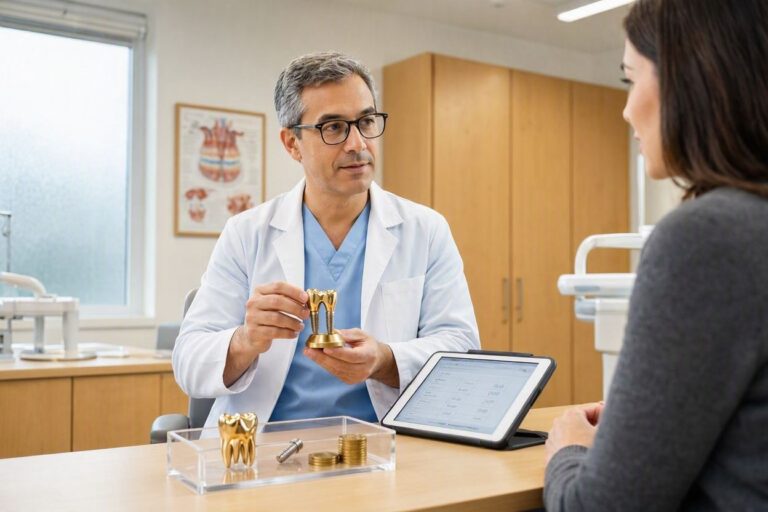
A dental implant is a highly engineered, three-component medical device designed to replace a missing tooth in its entirety, from the root to the crown.
Component 1: The Implant Fixture (The Artificial Root)
The implant fixture is the part placed within the bone. It is a precision-crafted post, typically cylindrical with a threaded exterior. It is manufactured from a medical-grade titanium alloy, specifically Ti-6Al-4V ELI. This material is chosen for its unique and scientifically proven property of osseointegration. Titanium is biocompatible, meaning the body does not recognize it as a foreign substance and does not mount an immune rejection against it. Instead, the titanium oxide layer that naturally forms on the surface actively attracts osteoblast cells. The bone cells anchor directly onto the roughened, micro-structured surface of the implant. Over a healing period, the implant becomes structurally fused to the living bone. It transforms into a synthetic tooth root, locked permanently within the jaw.
Component 2: The Abutment (The Connector Post)
Once the osseointegration process is successfully completed, a second small component is attached. The abutment is a connector post that is secured into the internal connection of the implant fixture. It passes from the level of the bone, through the gingival soft tissue, and into the oral cavity. Its function is to serve as the precise, stable platform for the final crown. In a state-of-the-art implant restoration, this abutment is a custom-milled component, digitally designed to support the gum tissue in a natural contour and to create the ideal emergence profile for the new tooth.
Component 3: The Implant Crown (The Visible Tooth)
The third component is the prosthetic crown, the part you see and use to chew. It is not a generic, mass-produced tooth. It is a custom-crafted restoration fabricated by a master ceramist in a dental laboratory. Using a digital scan of the patient’s mouth, the crown is milled from a solid block of high-strength, aesthetic ceramic. The most commonly used materials are monolithic lithium disilicate (such as Ivoclar e.max) and layered or full-contour yttria-stabilized zirconia. These materials are selected for their exceptional flexural strength and their ability to optically replicate the translucency, color, and texture of natural enamel.
The Phased Treatment Process for Buford Patients
The delivery of a dental implant follows a structured, biologically driven sequence. A reputable implant practice in Buford, GA, will never compromise these timelines.
Phase 1: Comprehensive 3D Diagnostic Workup
Your care begins with a thorough diagnostic appointment. The cornerstone of this phase is a Cone Beam Computed Tomography (CBCT) scan. A standard dental X-ray is not adequate for modern implant planning. The CBCT creates a high-resolution, three-dimensional volumetric model of your jaws. Using this model, the clinician evaluates the height, width, and density of the available alveolar bone, precisely identifies the location of the inferior alveolar nerve canal and the floor of the maxillary sinus, and performs a complete virtual surgical placement of the implant using specialized planning software.
Phase 2: Alveolar Ridge Augmentation (Bone Grafting)
If the CBCT reveals that the bone volume is insufficient to fully surround and support an implant of standard dimensions, a preparatory bone graft is indicated. This is a common and highly successful procedure. The surgeon places a sterile, biocompatible osteoconductive grafting material into the area of deficiency. This material acts as a scaffold, guiding the body’s own regenerative cells to populate the area and form new, living bone. In the upper posterior jaw, a maxillary sinus floor elevation (sinus lift) may be required to create enough vertical bone height. This phase has its own undisturbed healing period.
Phase 3: Surgical Implant Placement
The implant placement procedure is performed under local anesthesia in the dental office. Sedation options are available for patient comfort. The surgeon makes a precise incision, prepares an osteotomy—a carefully sized channel—in the bone using a progressive series of drills under strict temperature control, and inserts the titanium implant fixture. The gingival tissue is closed, and the biological healing phase commences.
Phase 4: Osseointegration Healing Period
Over the next 3 to 6 months, the patient wears a temporary tooth. The body’s natural healing processes are at work. Osteoblast cells migrate to the implant surface, depositing a new bone matrix that mineralizes and creates a rigid, load-bearing fusion. This osseointegration is the physiological event that defines implant dentistry.
Phase 5: Digital Prosthetic Restoration
Once healing is verified, the restorative phase begins. The implant is uncovered, the custom abutment is placed, and a digital intraoral scan is captured. The scan is used to design and mill the final custom crown. The crown is then delivered and secured, completing the restoration.
Types of Implant Prostheses
- Single Crown: One implant, one tooth. The ideal stand-alone replacement.
- Implant-Supported Fixed Bridge: Multiple implants support a span of ceramic teeth, eliminating the need for a removable partial denture.
- Full-Arch Fixed Prosthesis (All-on-4): A full arch of non-removable teeth anchored by a minimal number of strategically placed implants.
- Implant-Retained Overdenture: A removable denture with precision attachments that snap onto implants for superior stability and retention.
The Unique Health and Functional Benefits
Dental implants provide advantages that no other tooth replacement modality can offer.
- Preservation of Alveolar Bone: Only an implant transmits functional chewing loads to the bone, halting the process of resorption and preserving facial structure.
- Integrity of the Natural Dentition: A traditional tooth-supported bridge requires the aggressive, irreversible reduction of the adjacent healthy teeth. An implant is a completely independent unit that does not damage or compromise any neighboring natural tooth.
- Complete Functional Restoration: The implant provides a stable, bone-anchored chewing surface. It restores masticatory efficiency to a level comparable to natural teeth and eliminates the instability, discomfort, and dietary restrictions of removable dentures.
Patient Candidacy
Most adults with good systemic health and one or more missing teeth are candidates for implant therapy. Adequate bone quantity and quality is the primary local requirement, and this can be predictably established through grafting for nearly all patients. Significant, unmanaged risk factors include uncontrolled diabetes mellitus (as measured by a high HbA1c), active heavy smoking, and certain medications that affect bone metabolism, such as high-dose intravenous bisphosphonates. A full disclosure of medical history during the consultation is mandatory.
Selecting Your Implant Team in Buford
The training and skill of the provider are the most critical variables in the outcome of implant treatment. Look for a board-certified specialist—an oral and maxillofacial surgeon, a periodontist, or a prosthodontist—or a general dentist who holds an advanced, verifiable credential such as a Fellowship or Diplomate in the American Academy of Implant Dentistry (AAID) or the International Congress of Oral Implantologists (ICOI). The practice must utilize 3D CBCT imaging for every case. The consultation should be detailed, data-driven, and include a transparent, all-inclusive written financial plan that outlines the fees for the surgical, abutment, and crown phases.
Conclusion
Dental implants in Buford, GA, are a three-part medical device system—titanium alloy root, custom abutment, and high-performance ceramic crown—that completely replaces a missing tooth and restores the lost root-to-bone stimulation. The treatment follows a disciplined, phased sequence: 3D CBCT virtual planning, any necessary bone grafting, precise surgical placement, a biologically critical period of osseointegration, and a final, digitally crafted prosthetic restoration. Implants are unique in their ability to stop the progressive jawbone loss that follows tooth extraction, to exist as independent restorations without damaging adjacent teeth, and to provide a lifetime of stable, confident oral function.
FAQ
1. How long will the entire implant process take?
For a single implant without bone grafting, the total time from surgery to final crown is typically 3 to 6 months. Cases requiring grafting can extend to 9-12 months.
2. Is the surgical procedure painful?
No. It is performed under profound local anesthesia. Post-operative discomfort is generally mild and well-managed with over-the-counter or prescribed analgesics.
3. How do I maintain my dental implant?
You must perform meticulous daily hygiene—brushing the crown and cleaning the peri-implant sulcus with implant-specific floss or a water flosser. Professional maintenance cleanings every 3-6 months are mandatory for long-term survival.
4. What is the long-term success rate?
In healthy, non-smoking patients with excellent oral hygiene, the 10-year implant survival rate is consistently documented at 95-98%.
5. Will my dental insurance cover the procedure?
Dental insurance may provide a benefit toward the final restorative crown. The surgical placement is often a non-covered service. Your provider’s financial team will verify your exact benefits and provide a clear breakdown of all costs.
Additional Resource
For reliable, patient-centered information on the science and long-term care of dental implants, visit the educational resources provided by the American College of Prosthodontists (ACP).