A Dental Implant That Spreads?
The phrase “a dental implant that spreads” is not a standard clinical term in implant dentistry. It is a colloquial description that patients sometimes use to express concern about an implant that feels loose, is causing a spreading sensation in the jaw, or is associated with an infection that seems to be extending into adjacent tissues. This article addresses the three distinct clinical scenarios that a patient might describe with the words “a dental implant that spreads”: a mobile or failing implant, the spread of infection from a peri-implant site, and the rare but serious complication of peri-implantitis extending to adjacent teeth or implants. We will also briefly touch on the concept of spread in the context of implant placement techniques, such as bone spreading (ridge expansion) procedures. This guide provides a comprehensive, clinically accurate explanation of each scenario, the symptoms, the causes, and the appropriate management.
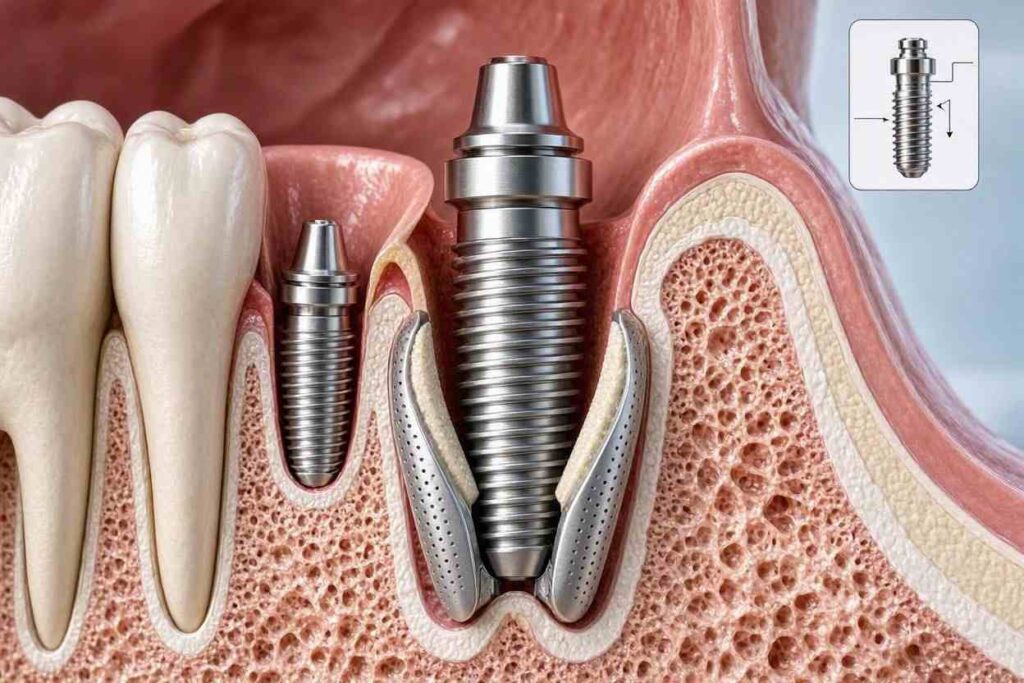
Scenario 1: The Implant Feels Loose—”It’s Spreading”
When a patient says their implant “feels like it’s spreading,” the most common clinical correlate is mobility. The implant complex or the implant body itself is moving. The sensation of “spreading” may be the patient’s perception of the implant crown pushing against the adjacent teeth as it shifts under biting forces.
Abutment Screw Loosening
This is the most common cause of a perceived loose implant. The abutment screw, which secures the abutment and crown to the implant body, has lost its preload. The crown and abutment are mobile as a unit, but the implant body is still rigidly osseointegrated in the bone.
The patient feels a wiggle, a click, or a spreading pressure when biting. The sensation is localized to the implant tooth. There is no pain, no swelling, and no bad taste unless the loosening has been present for some time and bacteria have entered the connection. The dentist removes the restoration, cleans the connection, inspects the screw, and retorques a new or the existing screw to the manufacturer’s specification. The problem is resolved in a single visit.
Implant Body Mobility (Failed Osseointegration)
If the implant body itself is mobile—meaning the bone-implant interface has failed—the sensation is different. The entire implant, including the portion in the bone, moves. The patient may feel a dull ache, a sense of pressure, and a definite movement that is more than just the crown. The implant may feel like it is pushing into the adjacent bone, creating a spreading sensation along the ridge.
This is a true implant failure. It requires removal of the implant, debridement of the site, and, after a healing period with bone grafting if necessary, placement of a new implant. An implant that is truly mobile is non-salvageable.
Scenario 2: Infection That Is Spreading—Peri-Implantitis and Beyond
The second interpretation of “a dental implant that spreads” is an infection that originates at the implant and extends to adjacent tissues.
Peri-Implantitis with Localized Spread
Peri-implantitis is a bacterial infection that causes inflammation of the peri-implant mucosa and progressive loss of the supporting bone. In its early stages, the infection is confined to the immediate implant site. The patient experiences bleeding when brushing, redness, swelling, and possibly a bad taste or pus discharge from the gum pocket around the implant. There is typically no pain until the disease is advanced.
If the peri-implantitis is not treated, the bacterial biofilm and the inflammatory infiltrate can spread along the bone surface. The infection can involve the adjacent natural tooth, causing periodontitis on that tooth, or it can spread to an adjacent implant. This “spread” of peri-implant disease is a serious clinical problem. Multiple implants in a reconstructed arch can be lost in a domino effect if the infection is uncontrolled.
Acute Peri-Implant Abscess with Cellulitis
An acute abscess can form at the apex of a failing implant or within a deep peri-implant pocket. The pus accumulates under pressure, causing severe, throbbing pain. If the abscess perforates the overlying bone and spreads into the soft tissue spaces, it can cause cellulitis—a diffuse, spreading infection of the soft tissues.
The patient experiences rapid onset of swelling of the face, cheek, or neck. The swelling is firm, hot, and tender. The patient may have fever, malaise, and trismus (difficulty opening the mouth). This is a dental emergency. The infection is spreading through the fascial planes of the head and neck. If the swelling compromises the airway or spreads to the deep neck spaces, it can become life-threatening.
Management requires immediate surgical drainage, removal of the causative implant, intravenous antibiotics, and possibly hospitalization. This is a rare but recognized complication of an untreated or aggressive peri-implant infection.
Osteomyelitis
Osteomyelitis is a rare, severe infection of the bone itself. Bacteria from an implant-related infection can invade the bone marrow, causing necrosis of the bone. The infection can spread within the bone, resulting in a large area of non-healing, infected bone. Management involves surgical resection of the necrotic bone, long-term intravenous antibiotics, and complex reconstruction. Osteomyelitis is an extremely uncommon complication in healthy implant patients but is a risk in immunocompromised individuals.
Scenario 3: Bone Spreading (Ridge Expansion) as a Surgical Technique
In the context of implant surgery, “spreading” can refer to a specific surgical technique: ridge splitting or bone spreading. This is not a complication; it is a controlled, planned procedure.
The Ridge Splitting Procedure
When a patient has a narrow alveolar ridge that is inadequate in width for implant placement, the surgeon may perform a ridge splitting procedure. The ridge is precisely cut along its crest with a piezoelectric surgical device or a fine bur. Specialized bone spreaders or osteotomes of gradually increasing diameter are gently tapped into the osteotomy to expand the ridge laterally, creating space for the implant. The implant is placed, and the expanded bone and any particulate graft are allowed to heal.
This is a deliberate, controlled spreading of the bone to avoid the need for a separate, more invasive block bone graft. The patient may experience a sensation of pressure and spreading during the healing phase, which is normal and expected. The surgeon will have explained this preoperatively.
Symptoms That Require Immediate Attention
A patient who experiences any of the following symptoms should contact their implant dentist or seek emergency care immediately:
- Mobility of the implant crown or the implant body
- A sensation of spreading pressure in the jaw that is worsening
- Swelling of the face, cheek, or neck that is expanding
- Difficulty opening the mouth or swallowing
- Fever and malaise associated with an implant site
- Pus discharge that is increasing in volume or foul odor
- Numbness in the lip, chin, or tongue
These symptoms indicate a spreading infection, a failing implant, or a nerve complication. Early intervention can prevent a minor mechanical problem from becoming a biological catastrophe.
Conclusion
“A dental implant that spreads” is a patient’s description that can refer to three distinct clinical situations: a mobile implant or abutment creating a spreading sensation under bite forces, a peri-implant infection spreading locally to adjacent teeth, bone, or soft tissue spaces (cellulitis), or a controlled surgical ridge-splitting procedure. The most common cause is simple abutment screw loosening, which is resolved in a single visit. An acute spreading infection with facial swelling is a dental emergency requiring immediate surgical drainage and implant removal. Any sensation of mobility, spreading pressure, or swelling around an implant warrants prompt professional evaluation.
Frequently Asked Questions
My implant feels like it’s pushing against the tooth next to it. Is this normal?
No. A properly restored implant should have a stable, passive contact with the adjacent tooth. A sensation of pushing or spreading pressure could indicate that the crown is loose, the contact is too tight, or there is an underlying biological problem. See your dentist for an evaluation and an X-ray.
Can an infection from one implant spread to my other implants?
Yes. Peri-implantitis is a bacterial infectious disease. The pathogens can migrate from one implant site to another, particularly in a full-arch reconstruction where the implants are connected by a bridge or where the implants are in close proximity. Rigorous daily cleaning of all implants and regular professional maintenance are the defenses against this spread.
What is the difference between an implant that is loose and one that has a loose crown?
A loose crown is mobile because the cement seal has failed or the prosthetic screw is loose. The implant body in the bone is stable. A loose implant means the implant body itself is mobile in the bone. This is a failed implant. Your dentist can distinguish between the two by applying lateral pressure and taking an X-ray.
I had a bone-spreading procedure. Is the pressure I feel normal?
Yes. A controlled ridge expansion procedure intentionally spreads the bone. Postoperative pressure, mild discomfort, and a sensation of tightness in the ridge are normal during the healing phase. This sensation gradually subsides as the bone heals and remodels around the implant over several weeks.
Additional Resource
The American Academy of Periodontology provides a patient education portal at perio.org that explains peri-implant diseases, their causes, and their treatment. The site includes a search tool for finding a board-certified periodontist, who is a specialist in the prevention and treatment of peri-implant infections and the preservation of the bone and soft tissues supporting implants.