Does CareFirst Cover Dental Implants?
You hold a CareFirst insurance card and you need dental implants. The question is straightforward: will your plan pay for them? The answer, like most things in dental insurance, is not a simple yes or no. CareFirst BlueCross BlueShield offers multiple dental plans with varying levels of coverage. What one CareFirst plan covers generously, another may exclude entirely.
This guide provides a detailed, honest look at CareFirst dental implant coverage. We will examine the different plan types, the typical coverage levels, the limitations and exclusions you need to know about, and the strategies for maximizing whatever benefit your specific plan provides. By the end, you will understand exactly how to determine your coverage, what questions to ask, and how to plan financially for implant treatment under a CareFirst policy.
CareFirst is a large regional insurer serving Maryland, Washington D.C., and parts of Virginia. Its dental plans are marketed to individuals, families, and employer groups. The coverage details depend on which specific plan you hold, so this guide will teach you how to read your policy documents and find the answers that apply to you.
Understanding CareFirst Dental Plan Structures
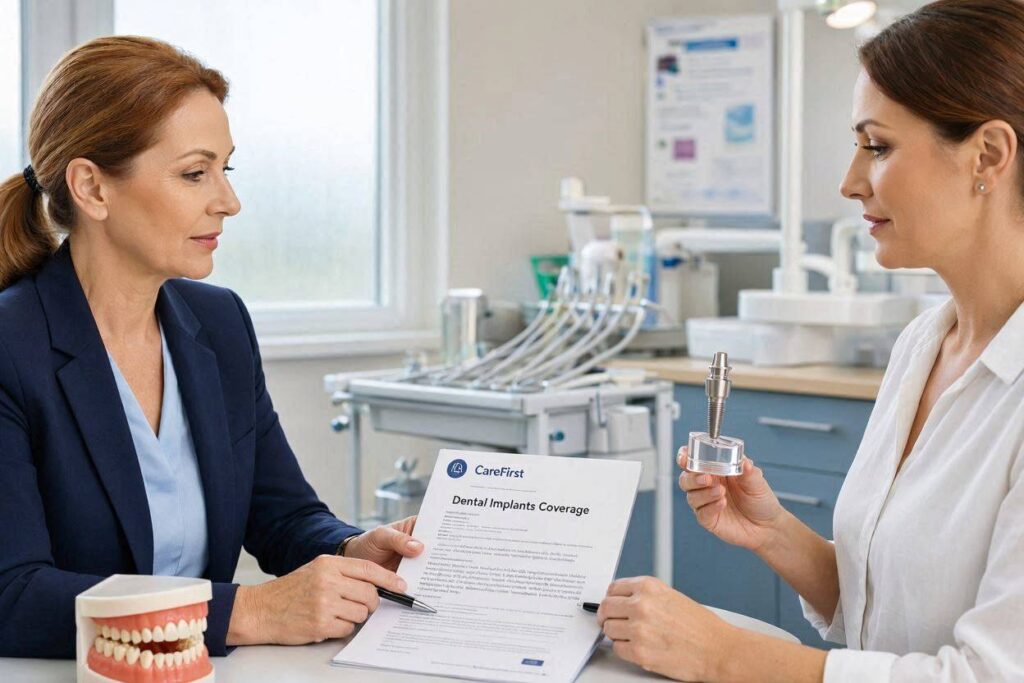
CareFirst offers several categories of dental plans, and the category you are enrolled in largely determines whether implants are covered and at what level.
Dental Preferred Provider Organization Plans
CareFirst’s Dental PPO plans provide the broadest network of participating dentists and typically offer the most comprehensive coverage, including at least some level of implant benefit on higher-tier plans. PPO plans allow you to see any licensed dentist, but you pay less when you stay within the CareFirst network.
Within the PPO category, CareFirst offers multiple plan levels. The higher-premium plans generally include implant coverage as a major service. The lower-premium plans may exclude implants or cover them at a lower percentage. The specific plan name and the summary of benefits document are your keys to understanding your coverage.
Dental Health Maintenance Organization Plans
CareFirst also offers DHMO plans, sometimes called prepaid dental plans. These plans operate differently from PPO plans. You select a primary care dentist from the network, and that dentist provides or refers you for all care. DHMO plans have fixed copayments for covered services rather than percentage-based coinsurance.
DHMO plans typically do not cover dental implants. They are designed to provide basic and preventive care at a predictable cost. Major restorative services like implants are generally excluded or offered only at a significant patient-paid upgrade fee if the participating dentist offers them at all.
Indemnity and Fee-for-Service Plans
Some CareFirst members, particularly those with older plans, may have indemnity or fee-for-service dental coverage. These plans reimburse a percentage of the dentist’s fee regardless of which dentist you see. Implant coverage on indemnity plans varies and may be more generous than on managed care plans, but these plan types are becoming rare.
How CareFirst Classifies Dental Implants
Understanding how CareFirst categorizes implants within its plan documents helps you locate the relevant coverage information.
Major Restorative Services
On CareFirst PPO plans that cover implants, they are classified as a major restorative service. This classification places implants in the same category as crowns, bridges, and dentures. Major services are reimbursed at a lower percentage than preventive services like cleanings and basic services like fillings.
A typical CareFirst PPO plan might cover preventive care at 100 percent, basic care at 80 percent, and major care at 50 percent. This means that even with implant coverage, you will pay a significant portion of the cost out of pocket.
The Annual Maximum
Like virtually all dental insurance plans, CareFirst policies include an annual maximum benefit. This is the total dollar amount the plan will pay for covered services in a calendar year. CareFirst annual maximums vary by plan. Lower-premium plans may have maximums of $1,000 or $1,500. Higher-premium plans may offer $2,000, $2,500, or in some cases $3,000.
Consider what this means for implant treatment. A single implant with crown costs $3,000 to $6,000. Even if your plan covers 50 percent, the annual maximum caps the total insurance payment. If your annual maximum is $1,500 and your plan covers 50 percent of a $5,000 implant, the plan will pay $1,500, and you will pay $3,500. The percentage coverage is effectively limited by the dollar cap.
Waiting Periods
Most CareFirst dental plans impose waiting periods for major services. If you are a new enrollee, you may need to wait 6 or 12 months before the plan will cover implant treatment. Waiting periods prevent people from enrolling only when they need expensive care and then dropping coverage.
If you are considering enrolling in a CareFirst plan specifically to cover implants, check the waiting period carefully. You may need to maintain coverage for a year before implant benefits activate.
Specific CareFirst Plan Tiers and Implant Coverage
CareFirst markets plans under various names to different customer segments. While the specific plan documents control, here is what you can generally expect from each tier.
High-Option PPO Plans
CareFirst’s high-option PPO plans, sometimes called Premium or Enhanced plans, offer the most comprehensive coverage. These plans typically cover major restorative services, including implants, at 50 percent of the allowed amount. The annual maximum on these plans is usually at the higher end of the range, often $2,000 to $3,000.
These plans have higher monthly premiums but provide meaningful assistance for implant treatment. A patient needing a single implant might receive $1,500 to $2,000 in benefits, reducing the out-of-pocket cost substantially.
Mid-Level PPO Plans
Mid-level plans, sometimes called Standard or Classic, may cover implants at 50 percent or may exclude them. The annual maximum is typically in the $1,500 to $2,000 range. Some mid-level plans cover implants but with a separate, lower annual maximum specifically for implant services, such as a $1,000 lifetime limit on implant benefits.
Read the exclusions section of your plan document carefully. A mid-level plan may list dental implants under covered major services or may specifically exclude them. Do not assume coverage based on the plan’s general description.
Basic or Preventive-Only Plans
CareFirst’s lower-premium plans may be limited to preventive and basic services only. These plans do not cover major restorative care and therefore do not cover implants. They are designed for patients who want coverage for routine cleanings and fillings but are willing to pay out of pocket for larger expenses.
If you hold a basic plan, you will need to pay for implants entirely out of pocket or upgrade to a higher-tier plan during the next open enrollment period, subject to any waiting periods on the new plan.
The Missing Tooth Clause
One of the most important and frequently overlooked provisions in CareFirst dental policies is the missing tooth clause. Understanding this clause can save you from an expensive assumption.
What the Missing Tooth Clause Means
A missing tooth clause states that the plan will not cover the replacement of a tooth that was missing before the effective date of coverage. If you lost the tooth before you enrolled in the CareFirst plan, the implant to replace that tooth is not covered.
The insurer’s logic is actuarial. Insurance is designed to cover future unforeseen events, not pre-existing conditions. Replacing a tooth that was already missing is not an insurable event from the insurer’s perspective.
How the Clause Affects Implant Coverage
If you lost tooth number 30 five years ago and enrolled in CareFirst last year, the implant to replace tooth number 30 is likely excluded under the missing tooth clause. If you lost the tooth after enrolling in the plan, coverage may apply, subject to all other plan terms.
Some higher-tier CareFirst plans waive the missing tooth clause or offer a limited benefit for pre-existing tooth loss. Others apply it strictly. Your plan document will state whether a missing tooth clause exists and how it is applied.
Documentation and Appeals
If you believe your tooth loss occurred after your coverage began, you may need to provide documentation. A dated X-ray showing the tooth was present after your coverage start date, or a dated extraction record, can establish that the loss occurred while you were covered. If the insurer invokes the missing tooth clause incorrectly, you have the right to appeal.
Coordination of Benefits
If you have coverage under more than one dental plan, perhaps through your employer and your spouse’s employer, CareFirst’s coordination of benefits rules determine how the two plans work together.
How Dual Coverage Works for Implants
The primary plan pays first according to its coverage terms. The secondary plan reviews the remaining patient responsibility and may pay a portion, up to its own coverage limits. The total reimbursement from both plans combined will not exceed 100 percent of the dentist’s allowed charge.
Dual coverage can significantly reduce your out-of-pocket cost for implants. If your primary plan pays 50 percent subject to a $1,500 maximum and the secondary plan also pays 50 percent, the secondary plan may cover much of the remaining balance, effectively increasing the total insurance contribution.
CareFirst as Secondary Payer
When CareFirst is the secondary payer, it will coordinate with the primary plan. You must submit the primary plan’s Explanation of Benefits to CareFirst along with the claim. CareFirst will then calculate its secondary payment.
Submitting a Predetermination
Before committing to implant treatment, submit a predetermination of benefits request to CareFirst. This is a critical step that many patients skip.
How Predetermination Works
Your dentist submits a treatment plan to CareFirst before the procedure is performed. The plan includes the proposed procedure codes, the diagnosis, and supporting documentation such as X-rays. CareFirst reviews the plan and issues a written estimate of what it will pay.
A predetermination is not a guarantee of payment, but it provides a reliable indication of coverage. It reveals any issues, such as the missing tooth clause, waiting periods, or plan exclusions, before you incur the expense. If the predetermination shows no coverage, you can decide to proceed with full knowledge or delay treatment until your coverage situation changes.
What the Predetermination Letter Tells You
The predetermination response will show the allowed amount for each procedure, the percentage covered, the plan’s estimated payment, and your estimated patient responsibility. It will also state whether the annual maximum has been reached or will be reached by the proposed treatment.
Review this document carefully with your dentist’s treatment coordinator. Ensure that all planned procedures are listed. If something is missing from the predetermination, it will not be considered when the actual claim is processed.
Alternatives When CareFirst Does Not Cover Implants
If your CareFirst plan excludes or severely limits implant coverage, you have alternatives.
Phased Treatment Across Plan Years
If your plan covers implants but has a low annual maximum, you can phase treatment across two calendar years. Place the implant in November of year one, using that year’s annual maximum. Place the abutment and crown in January of year two, using the new year’s annual maximum. This strategy effectively doubles the insurance contribution.
Coordinate with your dentist to ensure that phasing treatment is clinically appropriate. The implant must integrate with the bone for several months before the crown is placed, so a gap between the surgical and restorative phases is often standard practice anyway.
Upgrading During Open Enrollment
If you hold a basic plan that excludes implants, consider upgrading to a higher-tier plan during your employer’s open enrollment period or during the individual market open enrollment. Be aware that the new plan’s waiting period for major services will apply, so you may need to wait 6 to 12 months after upgrading before implant coverage activates.
Exploring Standalone Dental Implant Insurance
Some insurers offer standalone implant insurance policies or discount plans that specifically cover implant treatment. These are separate from your CareFirst plan and may provide benefits that fill the gaps in your primary coverage. Compare the premium cost to the expected benefit to determine whether a supplemental policy makes financial sense.
The CareFirst Dental Network and Implant Pricing
Using an in-network CareFirst dentist affects not just whether your care is covered but how much you pay.
Negotiated Fee Schedules
CareFirst negotiates fee schedules with in-network dentists. The dentist agrees to accept these negotiated rates as payment in full for covered services. The allowed amount, the maximum the dentist can charge for a covered procedure, is typically 20 to 40 percent below the dentist’s usual fee.
This means that even if you are paying a portion of the implant cost out of pocket, you are paying based on the negotiated rate, not the dentist’s full list price. A crown that lists for $1,800 might have an allowed amount of $1,200. Your 50 percent coinsurance is based on $1,200, not $1,800.
Out-of-Network Considerations
If you see an out-of-network dentist, CareFirst may still provide some coverage if your plan includes out-of-network benefits, but the reimbursement is based on a different, usually lower, fee schedule. The out-of-network dentist is not bound by CareFirst’s negotiated rates and can bill you for the difference between their fee and what CareFirst reimburses, a practice called balance billing.
For expensive procedures like implants, staying in network is strongly advisable. The savings from the negotiated fee schedule alone can be substantial, even before considering the insurance reimbursement.
Medicare and CareFirst Dental
Many CareFirst members are Medicare beneficiaries. Understanding how Medicare and CareFirst dental plans interact is important.
Original Medicare and Dental Coverage
Original Medicare, Part A and Part B, does not cover routine dental care, including implants. Some Medicare Advantage plans offered by CareFirst may include dental benefits. These benefits vary by plan.
CareFirst Medicare Advantage Dental Plans
CareFirst offers Medicare Advantage plans that include dental coverage. The implant coverage on these plans varies. Some cover implants as a major service. Others exclude implants. Review the Evidence of Coverage document for your specific Medicare Advantage plan to determine your implant benefits.
Common Reasons CareFirst Denies Implant Claims
Understanding common denial reasons helps you avoid them or appeal effectively.
Alternative Benefit Clause
Some CareFirst plans include an alternative benefit clause. This allows the plan to pay for a less expensive alternative treatment even if the more expensive treatment is covered. For example, the plan might pay for a partial denture to replace a missing tooth but not for an implant.
If your plan has an alternative benefit clause, the dentist must document why the alternative is not appropriate. Clinical reasons, such as the condition of adjacent teeth making a bridge inadvisable or the patient’s inability to tolerate a removable appliance, can support medical necessity for the implant.
Lack of Documentation
Claims are denied when documentation is insufficient to establish medical necessity or to verify that the procedure was performed. Your dentist must submit adequate radiographs, clinical notes, and narratives supporting the treatment.
Frequency Limitations
Some plans limit how often certain procedures are covered. A plan might cover a crown on a specific tooth only once every five or ten years. If you are replacing a crown on an existing implant, check whether the plan’s frequency limitation applies.
Appealing a CareFirst Implant Denial
If CareFirst denies your implant claim, you have the right to appeal. The appeal process is structured and has deadlines.
The Internal Appeal Process
The denial letter will explain the reason for denial and the deadline for filing an appeal. Your internal appeal should include a letter from your dentist explaining why the implant is medically necessary, additional clinical documentation such as radiographs and photographs, and any supporting literature establishing the standard of care.
Submit the appeal by certified mail and keep copies of everything. CareFirst must respond within a specified timeframe, usually 30 days for a standard appeal.
External Review
If the internal appeal is denied, you have the right to an independent external review. The external reviewer’s decision is binding on CareFirst. External reviewers are independent of the insurance company and may be more receptive to medical necessity arguments.
Conclusion
CareFirst covers dental implants on its higher-tier PPO plans, typically classifying them as a major restorative service reimbursed at 50 percent subject to an annual maximum of $1,500 to $3,000 and a waiting period of 6 to 12 months. Lower-tier plans and DHMO plans generally exclude implants or offer minimal benefits. The missing tooth clause, which excludes replacement of teeth missing before coverage began, is a critical limitation that applies to many CareFirst policies. Submitting a predetermination before treatment, staying in network to access negotiated fee schedules, phasing treatment across plan years to maximize annual maximums, and appealing denials with thorough documentation are the key strategies for optimizing whatever implant coverage your CareFirst plan provides.
Frequently Asked Questions
Does CareFirst cover implants for cosmetic reasons?
No, CareFirst dental plans cover implants only when they are necessary to replace missing teeth and restore function. Purely cosmetic treatment, such as implants to replace teeth that are not missing but are being extracted for aesthetic reasons, is not covered.
Can I get implant coverage added to my existing CareFirst plan?
You cannot modify your plan mid-year. During open enrollment, you can switch to a higher-tier plan that includes implant coverage. The new plan’s waiting periods and exclusions will apply.
Does CareFirst cover implant repairs?
Coverage for repair of an existing implant depends on the plan. Replacement of a fractured abutment or crown may be covered subject to frequency limitations and annual maximums. The implant fixture itself is usually covered only for initial placement.
How do I find a CareFirst in-network implant dentist?
Use the provider search tool on the CareFirst website. Filter by specialty, such as oral surgery, periodontics, or prosthodontics, and by dentists who list implants as a service. Confirm with the office directly that they are in network for your specific plan.
What if my implant treatment requires bone grafting?
Bone grafting is typically classified as a separate surgical procedure. Coverage depends on whether the grafting is deemed medically necessary for the implant placement. The grafting procedure is subject to its own coverage percentage and counts toward the annual maximum.
Additional Resource:
To find CareFirst’s provider network and check your specific plan benefits, visit the CareFirst website at https://www.carefirst.com.