How To Clean Dental Implant Teeth?
Cleaning dental implant teeth requires a different approach than cleaning natural teeth. While natural teeth have a periodontal ligament that provides some defense against bacterial invasion, implants rely entirely on the mechanical seal of the gum tissue against the abutment surface. Proper cleaning technique is therefore essential for long-term implant survival. This article provides a detailed, practical guide to cleaning implant restorations, covering tools, techniques, and the rationale behind each recommendation.
Why Implant Cleaning Differs from Natural Tooth Cleaning
Understanding the structural differences informs proper cleaning technique.
The Absence of Periodontal Ligament
Natural teeth are suspended in the jawbone by the periodontal ligament, a network of collagen fibers that provides a flexible, resilient attachment. This ligament contains blood vessels and immune cells that help defend against bacterial invasion. The sulcus around a natural tooth, the shallow crevice between gum and tooth, has a lining that provides some barrier function.
Implants have no periodontal ligament. They are in direct contact with bone through osseointegration. The soft tissue attachment to the implant abutment is a circumferential seal of epithelial and connective tissue. This seal is more vulnerable to bacterial penetration than the attachment around natural teeth. Once bacteria breach this seal, they reach the bone directly, without the defensive buffer of the periodontal ligament.
Surface Characteristics
The implant abutment surface, whether titanium or zirconia, is smoother than natural tooth root surface. This smoothness resists plaque accumulation somewhat but also means the soft tissue attachment is more tenuous. Scratches on the abutment surface, caused by inappropriate cleaning instruments, create niches where bacteria can establish colonies.
Restoration Contours
Implant crowns have contours designed to emerge from below the gum in a way that mimics natural teeth. However, the junction between crown and abutment, and between abutment and implant, creates interfaces that can harbor bacteria if not cleaned properly. The contour of the restoration may create areas that are difficult to access with standard cleaning tools.
Essential Tools for Implant Cleaning
A well-equipped implant patient uses specific tools designed for implant hygiene.
Toothbrushes
A soft-bristled manual toothbrush or an electric toothbrush with a soft brush head is appropriate for implant cleaning. Medium or hard bristles are too abrasive for the gum tissue around implants. Electric toothbrushes with pressure sensors help prevent overzealous brushing that can traumatize peri-implant tissue. Replace brush heads every three months or sooner if bristles become splayed.
Interdental Brushes
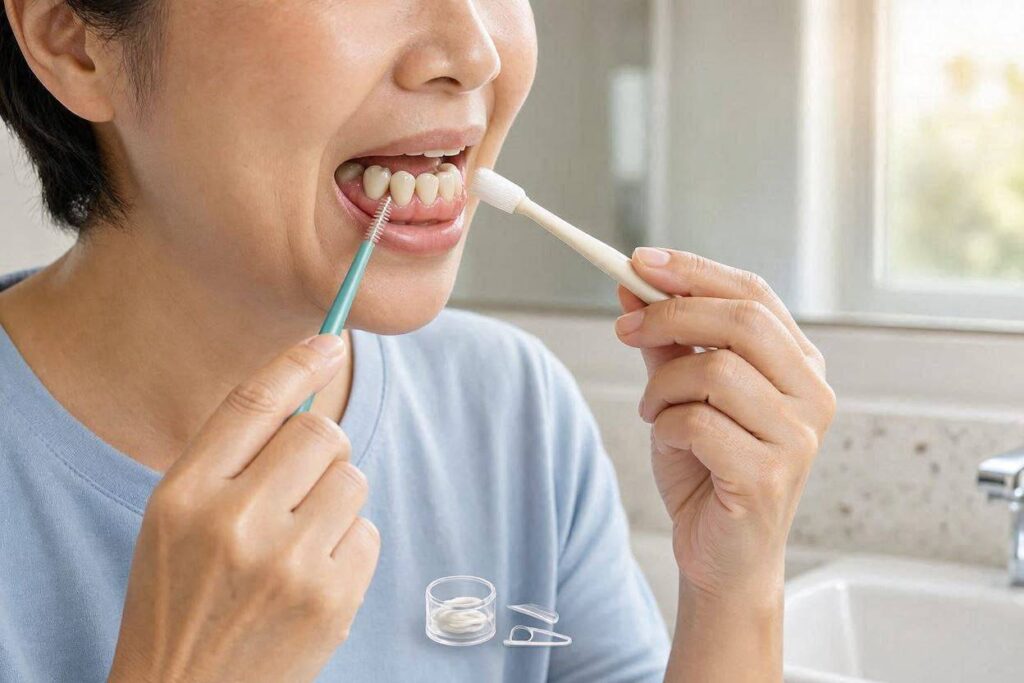
Interdental brushes, sometimes called proxy brushes or interproximal brushes, are small brushes designed to clean between teeth. For implants, these brushes clean the space between the implant crown and adjacent teeth, as well as under the crown contours. Select a brush size that passes through the space with slight resistance. The wire core should be coated to prevent scratching the abutment surface.
Implant-Specific Floss
Implant floss differs from conventional floss. It typically has a stiff threader on one end to guide the floss under the crown, a thicker middle section that cleans the abutment surface, and a standard floss section for cleaning adjacent natural teeth. The thicker cleaning section is designed to mechanically disrupt plaque on the abutment surface.
Water Flossers
Oral irrigators or water flossers provide a stream of pulsating water that flushes debris from around implants and beneath restorations. Use a non-metal tip to avoid scratching abutment surfaces. Low to medium pressure settings are sufficient and less likely to traumatize tissue than high pressure. Some devices offer specialized tips for implant and crown cleaning.
Rubber Tip Stimulators
Soft rubber tips can gently massage the gum tissue around implants and dislodge debris at the gum line. These are used with a gentle sweeping motion along the tissue margin.
Antimicrobial Rinses
Non-alcohol-based antimicrobial mouth rinses provide chemical plaque control that complements mechanical cleaning. Chlorhexidine, available by prescription, is the most effective antimicrobial but is generally reserved for short-term use during healing or treatment of peri-implant disease. Over-the-counter options include essential oil-based rinses and cetylpyridinium chloride formulations.
Step-by-Step Daily Cleaning Routine
A systematic approach ensures thorough cleaning.
Morning Cleaning Session
Begin with brushing. Apply a small amount of non-abrasive toothpaste to a soft toothbrush. Brush the implant crown and adjacent teeth using gentle circular motions. Angle the brush at 45 degrees to the gum line, allowing bristles to reach just under the gum margin. Spend at least two minutes brushing all tooth surfaces.
Follow with interdental cleaning. Use implant floss or an interdental brush to clean between the implant crown and adjacent teeth. Pass the floss or brush gently through the contact area. Move the cleaning device back and forth several times against the abutment surface below the gum line. Feel for any roughness or debris.
If using a water flosser, direct the stream at the gum line around the implant, moving slowly around the entire circumference. Angle the tip slightly toward the gum line rather than directly perpendicular.
Finish with a non-alcohol antimicrobial rinse if recommended by your dentist. Swish for 30 seconds, ensuring the rinse contacts all areas around the implant.
Evening Cleaning Session
Repeat the morning routine with equal thoroughness. The evening cleaning is particularly important to remove plaque that accumulated during the day before sleeping, when salivary flow decreases and bacterial proliferation increases.
After Meals
Rinse with water after meals to dislodge food debris. If a water flosser is available, a quick flush around the implant removes particles before they can contribute to plaque formation. Avoid using toothpicks or other sharp objects that could scratch abutment surfaces.
Cleaning Specific Types of Implant Restorations
Different implant restorations present different cleaning challenges.
Single Implant Crown
A single implant crown is cleaned similarly to a natural tooth but with implant-safe tools. Pay particular attention to the area where the crown meets the gum on the tongue side and cheek side. These areas are often missed during routine brushing.
Implant-Supported Bridge
Bridges connecting multiple implant crowns or connecting implants to natural teeth have areas under the pontics, the false teeth suspended between abutments, that require special attention. Super floss with a stiff threader passes under the pontic for cleaning. Floss threaders or water flossers reach areas a toothbrush cannot access. Your dentist or hygienist should demonstrate the specific technique for your bridge design.
Implant Overdenture
Removable overdentures that snap onto implants require cleaning of both the prosthesis and the implant attachments. Remove the overdenture after meals and at night, according to your dentist’s instructions. Brush the overdenture with a denture brush and non-abrasive denture cleanser. Do not use toothpaste on the overdenture, as it can scratch the acrylic.
Clean the implant abutments and the attachment components in the mouth using a soft toothbrush and the techniques described above. The O-rings, locator caps, or ball attachments require specific cleaning to maintain retention. Your dentist will recommend cleaning protocols for your specific attachment system.
Fixed Full-Arch Prosthesis
A fixed prosthesis replacing all teeth in an arch, such as an All-on-4 restoration, presents the greatest hygiene challenge. The junction between the prosthesis and the gum line extends around the entire arch. Food debris and plaque accumulate readily, particularly on the tongue side of the restoration.
Water flossers are particularly valuable for full-arch prosthesis hygiene. The pulsating stream reaches under the prosthesis where a toothbrush cannot access. Use a non-metal tip with low to medium pressure. Supplement with super floss or specialized implant floss threaded under the prosthesis where spaces permit. Interdental brushes clean between the prosthesis and the gum from the cheek and tongue sides.
Daily cleaning of a full-arch prosthesis is not optional. The consequences of inadequate hygiene with these restorations are severe, often leading to peri-implantitis affecting multiple implants simultaneously.
Professional Maintenance and Its Role
Home care is necessary but not sufficient. Professional maintenance complements daily cleaning.
What Happens at a Maintenance Visit
The hygienist or dentist examines the implant and surrounding tissues visually and with gentle probing. Peri-implant probing depths are recorded and compared to baseline measurements. Bleeding on probing indicates inflammation. Radiographs may be taken at intervals to assess bone levels.
Professional cleaning uses implant-specific instruments that do not scratch abutment surfaces. Plastic, graphite, or titanium scalers remove calcified deposits. A rubber cup with non-abrasive paste polishes the crown surfaces. The prosthesis may be removed, if screw-retained, for thorough cleaning and examination of the implant-abutment interface.
Recommended Recall Intervals
Most implant patients benefit from professional maintenance every three to four months. Patients with a history of periodontitis, smokers, diabetics, and those with full-arch prostheses often require three-month recalls. Your dentist individualizes the recall interval based on your risk profile and home care effectiveness.
Common Cleaning Mistakes to Avoid
Well-intentioned patients sometimes harm their implants through improper cleaning.
Using Abrasive Toothpaste
Whitening toothpastes and those containing baking soda or silica abrasives can scratch ceramic crown surfaces and roughen them over time. Roughened surfaces accumulate more stain and plaque. Use low-abrasion toothpaste formulated for sensitive teeth or specifically for implant restorations.
Using Metal Instruments at Home
Metal scalers and picks sold for home plaque removal should never be used on implants. They scratch abutment surfaces, creating crevices for bacterial colonization. Leave instrumentation to professionals with implant-safe armamentarium.
Excessive Pressure
Aggressive brushing traumatizes peri-implant tissue and can cause recession. The gum tissue around implants may be more susceptible to recession than tissue around natural teeth. Gentle, thorough technique is more effective and safer than forceful scrubbing.
Neglecting the Tongue Side
The lingual or tongue side of implant restorations receives less attention during home care than the cheek side. Plaque accumulates on all surfaces. Make a conscious effort to clean the tongue side thoroughly.
Conclusion
Cleaning dental implant teeth requires specific tools, techniques, and commitment beyond what natural teeth demand. The absence of the periodontal ligament’s protective functions means the mechanical disruption of plaque and the maintenance of a healthy soft tissue seal are entirely dependent on the patient’s daily efforts and professional maintenance. Soft toothbrushes, implant-specific floss, interdental brushes, water flossers, and non-alcohol antimicrobial rinses form the core armamentarium. Professional maintenance at three to four-month intervals complements home care. Implants that receive meticulous care survive decades. Those neglected fail, often silently, until significant bone loss has occurred.
Frequently Asked Questions
Can I use regular dental floss on my implant?
Regular floss can shred on implant crown margins. Implant-specific floss with a stiff threader and thicker cleaning section is preferable. If using regular floss, use floss threaders to access under the crown.
How do I know if I’m cleaning my implant well enough?
The gum around a healthy implant should be pink, firm, and not bleed when brushed or probed. Bleeding indicates inflammation from inadequate plaque removal. Your dentist or hygienist can assess your cleaning effectiveness at maintenance visits.
Is a water flosser better than string floss for implants?
Both have value and are complementary. String floss mechanically disrupts plaque biofilm directly on the abutment surface. Water flossers flush debris from areas floss cannot reach. Using both provides the most thorough cleaning.
Can I use whitening products on my implant crown?
No. Whitening agents do not affect ceramic or zirconia crown materials. The crown was fabricated to a specific shade and will not change. Whitening can alter the color of adjacent natural teeth, creating a mismatch.
Additional Resource
For detailed patient education on implant maintenance, visit the International Congress of Oral Implantologists at www.icoi.org. The ICOI provides resources on implant care and finding qualified providers.