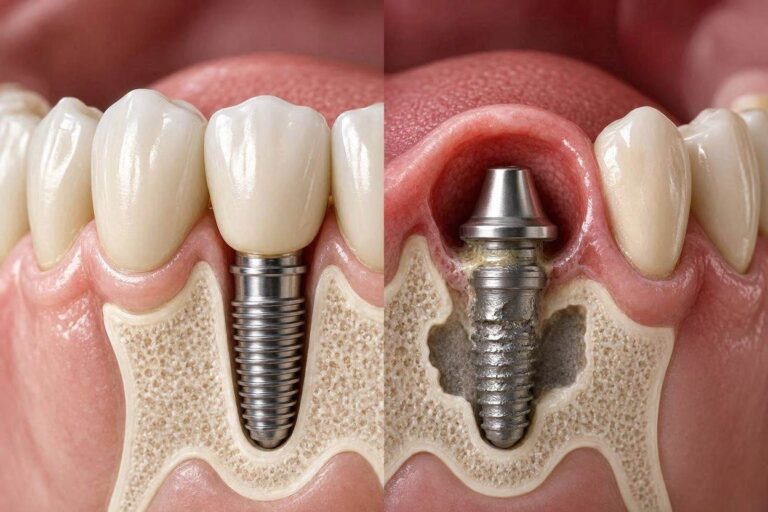
Can A Dental Implant Cause TMJ?
You finally replaced that missing molar with a dental implant. The surgery went well. The crown looks beautiful. But a few months later, you notice something unsettling. Your jaw feels stiff in the morning. You hear a clicking sound when you chew. A dull ache radiates from your jaw joint to your temple. You never had these problems before the implant. The timing feels suspicious. Could the dental implant have caused this temporomandibular joint disorder, commonly called TMJ or TMD? Is the implant to blame, or is something else going on?
This comprehensive guide will explore the complex relationship between dental implants and temporomandibular joint disorders. We will dissect the anatomy of the jaw joint and the bite mechanics that govern its health. We will examine the direct and indirect ways an implant can contribute to TMJ symptoms. We will also explore the critical distinction between correlation and causation, as many patients who develop TMJ problems after implant placement were predisposed to them. By the end of this article, you will understand the true nature of the implant-TMJ connection and what you can do to find relief.
Understanding TMJ and TMD
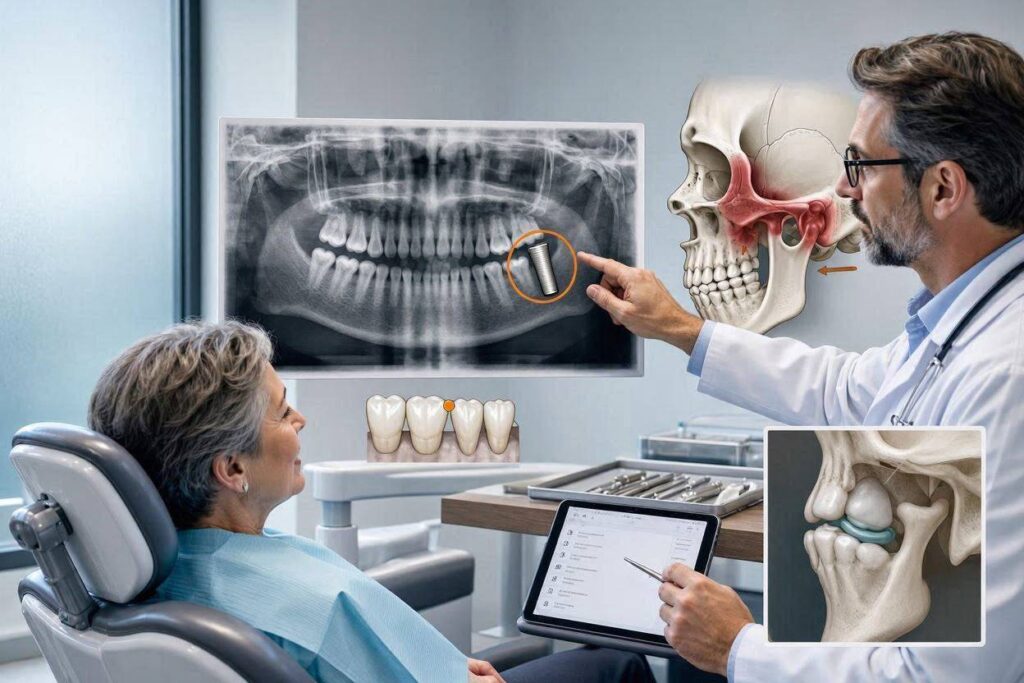
Before we can link an implant to jaw joint problems, we must define the terms with precision. TMJ is the acronym for the temporomandibular joint itself, the hinge that connects your lower jaw to your skull on each side of your head. You have two TMJs. They are among the most complex joints in the human body, capable of both rotation, opening and closing, and translation, sliding forward and side to side. The joint consists of the condyle of the mandible, the articular fossa of the temporal bone, and a small fibrocartilage disc that sits between them, cushioning the movement.
TMD stands for temporomandibular joint disorder. This is the collective term for a group of conditions that cause pain and dysfunction in the jaw joint and the muscles that control jaw movement. TMD encompasses a wide spectrum of problems, including myofascial pain, internal derangement of the joint disc, degenerative joint disease like arthritis, and bruxism-related muscle hypertrophy and pain.
The distinction is important. Everyone has TMJs. Not everyone has TMD. When a patient says, “I have TMJ,” they mean they have TMD. The implant dentist must determine which specific type of TMD is present to understand whether the implant played a role.
The Mechanism of a Healthy Bite
The health of the temporomandibular joints depends on a stable, balanced occlusion. Occlusion is the way your teeth fit together when you close your mouth and when you chew. In a healthy, stable bite, all the teeth contact evenly and simultaneously when you close. The forces of chewing are distributed across the entire dental arch. The jaw muscles contract in a coordinated, symmetrical pattern. The condyles sit in a comfortable, physiologically correct position within their fossae. The articular discs glide smoothly between the condyle and the bone.
This delicate balance can be disrupted by any change in the oral environment. A new filling that is slightly too high. A crown that is contoured incorrectly. A tooth that is extracted, leaving an empty space. An orthodontic treatment that shifts the bite. Or a dental implant with a crown that does not harmonize with the rest of the dentition. The disruption need not be large. The stomatognathic system, the mouth, jaws, and related structures, is exquisitely sensitive to even sub-millimeter changes in tooth contact. When the system is disturbed, the muscles and joints must adapt. Adaptation can lead to strain. Strain, over time, leads to pain and dysfunction.
Can an Implant Directly Cause TMJ? The Bite Imbalance Pathway
Yes, a dental implant can directly contribute to the development of TMJ symptoms through a pathway of occlusal disharmony. This is the most direct mechanism.
The High Restoration
The most common implant-related cause of TMJ symptoms is a crown that is too high. When the implant crown is fabricated, the dentist checks the bite using articulating paper, a thin, colored paper that marks where the teeth touch. You bite down, you grind side to side, and the dentist adjusts the high spots on the crown until the contacts feel even. This is done with you sitting upright in the dental chair. However, the jaw posture in the dental chair does not perfectly replicate your natural chewing posture or your nighttime clenching posture.
If the implant crown is even slightly too prominent, it hits the opposing tooth before any other teeth touch. This is a premature contact. Every time you close your mouth, to swallow, to chew, or to clench unconsciously, that single implant takes the brunt of the force. Your jaw muscles reflexively shift your mandible to avoid the high spot and find a more comfortable bite. This protective reflex is called an avoidance pattern. The muscles work asymmetrically to guide the jaw around the interference. Over weeks and months, this constant, abnormal muscle activity leads to myofascial pain. The muscles become fatigued, sore, and develop trigger points, knots of hyperirritable muscle tissue that refer pain to the jaw, temples, and neck.
The temporomandibular joints are also stressed. The condyle on the side of the high implant may be pulled slightly out of its ideal position in the fossa. The disc may be compressed or displaced. The joint itself may become inflamed, a condition called capsulitis or synovitis. The patient experiences clicking, popping, limited opening, and joint pain. All of this stems from a fraction of a millimeter of excess porcelain on the top of a crown.
The Low Restoration or Missing Contact
An implant crown that is too low, that does not touch the opposing tooth at all when you bite, can also cause TMJ problems, though the mechanism is different. If the implant was placed to replace a critical tooth in the arch, and that tooth is now out of occlusion, the other teeth must take on the chewing load that the missing contact was supposed to share. The force distribution is altered. The remaining teeth may become overloaded. More importantly, the lack of a posterior stop, a back tooth that touches firmly when you close, can cause the jaw to over-close. The condyles are pushed upward and backward into the fossae, compressing the delicate retrodiscal tissues, the nerves and blood vessels behind the disc. This posterior compression is a potent source of TMJ pain.
Improper Contour and Guidance
Even if the implant crown contacts the opposing tooth with the correct intensity, the shape of the crown matters profoundly. Natural teeth have specific contours on their biting surfaces and their sides that guide the jaw through excursive movements. When you slide your jaw to the side to chew, the canines and the premolars have inclines that gently separate the back teeth. This is called canine guidance or group function. If the implant crown has a flat or improperly shaped biting surface, it does not provide the correct guidance. It may interfere with the smooth, gliding movements of the jaw. The muscles must work overtime to navigate the abnormal landscape of the bite. This is a more subtle form of occlusal trauma, but it can be just as symptom-producing over time.
The Indirect Pathway: Changes in Chewing Patterns
An implant does not need to be incorrectly made to cause TMJ problems. The mere presence of a new tooth can alter your chewing behavior in ways that stress the joint.
A patient who has been missing a tooth for years has adapted to chewing on the other side of the mouth. They have been functioning with a unilateral chewing pattern. When the implant is placed and restored, they now have a complete arch again. They may unconsciously begin to chew on the implant side, using muscles that have been dormant or underused for a long time. These muscles are deconditioned. Suddenly asking them to do the work of chewing a steak or a crunchy apple can cause muscle fatigue and spasm. The joint on that side, which has not been loaded heavily for years, is now absorbing significant forces. It may react with inflammation.
This indirect pathway is not the fault of the implant or the dentist. It is the body’s response to a functional change. The treatment is typically conservative: a soft diet to rest the muscles, jaw exercises to recondition the musculature, and possibly a temporary occlusal splint to allow the joint to settle into its new functional pattern. Most patients adapt fully within a few weeks to months.
Preexisting TMJ Disorders Unmasked by Implant Treatment
This is perhaps the most important section of this article for patients who are certain their implant caused their TMJ problem. Many people have a latent, subclinical TMJ disorder that they are unaware of. They have a slightly displaced disc that clicks occasionally but causes no pain. They have mild bruxism, nighttime grinding that is wearing their teeth slowly but is not yet symptomatic. They have a muscle imbalance that their body has successfully compensated for. They are a TMD time bomb waiting to go off.
The implant treatment becomes the trigger that unmasks the preexisting condition. The surgery itself involves having the mouth open for an extended period, which can strain the jaw muscles and the joint capsule. The anesthetic injections in the jaw can cause muscle spasm or, rarely, needle trauma to a nerve. The post-operative period of a soft diet and altered chewing can disrupt the compensatory patterns that were keeping the TMD in check. The final crown changes the bite, even if it is perfectly adjusted, and the system that was barely stable is now pushed over the edge into symptomatic TMD.
In this scenario, the implant did not cause the TMD in the sense of creating a disease that did not exist. It was the stressor that exposed a vulnerable system. The distinction matters for treatment. The solution is not to remove the implant. The solution is to treat the underlying TMD with the comprehensive approach it requires: splint therapy, physical therapy, stress management, and perhaps medication. The implant can remain.
The Role of Surgical Trauma and Prolonged Opening
The implant placement surgery itself can be a direct source of TMJ trauma, independent of the final crown. This is an iatrogenic, or treatment-caused, TMJ problem. The surgery requires the patient to keep their mouth wide open for a prolonged period, often an hour or more. For patients with hypermobile joints or a history of disc displacement, this prolonged stretch can overstretch the joint capsule and the surrounding ligaments. The condyle can translate forward beyond its normal range. The disc can be displaced anteriorly. The patient wakes up from the surgery with a new click or a locked jaw.
The surgeon may have placed a bite block, a rubber prop that the patient bites on to keep the mouth open without muscle effort. While this reduces muscle fatigue, it still positions the joint in a maximally open position for an extended time. The risk is highest in patients with preexisting joint laxity.
Furthermore, the administration of local anesthetic involves injecting into the muscles of mastication, the masseter and the medial pterygoid muscles, and near the joint capsule. A hematoma, a collection of blood within the muscle, can cause prolonged spasm and pain. Direct needle trauma to the joint capsule or the lateral pterygoid muscle can cause inflammation and scarring. These surgical complications are rare but real.
Bruxism and Implant Overload
Patients who grind or clench their teeth, a condition called bruxism, are at significantly higher risk for both TMJ disorders and implant complications. Bruxism generates forces that far exceed normal chewing forces. These forces can fracture implant components, cause bone loss around the implant, and exacerbate muscle and joint pain.
An implant in a bruxist patient is a rigid, unyielding structure. Natural teeth have a periodontal ligament that provides a tiny amount of give, a shock absorber. The implant has no ligament. It is a direct bone-to-implant connection. When a bruxist clenches on an implant crown, the force is transmitted directly to the bone and, through the mandible, to the temporomandibular joint. The implant acts as an anvil. The joint absorbs the excess energy.
Bruxism is a primary cause of TMJ disorders. If a patient develops TMJ symptoms after implant placement and the dentist discovers significant wear on the other teeth or the implant crown, bruxism is likely the underlying culprit. The implant did not cause the bruxism, but the bruxism, channeled through the implant, is now causing joint pain. Treatment involves fabricating a hard occlusal nightguard that protects the implant, the natural teeth, and the joints from the forces of nighttime grinding.
Diagnosis: Determining the True Cause
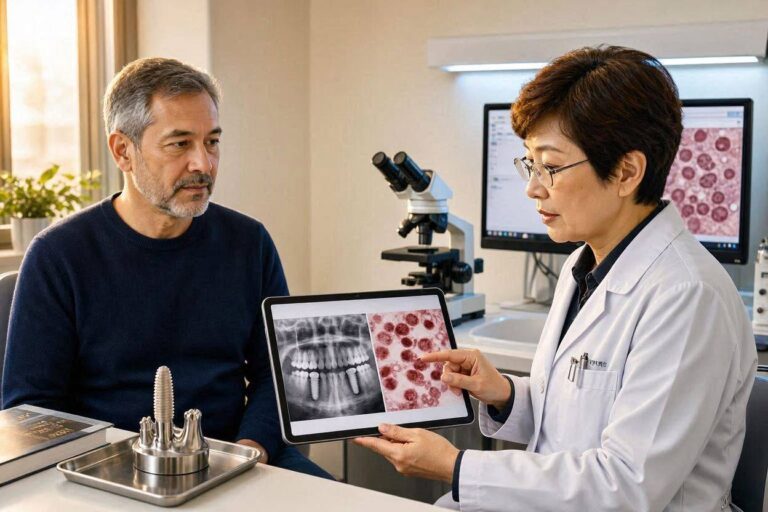
When a patient presents with TMJ pain after implant placement, the dentist must perform a thorough differential diagnosis. This is a systematic process of ruling out the various possible causes until the true etiology is identified.
The diagnostic workup includes a detailed history of the pain onset, character, duration, and aggravating factors. A clinical examination of the jaw muscles through palpation to identify trigger points and tenderness, measurement of the range of motion of the mandible, auscultation or listening to the joint sounds with a stethoscope to detect clicking or crepitus, and a thorough occlusal analysis to check for high contacts on the implant crown and on all other teeth. Imaging is often required. A panoramic X-ray provides an overview of the jaw and the joints. A Cone Beam CT scan provides a three-dimensional view of the joint anatomy, showing the position of the condyle in the fossa and any bony degenerative changes. An MRI can visualize the soft tissues, including the disc position.
The dentist may also use a T-scan or similar computerized occlusal analysis system. This device uses a thin, pressure-sensitive sensor that you bite on. It generates a digital map of your bite force across all your teeth in real-time. It can detect a premature contact on the implant crown with a precision that articulating paper cannot match. If a high spot is identified, the dentist adjusts it, and the symptoms often resolve quickly.
Treatment Strategies
The treatment for implant-related TMJ symptoms depends entirely on the diagnosed cause.
Occlusal Adjustment. If the implant crown is high or interfering, a precise adjustment using articulating paper or computerized analysis is the first step. This is a minor, non-invasive procedure. The dentist polishes a tiny amount of porcelain from the crown. The relief can be immediate and dramatic.
Nightguard Therapy. If bruxism is identified, a custom-fabricated hard acrylic nightguard is essential. The nightguard covers the teeth and provides a smooth, flat surface for the opposing teeth to glide against. It prevents the implant crown from taking concentrated forces and allows the jaw muscles to relax into a more physiologic position.
Physical Therapy. For myofascial pain and joint stiffness, physical therapy is highly effective. A physical therapist trained in TMJ disorders will perform manual therapy, intraoral and extraoral massage of the muscles of mastication, stretching exercises, and postural training. They may use ultrasound or electrical stimulation to reduce muscle spasm.
Pharmacotherapy. Nonsteroidal anti-inflammatory drugs (NSAIDs) like ibuprofen or naproxen reduce joint and muscle inflammation. Muscle relaxants like cyclobenzaprine can break a cycle of severe muscle spasm. These are used for short-term management.
Occlusal Splint Therapy. A full-coverage stabilization splint, different from a nightguard, is sometimes used to deprogram the muscles and allow the joint to seat into its most comfortable position. The splint is worn full-time for a period, then the bite is evaluated, and the implant crown or other teeth are adjusted to match the new, comfortable jaw position.
Implant Removal. In rare cases where the implant is demonstrably the source of the problem and all conservative measures have failed, the implant must be removed. This is a last resort. Scenarios include an implant that is impinging on a nerve, an implant that is severely malpositioned and cannot be restored in harmony with the bite, or an implant that has caused a chronic joint inflammation that resolves only when the implant is removed.
Prevention: How Your Dentist Can Protect Your TMJ
The best treatment for implant-related TMJ problems is prevention. A conscientious implant dentist takes specific steps to minimize the risk.
Pre-Treatment TMJ Screening. Before any implant surgery, the dentist should screen you for TMJ disorders. They should ask about jaw pain, clicking, locking, headaches, and a history of trauma. They should examine your jaw’s range of motion and palpate your muscles. If you have active TMD, it should be treated and stabilized before elective implant surgery.
Informed Consent. Patients with preexisting TMD or bruxism should be informed that implant treatment carries a risk of exacerbating their condition. This is part of informed consent. You should know the risk before you proceed.
Atraumatic Surgical Technique. The surgeon should use a bite block for prolonged procedures, minimize the time the mouth is maximally open, and use gentle tissue handling. Using 3D guided surgery reduces surgical time and trauma.
Meticulous Occlusal Design. When designing the final crown, the dentist must respect the principles of a balanced occlusion. The crown should contact evenly with the opposing teeth in centric occlusion, the position of maximum intercuspation. The excursive guidance should be on the natural teeth, not the implant, whenever possible. The implant crown should be slightly out of occlusion in heavy clenching, allowing it to touch during chewing but not taking the full brunt of bruxism forces. This is a nuanced clinical judgment.
Post-Operative Monitoring. At every follow-up visit, the dentist should ask about jaw function and comfort. Early detection of a developing TMJ problem allows for early intervention before the condition becomes chronic.
Quotations from TMJ and Implant Specialists
“I see patients who are convinced their implant ruined their jaw. In many cases, the implant was the straw that broke the camel’s back. The TMD was brewing for years. The implant just tipped them over the edge. That does not mean the implant should be removed. It means the TMD needs to be treated comprehensively.”
— Dr. Jeffrey Brown, Orofacial Pain Specialist
“A high crown is the most common cause of acute post-implant TMJ pain. The patient comes in with jaw pain, and I find a single implant crown with a heavy premature contact. I adjust it, and the pain melts away. It is gratifying and also a reminder of how exquisitely sensitive the masticatory system is.”
— Dr. Catherine Nunn, Prosthodontist
“I always tell my implant patients, if you clench or grind your teeth, you must wear a nightguard for the rest of your life. The implant will not fail, but your natural teeth or your jaw joint will suffer if you do not protect the system. The implant is the strongest link in the chain, so the force goes elsewhere.”
— Dr. Michael Torres, Board-Certified Oral and Maxillofacial Surgeon
Summary of Key Points on Implants and TMJ
- A dental implant can contribute to TMJ disorder through occlusal disharmony, most commonly a crown that is too high.
- Changes in chewing patterns, prolonged surgical opening, and the unmasking of preexisting TMD are other pathways.
- Bruxism combined with an implant can channel excessive forces to the jaw joint.
- Diagnosis requires a thorough history, clinical examination, and often imaging or computerized bite analysis.
- Treatment is usually conservative: occlusal adjustment, nightguard, physical therapy, and medication.
- Removal of the implant is a last resort, reserved for cases where the implant is clearly malpositioned or causing irreversible harm.
Conclusion
A dental implant can cause or contribute to TMJ disorder, but the relationship is rarely simple. The most common mechanism is a crown with an improper bite that forces the jaw muscles and joints into a strained, unbalanced position. Other times, the implant procedure unmasks a latent TMJ problem that was waiting to happen. The good news is that most implant-related TMJ symptoms are treatable with conservative, non-surgical interventions like occlusal adjustments and nightguard therapy. If you develop jaw pain, clicking, or headaches after implant treatment, do not suffer in silence. Return to your dentist for a comprehensive occlusal evaluation. The solution is often simpler than you fear.
Frequently Asked Questions (FAQ)
1. How soon after implant placement can TMJ symptoms appear?
Symptoms can appear immediately after surgery due to prolonged opening, within weeks after the crown is placed due to occlusal issues, or months later as muscle strain accumulates.
2. Can an implant on one side cause TMJ pain on the opposite side?
Yes. An avoidance pattern caused by a high implant on the right can strain the muscles and joint on the left, causing contralateral pain.
3. Will removing the implant cure the TMJ?
If the implant is the direct cause of the TMJ and conservative treatment has failed, removal may resolve the symptoms. However, if the TMD is a preexisting condition that was merely triggered by the implant, removing the implant may not cure the underlying TMD.
4. Is it safe to get a dental implant if I already have TMJ?
It can be safe if your TMJ condition is stable and well-managed. You must inform your implant surgeon about your TMJ history. The surgeon should coordinate care with your TMJ specialist.
5. Can a CT scan show if my implant is causing TMJ?
A Cone Beam CT scan can show the position of the implant, the condyle position in the fossa, and any bone changes. It is a valuable diagnostic tool but must be interpreted in conjunction with clinical findings.
6. Does a nightguard protect my implant as well as my joint?
Yes. A properly fitted nightguard distributes the forces of clenching and grinding evenly, protecting the implant, the opposing teeth, and the jaw joints from excessive load.
7. Can an implant be placed in a way that specifically avoids TMJ problems?
Yes. Modern implant planning uses 3D imaging and guided surgery to place the implant in the optimal position for prosthetic restoration, which directly influences the final occlusion and minimizes TMJ risk.
Additional Resource
For more information on temporomandibular disorders and finding a specialist, visit:
The TMJ Association