Can A Dental Implant Hurt?
You have taken a significant step toward restoring your smile. You have a dental implant, a titanium post surgically placed in your jawbone. The surgery is over. The healing has begun. But now, days, weeks, or even months later, you feel something. A twinge. A dull ache. A sharp sensation when you chew. Your mind races. Is this normal? Did the implant fail? Is something wrong? You were told implants are the gold standard, a permanent solution that feels just like a natural tooth. So why does it hurt?
This comprehensive guide will address every aspect of pain related to dental implants. We will distinguish between normal post-surgical discomfort and pain that signals a problem. We will explore the various stages of the implant journey, from the immediate post-operative period to years after the crown is placed, and explain what sensations are expected at each stage. By the end of this article, you will understand the difference between healing pain and warning pain. You will know when to wait, when to call your dentist, and when to seek immediate care.
The Nature of Implant Pain: Tooth vs. Implant
To understand implant pain, you must first understand a fundamental biological difference between a natural tooth and a dental implant. A natural tooth is alive. It has a pulp chamber containing nerves and blood vessels. It is suspended in its bony socket by the periodontal ligament, a network of collagen fibers that acts as a shock absorber and is richly innervated with sensory nerve endings. When you bite down on a natural tooth, the periodontal ligament compresses, and you feel a precise, modulated sense of pressure. When a natural tooth is in trouble, decay, infection, or a cracked root, the nerve inside the tooth sends a sharp, unmistakable pain signal.
A dental implant has none of these structures. It is a piece of titanium or zirconia that is screwed directly into the bone. There is no periodontal ligament. There is no nerve inside the implant. The implant itself cannot feel anything. It is an inanimate object. The bone that surrounds the implant is alive and has nerves, but the connection between the implant and the bone, osseointegration, is a direct structural bond without the intermediary ligament. This means that an implant does not feel pain the way a tooth feels pain. The pain you feel around an implant originates from the surrounding tissues, the gum, the bone, or the adjacent structures. This distinction is crucial for diagnosis.
Normal Post-Surgical Pain
Implant placement is a surgical procedure. The dentist or oral surgeon makes an incision in the gum, drills a precisely sized hole in the bone, and screws the implant into place. Sutures are placed. The body’s response to this controlled trauma is inflammation, which is the first stage of healing. Pain, swelling, and bruising in the days following surgery are not only normal, they are expected.
The First 24 to 72 Hours
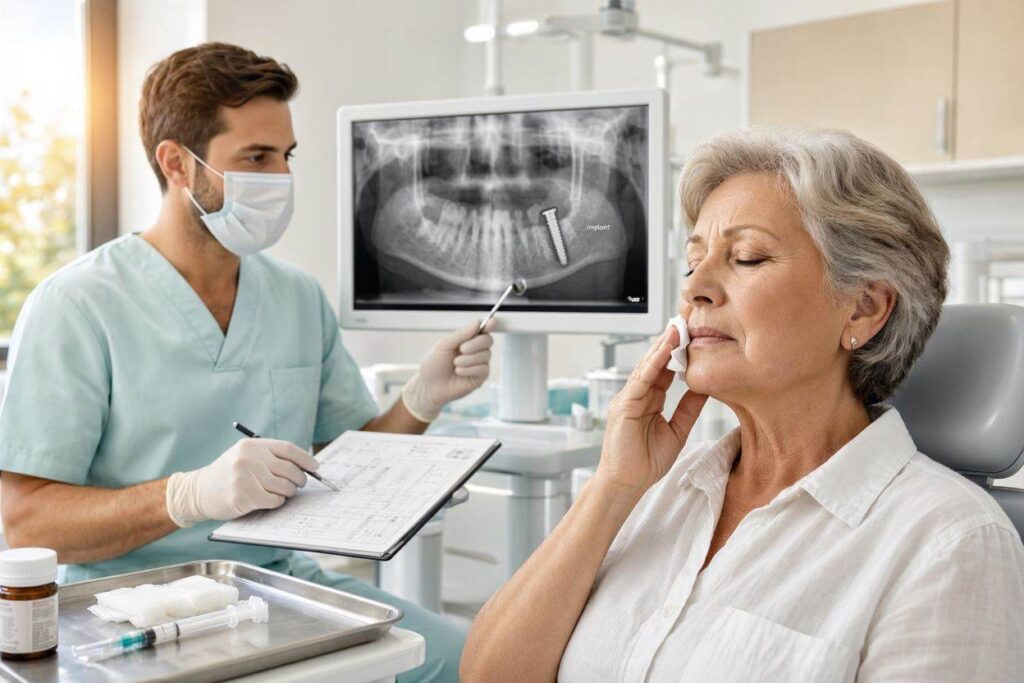
The peak of post-operative discomfort typically occurs during the first 24 to 72 hours. You will likely experience a dull, throbbing ache at the surgical site. This pain is the body’s inflammatory response. White blood cells rush to the area. Blood flow increases. Pressure builds in the tissues. The pain should be manageable with the pain relievers prescribed or recommended by your surgeon, typically a combination of ibuprofen and acetaminophen, or in some cases a narcotic analgesic for more complex surgeries.
Swelling of the gum and the face near the implant site is normal. Bruising, a black-and-blue discoloration of the skin, may appear a day or two after surgery. This is simply blood that has seeped into the tissues and is being broken down by the body. Swelling peaks around 48 to 72 hours after surgery and then gradually subsides.
You may also feel referred pain. An implant placed in the lower jaw can cause an ache that seems to radiate to the ear or the adjacent teeth. This is due to the complex innervation of the jaw. The nerves are branches of the trigeminal nerve, and pain signals can be perceived as originating from a broader area than the surgical site itself.
The First Week
By day four or five, the acute throbbing pain should transition to a milder soreness. The gum tissue around the implant will be tender to the touch. Sutures may start to feel loose or irritating. This is normal as the tissue knits together. You should be able to manage any discomfort with over-the-counter pain relievers. If the pain is increasing at day five or beyond, rather than decreasing, this is a red flag.
Abnormal Pain: Signs of Complication
Pain that deviates from the normal healing trajectory demands attention. You must be able to recognize the warning signs.
Dry Socket in the Implant Site
While a dental implant is placed into bone, the surgeon often extracts a tooth at the same time, known as an immediate implant placement. If a tooth was extracted, a blood clot forms in the extraction socket. If that clot is dislodged or fails to form, you develop a dry socket, or alveolar osteitis. The bone is exposed to air, food, and fluids. The pain from a dry socket is intense, deep, and unrelenting. It typically begins three to five days after the extraction and implant placement. It does not respond well to over-the-counter pain relievers. A dry socket requires treatment by your dentist, who will place a medicated dressing into the socket to soothe the exposed bone and promote healing.
Infection: Peri-Implant Mucositis and Peri-Implantitis
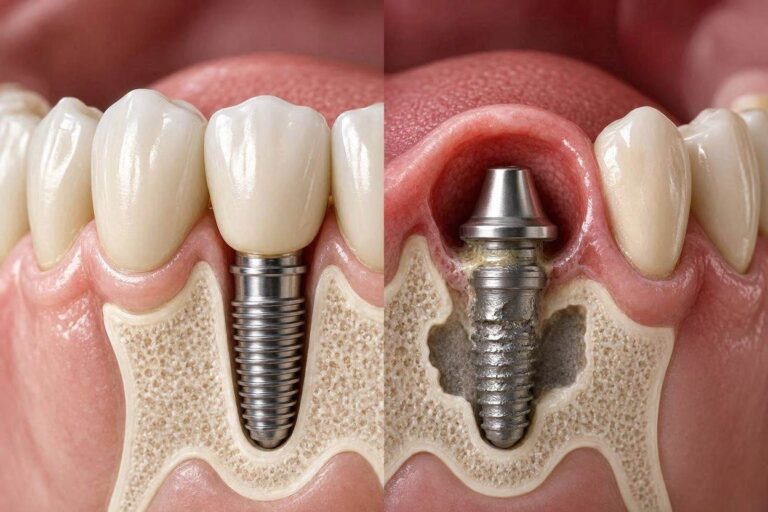
An implant can become infected. The early stage is called peri-implant mucositis, which is inflammation and infection of the gum tissue around the implant without bone loss. The later, more serious stage is called peri-implantitis, which involves inflammation, infection, and progressive loss of the bone supporting the implant.
An infection around an implant does not feel like a toothache. It often presents as a dull, deep ache, a sensation of pressure, or throbbing in the gum tissue. The gum will be red, swollen, and may bleed easily when brushed or probed. You may notice a bad taste in your mouth or a discharge of pus from around the implant. You may notice a small pimple-like bump on the gum, called a fistula, which is a drainage tract for pus. If you have these signs, you have an active infection. The pain may not be excruciating, but the process is destructive. The bone that supports the implant is being dissolved by the inflammatory response. You must see your dentist immediately. Infection left untreated will cause implant failure.
Overloading and Occlusal Trauma
An implant that is subjected to excessive biting forces before it has fully integrated can become painful. This is called overloading. The micromovement of the implant in the bone irritates the healing interface. The pain is typically felt when you bite down or chew. It is a sharp, localized pain that releases when you stop biting.
Even after successful integration and placement of the crown, an implant can be traumatized by a bite that is too high. If the crown is slightly too prominent, it hits the opposing tooth before the other teeth touch. This is called a premature contact. Every time you chew or clench, that single implant takes the brunt of the force. The bone and the implant components are stressed. The pain is a signal. It may feel like a bruised sensation around the implant. Your dentist must adjust the bite, a process called occlusal adjustment, to relieve the trauma.
Nerve Injury
A rare but serious complication of implant surgery is injury to a nerve. In the lower jaw, the inferior alveolar nerve runs through a canal in the mandible. It supplies sensation to the lower lip and chin. If an implant is placed too deeply and impinges on or transects this nerve, the patient experiences altered sensation. This may be numbness, tingling, a “pins and needles” sensation, or a burning, electric-shock-like pain. This is neuropathic pain. It is different in character from inflammatory pain. It may be constant or triggered by touch.
In the upper jaw, the infraorbital nerve can be affected, causing altered sensation in the cheek and upper lip. Nerve injuries are a true emergency. If you experience persistent numbness or neuropathic pain after implant surgery, you must inform your surgeon immediately. In some cases, early intervention, such as removing or repositioning the implant, can allow the nerve to recover. Delayed intervention reduces the chance of recovery.
Failed Osseointegration
An implant that fails to integrate with the bone may present with pain, but more commonly it presents with mobility. The implant feels loose. It may wiggle when manipulated. A successful implant is rock-solid, immobile, fused to the bone. A loose implant is a failing implant. The pain associated with a loose implant is often a dull ache caused by the inflammation at the failing bone-implant interface. This is a definitive sign of failure. The implant must be removed.
Sinus Complications
Implants placed in the upper back jaw, the maxillary posterior region, are in close proximity to the maxillary sinus. If an implant protrudes into the sinus cavity, it can cause chronic sinusitis. The patient may experience sinus pressure, pain, congestion, and post-nasal drip on the side of the implant. They may not localize the pain to the implant itself. They may think they have a persistent sinus infection. The connection is the implant. A CBCT scan will reveal the protrusion. Treatment may involve removing the implant and performing a sinus repair, or in some cases, the implant can be left in place if the sinus remains healthy and the implant is stable.
Pain During the Healing Phase (Osseointegration)
After the initial surgical pain subsides, typically after two weeks, you enter the osseointegration phase. The implant is buried under the gum or has a healing abutment protruding through it. You should feel no pain during this period. None. The implant is sitting passively in the bone, waiting for the bone to grow against it. You may have occasional mild tenderness if you press on the gum, but there should be no spontaneous pain, no throbbing, and no ache.
If you develop pain during the osseointegration phase, weeks or months after the surgery, you must suspect an infection or a failure of integration. A low-grade infection can simmer for months without dramatic symptoms. The pain may be subtle, a persistent dull awareness that something is not right. Do not dismiss a persistent, low-grade ache. See your dentist for an evaluation. An X-ray can show the status of the bone around the implant.
Pain After the Crown Is Placed
The implant has integrated. The abutment and crown are placed. You are now using the implant to chew. What pains are normal or abnormal at this stage?
Normal Post-Insertion Sensitivity
When the final crown is cemented or screwed into place, the gum tissue around the implant may be tender for a few days. The process of manipulating the abutment and seating the crown can irritate the peri-implant gum. This tenderness should resolve quickly. If the crown is screw-retained, the access hole is filled with a temporary filling material that can feel slightly rough to the tongue until it is polished.
Food Impaction and Interproximal Pain
An implant crown that does not have ideal contact with the adjacent teeth can trap food. The food impaction pushes the gum papilla, the little triangle of gum between the teeth, down and away. This causes a localized, sharp pain after eating. Flossing the area releases the food and relieves the pain. Food impaction is not a problem with the implant itself, but with the shape of the crown or the position of the adjacent tooth. Your dentist can adjust the contact or reshape the crown to close the food trap.
Cement-Induced Peri-Implantitis
If the crown was cemented onto the abutment, excess cement can become trapped under the gum. Dental cement is a rough, porous material. Bacteria adhere to it. The body cannot remove it. The retained cement acts as a foreign body, perpetually irritating the gum tissue. The result is a localized, stubborn area of inflammation, swelling, bleeding, and a dull ache that does not resolve with good hygiene. This is cement-induced peri-implantitis. The treatment is to surgically remove the retained cement. This is a recognized complication that has led many dentists to favor screw-retained crowns, which eliminate cement entirely.
Loose Abutment Screw
The abutment screw, the tiny screw that connects the abutment to the implant, can loosen over time. When it loosens, the abutment and crown microscopically rock on the implant. This movement irritates the surrounding tissues. The patient may feel a popping or clicking sensation. There may be a dull ache. If the screw loosens further, the crown may feel mobile. A loose abutment screw is not a failed implant, but it requires prompt attention. Your dentist will remove the crown, clean the internal connection, retighten the screw to the correct torque, and replace the filling over the screw. Left untreated, a loose screw can fracture, making removal very difficult.
Fractured Implant or Abutment
A fracture of the implant fixture itself or the abutment is rare but catastrophic. It usually occurs after years of heavy function, particularly in patients who grind or clench their teeth severely and do not wear a nightguard. A fracture often presents with a sudden change in the feel of the implant, a sharp pain upon biting, or a loose crown. The implant must be surgically removed and replaced.
The Psychological Component of Implant Pain
You must also consider the psychological dimension. You have invested significant money, time, and hope into your implant. You are hyper-aware of every sensation. A tiny twinge that you would ignore in a natural tooth becomes amplified when it occurs at the implant site. This hyper-vigilance is normal. Your brain is monitoring the foreign object in your body. This does not mean every minor sensation is a pathology. Try to observe the sensation without catastrophizing. A transient, mild sensation that disappears quickly is likely benign. A persistent, worsening, or functionally limiting pain is a reason to call your dentist.
How to Differentiate Implant Pain from Other Dental Pain
Pain in the mouth can be referred from one structure to another. A problem with an adjacent natural tooth can feel like pain at the implant. A decayed tooth next to the implant can cause pain that radiates to the implant site. Sinus pressure from allergies or a cold can feel like pain in an upper implant. Temporomandibular joint (TMJ) disorder and muscle pain from clenching can cause a diffuse ache in the jaw that you attribute to the implant.
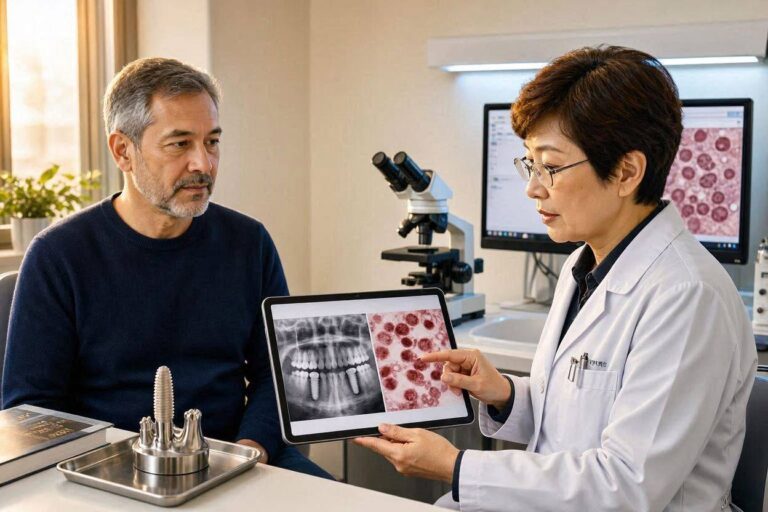
Your dentist has tools to localize the pain precisely. A periapical X-ray shows the bone around the implant and the adjacent teeth. A percussion test, tapping on the teeth and implant, can localize the source of pain. A bite test with a small piece of articulating paper reveals occlusal interferences. A cold test can determine the vitality of adjacent natural teeth. Do not self-diagnose. Let your dentist perform a systematic examination.
Pain Management for Normal Post-Operative Discomfort
After implant surgery, you can manage normal healing pain effectively at home.
Cold Therapy. Apply an ice pack to the outside of your face over the surgical site. Use the ice for 20 minutes on, 20 minutes off, during the first 24 to 48 hours. Ice reduces swelling and provides an analgesic effect by numbing the superficial nerves.
Medication. Take the pain relievers as directed. Ibuprofen is particularly effective for dental surgical pain because it reduces inflammation. If you cannot take NSAIDs, acetaminophen is an alternative. Your surgeon may prescribe a combination of the two or a short course of a stronger analgesic. Take the medication before the local anesthetic wears off to stay ahead of the pain. Managing pain is easier than chasing pain that has already peaked.
Head Elevation. Sleep with your head elevated on two or three pillows for the first few nights. This reduces hydrostatic pressure in the head and neck, minimizing swelling and throbbing.
Soft Diet and Hydration. Stick to cool, soft foods and liquids for the first few days. Avoid hot foods and beverages, which increase blood flow and swelling. Stay hydrated, as dehydration can worsen pain and delay healing.
Oral Hygiene. Gently rinse with warm salt water, one-half teaspoon of salt in a cup of warm water, starting 24 hours after surgery. Do not swish vigorously. Let the water gently bathe the surgical site. Avoid commercial mouthwashes with alcohol, which can irritate the wound.
Red Flags: When to Call Your Dentist Immediately
You should contact your dental provider without delay if you experience any of the following:
- Pain that is severe and not controlled by prescribed pain medication.
- Pain that increases after day three or four, rather than gradually subsiding.
- Persistent bleeding that will not stop with gentle pressure.
- Swelling that is expanding, hardening, or making it difficult to swallow or breathe.
- A fever over 101 degrees Fahrenheit (38.3 degrees Celsius).
- Numbness or altered sensation in the lip, chin, or tongue that persists more than eight hours after surgery.
- Pus or foul-tasting discharge from the implant site.
- A loose implant or a feeling that the implant is moving.
- A sharp, electric pain when the implant is touched or when you chew.
Quotations from Clinical Experts
“Patients often think an implant should be completely numb or dead. In reality, the living bone around the implant has nerves. You should feel pressure when you bite, but not sharp pain. Sharp pain always has a cause. It is the body’s alarm system. Never ignore it.”
— Dr. Samuel Hayes, Periodontist
“The most common cause of late implant pain I see in my practice is loose abutment screws. The patient thinks the implant is failing. I remove the crown, see the loose screw, retighten it, and the pain resolves instantly. It’s a simple fix for a problem that causes disproportionate anxiety.”
— Dr. Rachel Adams, Prosthodontist
“Nerve injuries from implant placement are devastating for patients and largely preventable with proper 3D imaging and planning. If a patient tells me their lip feels like it’s on fire or has pins and needles, I know we have a nerve issue. That is a true surgical emergency.”
— Dr. Marcus Lee, Oral and Maxillofacial Surgeon
Conclusion
A dental implant itself cannot hurt because it is an inanimate object with no nerves, but the living tissues that surround it, the bone, the gums, and the adjacent nerves, can and do produce pain when something is wrong. Normal post-surgical pain is a dull, throbbing ache that peaks within 48 hours and steadily subsides. Pain that worsens over time, sharp pain when biting, a loose implant, pus, or altered nerve sensation are all signs of a complication that requires professional evaluation. The key is to know the difference between healing and harm. When in doubt, always contact your implant dentist. A quick X-ray and a brief examination can provide reassurance or catch a problem before it becomes irreversible.
Frequently Asked Questions (FAQ)
1. How long should pain last after implant surgery?
Moderate discomfort typically lasts three to five days. Mild soreness may persist for two weeks. Pain beyond two weeks or pain that worsens is abnormal.
2. Can an implant hurt years after it was placed?
Yes. Late implant pain can be caused by peri-implantitis, a loose abutment screw, a fractured implant, occlusal trauma, or an adjacent tooth problem. A thorough examination is necessary.
3. Why does my implant hurt when I bite down?
Pain on biting usually indicates occlusal trauma, meaning the crown is hitting too heavily, or a loose abutment screw. It could also signal a failing implant. See your dentist for a bite adjustment and evaluation.
4. Can an infected dental implant be saved?
Peri-implant mucositis, infection of the gum only, is highly treatable and curable. Peri-implantitis with bone loss can be treated, but the bone does not typically grow back predictably. Early intervention offers the best chance of saving the implant.
5. Is it normal for the gum around my implant to bleed?
No. Healthy peri-implant gum tissue does not bleed. Bleeding indicates inflammation, usually from inadequate cleaning around the implant. You must improve your hygiene and see your dentist.
6. Can allergies or sinus problems cause implant pain?
Yes. An upper implant that is close to the sinus can transmit sinus pressure. A sinus infection can feel like implant pain. Conversely, an implant protruding into the sinus can cause sinus symptoms.
7. Does removing a failed implant hurt?
The removal procedure is typically less traumatic than the original placement. Local anesthesia is used, and post-operative discomfort is usually manageable. A failed implant often comes out relatively easily because the bone has not integrated with it.
Additional Resource
For more information on implant care and complications, visit the American Academy of Periodontology’s patient resource:
American Academy of Periodontology – Dental Implants