Can Dental Implants Cause AML?
You are researching dental implants, considering restoring your smile with this transformative technology. During your online search, you stumble upon a frightening claim. A forum post, a dubious website, or a social media comment suggests a link between dental implants and AML, Acute Myeloid Leukemia. Your blood runs cold. You were prepared for discussions about cost, pain, and success rates. You were not prepared to confront the possibility of cancer. You need a clear, evidence-based answer. Can the titanium post in your jaw truly trigger a deadly blood cancer?
This article will address this question with the scientific rigor and honesty it deserves. We will examine the biological plausibility of such a link. We will review the available scientific literature and epidemiological data. We will discuss the known risk factors for AML and the known safety profile of dental implants. By the end, you will have a factual, unemotional understanding of the actual risks, or lack thereof, associated with dental implants and blood cancers.
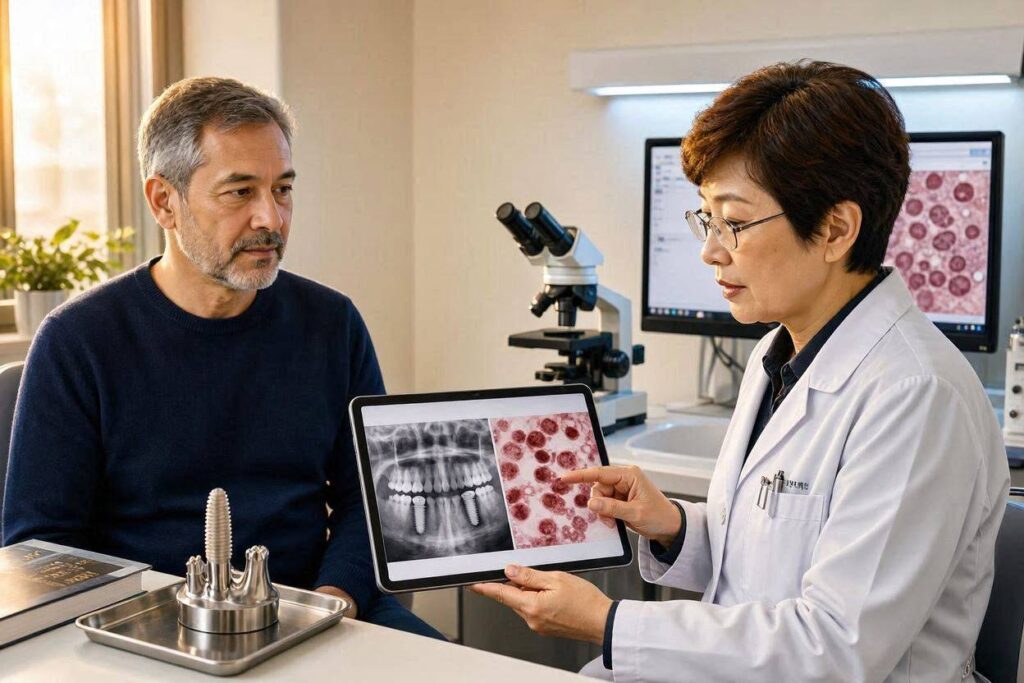
Understanding Acute Myeloid Leukemia (AML)
To assess any potential link, we must first understand what AML is. Acute Myeloid Leukemia is a cancer of the blood and bone marrow. It is characterized by the rapid proliferation of abnormal myeloid cells, immature white blood cells that crowd out healthy blood cells. The bone marrow, the factory where blood cells are produced, becomes filled with these leukemic blast cells. The production of normal red blood cells, white blood cells, and platelets is severely compromised.
AML is an acute leukemia, meaning it progresses rapidly and requires immediate treatment. It is the most common acute leukemia in adults, with a median age of diagnosis around 68 years. The symptoms include fatigue, shortness of breath, easy bruising and bleeding, frequent infections, and bone pain. The exact cause of AML is not fully understood, but science has identified several established risk factors.
The known risk factors for AML include exposure to high doses of ionizing radiation, such as from atomic bomb blasts or radiation therapy for other cancers. Exposure to certain chemicals, most notably benzene, which is found in cigarette smoke and industrial solvents, is a well-documented risk factor. Previous treatment with certain chemotherapy drugs, particularly alkylating agents and topoisomerase II inhibitors, can cause therapy-related AML. Certain genetic syndromes, such as Down syndrome and Fanconi anemia, carry an increased risk. Myelodysplastic syndromes and other preexisting bone marrow disorders can progress to AML. Family history can also play a role.
Note what is absent from this list of established risk factors. There is no mention of dental implants, titanium, or any dental materials. The established risk factors are genetic, environmental, and iatrogenic from cancer treatments.
The Origin of the Cancer Concern: Corrosion and Metal Ions
The concern about dental implants causing cancer, including AML, stems from a broader anxiety about metals in the body. We know that certain metals, such as nickel and chromium in some industrial settings, can be carcinogenic. We know that metal-on-metal hip implants, which involve large cobalt-chromium articulating surfaces, can release metal ions and particles into the surrounding tissues and bloodstream due to wear and corrosion. These metal ions have been associated with local tissue reactions, pseudotumors, and, in very rare cases, systemic toxicity.
Dental implants are made of titanium or titanium alloys, typically commercially pure titanium or Ti-6Al-4V, which is titanium alloyed with aluminum and vanadium. Titanium is chosen specifically because it is highly biocompatible, meaning the body tolerates it exceptionally well. It forms a stable, inert oxide layer on its surface that resists corrosion. Unlike the cobalt-chromium hip implants that experience significant mechanical wear, dental implants are static once they osseointegrate. They do not have moving parts rubbing against each other.
However, no material is perfectly inert. Studies have shown that trace amounts of titanium ions can be released from dental implants, particularly in the presence of inflammation, acidic conditions, or mechanical stress. Titanium particles have been found in the peri-implant tissues and, at very low levels, in distant organs such as the lymph nodes, spleen, and even blood. The question is whether these trace levels of titanium are biologically significant, specifically whether they can cause leukemia.
The Biological Plausibility: Does Titanium Cause Leukemia?
For a substance to cause leukemia, it must be able to damage the DNA of hematopoietic stem cells in the bone marrow. This is the fundamental mechanism of leukemogenesis. The carcinogen must reach the bone marrow, penetrate the stem cells, and cause mutations that lead to uncontrolled proliferation.
The plausibility of titanium dental implants causing AML is extremely low, approaching zero, for several reasons. First, the quantity of titanium ions released from a well-integrated implant is minuscule, measured in parts per billion in the blood. This is far below any known toxicological threshold. Second, titanium is not classified as a carcinogen by the International Agency for Research on Cancer (IARC). IARC has evaluated titanium dioxide, a form of titanium used in pigments and sunscreens, and classified it as possibly carcinogenic to humans, Group 2B, based on inhalation studies in rats showing lung tumors. This classification applies to inhaled titanium dioxide dust, not to solid titanium metal in a dental implant. Titanium metal is not classified as a carcinogen.
Third, even if titanium ions reach the bone marrow, which they likely do in trace amounts, there is no evidence that titanium causes the specific chromosomal translocations or genetic mutations characteristic of AML. Leukemia arises from very specific genetic insults. Titanium does not appear capable of producing these insults. In contrast, benzene, a known cause of AML, is a potent bone marrow toxin that directly damages the DNA of stem cells.
A Review of the Scientific Literature
If dental implants caused AML, we would expect to see epidemiological evidence. We would see an increased incidence of AML in populations with dental implants compared to the general population. We do not.
A comprehensive search of the PubMed database, the repository of the world’s biomedical literature, reveals no case reports, no case-control studies, and no cohort studies establishing a causal or even associative link between dental implants and Acute Myeloid Leukemia. This is a significant absence of evidence. In a world where millions of dental implants are placed annually, and where rare adverse events are documented and published as case reports, the complete lack of reported cases of AML attributed to dental implants is reassuring.
There is a body of literature on metal hypersensitivity reactions to titanium. Some patients develop a localized inflammatory response, peri-implantitis of non-infectious origin, that may be related to a titanium allergy or hypersensitivity. This is a local phenomenon. It affects the tissues immediately around the implant. There is no evidence that this local hypersensitivity progresses to systemic malignancy.
There is also a literature on dental radiographs and cancer risk. Dental implants require diagnostic X-rays for planning and follow-up. The radiation dose from dental X-rays is extremely low. While cumulative exposure to medical radiation is a minor risk factor for some cancers, the contribution of dental X-rays to AML risk is negligible and is not specific to implants. It applies to any dental treatment requiring radiographs.
The Distinction Between Correlation and Causation
A patient who develops AML may also have dental implants. This is a coincidence, not a causal relationship. The median age for AML diagnosis is around 68. The demographic that seeks dental implants is predominantly older adults. There is an overlap in age between the implant population and the AML population. If an older adult with implants develops AML, the two conditions coexist, but the implants did not cause the leukemia.
This is the classic logical fallacy of post hoc ergo propter hoc, “after this, therefore because of this.” Just because event B happened after event A does not mean A caused B. A person who eats breakfast every morning will eventually die, but breakfast did not cause their death. A person with a dental implant may someday develop cancer, but the implant is not the cause. Without rigorous epidemiological data showing an increased relative risk, the temporal association is meaningless.
What About Other Cancers?
The same logic applies to other types of cancer. There is no established link between dental implants and oral squamous cell carcinoma, the most common cancer of the mouth. In fact, chronic irritation from ill-fitting dentures is a known, though rare, risk factor for oral cancer. Dental implants, by providing a stable, non-irritating replacement for teeth, may actually reduce the chronic inflammation that can contribute to oral cancer. Some case reports have described squamous cell carcinoma developing around dental implants, but these are exceedingly rare and likely represent coincidental occurrence of cancer at the site of an implant, not cancer caused by the implant.
There is no established link between dental implants and lymphoma, multiple myeloma, or any other hematologic malignancy. The biological inertness of titanium makes such links highly implausible.
Known Biological Responses to Titanium Implants
To be thorough, let us describe the known biological responses to dental implants. These are well-characterized and do not include carcinogenesis.
Osseointegration. This is the desired response. Bone grows directly against the titanium oxide surface, creating a stable, functional ankylosis. This is a testament to the biocompatibility of titanium.
Peri-Implant Mucositis. This is a reversible inflammation of the soft tissue around the implant, caused by bacterial plaque. It is analogous to gingivitis around natural teeth. It is an infectious and inflammatory condition, not a neoplastic one.
Peri-Implantitis. This is a more severe, progressive inflammation that affects both the soft tissue and the supporting bone. It is caused by bacterial infection and the host’s inflammatory response. If left untreated, it leads to bone loss and implant failure. It is an inflammatory disease, not a cancerous one.
Titanium Hypersensitivity. In a small subset of patients, a Type IV delayed hypersensitivity reaction to titanium can occur. This manifests as persistent inflammation, erythema, and sometimes implant failure. It is a localized immune response. The diagnosis is challenging and often one of exclusion.
Titanium Particle Deposition. As mentioned, titanium wear particles and ions can be detected in peri-implant tissues and regional lymph nodes. Histological examination of these lymph nodes may show titanium pigmentation. Long-term studies have not shown an increased risk of lymphoma or other malignancies in these lymph nodes. The body appears to sequester the particles without malignant transformation.
The Importance of Reliable Information
The internet is a breeding ground for medical misinformation. Claims linking dental implants to cancer often originate from anti-metal groups, biological dentists who advocate for metal-free dentistry based on philosophies not supported by mainstream science, or from patients who have experienced implant failure and are seeking explanations for their suffering. While these patients’ suffering is real, their causal attributions are often speculative and unsupported by evidence.
As a patient, you must critically evaluate the sources of your health information. A single anecdote on a forum does not constitute evidence. A study showing titanium ions in the bloodstream is not a study showing that those ions cause cancer. Correlation is not causation. The gold standard for medical evidence is the systematic review of randomized controlled trials and large-scale epidemiological cohort studies. On the question of dental implants and AML, that evidence does not show a link.
Summary of Scientific Findings
- Dental implants are made of titanium, a highly biocompatible metal that does not cause cancer.
- The International Agency for Research on Cancer does not classify titanium metal as a carcinogen.
- There are no case reports or epidemiological studies linking dental implants to Acute Myeloid Leukemia.
- The established risk factors for AML are genetic mutations, exposure to high-dose radiation, benzene, certain chemotherapy drugs, and preexisting bone marrow disorders.
- Trace metal ion release from implants is a known phenomenon, but the levels are far below thresholds known to cause systemic toxicity or malignancy.
- The absence of evidence, combined with the lack of biological plausibility, supports the conclusion that dental implants do not cause AML.
Conclusion
Dental implants do not cause Acute Myeloid Leukemia. The fear that a titanium post in your jaw could trigger a deadly blood cancer is not supported by any credible scientific evidence. The biological properties of titanium, the absence of any epidemiological signal despite millions of implants placed worldwide, and the well-characterized risk factors for AML all point to the same conclusion: dental implants are safe from a carcinogenic standpoint. If you are considering dental implants, you should focus on the known, manageable risks such as infection, implant failure, and peri-implantitis. Do not let unfounded fears of cancer prevent you from receiving a treatment that can profoundly improve your quality of life.
Frequently Asked Questions (FAQ)
1. Can titanium from dental implants get into my bloodstream?
Yes, trace amounts of titanium ions can be released from the implant surface and enter the bloodstream. These levels are extremely low and have not been shown to cause any systemic health problems.
2. Has anyone ever gotten leukemia from a dental implant?
There are no documented cases in the medical literature of a dental implant causing leukemia. No causal link has been established.
3. What about metal allergies? Can a titanium allergy cause cancer?
Titanium allergy is rare and usually manifests as a local skin or tissue reaction. There is no evidence that metal allergies cause cancer.
4. Should I have my titanium implants removed because I am worried about cancer?
No. There is no scientific justification for removing healthy, well-integrated dental implants due to cancer fear. The risk of a surgical procedure to remove them outweighs any hypothetical and unproven cancer risk.
5. Are zirconia implants safer regarding cancer risk?
Zirconia implants are metal-free and are an alternative for patients with proven titanium allergy or a strong preference for metal-free dentistry. However, there is no evidence that titanium implants pose a cancer risk that zirconia implants avoid.
6. Can dental X-rays for implant planning cause AML?
The radiation dose from dental X-rays is extremely low. The additional risk of cancer from dental radiographs is considered negligible, especially when proper shielding and modern digital sensors are used.
7. What should I do if I have dental implants and I am worried about AML?
Speak with your primary care physician. If you have symptoms such as unexplained bruising, fatigue, recurrent infections, or abnormal bleeding, you can have a complete blood count (CBC) to screen for leukemia. The presence of dental implants is not an indication for AML screening.
Additional Resource
For reliable information on leukemia, its causes, and treatment, visit:
Leukemia & Lymphoma Society