Can A Dental Implant Affect Singing?
You are a singer. Your voice is your instrument. Perhaps you perform professionally on stage, sing in a choir, teach music, or simply find joy in singing in the shower or the car. You are considering a dental implant to replace a missing tooth, or you have recently had one placed. You are concerned about how a piece of titanium in your jaw and a porcelain crown might alter the subtle, precise movements of your mouth that produce your unique sound. Can a dental implant affect your singing voice, your resonance, your articulation, or your embouchure? This is a question that deserves a detailed, nuanced answer, especially for vocal professionals and serious amateurs.
This guide will explore the relationship between dental implants and vocal production. We will examine the anatomy of the vocal tract and how teeth interact with sound. We will discuss the potential effects of missing teeth on singing and how implants can restore function. We will address the concerns specific to wind instrument players who also sing. By the end, you will understand how to approach implant treatment to protect, and potentially enhance, your vocal abilities.
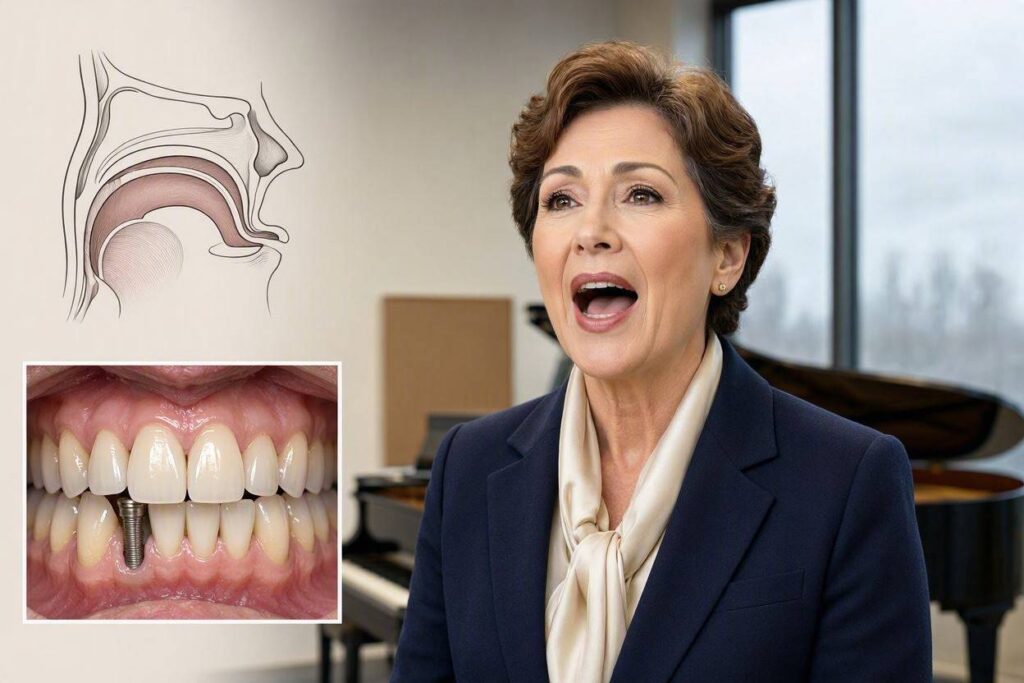
The Vocal Tract and the Role of Teeth
To understand how a dental implant might affect singing, you must first understand the components of the vocal instrument and the role of the oral cavity.
The human voice is produced by the vibration of the vocal folds, commonly called vocal cords, in the larynx. This vibration creates a raw sound, a buzz, that is then shaped and amplified by the resonating chambers of the throat, the pharynx, the mouth, the oral cavity, and the nasal passages. The tongue, the soft palate, the lips, and the teeth act as articulators, molding the sound into recognizable vowels and consonants.
The teeth play a specific and critical role in singing. The upper front teeth, in particular, are essential for the articulation of certain consonants. The “th” sound, as in “the,” requires the tongue to gently contact the back of the upper front teeth. The “f” and “v” sounds require the lower lip to contact the upper front teeth. The “s” and “z” sounds require a precise channel of air to flow between the tongue and the upper front teeth or the alveolar ridge, the bony bump just behind the teeth. The teeth also contribute to the shape of the oral cavity, which affects resonance and timbre.
A missing tooth, especially an upper front tooth, creates a gap that alters the air flow and the tongue’s contact point. Singers with a missing front tooth often report a whistling sound on certain consonants, difficulty articulating clearly, and a sense of air leakage. They may unconsciously alter their tongue or lip position to compensate, which can introduce tension into the vocal mechanism and affect tone quality.
How a Missing Tooth Affects a Singer
If you are considering an implant, you likely currently have a missing tooth or a failing tooth that needs replacement. The baseline from which you are comparing the implant is not a perfect natural tooth. It is an empty space, a damaged tooth, or a temporary removable appliance like a flipper. Any of these can negatively affect your singing.
A missing tooth can cause a lisp or a whistle, especially on sibilant sounds. It can make it difficult to produce a clear, focused tone because the air stream is not being properly directed. The gap can become a psychological distraction, making you self-conscious and inhibiting your full expression. If you wear a removable partial denture to fill the gap, the acrylic base plate can interfere with tongue placement and reduce the resonant space of the oral cavity. The clasps that hold the partial in place can catch on your cheeks or tongue. A flipper, a temporary removable tooth, is often bulky and can impair articulation.
A failing tooth with a large filling or a temporary crown can also be a source of discomfort and altered sensation. The uncertainty of biting into an apple or even singing a high note with a loose tooth can create tension. The implant, therefore, is not replacing a perfect natural tooth. It is replacing a compromised situation. When viewed from this perspective, a successful dental implant is a restoration of normal function, not an introduction of a foreign impediment.
The Implant Restoration: Restoring Normal Anatomy
A well-placed and properly restored dental implant should mimic the natural tooth it replaces in form and function. The implant fixture is buried in the bone and has no direct sensation. The crown that sits on top is designed to replicate the size, shape, and contour of the original tooth. The emergence profile, the way the crown emerges from the gum, is shaped to support the gum tissue and create a natural contour.
For a singer, this means that the contact points for the tongue and lips are restored. The upper front tooth that provides the contact point for “th,” “f,” and “v” sounds is back in its proper position. The channel for the “s” sound is reestablished. The air stream is directed correctly. The resonance of the oral cavity is not disrupted by a gap or a bulky appliance.
Most singers who transition from a missing tooth to a well-made implant crown report a significant improvement in their ability to articulate clearly and project their voice. They feel that their mouth is whole again. The psychological distraction of the gap is gone. The tension caused by compensating for the missing tooth dissipates. The implant becomes a seamless part of their vocal instrument.
Potential Problems: When an Implant Could Interfere
While a successful implant should restore function, certain complications or design flaws could negatively affect singing.
Improper Crown Contour
The most likely culprit for vocal interference is an implant crown that is too bulky, too thick, or incorrectly shaped. If the crown is thicker than the natural tooth it replaced, it can encroach on the tongue space. The tongue, which is exquisitely sensitive to spatial changes in the mouth, will feel the bulk. This can subtly alter tongue position and articulation. A crown that is too long can hit the lower lip or teeth prematurely, affecting the embouchure and the production of labial sounds. A crown that is too flat on the back surface, the palatal or lingual contour, can misdirect the air stream, causing a whistle or a lisp. The restoration must be crafted by a dentist who understands phonetics and the functional requirements of a singer.
Altered Palatal Sensation
For an upper anterior implant, the crown rests in the bone of the premaxilla. The palatal tissue behind the crown is unchanged. However, if the implant was placed in a position that required significant bone grafting or if the surgical healing altered the contours of the palatal vault, the resonating chamber of the mouth could theoretically be changed. This is extremely rare. The implant is a relatively small structure, and the overall volume of the oral cavity is not significantly altered by a single implant. Full-arch implant prostheses that cover the palate are a different story and are discussed below.
Excess Cement
If the implant crown is cemented and excess cement is not fully removed, the retained cement can cause inflammation and swelling of the gum tissue. This swelling can alter the sensation in that area of the mouth. The gum may feel tender or strange when the tongue touches it. This is a temporary issue that resolves once the cement is removed and the tissue heals.
Loose Components
A loose abutment screw or a loose crown can move slightly when you sing, especially on high notes or forte passages that involve strong air pressure and muscle contractions. This movement may be perceptible as a clicking or a feeling of instability. It can be a source of distraction. A loose component must be tightened by your dentist.
Implant Position Too Far Forward or Backward
If the implant is placed in a position that forces the crown to be angled or positioned significantly differently from the natural tooth, the tongue and lip contact points will be altered. A tooth that is positioned too far forward, proclined, can interfere with the “f” and “v” sounds. A tooth that is too far back, retroclined, can alter the “s” sound. Careful surgical planning with a surgical guide ensures the implant is placed in the ideal prosthetic position, which is also the ideal functional position for speech and singing.
Full-Arch Implant Prostheses and Singing
There is a significant difference between a single implant crown and a full-arch implant prosthesis, such as an All-on-4 fixed hybrid bridge or an implant-retained overdenture. These full-arch solutions replace all the teeth on an arch. The design of these prostheses can have a more noticeable impact on singing.
An implant-retained overdenture that snaps onto implants but still covers the palate will affect the oral resonance. The palatal coverage dampens the vibrations of the hard palate, which acts as a sounding board. Singers who wear a palatal-covering denture often report that their voice sounds duller or less resonant. They may have difficulty with certain consonant sounds that require the tongue to touch the palate.
A fixed hybrid prosthesis, such as a screw-retained acrylic bridge with a titanium framework, is horseshoe-shaped and leaves the palate exposed. This is significantly better for singing. The palate is free to resonate. The tongue can move naturally. However, the prosthesis has some bulk, and the acrylic base where it meets the gums can feel thick to the tongue. An adjustment period is required. Over time, most singers adapt well. A full-zirconia fixed prosthesis can be milled to a thinner, more precise contour, mimicking the feel of natural teeth and gums very closely. For a professional singer who needs full-arch rehabilitation, a high-quality, custom-milled zirconia prosthesis designed with input from the patient about their functional needs is the gold standard.
Wind Instrument Players Who Sing
Singers who also play wind instruments, brass or woodwinds, have an additional layer of concern. The embouchure required for a trumpet, clarinet, or flute is highly specific. The teeth support the lips and the mouthpiece. An implant in the anterior region must be positioned and contoured to provide the correct support for the mouthpiece without causing discomfort or air leakage.
The pressure from a wind instrument mouthpiece is directed against the teeth and the lips. An implant does not have the periodontal ligament that provides a shock absorber for natural teeth. The force from the mouthpiece is transmitted directly to the bone. This is usually well-tolerated, but the sensation may feel slightly different to the player. The crown must be contoured smoothly so that the mouthpiece does not catch on the edge. A collaborative approach between the implant dentist, the restorative dentist, and the musician is essential. The musician should bring their instrument to the try-in appointment for the crown to test the fit and feel before the crown is finalized.
The Adaptation Period
Even a perfectly designed implant crown requires an adaptation period. Your brain has become accustomed to the sensation of the missing tooth or the old temporary crown. The nerve endings in the tongue and lips have mapped a certain oral landscape. When the new crown is placed, that map is suddenly wrong. The brain receives new sensory input. It must recalibrate.
During the first few days and weeks, you may feel that the crown is too big, too prominent, or in the way. This is a normal neurological response, not a problem with the crown. You will salivate more initially. Your tongue will unconsciously explore the new surface. Your articulation on certain sounds may feel off. This is temporary. Practice your vocal scales. Read aloud. Sing passages that include the problematic consonants. Your brain will adapt. The crown will fade from conscious awareness and become a natural part of your oral environment.
Communication with Your Dental Team
If you are a singer, you must communicate this to your implant dentist before treatment begins. Say, “I am a singer. My voice is important to my career or my quality of life. I need the implant crown to be contoured in a way that does not interfere with my articulation or resonance. I may want to try in the crown and sing a few notes before it is permanently cemented or tightened.” A skilled prosthodontist will welcome this information. They will take extra care with the provisional restoration, the temporary crown. Use the provisional phase as a test drive. Sing with the temporary. Identify any issues. The temporary crown is the blueprint for the final crown. Any modifications made to the temporary can be communicated to the dental laboratory for the final restoration.
Conclusion
A properly placed and well-designed single dental implant should not negatively affect your singing voice. On the contrary, by replacing a missing or failing tooth and restoring the normal anatomy of your oral cavity, an implant will likely improve your articulation, eliminate air leaks, and allow you to sing with greater confidence and less tension. The key is meticulous treatment planning, precise surgical placement, a custom-contoured crown, and clear communication with your dental team about your functional needs as a vocalist. Full-arch prostheses require more careful consideration regarding palatal coverage and bulk. If you are a singer considering an implant, choose a dentist who listens to your concerns and is willing to collaborate with you to protect your voice.
Frequently Asked Questions (FAQ)
1. Will a dental implant change the sound of my voice?
A single implant restoring a missing tooth is unlikely to change your vocal resonance or timbre. It will likely improve articulation. A full palatal-coverage denture can affect resonance.
2. How long after implant surgery can I sing?
Rest your voice and your jaw for the first few days after surgery to allow initial healing. You can resume gentle vocal warm-ups after a week, but avoid strenuous singing for two to three weeks. Consult your surgeon.
3. Can I play a wind instrument after getting an implant?
You should avoid wind instrument playing for at least two to three weeks after surgery to allow the tissues to heal and the implant to begin integrating. Return to playing gradually.
4. Will I feel the implant when I sing?
Initially, you will feel the new crown because it is a new sensation. After an adaptation period of a few weeks, it should feel like a natural part of your mouth.
5. Can an implant help my singing if I have a missing front tooth?
Yes. Restoring the missing front tooth provides the necessary contact for labial and lingual consonants, eliminates air leaks, and removes the psychological distraction of the gap.
6. What if my implant crown feels too thick when I sing?
Return to your dentist. The crown can be polished and adjusted. Use the provisional crown phase to identify these issues before the final crown is fabricated.
7. Is a screw-retained or cement-retained crown better for a singer?
Screw-retained crowns eliminate the risk of retained cement causing tissue inflammation. They are generally preferred for implant restorations, especially in aesthetic and functionally critical zones.
Additional Resource
For information on vocal health and finding a voice specialist, visit:
The Voice Foundation