What Materials Are Used To Make Dental Implant Posts?
The dental implant post is the hidden foundation of your new smile. It is the screw-shaped anchor that is surgically placed into your jawbone, the silent, buried root upon which the visible crown is built. You have heard the word “titanium.” You may have seen the term “zirconia.” But what are these materials, exactly? What makes them uniquely suited to be placed into living bone and expected to remain there, functional and safe, for decades?
This article is a deep dive into the materials science of dental implant posts. We will explore the specific metals and ceramics used, the engineering reasons for their selection, and the critical surface modifications that transform a simple screw into a biologically integrated part of the human body. This is not a dry chemistry lesson. It is the story of how materials engineering has solved one of the most demanding biocompatibility challenges in modern medicine.
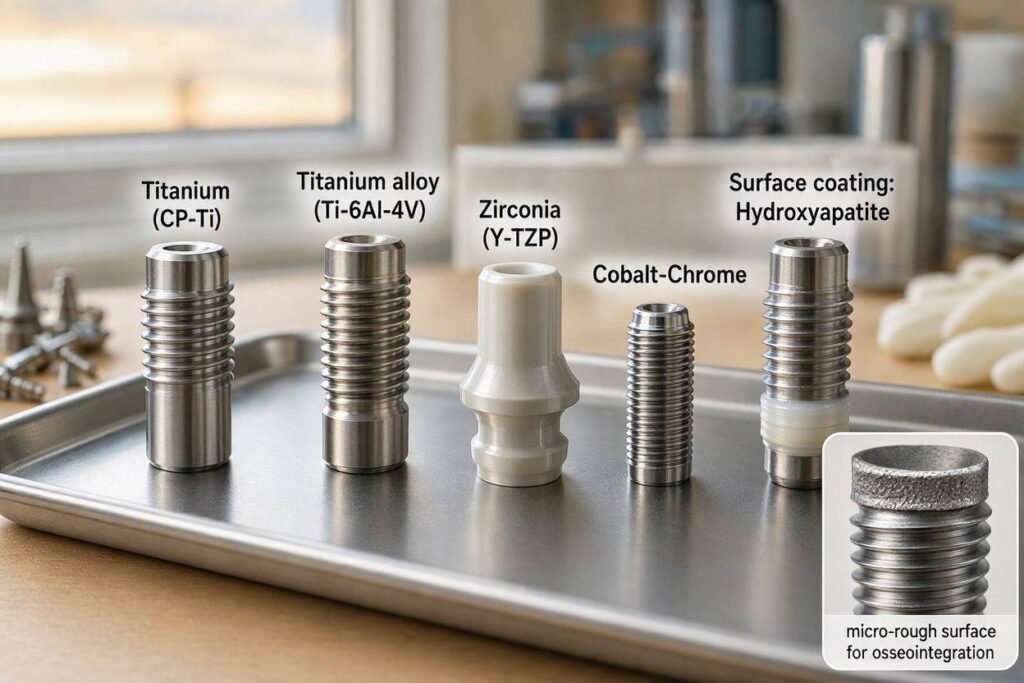
The Gold Standard: Titanium and Its Alloys
The overwhelming majority of dental implants placed in the world today are made from titanium. Pure titanium, in its elemental form, is a remarkable metal. It is as strong as some steels but 45% lighter. It is highly resistant to corrosion because it spontaneously forms a thin, tenacious, and self-healing oxide layer (TiO2) on its surface when exposed to air or water. This oxide layer is the secret to titanium’s biological success.
However, pure titanium, also known as commercially pure (CP) titanium, comes in different grades (Grade 1 through 4), which vary in their oxygen and iron content. Grade 4 CP titanium, the strongest of the pure grades, has been used for dental implants. But it has mechanical limitations. It can be bent or fractured under the extreme, repeated forces of chewing, particularly in smaller diameter implants used in tight spaces.
The solution is an alloy. The most widely used and extensively researched material for modern dental implants is Ti-6Al-4V ELI, which stands for Titanium-6% Aluminum-4% Vanadium, Extra Low Interstitial. This alloy is a workhorse of both aerospace engineering and medical implants. By adding small, precisely controlled amounts of aluminum and vanadium, the strength and fatigue resistance of the metal are dramatically increased while maintaining its excellent corrosion resistance and biocompatibility. An implant post made of Ti-6Al-4V ELI is incredibly strong and resistant to fracture, even under years of cyclic loading.
The “ELI” designation, Extra Low Interstitial, is critical. It specifies extremely low levels of impurities like oxygen, nitrogen, and carbon. This fine-tuned composition enhances the alloy’s ductility and fracture toughness, making it the material of choice for the demanding mechanical environment of the human jaw. This is not a mystery metal. It is a precisely engineered, medical-grade alloy with a proven track record of decades.
The Zirconia Alternative: The Metal-Free Implant
For a small but significant segment of patients, the idea of a metal implant is unacceptable. They may have a diagnosed metal allergy, a strong holistic preference for metal-free materials, or a high aesthetic demand for a white, rather than a grey, implant post. For these patients, the alternative is a ceramic implant made from zirconia, specifically, yttria-stabilized tetragonal zirconia polycrystal (Y-TZP).
Zirconia is a ceramic material, chemically known as zirconium dioxide (ZrO2). In its pure form, it is unstable. By adding a small amount of yttrium oxide as a stabilizer, the material is locked into a tough, durable, and extremely strong crystal structure. The result is a white, tooth-colored ceramic that is exceptionally hard, wear-resistant, and completely biocompatible. It does not corrode. It does not conduct electricity or heat. It has an extremely low affinity for bacterial plaque.
Zirconia implants offer a distinct aesthetic advantage in patients with thin, translucent gum tissue. A titanium implant can sometimes cast a dark grey shadow through the overlying gum, an aesthetic compromise in the front of the mouth. A white zirconia implant eliminates this risk. The material is also hypoallergenic, providing a definitive solution for patients with a proven titanium sensitivity.
The trade-off is a difference in mechanical behavior and surgical handling. Zirconia is immensely strong in compression, but it is more brittle and less ductile than titanium. It can fracture if subjected to a sharp, point-contact overload. Titanium, as a metal, has a degree of elastic flexibility and will bend before it breaks. Zirconia will not bend. It will hold its rigid shape until a critical stress is reached, and then it will crack. This means the implant design, surgical placement, and bite forces must be managed with extreme precision. Zirconia implants are also typically a single, one-piece design (the implant and abutment are a single unit), whereas titanium implants are usually two-piece systems with a separate abutment screwed into the implant post. This one-piece design limits the restorative flexibility but simplifies the system.
The Reality of Titanium Allergy: True, immunologically confirmed allergy to titanium is exceedingly rare. Many patients who present with a “metal allergy” concern are reacting to other metals like nickel, palladium, or chromium, which are commonly found in cheaper dental alloys but are not present in Ti-6Al-4V ELI. A patch test by a dermatologist or allergist can definitively diagnose a titanium hypersensitivity. For the vast majority of patients, titanium remains the biologically safest and mechanically most predictable choice.
The Surface: Where the Magic Happens
The base material of an implant post—whether titanium alloy or zirconia—is only half the story. The surface of the implant, the microscopic topography that the bone cells encounter, is the critical determinant of osseointegration. A smooth, mirror-polished implant surface will not integrate. Bone cells need a rough, textured surface to anchor to and grow into. The modern history of implant dentistry is largely the history of surface engineering.
SLA: Sandblasted, Large-Grit, Acid-Etched
This is the most common, well-documented, and successful surface treatment for titanium implants. The machined implant post is first blasted with a stream of hard, biocompatible grit (like aluminum oxide or titanium oxide), creating a macro-roughness. It is then submerged in a strong acid bath (a mixture of hydrochloric and sulfuric acid) to create a superimposed micro-roughness. The result is a three-dimensional, complex surface topography of peaks and valleys, designed to mimic the porous structure of cancellous bone. This surface massively increases the surface area available for bone cell attachment, creates a scaffold for fibrin clot stabilization during healing, and actively stimulates the differentiation of osteoblast cells. The SLA surface is the workhorse of modern implantology, with decades of peer-reviewed data confirming its high success rates.
Anodization and Hydroxyapatite Coatings
Some implant systems use anodization, an electrochemical process that thickens and colors the titanium oxide layer and creates a unique porous surface. Others apply a thin, plasma-sprayed coating of hydroxyapatite, a calcium phosphate ceramic that is chemically very similar to the mineral component of natural bone. Hydroxyapatite is bioactive; bone cells will recognize it and bond directly to it. Early, thick hydroxyapatite coatings had problems with delamination and bacterial contamination. Modern, thin, nano-scale hydroxyapatite coatings, applied by a sol-gel or electrochemical process, have overcome these issues and are used by some premium implant brands to accelerate the early stages of osseointegration.
Zirconia Surface Treatments
Zirconia is non-etchable by conventional acids and cannot be sandblasted without risking micro-fractures. The surface of a zirconia implant is roughened by a process of subtractive manufacturing, such as laser etching, or by an additive process, where a porous zirconia slurry is sintered onto the surface. This creates a micro-rough, bioactive surface that supports osseointegration. The surface engineering of zirconia implants is a more recent and rapidly evolving field.
The Internal Connection: The Platform Switch
The material of the implant post is intimately connected to its internal design. The connection between the implant and the abutment is a microscopic, precision-engineered interface. Modern implants use an internal conical connection, often with a “platform switching” design. The abutment is narrower than the implant platform, which creates a horizontal step. This step shifts the inflammatory cell infiltrate away from the bone crest and toward the center of the implant. This is a material and design innovation that has been clinically shown to better preserve the marginal bone level over the long term. The precision with which this connection is machined, often to tolerances of a few microns, is a direct result of the high-quality, medical-grade alloy used.
Conclusion
Dental implant posts are made from two principal materials: medical-grade titanium alloy (Ti-6Al-4V ELI) and yttria-stabilized zirconia ceramic (Y-TZP). Titanium alloy is the gold standard, offering an unmatched combination of strength, fatigue resistance, and biocompatibility, enhanced by sophisticated SLA surface roughening. Zirconia provides a metal-free, white, and biofilm-resistant alternative for specific patient needs. The long-term clinical success of both materials depends not just on their bulk composition, but on the precision-engineered surface and the microscopically exact internal connection that interfaces with the living bone.
Frequently Asked Questions
Can I have an MRI with a titanium dental implant?
Yes, absolutely. Titanium is non-ferromagnetic (paramagnetic). It will not move, heat up, or be damaged by an MRI. It will cause a localized artifact (image distortion) on a head or neck scan, but it is completely safe. Zirconia implants are entirely non-magnetic and cause no artifact at all.
Which is better, titanium or zirconia?
Neither is universally “better.” Titanium has the longest, most proven track record, superior ductility, and the flexibility of a two-piece restorative system. Zirconia offers a metal-free, white, plaque-resistant alternative. The choice depends on the patient’s specific clinical situation, aesthetic demands, and personal preference, in consultation with their implant surgeon.
How long will a titanium implant post last in my body?
With successful osseointegration and proper maintenance, a high-quality titanium implant post can last a lifetime. The implant fixture itself is extraordinarily resistant to corrosion and fatigue. The most common threats to its long-term survival are not material failure, but biological complications like peri-implantitis, which is an infection of the surrounding bone, and mechanical overload from an unbalanced bite.
Additional Resource:
For a deeper scientific overview of dental implant materials and their properties, visit the International Congress of Oral Implantologists: https://www.icoi.org/patient-education/dental-implant-materials/