An Overview Of Dental Implants’ Past
The dental implant sitting in your jaw represents the culmination of thousands of years of human ingenuity. The titanium fixture that fuses with your bone, the precision abutment, the lifelike crown, all of these are the products of a long and often strange history of attempts to replace missing teeth. Understanding this history gives you an appreciation for the technology that makes modern implant treatment possible and for the clinical research that established its reliability.
This guide traces the evolution of dental implants from ancient civilizations through the accidental discovery that revolutionized the field to the modern digital workflow. We will explore the failures that taught important lessons, the breakthroughs that changed everything, and the ongoing developments that continue to improve outcomes for patients. This is not a dry academic exercise. It is the story of how a procedure with a success rate above 95 percent emerged from centuries of trial, error, and occasional brilliance.
Ancient Attempts at Tooth Replacement
The desire to replace missing teeth is not modern. Archaeological evidence shows that humans have been trying to fill the gaps in their smiles for millennia.
The Earliest Known Implants
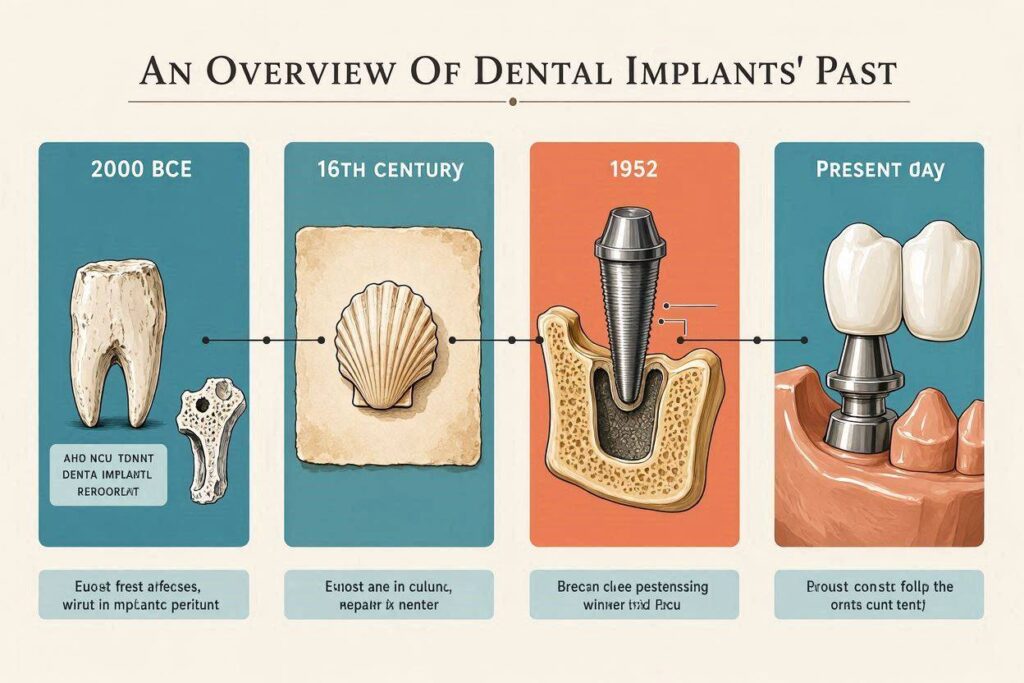
The oldest known dental implants were discovered in the remains of a Mayan woman who lived around 600 AD. Her jaw contained three tooth-shaped pieces of shell that had been placed into the sockets of missing teeth. Radiographic analysis showed bone growth around these shell implants, suggesting that they had integrated with the jawbone in a manner similar to modern osseointegration. Whether this integration was intentional or accidental, we cannot know, but the result anticipated the biological principle that would not be understood for another thirteen centuries.
In ancient Egypt, missing teeth were sometimes replaced with teeth from animals or from human donors, wired to adjacent teeth. These were not implants in the modern sense. They were transplanted teeth, and the body likely rejected them or they became infected. The ancient Egyptians also used gold wire to stabilize loose teeth, a precursor to modern splinting.
The Etruscans and Romans
The Etruscans of ancient Italy crafted some of the earliest known dental bridges, using gold bands to hold replacement teeth carved from animal bone or ivory. The Romans adopted and refined these techniques. Missing teeth were replaced with removable appliances or fixed bridges, but the idea of placing a foreign object into the jawbone to serve as an artificial root does not appear in Roman texts.
The Pre-Modern Era
For most of human history, tooth loss was an inevitability. People lost teeth to decay, trauma, and wear, and they lived with the gaps or replaced them with removable dentures of varying sophistication. The idea of a permanent, bone-anchored replacement remained elusive. Dentures made of wood, ivory, and human teeth were common in the eighteenth and nineteenth centuries. George Washington famously wore dentures, though they were not made of wood but rather of hippopotamus ivory, human teeth, and metal springs.
The key missing element was an understanding of how living bone would respond to an implanted foreign material. Without that knowledge, any attempt at implantation was a gamble.
The Early Experiments with Implantation
The late nineteenth and early twentieth centuries saw the first systematic attempts to place artificial roots into the jawbone.
Gold and Platinum Implants
In the late 1800s, dentists experimented with implants made of gold and platinum. These metals were chosen because they were inert and did not corrode in the body. The implants were often shaped like tooth roots or like cages that bone could grow into. Some of these early implants survived for years, but success was unpredictable. The implant would sometimes become surrounded by a fibrous capsule of scar tissue rather than integrating with the bone. Without true osseointegration, the implants eventually loosened and failed.
The Strock Brothers and Vitallium
In the 1930s, the Strock brothers, Alvin and Moses, placed the first successful endosseous implants made of Vitallium, a cobalt-chromium-molybdenum alloy that had been developed for orthopedic use. They implanted Vitallium screws into the jawbone and allowed them to heal. They then placed crowns on the screws. Some of these implants survived for decades. The Strock brothers’ work demonstrated that biocompatible metals could remain in the jawbone without being rejected, a crucial step toward modern implantology.
The Blade Implant Era
In the 1960s and 1970s, blade implants became popular. These were flat, blade-shaped pieces of metal that were tapped into a groove cut into the jawbone. They were developed by Leonard Linkow, who placed thousands of them and wrote extensively about implant techniques. Blade implants had posts that extended through the gum to support crowns or bridges.
Blade implants had significant problems. They often failed because the bone around them became infected. When they failed, they were difficult to remove, and their removal caused significant bone destruction. Despite their limitations, blade implants represented the first widespread use of dental implants in clinical practice. They paved the way for the root-form implants that would replace them.
The Accidental Discovery That Changed Everything
The most important event in the history of dental implants was an accident. It happened in a Swedish laboratory in 1952, and it transformed implant dentistry from a speculative endeavor into a predictable science.
Per-Ingvar Brånemark and the Rabbit Experiment
Per-Ingvar Brånemark was a Swedish orthopedic surgeon studying blood flow in bone. He and his team inserted small titanium chambers into the leg bones of rabbits to observe the healing process using a microscope. When the experiment was complete, Brånemark attempted to remove the titanium chambers. To his surprise, they would not come out. The bone had fused to the titanium so tightly that the chambers could not be removed without breaking the bone.
Brånemark called this phenomenon osseointegration, from the Latin “osseus” for bone and “integrare” to make whole. He recognized immediately that this biological bond between living bone and titanium had profound implications for medicine and dentistry. He shifted his research focus and spent the next decade studying the conditions under which osseointegration occurred and how it could be harnessed for clinical use.
The First Titanium Dental Implants
In 1965, Brånemark placed the first titanium dental implants in a human patient, a Swedish man named Gösta Larsson. Larsson had severe jaw defects and could not wear conventional dentures. Brånemark placed four titanium implants in Larsson’s lower jaw, allowed them to integrate, and then attached a fixed prosthesis. The implants remained functional for the rest of Larsson’s life, more than 40 years.
Brånemark’s early work was met with skepticism from the dental establishment. The idea that a metal could fuse with living bone was contrary to the prevailing understanding of how the body responded to foreign materials. Brånemark persisted, publishing his research and placing implants in more patients. Slowly, the evidence accumulated, and the dental profession began to take notice.
The Toronto Conference and Acceptance
In 1982, Brånemark presented his research at a landmark conference in Toronto. He brought data from thousands of patients over more than 15 years, demonstrating success rates above 90 percent. The presentation was a turning point. The dental profession, which had viewed dental implants with suspicion, began to embrace osseointegration as the biological basis for implant dentistry.
The Toronto conference launched implant dentistry into the mainstream. Over the next two decades, implant treatment became the standard of care for replacing missing teeth. Brånemark’s titanium screw design, often called the Brånemark System and later marketed by Nobel Biocare, became the template for modern root-form implants.
The Evolution of Implant Design
Since Brånemark’s original work, implant design has evolved continuously, driven by research and clinical experience.
The Original Machined Surface
Brånemark’s original implants had a smooth, machined surface. They worked, but osseointegration took months, and failure rates, while low, were not negligible. Researchers began to investigate whether altering the implant surface could improve and accelerate osseointegration.
Surface Modifications
The development of roughened implant surfaces was a major advance. By blasting the titanium surface with grit, acid-etching it, or coating it with hydroxyapatite, manufacturers created surfaces with microscopic topography that bone cells recognized and attached to more readily. Roughened surfaces increased the surface area for bone contact, improved the mechanical interlock between implant and bone, and accelerated the healing process.
Modern implants feature moderately rough surfaces that have been extensively researched and optimized. The specific surface technology varies by manufacturer, but all aim to promote rapid and complete osseointegration.
The Shift to Internal Connections
Brånemark’s original implant used an external hex connection, a six-sided protrusion on top of the implant that the abutment fitted over. External hex connections worked but were vulnerable to screw loosening and fracture under heavy forces. The industry shifted toward internal connections, where the abutment fits into a recess within the implant body. Internal connections provide greater stability, better force distribution, and a lower incidence of mechanical complications.
Platform Switching
In the 1990s, researchers noticed that using an abutment slightly narrower than the implant platform reduced bone loss around the implant. This phenomenon, called platform switching, is now a standard design feature. By shifting the abutment-implant junction inward, away from the bone, the inflammatory response that causes crestal bone loss is minimized.
The Development of the Restorative Phase
The surgical advances in implant dentistry were matched by advances in the design and fabrication of the teeth that attach to implants.
From Gold to Ceramics
Early implant crowns were made of gold alloy or porcelain-fused-to-metal. These materials were strong and functional but not always aesthetic. The metal substructure could create a gray discoloration at the gum line, particularly in patients with thin gum tissue.
The development of all-ceramic materials, including lithium disilicate and zirconia, has transformed implant aesthetics. Modern implant crowns can be indistinguishable from natural teeth. Zirconia, in particular, is strong enough to be used for full-arch prostheses and is metal-free, eliminating concerns about metal allergies and aesthetics.
The Digital Workflow Revolution
The introduction of cone beam computed tomography and intraoral digital scanning has transformed implant planning and restoration. The dentist can now plan the implant placement virtually, design a surgical guide that directs the implant to the exact planned position, and take a digital impression of the implant site without the need for messy traditional impression materials.
Computer-aided design and manufacturing technology allows the fabrication of custom abutments and crowns with a level of precision that was impossible with traditional casting techniques. The digital workflow reduces chair time, improves accuracy, and enhances the patient experience.
The Implant-Abutment-Crown System Today
The modern dental implant system is the product of all this historical development. The implant body is a root-form titanium fixture with a roughened surface and an internal connection. The abutment is custom-milled to match the patient’s anatomy. The crown is an all-ceramic restoration fabricated with digital precision. The entire system is planned with three-dimensional imaging and placed with guided surgery.
This system achieves success rates above 95 percent over ten years. It is one of the most predictable and successful procedures in all of medicine and dentistry.
The Pioneers Who Shaped Implant Dentistry
The history of dental implants is populated by individuals whose contributions deserve recognition.
Leonard Linkow
Leonard Linkow placed his first dental implant in 1952, the same year Brånemark made his discovery of osseointegration. Linkow developed the blade implant and placed thousands of implants over his career. He was a controversial figure, criticized for promoting implant designs that did not have strong scientific support, but he was also a tireless advocate for implant dentistry at a time when the dental establishment was hostile to it. He wrote extensively and taught courses around the world.
André Schroeder
André Schroeder, a Swiss researcher, made important contributions to the understanding of the implant-tissue interface. He developed the concept of the biologic width around implants and contributed to the development of the ITI implant system, which became Straumann. Schroeder’s work helped establish the scientific foundations of modern implantology.
George Zarb
George Zarb, a Canadian prosthodontist, was one of the early adopters of Brånemark’s system in North America. He conducted long-term clinical studies that documented the success of osseointegrated implants and trained a generation of prosthodontists in implant restoration. Zarb’s textbook on osseointegration became a standard reference.
The Future of Implant Dentistry
The evolution of implant dentistry continues. Current areas of research and development include the use of growth factors and stem cells to accelerate osseointegration, the development of new implant materials with improved biological properties, and the refinement of digital workflows and artificial intelligence for treatment planning.
Zirconia implants are gaining popularity as an alternative to titanium, offering metal-free treatment and improved aesthetics in patients with thin gum tissue. Short implants and narrow implants continue to improve, allowing treatment of patients with limited bone without grafting. The trend toward minimally invasive surgery and immediate loading protocols continues to reduce treatment time and patient discomfort.
The trajectory of the field is toward faster, less invasive, more predictable, and more aesthetic treatment. The dental implant of the future may look very different from the implant of today, but it will rest on the foundation laid by centuries of experimentation and the serendipitous discovery of osseointegration in a Swedish laboratory.
Conclusion
The history of dental implants stretches from ancient Mayan shell implants and Egyptian tooth transplants through early gold and platinum experiments, the blade implant era, and the accidental discovery of osseointegration by Per-Ingvar Brånemark in 1952, which transformed implant dentistry from speculation to predictable science. Modern implants are the product of decades of refinement in surface technology, connection design, restorative materials, and digital planning, achieving success rates above 95 percent. The field continues to evolve toward faster, less invasive, and more aesthetic treatment.
Frequently Asked Questions
Who invented the modern dental implant?
Per-Ingvar Brånemark, a Swedish orthopedic surgeon, discovered osseointegration in 1952 and developed the first titanium dental implants. He placed the first implants in a human patient in 1965. His work established the biological and clinical foundation for modern implant dentistry.
What did people use before dental implants?
Before modern implants, people used removable dentures made of wood, ivory, animal teeth, and human teeth. Fixed bridges were used where adjacent teeth were available. Early implant attempts used gold, platinum, and Vitallium but were unpredictable.
When did dental implants become widely accepted?
Dental implants gained widespread acceptance after the 1982 Toronto conference where Brånemark presented long-term data demonstrating success rates above 90 percent. Over the following two decades, implant treatment became the standard of care for tooth replacement.
What is the difference between old blade implants and modern root-form implants?
Blade implants were flat, knife-like pieces of metal tapped into a groove in the bone. They had high failure rates and caused significant bone loss when they failed. Modern root-form implants are cylindrical or tapered, shaped like natural tooth roots, and achieve osseointegration with high predictability.
Are there any implant pioneers still practicing today?
Most of the early pioneers have retired or passed away. Their legacy continues through the implant systems they developed, the research they published, and the clinicians they trained.
Additional Resource:
For more information on the history and science of osseointegration, visit the Academy of Osseointegration at https://www.osseo.org.