Can Someone With Bone Loss Obtain A Dental Implant?
Bone loss in the jaw is a common concern for patients considering dental implants. Many people assume that once bone has deteriorated, implants are no longer an option. The good news is that this is often not the case. Advances in dental technology and surgical techniques have made implants possible for many patients with significant bone loss.
This guide explores the relationship between bone loss and dental implants. You will learn what causes bone loss, how it affects implant candidacy, and the solutions available to overcome this challenge.
Understanding Jawbone Loss
Before discussing solutions, it helps to understand why bone loss occurs and how it affects your mouth.
What Causes Jawbone Loss?
Several factors contribute to bone deterioration in the jaw.
Tooth Loss:
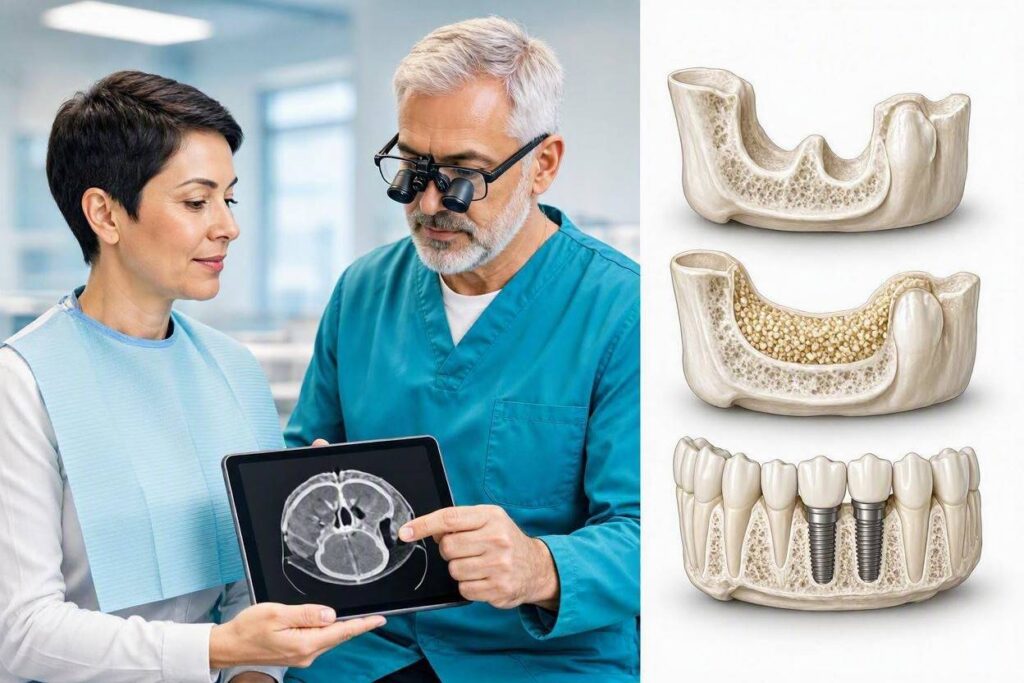
When a tooth is missing, the bone that once supported it begins to resorb. The body redirects minerals to areas where they are needed more. Without the stimulation provided by the tooth root, the bone deteriorates.
Periodontal Disease:
Advanced gum disease destroys the bone supporting teeth. The infection triggers an inflammatory response that breaks down bone tissue.
Trauma:
Injury to the jaw can damage bone and lead to resorption.
Osteoporosis:
This systemic condition reduces bone density throughout the body, including the jaw.
Dentures:
Traditional dentures do not stimulate the underlying bone. Over time, wearing dentures accelerates bone loss.
Tumors or Cysts:
Growths in the jaw can destroy bone tissue.
The Rate of Bone Loss
Bone loss begins soon after tooth loss.
Timeline:
- First Year: Up to 25% of bone width is lost
- Subsequent Years: Continued gradual loss
- Long-Term: Significant deterioration over decades
Why Bone Matters for Implants
Dental implants require adequate bone for stability.
How Implants Work:
- The implant post is placed into the jawbone
- The bone fuses with the implant through osseointegration
- This fusion provides stability and support
Minimum Bone Requirements:
- Typically 1 to 2 millimeters of bone around the implant
- Adequate bone height and width
- Sufficient bone density
Can You Get Implants with Bone Loss?
The short answer is yes, in most cases.
Mild to Moderate Bone Loss
Patients with mild to moderate bone loss are often still candidates for standard implants.
What This Means:
- Enough bone remains to support implants
- Standard implant placement is possible
- No additional procedures required
Significant Bone Loss
Patients with significant bone loss may require additional procedures before implants.
Solutions Available:
- Bone grafting
- Sinus lift
- Ridge expansion
- Specialized implant types
Severe Bone Loss
Even patients with severe bone loss have options.
Advanced Solutions:
- Extensive bone grafting
- Zygomatic implants
- Short implants
- Alternative treatments
Bone Grafting Solutions
Bone grafting is the most common solution for insufficient bone.
What Is Bone Grafting?
Bone grafting involves adding bone material to the jaw to create a stable foundation for implants.
Types of Bone Grafts
Autografts:
Bone harvested from your own body, typically from the chin, jaw, hip, or tibia.
Advantages:
- Contains living cells that promote healing
- Considered the gold standard
Disadvantages:
- Requires a second surgical site
- More invasive
Allografts:
Bone from a human donor, processed for safety.
Advantages:
- No second surgical site
- Readily available
Disadvantages:
- Less osteogenic than autografts
- Requires processing
Xenografts:
Bone from animal sources, usually bovine.
Advantages:
- Abundant supply
- Good structural support
Disadvantages:
- No living cells
- Slower integration
Alloplasts:
Synthetic bone graft materials.
Advantages:
- No risk of disease transmission
- Unlimited supply
Disadvantages:
- Least osteogenic
- May take longer to integrate
The Bone Grafting Procedure
The procedure involves several steps.
Step 1: Incision
The gum is opened to access the bone.
Step 2: Preparation
The area is cleaned and prepared.
Step 3: Graft Placement
The graft material is placed into the defect.
Step 4: Membrane Placement
A protective membrane may cover the graft.
Step 5: Closure
The gum is stitched closed.
Healing Time
Bone grafts require time to integrate.
Typical Timeline:
- Soft Tissue Healing: 2 to 4 weeks
- Bone Integration: 3 to 6 months
- Implant Placement: After integration is complete
Bone Grafting Costs
| Graft Type | Average Cost per Site |
|---|---|
| Socket Preservation | $300 – $800 |
| Ridge Augmentation | $500 – $1,500 |
| Sinus Lift | $1,000 – $2,500 |
| Major Reconstruction | $2,000 – $5,000+ |
Sinus Lift Procedure
For upper jaw implants, a sinus lift may be necessary.
What Is a Sinus Lift?
A sinus lift, also called sinus augmentation, adds bone to the upper jaw in the area of the molars and premolars. The sinus membrane is lifted, and bone graft material is placed beneath it.
When a Sinus Lift Is Needed
- Insufficient bone height in the upper jaw
- The sinus is too close to the jaw for implant placement
- Bone loss in the posterior upper jaw
The Sinus Lift Procedure
Step 1: Incision in the gum
Step 2: Access to the sinus membrane
Step 3: Gentle lifting of the membrane
Step 4: Placement of bone graft
Step 5: Closure of the incision
Healing Time
Sinus lifts require 4 to 9 months of healing before implants can be placed.
Sinus Lift Costs
Sinus lifts cost $1,000 to $2,500 per side.
Ridge Expansion
Ridge expansion widens a narrow jawbone.
What Is Ridge Expansion?
Ridge expansion, also called ridge splitting, involves widening the jawbone to accommodate implants.
When Ridge Expansion Is Needed
- Narrow jawbone
- Insufficient bone width for implants
- Bone loss after extraction
The Ridge Expansion Procedure
Step 1: Incision in the gum
Step 2: The bone is split lengthwise
Step 3: The gap is widened
Step 4: Bone graft material is placed
Step 5: Closure
Healing Time
Ridge expansion requires 3 to 6 months of healing.
Ridge Expansion Costs
Ridge expansion costs $500 to $2,000 per site.
Alternative Implant Types
Specialized implants can work with less bone.
Short Implants
Short implants are shorter than standard implants, requiring less bone height.
Advantages:
- Avoid bone grafting
- Less invasive
- Shorter healing time
Disadvantages:
- May be less stable
- Not suitable for all situations
Cost: $1,000 to $3,000 per implant
Narrow Implants
Narrow implants, also called mini implants, have a smaller diameter.
Advantages:
- Require less bone width
- Less invasive placement
- Lower cost
Disadvantages:
- Less surface area for osseointegration
- May not support heavy chewing forces
Cost: $500 to $1,500 per implant
Zygomatic Implants
Zygomatic implants anchor into the cheekbone rather than the jawbone.
Advantages:
- Avoid bone grafting entirely
- Long implants provide excellent stability
- Immediate loading possible
Disadvantages:
- More complex surgery
- Requires specialized training
- Higher cost
Cost: $5,000 to $10,000 per implant
Subperiosteal Implants
Subperiosteal implants sit on top of the bone, beneath the gum.
Advantages:
- No drilling into bone
- Suitable for severe bone loss
Disadvantages:
- Less stable than endosteal implants
- Higher failure rates
- Less commonly used
Cost: $3,000 to $8,000 per implant
The Complete Treatment Timeline
Understanding the full timeline helps you plan.
Standard Implant with Adequate Bone
- Month 1: Consultation and planning
- Month 2: Implant placement
- Months 3-6: Healing and osseointegration
- Month 7: Abutment placement
- Month 8: Crown placement
Total Time: 6 to 8 months
Implant with Bone Grafting
- Month 1: Consultation and planning
- Month 2: Bone grafting
- Months 3-8: Graft healing
- Month 9: Implant placement
- Months 10-13: Osseointegration
- Month 14: Abutment placement
- Month 15: Crown placement
Total Time: 12 to 15 months
Implant with Sinus Lift
- Month 1: Consultation and planning
- Month 2: Sinus lift
- Months 3-9: Graft healing
- Month 10: Implant placement
- Months 11-14: Osseointegration
- Month 15: Abutment placement
- Month 16: Crown placement
Total Time: 14 to 16 months
Factors That Affect Success with Bone Loss
Several factors influence the success of implants in patients with bone loss.
Overall Health
Good general health supports healing and osseointegration.
Smoking Status
Smoking significantly reduces implant success. Quitting is strongly recommended.
Oral Hygiene
Excellent oral hygiene is essential for implant success.
Bone Quality
The density and quality of remaining bone affect outcomes.
Provider Experience
An experienced implant dentist can manage complex cases effectively.
Total Costs for Implants with Bone Loss
Understanding total costs helps you budget.
Cost Breakdown
| Component | Average Cost |
|---|---|
| Bone Grafting | $500 – $5,000+ |
| Sinus Lift | $1,000 – $2,500 |
| Implant Post | $1,000 – $3,000 |
| Abutment | $300 – $500 |
| Crown | $1,000 – $3,000 |
| CT Scan | $200 – $500 |
| Total | $3,000 – $14,500+ |
Conclusion
Bone loss does not automatically disqualify you from receiving dental implants. Solutions like bone grafting, sinus lifts, ridge expansion, and specialized implant types make implants possible for most patients. The treatment timeline is longer when grafting is required, and costs are higher, but the result is a stable, functional, and aesthetic restoration that can last decades.
Frequently Asked Questions (FAQ)
Q: How much bone is needed for a dental implant?
A: Typically 1 to 2 millimeters of bone around the implant is required for stability.
Q: Can I get implants if I have been wearing dentures for years?
A: Yes, but you may need bone grafting to restore the bone that has resorbed under the dentures.
Q: Is bone grafting painful?
A: Bone grafting is performed under anesthesia. Post-operative discomfort is manageable with medication.
Q: How long does the entire process take with bone grafting?
A: The complete timeline is typically 12 to 15 months from grafting to final crown placement.
Q: Are zygomatic implants a good option for severe bone loss?
A: Zygomatic implants can be an excellent option for severe upper jaw bone loss, avoiding the need for grafting.
Q: What is the success rate of implants with bone grafting?
A: Success rates for implants with bone grafting are similar to standard implants, around 90% to 95%.
Additional Resource
For more information on bone grafting and dental implants, visit the American Academy of Periodontology (AAP) at www.perio.org. They provide educational resources for patients.