Can You Secure Dentures With Two Implants?
For millions of people, traditional dentures are a source of constant frustration. They slip, they click when you talk, and they make it difficult to eat the foods you love. The fear of a denture falling out in public is a daily anxiety. For these individuals, dental implants offer a life-changing solution. But the thought of getting a mouthful of implants can be daunting, both financially and surgically.
This is where the concept of “implant-secured dentures” comes in. It offers a middle ground between the instability of traditional dentures and the high cost of full-arch fixed bridges (like All-on-4). The most common and affordable version of this treatment uses just two implants to secure a lower denture.
The answer to the question is a resounding yes. You can absolutely secure a denture with just two implants. In fact, for the lower jaw, it is the standard of care and the minimum number recommended by dental professionals.
This guide will explain how two implants can transform your denture experience, the costs involved, and what to expect from the procedure.
The Problem with Lower Dentures
To understand why two implants are so effective, you need to understand the anatomy of the mouth. An upper denture is held in place by suction. The large surface area of the palate (the roof of your mouth) creates a seal that keeps the denture up.
The lower denture has no such luxury. It is a horseshoe-shaped piece of acrylic that rests on the lower gums. There is no palate to create suction. The tongue, cheeks, and lips are constantly pushing against it. As a result, a lower denture is notoriously unstable. It floats around, making chewing and speaking a challenge.
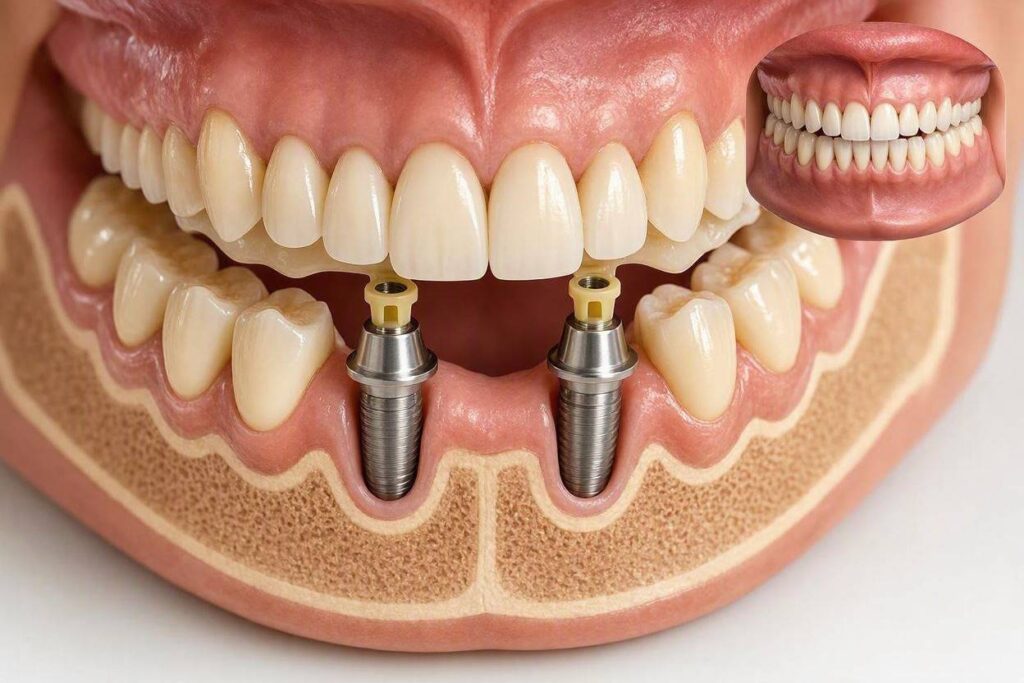
This is where implants shine. By placing two implants in the front of the lower jaw, you create two solid anchor points. These anchors can lock the denture in place, eliminating the movement and restoring function.
How the System Works: Implant-Retained Overdentures
The system of using two implants to support a denture is formally called an “implant-retained overdenture” or a “two-implant overdenture.”
Here is the process:
- Surgical Placement: Two titanium implants are surgically placed into the lower jawbone, usually in the area where the canine teeth used to be. These are placed in the front of the jaw because the bone is denser and less prone to resorption (shrinkage) there.
- Healing: Over a period of 3-6 months, the bone fuses to the implants (osseointegration).
- Attachment: After healing, special attachments are connected to the implants. These attachments come in two main types:
- Ball Attachments (O-rings): A small ball-shaped piece sticks out of the implant. The denture has a corresponding socket with a rubber O-ring that snaps over the ball.
- Locator Attachments: A modern, low-profile stud is attached to the implant. The denture has a corresponding nylon insert that snaps onto the stud. Locators are the most common system used today.
- Denture Modification: Your existing denture (or a new one) is fitted with the corresponding sockets or inserts. When you push the denture down, it snaps securely onto the implants.
The result is a denture that is dramatically more stable. It will not float around. You can bite into an apple or a sandwich with confidence.
The Cost of a Two-Implant Overdenture
This treatment is much more affordable than a full set of fixed teeth. The cost is a fraction of what you would pay for a non-removable bridge.
Here is a breakdown of the average costs (without insurance).
| Component | Average Cost |
|---|---|
| Diagnostics (X-rays, CBCT Scan) | $200 – $600 |
| Implant Surgery (2 implants) | $2,000 – $4,000 ($1,000 – $2,000 each) |
| Attachments (2 Locator Abutments) | $800 – $1,600 ($400 – $800 each) |
| New Denture (or modification of existing) | $1,000 – $3,000 |
| Total Estimated Cost | $4,000 – $9,200 |
Important Note: This is significantly cheaper than a fixed full-arch restoration (like All-on-4), which typically costs $20,000 to $40,000 per arch. The overdenture is removable, which is a con for some, but the cost savings are massive.
The Benefits of Two Implants vs. Traditional Dentures
The advantages are profound and impact daily life.
1. Stability and Retention
This is the obvious one. The denture is locked in place. It will not move when you talk, laugh, or eat. This is a massive boost to confidence.
2. Improved Chewing Ability
Studies show that a two-implant overdenture can increase biting force by 60-200% compared to a standard denture. You can eat a much wider variety of foods, which improves your nutrition and overall health.
3. Preservation of Bone
When you lose teeth, the bone in your jaw shrinks. A traditional denture rests on the gums and actually accelerates this bone loss. The implants stimulate the bone, tricking the body into thinking the roots are still there. This slows down the bone loss process significantly.
4. Psychological Well-being
The anxiety of a slipping denture is real. The peace of mind that comes with knowing your teeth are secure is priceless.
The Drawbacks to Consider
It is important to have realistic expectations.
1. It is Still Removable
You must take the denture out at night to clean it and to clean the attachments. It is not a fixed set of teeth. You will still experience some micro-movement, though it is vastly reduced.
2. Maintenance
The nylon inserts in the denture wear out over time and need to be replaced (usually every 6-12 months). This is a small ongoing cost (usually $50-$100 per replacement).
3. Surgery is Required
Even though it is only two implants, it is still a surgical procedure. There are risks like infection and implant failure, though the success rate for lower implants is very high (over 95%).
Are Two Implants Enough for the Upper Jaw?
This is a critical distinction. Two implants are often sufficient for the lower jaw because the lower denture is a horseshoe shape and the bone in the front is strong.
For the upper jaw, two implants are generally not recommended. The upper jawbone is softer. An upper denture covers the entire palate, providing some suction even without implants. To secure an upper denture properly and eliminate the need for the palate plate, dentists typically recommend four implants.
Financing Your Two-Implant Overdenture
The cost of $4,000 to $9,000 is still significant. However, the strategies discussed in previous articles apply here too.
- Dental Insurance: Many plans will cover a portion of the implants and the denture as a “major” service, subject to the annual maximum.
- Dental Discount Plans: As discussed, these can provide immediate discounts on the surgical fees and the denture.
- Dental Schools: This is the best option for low-cost care. Dental schools with implant programs offer this treatment at a reduced rate.
- Payment Plans: Most dental offices offer interest-free or low-interest payment plans.
The Verdict
Securing a denture with two implants is one of the most effective and affordable ways to restore function and confidence for lower denture wearers. It is a proven, predictable procedure with a very high success rate. If you are tired of fighting with your lower denture, this treatment is a game-changer. It is an investment in your quality of life.
Frequently Asked Questions (FAQ)
Q: Is it painful to get two implants for dentures?
A: The procedure is performed under local anesthesia, so you will not feel pain during the surgery. There will be some soreness and swelling for a few days after the procedure, which can be managed with over-the-counter pain medication.
Q: How long does the whole process take?
A: From the day of surgery to the day your denture is attached, the process takes about 3 to 6 months. This allows time for the bone to fuse to the implants.
Q: Can I use my existing denture with two implants?
A: Sometimes. If your current denture is in good condition and fits well, the dentist may be able to modify it to accept the attachments. If it is old or worn out, you will need a new denture.
Q: What is the success rate for two-implant overdentures?
A: The success rate is extremely high, generally over 95% for implants placed in the lower front jaw. The main risks are infection, smoking, and uncontrolled diabetes.
Q: Is this better than getting a full set of fixed teeth (All-on-4)?
A: It depends on your priorities. A fixed bridge (All-on-4) is non-removable and feels the most like natural teeth, but it costs 3-4 times more. The two-implant overdenture is removable but offers excellent stability at a much lower price point.
Additional Resource:
To learn more about denture stabilization options from a professional perspective, you can visit the American College of Prosthodontists (ACP): https://www.gotoapro.org/