How Much Does Oral Surgery Cost?
Oral surgery is a broad term that covers many different procedures. It can range from a simple tooth extraction to complex jaw reconstruction. Whether you need a wisdom tooth removed, a dental implant placed, or corrective jaw surgery, the cost can be significant. If you are facing oral surgery, you are probably wondering: how much does it cost?
The answer varies widely. A simple extraction might cost $150. A full jaw surgery could cost $50,000 or more. The price depends on the procedure, the surgeon, your location, and whether you have insurance. It can feel overwhelming, especially if you are in pain and need treatment urgently.
This guide will break down the costs of common oral surgery procedures. We will explain what affects the price, how insurance works, and what payment options are available. We will also share tips to save money without sacrificing quality. By the end, you will have a clear picture of what to expect.
What Is Oral Surgery?
Oral surgery is any surgical procedure performed on the mouth, teeth, gums, or jaw. It is usually done by an oral and maxillofacial surgeon (OMS). These are dentists who have completed additional years of surgical training.
Common oral surgery procedures include:
- Tooth extractions (including wisdom teeth).
- Dental implant placement.
- Bone grafting.
- Jaw surgery (orthognathic surgery).
- Treatment of oral infections.
- Biopsies of oral tissue.
- TMJ (jaw joint) surgery.
- Cleft lip and palate repair.
The Average Cost Of Oral Surgery Procedures
Let’s start with the numbers. These are average costs in the United States. Prices in other countries vary.
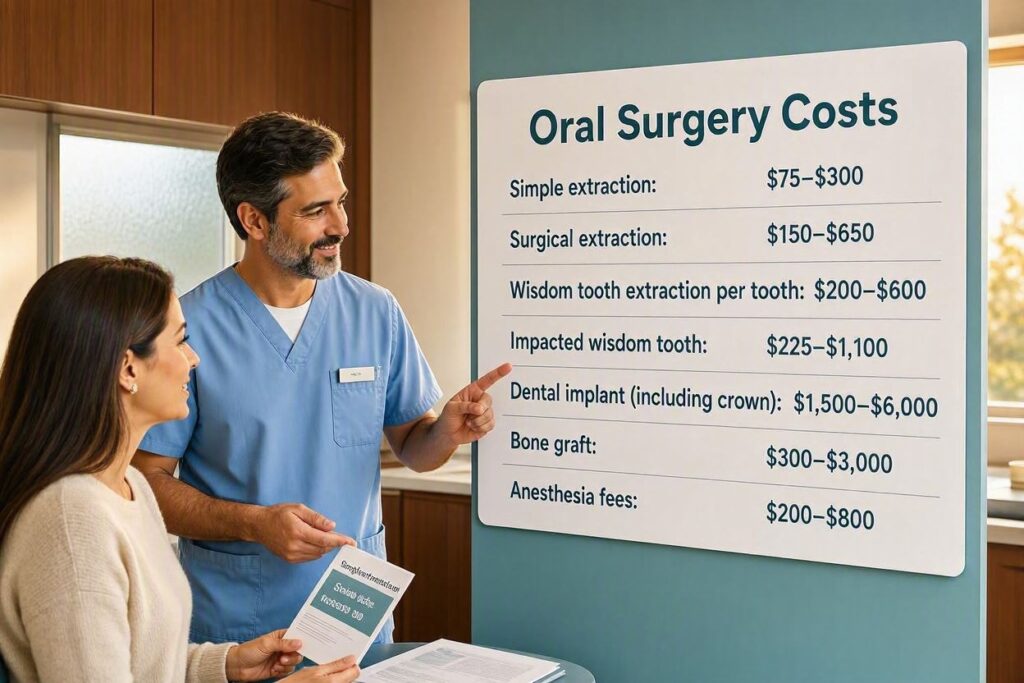
| Procedure | Average Cost (USD) |
|---|---|
| Simple Tooth Extraction | $150 – $300 |
| Surgical Tooth Extraction | $250 – $650 |
| Wisdom Tooth Removal (One) | $200 – $600 |
| Wisdom Tooth Removal (All Four) | $800 – $2,500 |
| Dental Implant (Single) | $3,000 – $5,000 |
| Bone Graft | $500 – $3,000 |
| Sinus Lift | $1,500 – $3,000 |
| Jaw Surgery (Orthognathic) | $20,000 – $50,000+ |
| TMJ Surgery | $5,000 – $15,000 |
| Frenectomy | $300 – $800 |
| Biopsy | $200 – $600 |
These prices are for the surgery itself. They may not include anesthesia, X-rays, medications, or follow-up visits.
Factors That Affect The Cost Of Oral Surgery
Several factors determine what you will pay for oral surgery.
1. The Type Of Procedure
Simple procedures like a basic extraction cost less. Complex procedures like jaw surgery cost more.
2. The Surgeon’s Experience
An oral and maxillofacial surgeon (OMS) charges more than a general dentist. A surgeon with decades of experience charges more than a recent graduate.
3. Your Location
Prices vary by region. In big cities like New York or Los Angeles, prices are higher. In rural areas, they are lower.
4. Anesthesia
The type of anesthesia affects the cost.
- Local Anesthesia: Included in the procedure fee.
- Nitrous Oxide (Laughing Gas): $50 – $200.
- Oral Sedation: $200 – $500.
- IV Sedation: $400 – $1,000.
- General Anesthesia: $1,000 – $3,000.
5. The Complexity Of The Case
Impacted wisdom teeth, teeth with curved roots, or teeth near nerves are harder to remove. This increases the cost.
6. Additional Procedures
Bone grafting, sinus lifts, and other procedures add to the cost.
7. The Facility
A procedure done in a hospital operating room costs more than one done in a dental office.
Detailed Cost Breakdown By Procedure
1. Tooth Extraction
Tooth extraction is the most common oral surgery. It is done when a tooth is too damaged to repair.
- Simple Extraction: $150 – $300. The tooth is visible above the gum line. The dentist uses forceps to remove it.
- Surgical Extraction: $250 – $650. The tooth is broken or below the gum line. The dentist makes an incision and may remove bone.
2. Wisdom Tooth Removal
Wisdom teeth are the third molars. They often become impacted (stuck in the jaw). They can cause pain, infection, and damage to other teeth.
- One Wisdom Tooth: $200 – $600.
- All Four Wisdom Teeth: $800 – $2,500.
- Impacted Wisdom Teeth: $300 – $800 per tooth.
3. Dental Implants
Dental implants are titanium posts placed in the jawbone. They replace missing tooth roots and support crowns, bridges, or dentures.
- Single Implant (including crown): $3,000 – $5,000.
- Implant-Supported Bridge: $6,000 – $15,000.
- All-on-4 (Full Arch): $20,000 – $30,000+.
4. Bone Grafting
If you have bone loss, you may need a bone graft before an implant. This adds to the cost.
- Minor Bone Graft: $500 – $1,500.
- Major Bone Graft: $2,000 – $5,000.
5. Sinus Lift
A sinus lift is a procedure that adds bone to the upper jaw near the sinuses. It is often needed for implants in the upper back teeth.
- Cost: $1,500 – $3,000.
6. Jaw Surgery (Orthognathic Surgery)
Jaw surgery corrects skeletal problems. It is used for severe overbites, underbites, and open bites. It is often combined with orthodontics.
- Cost: $20,000 – $50,000+.
- Note: This is often covered by medical insurance if deemed medically necessary.
7. TMJ Surgery
TMJ surgery treats disorders of the temporomandibular joint. It is usually a last resort after other treatments fail.
- Cost: $5,000 – $15,000.
8. Frenectomy
A frenectomy removes a tight frenulum (the tissue that connects the lip or tongue to the mouth). It is often done for children with tongue-tie.
- Cost: $300 – $800.
9. Biopsy
A biopsy removes a small sample of tissue for testing. It is used to diagnose oral cancer and other conditions.
- Cost: $200 – $600.
Comparison Table: Oral Surgery Costs In Different Countries
| Procedure | USA | UK (Private) | Mexico | Thailand |
|---|---|---|---|---|
| Simple Extraction | $150 – $300 | £100 – £250 | $30 – $80 | $30 – $80 |
| Wisdom Tooth (One) | $200 – $600 | £150 – £400 | $80 – $200 | $80 – $200 |
| Dental Implant | $3,000 – $5,000 | £2,000 – £3,500 | $1,200 – $2,500 | $1,200 – $2,500 |
| Bone Graft | $500 – $3,000 | £500 – £2,000 | $300 – $1,000 | $300 – $1,000 |
| Jaw Surgery | $20,000 – $50,000 | £15,000 – £40,000 | $8,000 – $20,000 | $8,000 – $20,000 |
As you can see, the same procedure can cost ten times more in one country than another. This is why many people travel abroad for oral surgery.
Does Insurance Cover Oral Surgery?
Insurance coverage for oral surgery depends on the type of insurance and the procedure.
Dental Insurance
Dental insurance often covers medically necessary oral surgery. This includes:
- Extractions.
- Wisdom tooth removal.
- Biopsies.
- Treatment of infections.
Coverage is usually 50% to 80% after a deductible. There is often an annual maximum of $1,000 to $2,000.
Medical Insurance
Medical insurance may cover oral surgery if it is for a medical condition, not a dental one. This includes:
- Jaw surgery (orthognathic).
- TMJ surgery.
- Cleft lip and palate repair.
- Surgery for oral cancer.
- Facial trauma.
You will need a diagnosis and prior authorization. Coverage varies widely.
What Is Usually Not Covered?
- Cosmetic procedures.
- Dental implants (often considered cosmetic by medical insurance).
- Bone grafting (unless medically necessary).
How To Check Your Coverage
Call your insurance company. Ask:
- Is this procedure covered?
- Do I need a pre-authorization?
- What is my deductible and co-pay?
- Are there any limits?
- Is the surgeon in-network?
Medicare And Oral Surgery
Original Medicare (Part A and Part B) does not cover most dental procedures, including oral surgery. However, it may cover oral surgery if it is performed in a hospital for a medical condition. Medicare Advantage plans may offer additional coverage.
Medicaid And Oral Surgery
Medicaid coverage for oral surgery varies by state. In many states, Medicaid covers extractions and other medically necessary procedures. Coverage for implants and cosmetic procedures is limited.
Payment Plans And Financing Options
Oral surgery can be expensive. Most oral surgeons offer payment plans.
1. In-House Payment Plans
Many offices offer interest-free monthly payments. You pay a down payment and then pay the rest over 6 to 24 months.
2. Third-Party Financing
Companies like CareCredit, LendingPoint, and iFinance offer loans for medical and dental procedures. You can apply online and get approved quickly.
3. Health Savings Accounts (HSAs) And Flexible Spending Accounts (FSAs)
You can use pre-tax dollars from your HSA or FSA to pay for oral surgery. This can save you 20% to 30%.
4. Dental Savings Plans
These are not insurance. You pay an annual fee to join a network of providers. You get discounted rates on procedures.
How To Save Money On Oral Surgery
You do not have to pay full price. Here are some tips.
1. Get Multiple Quotes
Visit several oral surgeons. Ask for a written treatment plan and a full breakdown of costs. Compare them.
2. Consider A Dental School
Dental schools offer oral surgery at reduced costs. The work is done by supervised students. It takes longer, but it can save you thousands.
3. Go To A Rural Area
Prices are lower in rural areas than in big cities. If you live near a rural area, consider traveling for your surgery.
4. Consider Dental Tourism
Countries like Mexico, Thailand, and Hungary offer oral surgery at a fraction of US prices. A dental implant in Mexico might cost $1,500 instead of $5,000. Just do your research and choose a reputable clinic.
5. Ask For A Discount
Some surgeons offer discounts for cash payments or for seniors. It never hurts to ask.
6. Use Your Insurance
If you have insurance, use it. It can cover a significant portion of the cost.
7. Negotiate A Bundle
If you need multiple procedures, ask if the surgeon will bundle them at a lower price.
The Process Of Oral Surgery
Here is what to expect.
Step 1: Consultation
The surgeon examines your mouth and takes X-rays. They discuss your options and give you a treatment plan.
Step 2: Pre-Surgical Preparation
You may need blood tests, a physical exam, or to stop taking certain medications.
Step 3: The Surgery
The surgery is performed. Depending on the procedure, it may take 30 minutes to several hours.
Step 4: Recovery
You will be given instructions for aftercare. This includes pain management, diet, and activity restrictions.
Step 5: Follow-Up
You will have follow-up visits to check your healing and remove stitches if needed.
Quotes From Patients Who Had Oral Surgery
“I had all four wisdom teeth removed. It cost $2,000. My insurance covered $1,200. I paid $800 out of pocket. The surgery was quick and painless.” — Mark, California
“I needed a dental implant. The total cost was $4,500. I went to Mexico and paid $1,800. The clinic was modern and the surgeon was excellent.” — Lisa, Texas
“I had jaw surgery for a severe underbite. It was covered by my medical insurance. I only paid $2,000 out of pocket. It changed my life.” — Sarah, New York
Important Note For Readers
Prices for oral surgery change over time. The ranges in this article are estimates based on current market data. Always get a personalized quote from a licensed oral surgeon. Do not rely solely on online information for your treatment decisions. Your specific needs may result in a different price.
Frequently Asked Questions (FAQ)
1. How much does oral surgery cost?
Oral surgery costs range from $150 for a simple extraction to $50,000 or more for jaw surgery. The price depends on the procedure, the surgeon, and your location.
2. Does insurance cover oral surgery?
Dental insurance often covers medically necessary oral surgery. Medical insurance may cover jaw surgery and other procedures. Coverage varies widely.
3. How much does it cost to remove wisdom teeth?
Wisdom tooth removal costs $200 to $600 per tooth. Removing all four can cost $800 to $2,500.
4. How much does a dental implant cost?
A single dental implant with a crown costs $3,000 to $5,000 in the US. In Mexico or Thailand, it can cost $1,200 to $2,500.
5. Is jaw surgery covered by insurance?
Jaw surgery is often covered by medical insurance if it is deemed medically necessary. You will need a diagnosis and prior authorization.
6. How long does it take to recover from oral surgery?
Recovery time varies. A simple extraction takes a few days. Wisdom tooth removal takes 1 to 2 weeks. Jaw surgery takes 4 to 8 weeks.
7. Can I eat after oral surgery?
You should eat soft foods for the first few days. Avoid hot, spicy, and crunchy foods. Do not use a straw, as it can dislodge blood clots.
8. What are the risks of oral surgery?
Risks include infection, bleeding, nerve damage, and reactions to anesthesia. Choose a qualified surgeon to minimize these risks.
9. How do I find a good oral surgeon?
Ask for referrals from your dentist. Check reviews and credentials. Look for a board-certified oral and maxillofacial surgeon.
10. Can I get oral surgery abroad?
Yes. Many people travel to Mexico, Thailand, or Eastern Europe for oral surgery. The savings can be significant. Do your research and choose a reputable clinic.
Conclusion
The cost of oral surgery varies widely depending on the procedure, the surgeon, and your location. Simple extractions cost a few hundred dollars, while complex jaw surgery can cost tens of thousands. Insurance can help, but many people pay out of pocket. By getting multiple quotes, considering dental schools, or exploring dental tourism, you can find a solution that fits your budget. Oral surgery is an investment in your health and quality of life. With proper planning, you can get the treatment you need without breaking the bank.
Additional Resource:
For more information on oral surgery and to find a board-certified oral surgeon, visit the American Association of Oral and Maxillofacial Surgeons: